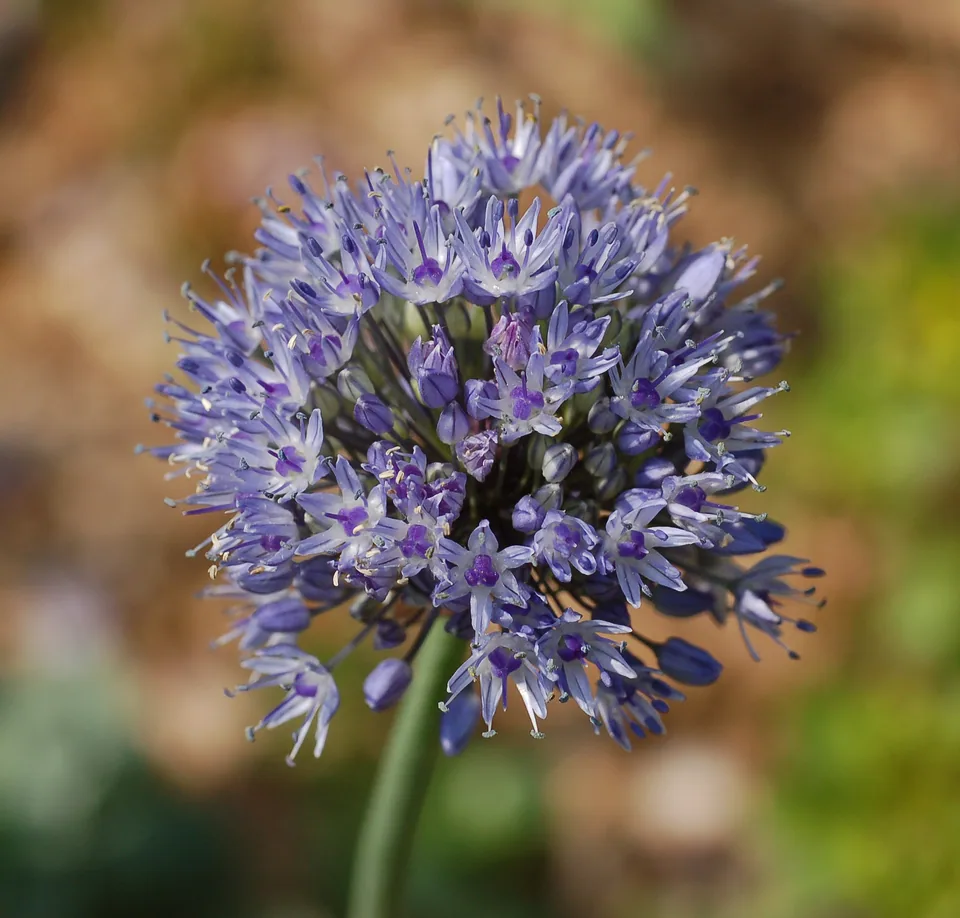


How to Grow and Care for Blue Globe Onion
Allium caeruleum
Written by Emilio Marruso · last checked
Toxic to: People · Why
At a glance
This easygoing bulb asks for very little: plant it in fall for spring blooms, give it full sun and keep it on the dry side. It grows 1–2 feet tall, rarely needs feeding and has no serious insect problems. As a bonus, its mildly bitter flowers and young leaves can be eaten in small amounts in salads.
- Sun
Full sun
What the sources say (1)
Light: Full sun
Light: Full sun (6 or more hours of direct sunlight a day) Soil Texture:
— Allium caeruleum (Blue Globe Onion, Ornamental Onion) | North Carolina Extension Gardener Plant Toolbox [1] - Water
Likes it dry: too much moisture rots the bulbs
What the sources say (3)
Watering: Does best in dry conditions
It does best in dry conditions, as bulbs may rot in excessively moist soil.
— Allium caeruleum (Blue Globe Onion, Ornamental Onion) | North Carolina Extension Gardener Plant Toolbox [1] Watering notes: Bulbs may rot in excessively moist soil; grows in humus-rich, well-drained, moist to dry loams
It does best in dry conditions, as bulbs may rot in excessively moist soil.
— Allium caeruleum (Blue Globe Onion, Ornamental Onion) | North Carolina Extension Gardener Plant Toolbox [1] The bulb grows easily in humus-rich, well-drained, moist to dry loams in full sun.
— Allium caeruleum (Blue Globe Onion, Ornamental Onion) | North Carolina Extension Gardener Plant Toolbox [1] - Cold
Survives winters down to −30 °F (−34.4 °C)
Very hardy · USDA 4a · RHS H7 · Z4
What the sources say (2)
Hardiness, coldest zone: 4a [winter low −34.4 to −31.7 °C (−30 to −25 °F)]
USDA Plant Hardiness Zone: 4a, 4b, 5a, 5b, 6a, 6b, 7a, 7b, 8a, 8b
— Allium caeruleum (Blue Globe Onion, Ornamental Onion) | North Carolina Extension Gardener Plant Toolbox [1] Hardiness, warmest zone: 8b [winter low −9.4 to −6.7 °C (15 to 20 °F)]
USDA Plant Hardiness Zone: 4a, 4b, 5a, 5b, 6a, 6b, 7a, 7b, 8a, 8b
— Allium caeruleum (Blue Globe Onion, Ornamental Onion) | North Carolina Extension Gardener Plant Toolbox [1] - Soil
Rich soil that drains well
What the sources say (2)
Watering notes: Bulbs may rot in excessively moist soil; grows in humus-rich, well-drained, moist to dry loams
It does best in dry conditions, as bulbs may rot in excessively moist soil.
— Allium caeruleum (Blue Globe Onion, Ornamental Onion) | North Carolina Extension Gardener Plant Toolbox [1] The bulb grows easily in humus-rich, well-drained, moist to dry loams in full sun.
— Allium caeruleum (Blue Globe Onion, Ornamental Onion) | North Carolina Extension Gardener Plant Toolbox [1] - Planting
Plant the bulbs in fall for spring blooms
What the sources say (1)
Planting: Fall (for spring blooms)
Plant bulbs four to six inches deep or divide established plants in the fall for spring blooms.
— Allium caeruleum (Blue Globe Onion, Ornamental Onion) | North Carolina Extension Gardener Plant Toolbox [1] - Feeding
Usually no feeding; a light all-purpose feed in early spring only if a soil test shows a need
What the sources say (3)
When: Early spring as the foliage emerges, only if a soil test shows a need
Fertilizer is unnecessary, but a light fertilizer application every few years using an all-purpose fertilizer in early spring as the foliage emerges can be done if a soil test shows it's needed.
— [4] How often: Usually unnecessary; at most a light application every few years if a soil test shows a need
Fertilizer is unnecessary, but a light fertilizer application every few years using an all-purpose fertilizer in early spring as the foliage emerges can be done if a soil test shows it's needed.
— [4] Mineral fertilizers: All-purpose fertilizer, light application, only if a soil test shows a need
Fertilizer is unnecessary, but a light fertilizer application every few years using an all-purpose fertilizer in early spring as the foliage emerges can be done if a soil test shows it's needed.
— [4] - Harvest
Flowers and young leaves are edible in small amounts, raw in salads or cooked in soups
- Pests
Can get downy mildew; no serious insect problems
What the sources say (1)
Diseases: downy mildew
There are no serious insect or disease problems. May be susceptible to downy mildew.
— Allium caeruleum (Blue Globe Onion, Ornamental Onion) | North Carolina Extension Gardener Plant Toolbox [1] - Size
1–2 ft tall
What the sources say (1)
Mature height: 30.48-60.96 cm (1-2 ft)
Blue flowers form in 1-inch clusters atop 1- to 2-foot stiff stems, May through June.
— Allium caeruleum (Blue Globe Onion, Ornamental Onion) | North Carolina Extension Gardener Plant Toolbox [1] - Propagation
Make new plants by dividing the clumps
What the sources say (2)
Propagation: Division
Plant bulbs four to six inches deep or divide established plants in the fall for spring blooms.
— Allium caeruleum (Blue Globe Onion, Ornamental Onion) | North Carolina Extension Gardener Plant Toolbox [1] Family: Alliaceae Life Cycle: Bulb Perennial Recommended Propagation Strategy: Division
— Allium caeruleum (Blue Globe Onion, Ornamental Onion) | North Carolina Extension Gardener Plant Toolbox [1] - Safety
Low toxicity: harmful only if eaten in large amounts
Overview
Blue globe onion is a perennial bulb with blue globe-shaped flower clusters in May and June. [1] It grows in full sun and does best in dry, well-drained conditions. [1] NC State Extension rates it low in poison severity for humans. [1]
This record is incomplete: the sources we read do not cover every field yet.
Not yet covered by our sources: Pruning
Blue Globe Onion care
How to water Blue Globe Onion
Watering
Does best in dry conditions
What the sources say (1)
It does best in dry conditions, as bulbs may rot in excessively moist soil.Watering notes
Bulbs may rot in excessively moist soil; grows in humus-rich, well-drained, moist to dry loams
What the sources say (2)
It does best in dry conditions, as bulbs may rot in excessively moist soil.The bulb grows easily in humus-rich, well-drained, moist to dry loams in full sun.How much light Blue Globe Onion needs
Full sun
What the sources say (1)
Light:
Full sun (6 or more hours of direct sunlight a day)
Soil Texture:How much cold Blue Globe Onion can take
Hardiness, coldest zone
4a [winter low −34.4 to −31.7 °C (−30 to −25 °F)]
What the sources say (1)
USDA Plant Hardiness Zone:
4a, 4b, 5a, 5b, 6a, 6b, 7a, 7b, 8a, 8bHardiness, warmest zone
8b [winter low −9.4 to −6.7 °C (15 to 20 °F)]
What the sources say (1)
USDA Plant Hardiness Zone:
4a, 4b, 5a, 5b, 6a, 6b, 7a, 7b, 8a, 8bHow to propagate Blue Globe Onion
Division
What the sources say (2)
Plant bulbs four to six inches deep or divide established plants in the fall for spring blooms.Family:
Alliaceae
Life Cycle:
Bulb
Perennial
Recommended Propagation Strategy:
DivisionHow to grow Blue Globe Onion
The plant
Life cycle
perennial
What the sources say (1)
The blue globe onion is a perennial bulb from the amaryllis family (Amaryllidaceae).Family
Amaryllidaceae
What the sources say (1)
The blue globe onion is a perennial bulb from the amaryllis family (Amaryllidaceae).Mature height
30.48-60.96 cm (1-2 ft)
What the sources say (1)
Blue flowers form in 1-inch clusters atop 1- to 2-foot stiff stems, May through June.Pests and diseases
Diseases
downy mildew
What the sources say (1)
There are no serious insect or disease problems. May be susceptible to downy mildew.Fertilizing
When
Early spring as the foliage emerges, only if a soil test shows a need
What the sources say (1)
Fertilizer is unnecessary, but a light fertilizer application every few years using an all-purpose fertilizer in early spring as the foliage emerges can be done if a soil test shows it's needed.How often
Usually unnecessary; at most a light application every few years if a soil test shows a need
What the sources say (1)
Fertilizer is unnecessary, but a light fertilizer application every few years using an all-purpose fertilizer in early spring as the foliage emerges can be done if a soil test shows it's needed.Mineral fertilizers
All-purpose fertilizer, light application, only if a soil test shows a need
What the sources say (1)
Fertilizer is unnecessary, but a light fertilizer application every few years using an all-purpose fertilizer in early spring as the foliage emerges can be done if a soil test shows it's needed.Blue Globe Onion pests and problems
Bulb rot
Symptom: Bulbs may rot in excessively moist soil
What to do: It does best in dry conditions
What the sources say (1)
It does best in dry conditions, as bulbs may rot in excessively moist soil.
— Allium caeruleum (Blue Globe Onion, Ornamental Onion) | North Carolina Extension Gardener Plant Toolbox [1] Downy mildew
Symptom: May be susceptible to downy mildew
What to do: There are no serious insect or disease problems
What the sources say (1)
There are no serious insect or disease problems. May be susceptible to downy mildew.
— Allium caeruleum (Blue Globe Onion, Ornamental Onion) | North Carolina Extension Gardener Plant Toolbox [1]
Remedies
Each remedy shows what official sources say about it; traditional remedies without an official source are marked as such. Harmful ones are listed so you know to avoid them.
Treating the plant
allium leafminer
row covers Works
Row covers should not be used in fields which were infested with the previous generation of ALM.
— umass.edu [6] How: Cover the young plants with row covers to prevent adult allium leafminers from laying eggs on the alliums.
Move your alliums each spring and cover the young plants with row covers to prevent adult allium leafminers from laying eggs on your alliums.
— morningchores.com [5] What the evidence says Insect netting, as opposed to spun bond row covers, will provide protection without trapping heat. Any row cover must be well-anchored to prevent gaps between the ground and the crop in order to be effective.
— umass.edu [6] rotate allium crops Works
How: Move the alliums to a new spot each spring.
Controlling these pests is simply a matter of crop rotation and row covers. Move your alliums each spring and cover the young plants with row covers
— morningchores.com [5] What the evidence says Rotate allium crops with non-alliums, both between and within seasons. ALM adults are strong fliers and can move relatively long distances across fields, so rotating further away is better.
— umass.edu [6]
aphids
insecticidal soap spray Not verified
Traditional remedy, not verified by an official source.
How: Spray the allium beds with insecticidal soap if aphids are noticed.
neem oil Not verified
Traditional remedy, not verified by an official source.
How: Use neem oil to break up the life cycle of the aphids.
onion maggots
beneficial nematodes Not verified
Traditional remedy, not verified by an official source.
How: Apply nematodes to the soil before planting, then cover young plants with row covers.
neck rot
destroying infected bulbs Not verified
Traditional remedy, not verified by an official source.
How: Destroy infected bulbs when seen and cut back on watering right before harvest.
Is Blue Globe Onion poisonous?
Reported by the source, quoted verbatim. This is not medical or veterinary advice: if a person or an animal may have eaten this plant, contact a poison control centre or a veterinarian.
Poison Severity: Low Poison Symptoms: Poisonous if ingested in large quantities.
[1]- Poisonous parts
Causes Contact Dermatitis: No Poison Part: Flowers Fruits Leaves Roots Seeds Stems
[1]- Toxic principle
Poison Toxic Principle: Sulfides Causes Contact Dermatitis: No
[1]- Symptoms
Poisonous if ingested in large quantities. Symptoms may include: Nausea, Vomiting, and Diarrhea.
[1]- Severity
Poison Severity: Low Poison Symptoms: Poisonous if ingested in large quantities.
[1]
Calendar
Planting
Fall (for spring blooms)
What the sources say (1)
Plant bulbs four to six inches deep or divide established plants in the fall for spring blooms.Pruning
Not stated in the sources we read.
Months as given by the sources, which are mostly from the United States (northern hemisphere). In the southern hemisphere they shift by about six months.
Edibility
Reported by the source, quoted verbatim. Do not eat a plant on the basis of this page alone: identification mistakes can be dangerous.
Flowers have a mildly bitter flavor and, like the young leaves, can be eaten in small quantities raw in salads and sandwiches or cooked in tea and soups.
[1]
Similar plants
- Allium triquetrum Allium triquetrum
- Broadleaf wild leek Allium ampeloprasum
- Field Garlic Allium vineale
- Garlic Chives Allium tuberosum
- Lily Leek Allium moly
- Nodding Onion Allium cernuum
- Onion Allium cepa
- Ornamental Onion Allium aflatunense
Sources
Every value above is quoted from these documents. Links lead to the original publisher.
- Allium caeruleum (Blue Globe Onion, Ornamental Onion) | North Carolina Extension Gardener Plant Toolbox · plants.ces.ncsu.edu, consulted
- Blue Globe Onion - Allium caeruleum | North Carolina Extension Gardener Plant Toolbox · plants.ces.ncsu.edu, consulted
- Allium (Onion, Ornamental Onions) | North Carolina Extension Gardener Plant Toolbox · plants.ces.ncsu.edu, consulted
- yardandgarden.extension.iastate.edu · yardandgarden.extension.iastate.edu
- morningchores.com · morningchores.com
- umass.edu · umass.edu
Written by Emilio Marruso · last checked