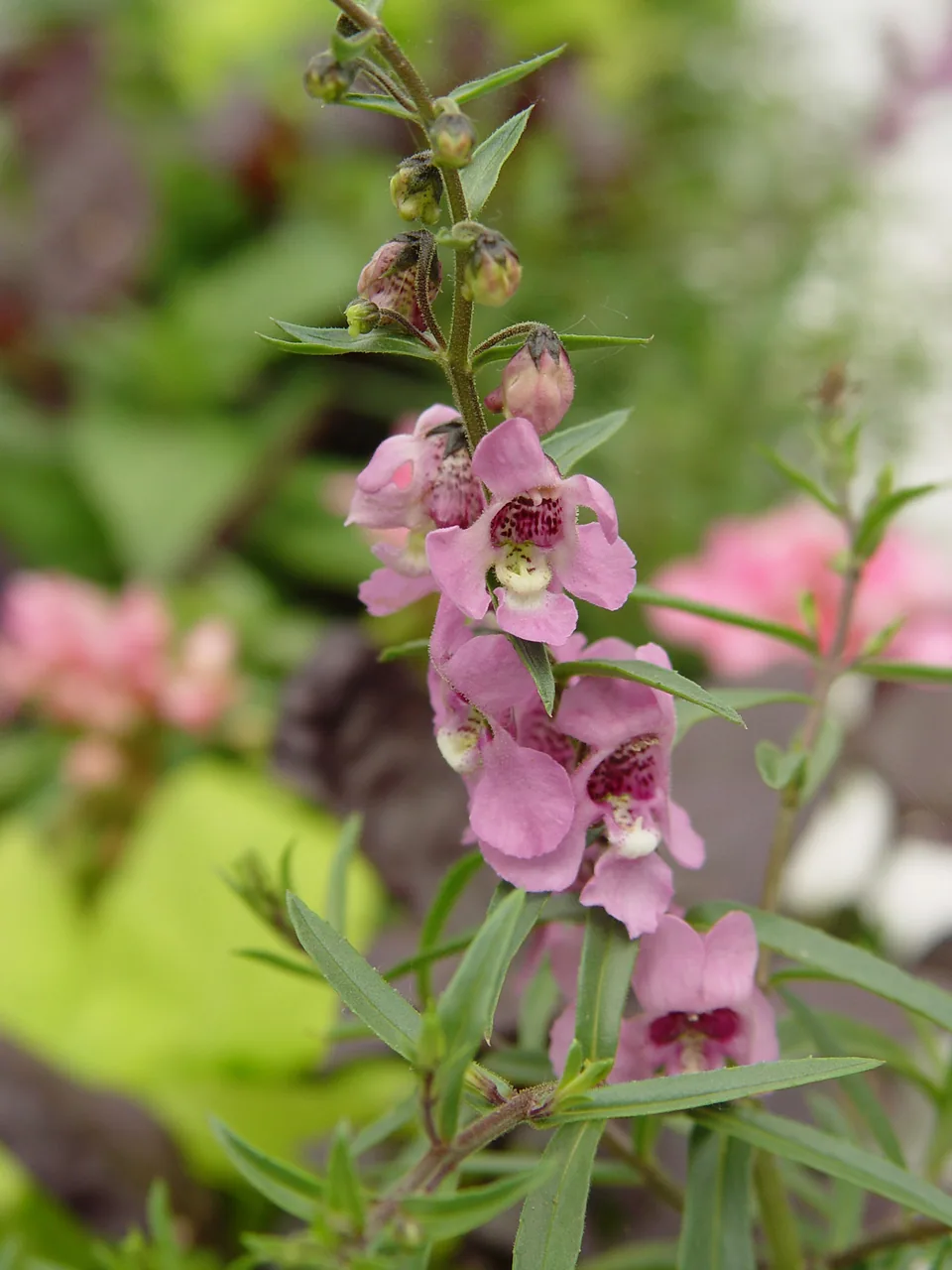


Cómo cultivar y cuidar Angelonia
Angelonia angustifolia
Escrito por Emilio Marruso · última revisión
De un vistazo
La angelonia adora el sol y, una vez establecida, aguanta bien la sequía; además, crece sin problemas en maceta. Recórtala a la mitad a mediados de temporada y en solo 2–3 semanas vuelve a llenarse de flores. Plántala a finales de primavera, abónala con moderación y disfruta de una perenne que muchos cultivan como anual.
- Sol
Sol pleno
Qué dicen las fuentes (2)
Luz: Pleno sol
Angelonia prefers moist, fertile soils with good drainage in full sun.
— Angelonia angustifolia (Angelonia, Blue Wings, Narrowleaf Angelon, Summer Snapdragon) | North Carolina Extension Gardener Plant Toolbox [1] Angelonias perform best in full sun and are exceptionally drought tolerant.
— Angelonias – Summer Snapdragons | Home & Garden Information Center [5] - Riego
Aguanta la sequía una vez establecida; deja que la tierra se seque un poco entre riegos
Qué dicen las fuentes (4)
Riego: Tolerante a la sequía una vez establecida; el suelo puede dejarse secar temporalmente entre riegos
Angelonias perform best in full sun and are exceptionally drought tolerant. Soils should be well-drained, and once plants are established, the soil can be allowed to dry temporarily between waterings.
— Angelonias – Summer Snapdragons | Home & Garden Information Center [5] Once established, these plants can be quite drought-tolerant
— Angelonia – Gardening Solutions [3] Notas sobre el riego: Prefiere suelo húmedo, fértil y bien drenado; el suelo rico en materia orgánica y el acolchado mejoran la tolerancia a la sequía una vez establecida
Angelonia prefers moist, fertile soils with good drainage in full sun.
— Angelonia angustifolia (Angelonia, Blue Wings, Narrowleaf Angelon, Summer Snapdragon) | North Carolina Extension Gardener Plant Toolbox [1] especially if the soil is rich in organic material and a layer of mulch has been added.
— Angelonia – Gardening Solutions [3] - Frío
Aguanta inviernos de hasta −6,7 °C (20 °F)
Rústica en inviernos normales · USDA 9a · RHS H4 · Z9
Qué dicen las fuentes (2)
Rusticidad, zona más fría: 9a [mínima invernal de −6,7 a −3,9 °C (de 20 a 25 °F)]
USDA Plant Hardiness Zone: 9a, 9b, 10a, 10b, 11a, 11b
— Angelonia angustifolia (Angelonia, Blue Wings, Narrowleaf Angelon, Summer Snapdragon) | North Carolina Extension Gardener Plant Toolbox [1] Rusticidad, zona más cálida: 11b [mínima invernal de 7,2 a 10 °C (de 45 a 50 °F)]
USDA Plant Hardiness Zone: 9a, 9b, 10a, 10b, 11a, 11b
— Angelonia angustifolia (Angelonia, Blue Wings, Narrowleaf Angelon, Summer Snapdragon) | North Carolina Extension Gardener Plant Toolbox [1] - Suelo
Suelo húmedo, fértil y con buen drenaje; el acolchado la ayuda a aguantar la sequía
Qué dicen las fuentes (2)
Notas sobre el riego: Prefiere suelo húmedo, fértil y bien drenado; el suelo rico en materia orgánica y el acolchado mejoran la tolerancia a la sequía una vez establecida
Angelonia prefers moist, fertile soils with good drainage in full sun.
— Angelonia angustifolia (Angelonia, Blue Wings, Narrowleaf Angelon, Summer Snapdragon) | North Carolina Extension Gardener Plant Toolbox [1] especially if the soil is rich in organic material and a layer of mulch has been added.
— Angelonia – Gardening Solutions [3] - Plantación
Planta a finales de primavera
Qué dicen las fuentes (1)
Plantación: Fines de la primavera
For best performance, plant angelonia in late spring in a spot that receives full sun
— Angelonia – Gardening Solutions [3] - Abonado
Abona poco al plantar y luego en verano si hace falta; el exceso da más hojas y menos flores
Qué dicen las fuentes (3)
Cuándo: Al plantar, luego según sea necesario durante el verano
Fertilize angelonias every 2 months with a slow-release landscape fertilizer or a slow-release fertilizer can be incorporated into the soil at planting and then supplemented with a liquid fertilizer as needed during the summer.
— Angelonias – Summer Snapdragons | Home & Garden Information Center [5] Evitar: Exceso de fertilización
Fertilize the plants with a light, monthly application of a 10-5-10 fertilizer or similar mix, but be careful not to overfertilize or the plants will produce more leaves and less flowers.
— Angelonia – Gardening Solutions [3] Signos de exceso: Más hojas y menos flores
Fertilize the plants with a light, monthly application of a 10-5-10 fertilizer or similar mix, but be careful not to overfertilize or the plants will produce more leaves and less flowers.
— Angelonia – Gardening Solutions [3] - Poda
A mediados de temporada, recorta la planta a la mitad; vuelve a florecer en 2–3 semanas
Qué dicen las fuentes (2)
Poda: Mediados de temporada (recorta las plantas a la mitad; la refloración sigue en 2-3 semanas)
shear plants back 50% at mid-season which will initiate a rebloom
— Summertime angels in the garden - UF/IFAS Extension Charlotte County [2] Plants may be sheared back half way in mid-season if desired
— Angelonias – Summer Snapdragons | Home & Garden Information Center [5] - Plagas
Vigila el pulgón, el oídio y la podredumbre de raíz o de tallo
Qué dicen las fuentes (2)
Plagas: pulgones
Insects Diseases and Other Plant Problems: Susceptible to aphids and powdery mildew. Some cultivars have shown excellent resistance to phytophthora root rot or stem rot while other cultivars had poor resistance.
— Angelonia angustifolia (Angelonia, Blue Wings, Narrowleaf Angelon, Summer Snapdragon) | North Carolina Extension Gardener Plant Toolbox [1] Enfermedades: mildiu polvoriento, pudrición por phytophthora de la raíz o pudrición del tallo
Insects Diseases and Other Plant Problems: Susceptible to aphids and powdery mildew. Some cultivars have shown excellent resistance to phytophthora root rot or stem rot while other cultivars had poor resistance.
— Angelonia angustifolia (Angelonia, Blue Wings, Narrowleaf Angelon, Summer Snapdragon) | North Carolina Extension Gardener Plant Toolbox [1] - Tamaño
20–30 cm de ancho
Qué dicen las fuentes (1)
Anchura adulta: 20-30 cm (8-12 pulgadas)
Dimensions: Height: 1 ft. 0 in. - 1 ft. 6 in. Width: 0 ft. 8 in. - 1 ft. 0 in.
— Angelonia angustifolia (Angelonia, Blue Wings, Narrowleaf Angelon, Summer Snapdragon) | North Carolina Extension Gardener Plant Toolbox [1] - Multiplicación
Multiplícala por esquejes de punta, dividiendo la mata o por semilla
Qué dicen las fuentes (1)
Propagación: Esquejes de punta; división de la masa de raíces; semilla
Propagate angelonias by tip cuttings, division of the root mass, or collected seed.
— Angelonias – Summer Snapdragons | Home & Garden Information Center [5] - Siembra
Siembra 6–8 semanas antes de la última helada de primavera; germina en 7–14 días
Qué dicen las fuentes (2)
Siembra: Comienza la siembra de semillas de 6 a 8 semanas antes de la última helada de primavera prevista
Start seed 6 to 8 weeks before the last anticipated spring frost.
— Angelonias – Summer Snapdragons | Home & Garden Information Center [5] Días de germinación: 7-14
These seeds need light to germinate, and take 7 to 14 days for seedlings to appear.
— Angelonias – Summer Snapdragons | Home & Garden Information Center [5] - Maceta
Crece también en maceta
Qué dicen las fuentes (1)
En maceta: Sí
Use this plant in borders, groups or containers to add
— Angelonia angustifolia (Angelonia, Blue Wings, Narrowleaf Angelon, Summer Snapdragon) | North Carolina Extension Gardener Plant Toolbox [1]
Resumen
La angelonia es una perenne herbácea con floración, conocida por su larga floración de verano con flores parecidas a las de la boca de dragón. [1] Prefiere suelo húmedo, fértil y bien drenado a pleno sol y tiene cierta tolerancia a la sequía. [1] Se propaga mediante esquejes de punta, división de la masa de raíces o semillas recolectadas. [5]
Citado en inglés, como en la fuente.
Cuidados
Riego
Riego
Tolerante a la sequía una vez establecida; el suelo puede dejarse secar temporalmente entre riegos
Qué dicen las fuentes (2)
Angelonias perform best in full sun and are exceptionally drought tolerant. Soils should be well-drained, and once plants are established, the soil can be allowed to dry temporarily between waterings.Once established, these plants can be quite drought-tolerantNotas sobre el riego
Prefiere suelo húmedo, fértil y bien drenado; el suelo rico en materia orgánica y el acolchado mejoran la tolerancia a la sequía una vez establecida
Qué dicen las fuentes (2)
Angelonia prefers moist, fertile soils with good drainage in full sun.especially if the soil is rich in organic material and a layer of mulch has been added.Luz
Pleno sol
Qué dicen las fuentes (2)
Angelonia prefers moist, fertile soils with good drainage in full sun.Angelonias perform best in full sun and are exceptionally drought tolerant.Clima y frío
Rusticidad, zona más fría
9a [mínima invernal de −6,7 a −3,9 °C (de 20 a 25 °F)]
Qué dicen las fuentes (1)
USDA Plant Hardiness Zone:
9a, 9b, 10a, 10b, 11a, 11bRusticidad, zona más cálida
11b [mínima invernal de 7,2 a 10 °C (de 45 a 50 °F)]
Qué dicen las fuentes (1)
USDA Plant Hardiness Zone:
9a, 9b, 10a, 10b, 11a, 11bDónde cultivarla
En maceta
Sí
Qué dicen las fuentes (1)
Use this plant in borders, groups or containers to addDistancia de plantación
Las fuentes dan valores distintos según la región, la zona o las condiciones de cultivo.
Lo que dice cada fuente
Según NC State Extension: 22.9-30.5 cm (9-12 pulgadas)
Según UF/IFAS Extension Charlotte County: 30.5-40.6 cm (12-16 pulgadas)
Según Clemson HGIC: 20.3-22.9 cm (8-9 pulgadas)
Qué dicen las fuentes (3)
Según NC State Extension: Space plants 9 to 12 inches apart in the ground.Según UF/IFAS Extension Charlotte County: Place plants from 12-16 inches apart in beds for mass planting.Según Clemson HGIC: By spacing plants a little closer (at 8 to 9 inches apart)Propagación
Esquejes de punta; división de la masa de raíces; semilla
Qué dicen las fuentes (1)
Propagate angelonias by tip cuttings, division of the root mass, or collected seed.Cultivo
La planta
Ciclo de vida
perenne (a menudo cultivada como anual)
Qué dicen las fuentes (2)
Angelonia is a vigorous, herbaceous flowering perennial shrub in the Plantaginaceae family and native to Mexico and the West Indiesmany backyard gardeners will treat the plant as an annual and obtain new plants each spring.Familia
Plantaginaceae
Qué dicen las fuentes (1)
Angelonia is a vigorous, herbaceous flowering perennial shrub in the Plantaginaceae family and native to Mexico and the West IndiesAltura adulta
Las fuentes no coinciden:
Space plants 9 to 12 inches apart in the ground. Plants typically grow 12 to 18 inches tall.
[1]Plant heights will vary by cultivar, but typically in the South, angelonias will get 1½ to 3 feet tall and 1 foot wide.
[5]By the end of the season, the plants should reach eighteen to twenty-four inches tall.
[3]
Anchura adulta
20-30 cm (8-12 pulgadas)
Qué dicen las fuentes (1)
Dimensions: Height: 1 ft. 0 in. - 1 ft. 6 in. Width: 0 ft. 8 in. - 1 ft. 0 in.Siembra y crecimiento
Días de germinación
7-14
Qué dicen las fuentes (1)
These seeds need light to germinate, and take 7 to 14 days for seedlings to appear.Cosecha y conservación
Guardar semillas
Las semillas son pequeñas; recógelas de las vainas de semillas a fines del verano, sécalas y guárdalas en sobres para plantarlas la primavera siguiente.
Qué dicen las fuentes (1)
Angelonia seeds are small, and can be harvested from seed pods in late summer, dried, and stored in envelopes to plant the following spring.Plagas y enfermedades
Plagas
pulgones
Qué dicen las fuentes (1)
Insects Diseases and Other Plant Problems: Susceptible to aphids and powdery mildew. Some cultivars have shown excellent resistance to phytophthora root rot or stem rot while other cultivars had poor resistance.Enfermedades
mildiu polvoriento, pudrición por phytophthora de la raíz o pudrición del tallo
Qué dicen las fuentes (1)
Insects Diseases and Other Plant Problems: Susceptible to aphids and powdery mildew. Some cultivars have shown excellent resistance to phytophthora root rot or stem rot while other cultivars had poor resistance.Abonado
Cuándo
Al plantar, luego según sea necesario durante el verano
Qué dicen las fuentes (1)
Fertilize angelonias every 2 months with a slow-release landscape fertilizer or a slow-release fertilizer can be incorporated into the soil at planting and then supplemented with a liquid fertilizer as needed during the summer.Frecuencia
Las fuentes no coinciden:
Fertilize the plants with a light, monthly application of a 10-5-10 fertilizer or similar mix, but be careful not to overfertilize or the plants will produce more leaves and less flowers.
[3]Fertilize angelonias every 2 months with a slow-release landscape fertilizer or a slow-release fertilizer can be incorporated into the soil at planting and then supplemented with a liquid fertilizer as needed during the summer.
[5]
Abonos minerales
Aplicaciones ligeras de 10-5-10 o una mezcla similar, o un fertilizante de liberación lenta para paisaje incorporado al plantar y complementado con fertilizante líquido
Lo que dice cada fuente
plántulas: Fertilizante líquido
Qué dicen las fuentes (3)
plántulas: Seedlings should be fertilized with a liquid fertilizer.Fertilize the plants with a light, monthly application of a 10-5-10 fertilizer or similar mix, but be careful not to overfertilize or the plants will produce more leaves and less flowers.Fertilize angelonias every 2 months with a slow-release landscape fertilizer or a slow-release fertilizer can be incorporated into the soil at planting and then supplemented with a liquid fertilizer as needed during the summer.Evitar
Exceso de fertilización
Qué dicen las fuentes (1)
Fertilize the plants with a light, monthly application of a 10-5-10 fertilizer or similar mix, but be careful not to overfertilize or the plants will produce more leaves and less flowers.Signos de exceso
Más hojas y menos flores
Qué dicen las fuentes (1)
Fertilize the plants with a light, monthly application of a 10-5-10 fertilizer or similar mix, but be careful not to overfertilize or the plants will produce more leaves and less flowers.Problemas
Pulgones y mildiu polvoriento
Síntoma: Susceptible a pulgones y mildiu polvoriento; los cultivares varían en resistencia a la pudrición de raíces por phytophthora o pudrición del tallo
Qué dicen las fuentes (1)
Susceptible to aphids and powdery mildew. Some cultivars have shown excellent resistance to phytophthora root rot or stem rot while other cultivars had poor resistance.
— Angelonia angustifolia (Angelonia, Blue Wings, Narrowleaf Angelon, Summer Snapdragon) | North Carolina Extension Gardener Plant Toolbox [1]
Remedios
Cada remedio indica qué dicen las fuentes oficiales; los remedios tradicionales sin fuente oficial aparecen marcados. Los perjudiciales están para que sepas evitarlos.
Cuidar la planta
pulgones
chorro fuerte de agua Funciona
Cómo: intenta ahuyentar los pulgones con un chorro de agua
Be on the lookout for them, and try to avert them with a spray of water.
— gardeningchannel.com [6] Qué dicen las pruebas On sturdy plants, aphids can be knocked off with a strong stream of water.
— ipm.ucanr.edu [7] poda las hojas infestadas Funciona
Cómo: retira las partes de la planta que estén infestadas
Remove portions of your plant that are infested if you have to.
— gardeningchannel.com [6] Qué dicen las pruebas Aphids hidden within curled leaves will not be affected by pesticides that work on contact. Prune these out.
— ipm.ucanr.edu [7] atrae mariquitas Funciona
Cómo: las mariquitas son depredadores naturales de los pulgones y deben ser bienvenidas en el jardín de flores
Ladybugs are natural predators to aphids too, so they should always be welcome in your flower garden.
— gardeningchannel.com [6] Qué dicen las pruebas Naturally occurring insect predators such as lady beetles and lacewings will visit plants when aphids are abundant.
— ipm.ucanr.edu [7] spray de jabón insecticida Funciona
Cómo: elige aceites y jabones insecticidas disponibles comercialmente; sofocan a los pulgones, así que aplícalos a fondo
If insecticides seem necessary, choose products that are less toxic to natural enemies, such as commercially available insecticidal oils and soaps. When properly used, these materials solve most aphid problems.
— ipm.ucanr.edu [7] Qué dicen las pruebas If insecticides seem necessary, choose products that are less toxic to natural enemies, such as commercially available insecticidal oils and soaps. When properly used, these materials solve most aphid problems.
— ipm.ucanr.edu [7]
mildiu polvoriento
favorece la circulación de aire mediante el espaciamiento y la poda Funciona
Cómo: pleno sol y prácticas culturales que favorezcan el flujo de aire, como la poda y el espaciamiento adecuado
Because of this, putting plants in full sun and cultural practices that promote airflow (such as pruning and appropriate spacing) can help to minimize powdery mildew problems.
— yardandgarden.extension.iastate.edu [8] Qué dicen las pruebas Because of this, putting plants in full sun and cultural practices that promote airflow (such as pruning and appropriate spacing) can help to minimize powdery mildew problems.
— yardandgarden.extension.iastate.edu [8] limpieza a fines del otoño Funciona
Cómo: la limpieza a fines del otoño reduce el patógeno presente en el jardín el próximo año; no coloques material enfermo en el contenedor de compost
late fall sanitation is recommended to help reduce the amount of the pathogen present in the garden next year.
— yardandgarden.extension.iastate.edu [8] Qué dicen las pruebas late fall sanitation is recommended to help reduce the amount of the pathogen present in the garden next year.
— yardandgarden.extension.iastate.edu [8]
Calendario
Siembra
Comienza la siembra de semillas de 6 a 8 semanas antes de la última helada de primavera prevista
Qué dicen las fuentes (1)
Start seed 6 to 8 weeks before the last anticipated spring frost.Plantación
Fines de la primavera
Qué dicen las fuentes (1)
For best performance, plant angelonia in late spring in a spot that receives full sunPoda
Mediados de temporada (recorta las plantas a la mitad; la refloración sigue en 2-3 semanas)
Meses tal como los dan las fuentes, en su mayoría de Estados Unidos (hemisferio norte). En el hemisferio sur se desplazan unos seis meses.
Respecto a las heladas
Estimación menos precisa: no hay ninguna estación meteorológica a menos de 300 km.
Busca las fechas de heladas por código postal o ciudad
Siembra en interior: de 6 a 8 semanas antes de la última helada
Start seed 6 to 8 weeks before the last anticipated spring frost.
— Angelonias – Summer Snapdragons | Home & Garden Information Center [5]
Cuenta desde las fechas medias de las heladas de tu zona.
Valores orientativos
Valores de una fuente secundaria, no comprobados palabra por palabra como el resto de esta página. Úselos como punto de partida.
- Resiste la sequía
- SíValor orientativo, adáptalo a tu clima · Fuente secundaria
- pH del suelo
- 5.5-6.5Valor orientativo, adáptalo a tu clima · Fuente secundaria
- Nivel de cuidado
- MedioValor orientativo, adáptalo a tu clima · Fuente secundaria
- Crecimiento
- AltaValor orientativo, adáptalo a tu clima · Fuente secundaria
Plantas similares
- Birdeye Speedwell Veronica persica
- Blue Toadflax Linaria canadensis
- Brazilian Snapdragon Achetaria azurea
- O linaria Linaria vulgaris
- Lágrimas de Cupido Russelia equisetiformis
- Creeping Gloxinia Lophospermum erubescens
- Culver's Root Veronicastrum virginicum
- Dew Flower Penstemon cobaea
Fuentes
Cada valor anterior se cita de estos documentos. Los enlaces llevan al editor original.
- Angelonia angustifolia (Angelonia, Blue Wings, Narrowleaf Angelon, Summer Snapdragon) | North Carolina Extension Gardener Plant Toolbox · plants.ces.ncsu.edu, consultado
- Summertime angels in the garden - UF/IFAS Extension Charlotte County · blogs.ifas.ufl.edu, consultado
- Angelonia – Gardening Solutions · gardeningsolutions.ifas.ufl.edu, consultado
- Angelonia - Angelonia angustifolia | North Carolina Extension Gardener Plant Toolbox · plants.ces.ncsu.edu, consultado
- Angelonias – Summer Snapdragons | Home & Garden Information Center · hgic.clemson.edu, consultado
- gardeningchannel.com · gardeningchannel.com
- ipm.ucanr.edu · ipm.ucanr.edu
- yardandgarden.extension.iastate.edu · yardandgarden.extension.iastate.edu
Escrito por Emilio Marruso · última revisión