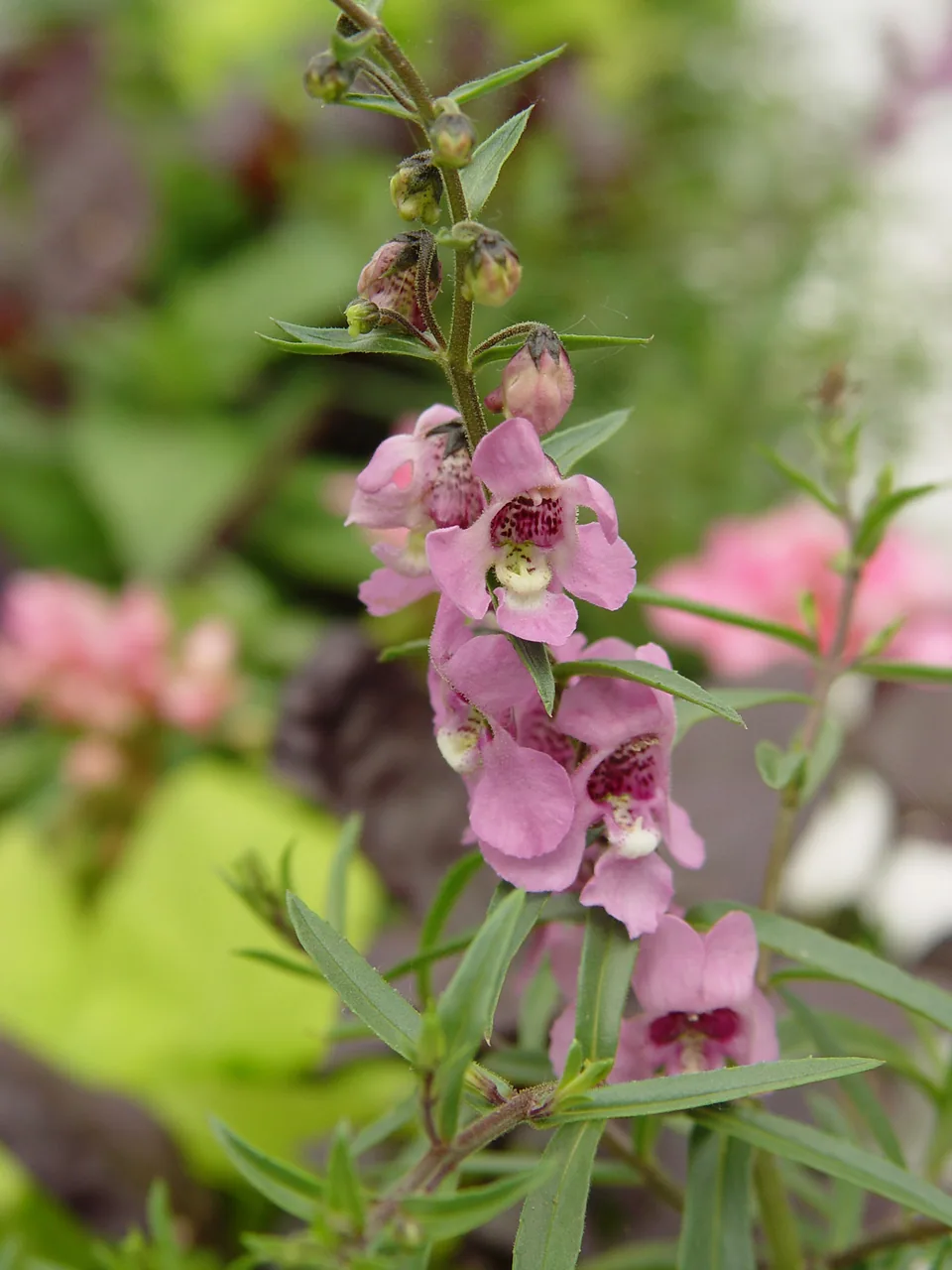


How to Grow and Care for Angelonia
Angelonia angustifolia
Written by Emilio Marruso · last checked
At a glance
Angelonia is a sun lover that shrugs off dry spells once established, and it grows happily in containers too. Shear it back by half in midseason and fresh flowers return in just 2–3 weeks. Plant it out in late spring, feed it lightly, and enjoy a perennial that many gardeners grow as an easy annual.
- Sun
Full sun
What the sources say (2)
Light: Full sun
Angelonia prefers moist, fertile soils with good drainage in full sun.
— Angelonia angustifolia (Angelonia, Blue Wings, Narrowleaf Angelon, Summer Snapdragon) | North Carolina Extension Gardener Plant Toolbox [1] Angelonias perform best in full sun and are exceptionally drought tolerant.
— Angelonias – Summer Snapdragons | Home & Garden Information Center [5] - Water
Handles dry spells once settled; let the soil dry a little between waterings
What the sources say (4)
Watering: Drought tolerant once established; soil can be allowed to dry temporarily between waterings
Angelonias perform best in full sun and are exceptionally drought tolerant. Soils should be well-drained, and once plants are established, the soil can be allowed to dry temporarily between waterings.
— Angelonias – Summer Snapdragons | Home & Garden Information Center [5] Once established, these plants can be quite drought-tolerant
— Angelonia – Gardening Solutions [3] Watering notes: Prefers moist, fertile, well-drained soil; rich organic soil and mulch improve drought tolerance once established
Angelonia prefers moist, fertile soils with good drainage in full sun.
— Angelonia angustifolia (Angelonia, Blue Wings, Narrowleaf Angelon, Summer Snapdragon) | North Carolina Extension Gardener Plant Toolbox [1] especially if the soil is rich in organic material and a layer of mulch has been added.
— Angelonia – Gardening Solutions [3] - Cold
Survives winters down to 20 °F (−6.7 °C)
Hardy in average winters · USDA 9a · RHS H4 · Z9
What the sources say (2)
Hardiness, coldest zone: 9a [winter low −6.7 to −3.9 °C (20 to 25 °F)]
USDA Plant Hardiness Zone: 9a, 9b, 10a, 10b, 11a, 11b
— Angelonia angustifolia (Angelonia, Blue Wings, Narrowleaf Angelon, Summer Snapdragon) | North Carolina Extension Gardener Plant Toolbox [1] Hardiness, warmest zone: 11b [winter low 7.2 to 10 °C (45 to 50 °F)]
USDA Plant Hardiness Zone: 9a, 9b, 10a, 10b, 11a, 11b
— Angelonia angustifolia (Angelonia, Blue Wings, Narrowleaf Angelon, Summer Snapdragon) | North Carolina Extension Gardener Plant Toolbox [1] - Soil
Moist, rich soil that drains well; mulch helps it handle dry spells
What the sources say (2)
Watering notes: Prefers moist, fertile, well-drained soil; rich organic soil and mulch improve drought tolerance once established
Angelonia prefers moist, fertile soils with good drainage in full sun.
— Angelonia angustifolia (Angelonia, Blue Wings, Narrowleaf Angelon, Summer Snapdragon) | North Carolina Extension Gardener Plant Toolbox [1] especially if the soil is rich in organic material and a layer of mulch has been added.
— Angelonia – Gardening Solutions [3] - Planting
Plant out in late spring
What the sources say (1)
Planting: Late spring
For best performance, plant angelonia in late spring in a spot that receives full sun
— Angelonia – Gardening Solutions [3] - Feeding
Feed lightly at planting, then in summer as needed; too much gives leaves and fewer flowers
What the sources say (3)
When: At planting, then as needed during the summer
Fertilize angelonias every 2 months with a slow-release landscape fertilizer or a slow-release fertilizer can be incorporated into the soil at planting and then supplemented with a liquid fertilizer as needed during the summer.
— Angelonias – Summer Snapdragons | Home & Garden Information Center [5] Avoid: Overfertilizing
Fertilize the plants with a light, monthly application of a 10-5-10 fertilizer or similar mix, but be careful not to overfertilize or the plants will produce more leaves and less flowers.
— Angelonia – Gardening Solutions [3] Signs of excess: More leaves and fewer flowers
Fertilize the plants with a light, monthly application of a 10-5-10 fertilizer or similar mix, but be careful not to overfertilize or the plants will produce more leaves and less flowers.
— Angelonia – Gardening Solutions [3] - Pruning
In midseason, cut plants back by half; new flowers come in 2–3 weeks
What the sources say (2)
Pruning: Mid-season (shear plants back by half; rebloom follows in 2-3 weeks)
shear plants back 50% at mid-season which will initiate a rebloom
— Summertime angels in the garden - UF/IFAS Extension Charlotte County [2] Plants may be sheared back half way in mid-season if desired
— Angelonias – Summer Snapdragons | Home & Garden Information Center [5] - Pests
Watch for aphids, powdery mildew, and root or stem rot
What the sources say (2)
Pests: aphids
Insects Diseases and Other Plant Problems: Susceptible to aphids and powdery mildew. Some cultivars have shown excellent resistance to phytophthora root rot or stem rot while other cultivars had poor resistance.
— Angelonia angustifolia (Angelonia, Blue Wings, Narrowleaf Angelon, Summer Snapdragon) | North Carolina Extension Gardener Plant Toolbox [1] Diseases: powdery mildew, phytophthora root rot or stem rot
Insects Diseases and Other Plant Problems: Susceptible to aphids and powdery mildew. Some cultivars have shown excellent resistance to phytophthora root rot or stem rot while other cultivars had poor resistance.
— Angelonia angustifolia (Angelonia, Blue Wings, Narrowleaf Angelon, Summer Snapdragon) | North Carolina Extension Gardener Plant Toolbox [1] - Size
8–12 in wide
What the sources say (1)
Mature width: 20-30 cm (8-12 in)
Dimensions: Height: 1 ft. 0 in. - 1 ft. 6 in. Width: 0 ft. 8 in. - 1 ft. 0 in.
— Angelonia angustifolia (Angelonia, Blue Wings, Narrowleaf Angelon, Summer Snapdragon) | North Carolina Extension Gardener Plant Toolbox [1] - Propagation
Grow new plants from tip cuttings, by dividing the roots, or from seed
What the sources say (1)
Propagation: Tip cuttings; division of the root mass; seed
Propagate angelonias by tip cuttings, division of the root mass, or collected seed.
— Angelonias – Summer Snapdragons | Home & Garden Information Center [5] - Sowing
Start seeds 6–8 weeks before the last spring frost; they sprout in 7–14 days
What the sources say (2)
Sowing: Start seed 6 to 8 weeks before the last anticipated spring frost
Start seed 6 to 8 weeks before the last anticipated spring frost.
— Angelonias – Summer Snapdragons | Home & Garden Information Center [5] Days to germination: 7-14
These seeds need light to germinate, and take 7 to 14 days for seedlings to appear.
— Angelonias – Summer Snapdragons | Home & Garden Information Center [5] - Containers
Grows in containers too
What the sources say (1)
In containers: Yes
Use this plant in borders, groups or containers to add
— Angelonia angustifolia (Angelonia, Blue Wings, Narrowleaf Angelon, Summer Snapdragon) | North Carolina Extension Gardener Plant Toolbox [1]
Overview
Angelonia is a herbaceous flowering perennial noted for its long summer bloom of snapdragon-like flowers. [1] It prefers moist, fertile, well-drained soil in full sun and has some drought tolerance. [1] It is propagated by tip cuttings, division of the root mass, or collected seed. [5]
Angelonia care
How to water Angelonia
Watering
Drought tolerant once established; soil can be allowed to dry temporarily between waterings
What the sources say (2)
Angelonias perform best in full sun and are exceptionally drought tolerant. Soils should be well-drained, and once plants are established, the soil can be allowed to dry temporarily between waterings.Once established, these plants can be quite drought-tolerantWatering notes
Prefers moist, fertile, well-drained soil; rich organic soil and mulch improve drought tolerance once established
What the sources say (2)
Angelonia prefers moist, fertile soils with good drainage in full sun.especially if the soil is rich in organic material and a layer of mulch has been added.How much light Angelonia needs
Full sun
What the sources say (2)
Angelonia prefers moist, fertile soils with good drainage in full sun.Angelonias perform best in full sun and are exceptionally drought tolerant.How much cold Angelonia can take
Hardiness, coldest zone
9a [winter low −6.7 to −3.9 °C (20 to 25 °F)]
What the sources say (1)
USDA Plant Hardiness Zone:
9a, 9b, 10a, 10b, 11a, 11bHardiness, warmest zone
11b [winter low 7.2 to 10 °C (45 to 50 °F)]
What the sources say (1)
USDA Plant Hardiness Zone:
9a, 9b, 10a, 10b, 11a, 11bWhere to grow Angelonia
In containers
Yes
What the sources say (1)
Use this plant in borders, groups or containers to addSpacing
The sources give different values depending on region, zone or growing conditions.
What each source says
According to NC State Extension: 22.9-30.5 cm (9-12 in)
According to UF/IFAS Extension Charlotte County: 30.5-40.6 cm (12-16 in)
According to Clemson HGIC: 20.3-22.9 cm (8-9 in)
What the sources say (3)
According to NC State Extension: Space plants 9 to 12 inches apart in the ground.According to UF/IFAS Extension Charlotte County: Place plants from 12-16 inches apart in beds for mass planting.According to Clemson HGIC: By spacing plants a little closer (at 8 to 9 inches apart)How to propagate Angelonia
Tip cuttings; division of the root mass; seed
What the sources say (1)
Propagate angelonias by tip cuttings, division of the root mass, or collected seed.How to grow Angelonia
The plant
Life cycle
perennial (often grown as an annual)
What the sources say (2)
Angelonia is a vigorous, herbaceous flowering perennial shrub in the Plantaginaceae family and native to Mexico and the West Indiesmany backyard gardeners will treat the plant as an annual and obtain new plants each spring.Family
Plantaginaceae
What the sources say (1)
Angelonia is a vigorous, herbaceous flowering perennial shrub in the Plantaginaceae family and native to Mexico and the West IndiesMature height
The sources disagree:
Space plants 9 to 12 inches apart in the ground. Plants typically grow 12 to 18 inches tall.
[1]Plant heights will vary by cultivar, but typically in the South, angelonias will get 1½ to 3 feet tall and 1 foot wide.
[5]By the end of the season, the plants should reach eighteen to twenty-four inches tall.
[3]
Mature width
20-30 cm (8-12 in)
What the sources say (1)
Dimensions: Height: 1 ft. 0 in. - 1 ft. 6 in. Width: 0 ft. 8 in. - 1 ft. 0 in.Sowing and growth
Days to germination
7-14
What the sources say (1)
These seeds need light to germinate, and take 7 to 14 days for seedlings to appear.Harvest and storage
Saving seeds
Seeds are small; harvest them from seed pods in late summer, dry them and store them in envelopes to plant the following spring.
What the sources say (1)
Angelonia seeds are small, and can be harvested from seed pods in late summer, dried, and stored in envelopes to plant the following spring.Pests and diseases
Pests
aphids
What the sources say (1)
Insects Diseases and Other Plant Problems: Susceptible to aphids and powdery mildew. Some cultivars have shown excellent resistance to phytophthora root rot or stem rot while other cultivars had poor resistance.Diseases
powdery mildew, phytophthora root rot or stem rot
What the sources say (1)
Insects Diseases and Other Plant Problems: Susceptible to aphids and powdery mildew. Some cultivars have shown excellent resistance to phytophthora root rot or stem rot while other cultivars had poor resistance.Fertilizing
When
At planting, then as needed during the summer
What the sources say (1)
Fertilize angelonias every 2 months with a slow-release landscape fertilizer or a slow-release fertilizer can be incorporated into the soil at planting and then supplemented with a liquid fertilizer as needed during the summer.How often
The sources disagree:
Fertilize the plants with a light, monthly application of a 10-5-10 fertilizer or similar mix, but be careful not to overfertilize or the plants will produce more leaves and less flowers.
[3]Fertilize angelonias every 2 months with a slow-release landscape fertilizer or a slow-release fertilizer can be incorporated into the soil at planting and then supplemented with a liquid fertilizer as needed during the summer.
[5]
Mineral fertilizers
Light applications of 10-5-10 or a similar mix, or a slow-release landscape fertilizer worked in at planting and supplemented with liquid fertilizer
What each source says
seedlings: Liquid fertilizer
What the sources say (3)
seedlings: Seedlings should be fertilized with a liquid fertilizer.Fertilize the plants with a light, monthly application of a 10-5-10 fertilizer or similar mix, but be careful not to overfertilize or the plants will produce more leaves and less flowers.Fertilize angelonias every 2 months with a slow-release landscape fertilizer or a slow-release fertilizer can be incorporated into the soil at planting and then supplemented with a liquid fertilizer as needed during the summer.Avoid
Overfertilizing
What the sources say (1)
Fertilize the plants with a light, monthly application of a 10-5-10 fertilizer or similar mix, but be careful not to overfertilize or the plants will produce more leaves and less flowers.Signs of excess
More leaves and fewer flowers
What the sources say (1)
Fertilize the plants with a light, monthly application of a 10-5-10 fertilizer or similar mix, but be careful not to overfertilize or the plants will produce more leaves and less flowers.Angelonia pests and problems
Aphids and powdery mildew
Symptom: Susceptible to aphids and powdery mildew; cultivars vary in resistance to phytophthora root rot or stem rot
What the sources say (1)
Susceptible to aphids and powdery mildew. Some cultivars have shown excellent resistance to phytophthora root rot or stem rot while other cultivars had poor resistance.
— Angelonia angustifolia (Angelonia, Blue Wings, Narrowleaf Angelon, Summer Snapdragon) | North Carolina Extension Gardener Plant Toolbox [1]
Remedies
Each remedy shows what official sources say about it; traditional remedies without an official source are marked as such. Harmful ones are listed so you know to avoid them.
Treating the plant
aphids
strong spray of water Works
How: try to avert aphids with a spray of water
Be on the lookout for them, and try to avert them with a spray of water.
— gardeningchannel.com [6] What the evidence says On sturdy plants, aphids can be knocked off with a strong stream of water.
— ipm.ucanr.edu [7] pruning out infested leaves Works
How: remove portions of the plant that are infested
Remove portions of your plant that are infested if you have to.
— gardeningchannel.com [6] What the evidence says Aphids hidden within curled leaves will not be affected by pesticides that work on contact. Prune these out.
— ipm.ucanr.edu [7] attracting lady beetles Works
How: ladybugs are natural predators of aphids and should be welcome in the flower garden
Ladybugs are natural predators to aphids too, so they should always be welcome in your flower garden.
— gardeningchannel.com [6] What the evidence says Naturally occurring insect predators such as lady beetles and lacewings will visit plants when aphids are abundant.
— ipm.ucanr.edu [7] insecticidal soap spray Works
How: choose commercially available insecticidal oils and soaps; they smother aphids so apply thoroughly
If insecticides seem necessary, choose products that are less toxic to natural enemies, such as commercially available insecticidal oils and soaps. When properly used, these materials solve most aphid problems.
— ipm.ucanr.edu [7] What the evidence says If insecticides seem necessary, choose products that are less toxic to natural enemies, such as commercially available insecticidal oils and soaps. When properly used, these materials solve most aphid problems.
— ipm.ucanr.edu [7]
powdery mildew
air circulation through spacing and pruning Works
How: full sun and cultural practices that promote airflow, such as pruning and appropriate spacing
Because of this, putting plants in full sun and cultural practices that promote airflow (such as pruning and appropriate spacing) can help to minimize powdery mildew problems.
— yardandgarden.extension.iastate.edu [8] What the evidence says Because of this, putting plants in full sun and cultural practices that promote airflow (such as pruning and appropriate spacing) can help to minimize powdery mildew problems.
— yardandgarden.extension.iastate.edu [8] late fall sanitation Works
How: late fall sanitation reduces the pathogen present in the garden next year; do not place diseased material in the compost bin
late fall sanitation is recommended to help reduce the amount of the pathogen present in the garden next year.
— yardandgarden.extension.iastate.edu [8] What the evidence says late fall sanitation is recommended to help reduce the amount of the pathogen present in the garden next year.
— yardandgarden.extension.iastate.edu [8]
Calendar
Sowing
Start seed 6 to 8 weeks before the last anticipated spring frost
What the sources say (1)
Start seed 6 to 8 weeks before the last anticipated spring frost.Planting
Late spring
What the sources say (1)
For best performance, plant angelonia in late spring in a spot that receives full sunPruning
Mid-season (shear plants back by half; rebloom follows in 2-3 weeks)
Months as given by the sources, which are mostly from the United States (northern hemisphere). In the southern hemisphere they shift by about six months.
Relative to frost
Less precise estimate: there is no weather station within 300 km.
Find frost dates by ZIP code or city
Sow indoors: 6 to 8 weeks before the last frost
Start seed 6 to 8 weeks before the last anticipated spring frost.
— Angelonias – Summer Snapdragons | Home & Garden Information Center [5]
Count from the average frost dates where you live.
Indicative values
Values from a secondary source, not checked word for word like the rest of this page. Use them as a starting point.
- Drought tolerant
- yesIndicative value, adapt it to your climate · Secondary source
- Soil pH
- 5.5-6.5Indicative value, adapt it to your climate · Secondary source
- Care level
- MediumIndicative value, adapt it to your climate · Secondary source
- Growth rate
- HighIndicative value, adapt it to your climate · Secondary source
Similar plants
- Birdeye Speedwell Veronica persica
- Blue Toadflax Linaria canadensis
- Brazilian Snapdragon Achetaria azurea
- Butter and Eggs Linaria vulgaris
- Coral Plant Russelia equisetiformis
- Creeping Gloxinia Lophospermum erubescens
- Culver's Root Veronicastrum virginicum
- Dew Flower Penstemon cobaea
Sources
Every value above is quoted from these documents. Links lead to the original publisher.
- Angelonia angustifolia (Angelonia, Blue Wings, Narrowleaf Angelon, Summer Snapdragon) | North Carolina Extension Gardener Plant Toolbox · plants.ces.ncsu.edu, consulted
- Summertime angels in the garden - UF/IFAS Extension Charlotte County · blogs.ifas.ufl.edu, consulted
- Angelonia – Gardening Solutions · gardeningsolutions.ifas.ufl.edu, consulted
- Angelonia - Angelonia angustifolia | North Carolina Extension Gardener Plant Toolbox · plants.ces.ncsu.edu, consulted
- Angelonias – Summer Snapdragons | Home & Garden Information Center · hgic.clemson.edu, consulted
- gardeningchannel.com · gardeningchannel.com
- ipm.ucanr.edu · ipm.ucanr.edu
- yardandgarden.extension.iastate.edu · yardandgarden.extension.iastate.edu
Written by Emilio Marruso · last checked