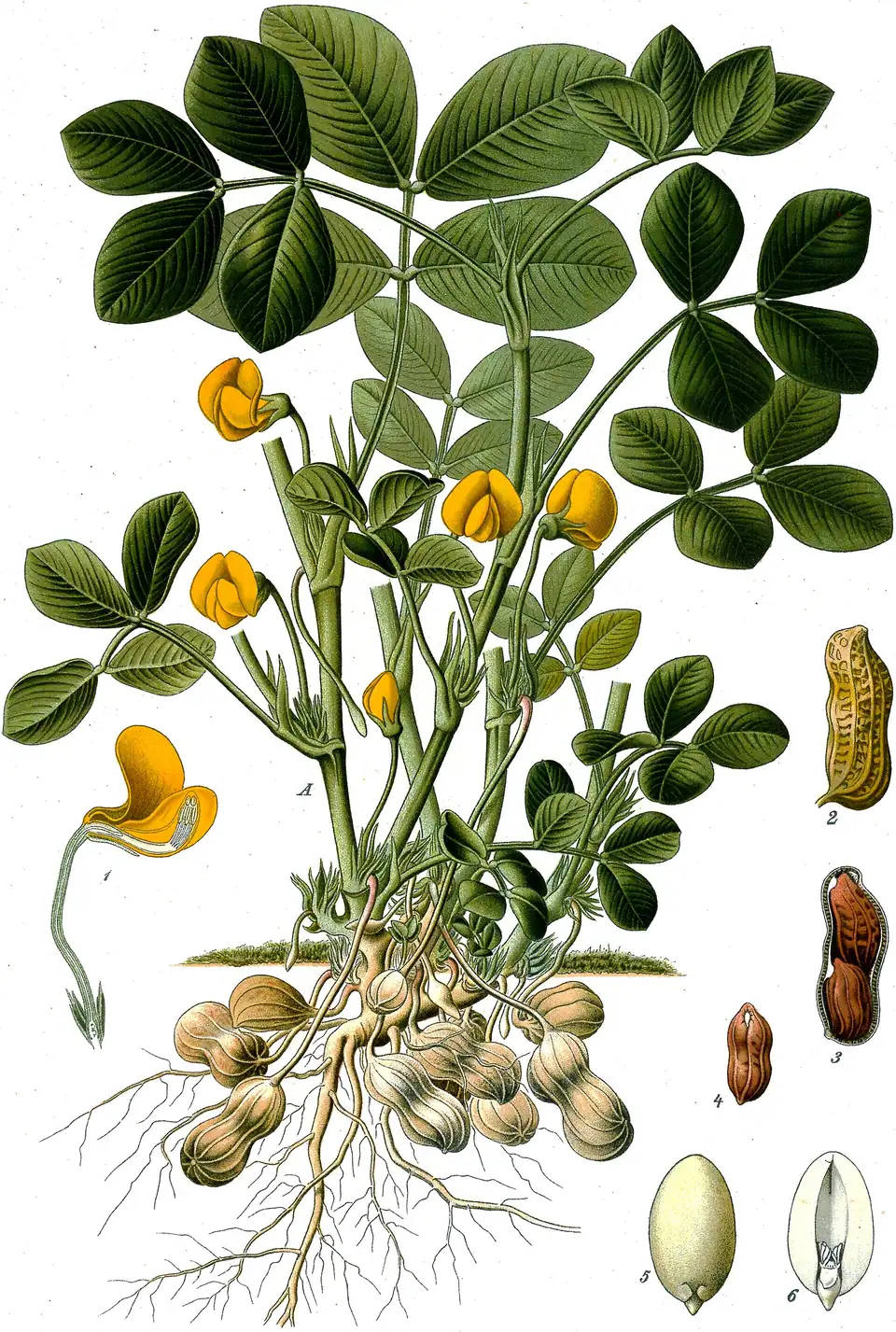


Cómo cultivar y cuidar Maní
Arachis hypogaea
Escrito por Emilio Marruso · última revisión
Tóxica para: Personas · Por qué
De un vistazo
El cacahuete es un cultivo divertido: plantas cacahuetes crudos con su cáscara y la planta mete sus tallitos en la tierra, donde crecen las vainas. Dale sol pleno y 25 mm de agua a la semana, y arranca la planta entera cuando las hojas empiecen a amarillear. Resiste bien la sequía, pero los períodos secos largos reducen la cosecha.
- Sol
Sol pleno: 6 horas o más al día, 8 o más para crecer mejor
Qué dicen las fuentes (2)
Luz: Pleno sol (6 o más horas de luz solar directa al día); 8 o más horas de luz solar directa diarias para un crecimiento óptimo.
Full sun (6 or more hours of direct sunlight a day)
— Arachis hypogaea (Earthnut, Goober, Goober Peas, Groundnut, Monkey Nut, Peanut, Peanuts, Pindar, Pygmy Nut, Virginia Peanut) | North Carolina Extension Gardener Plant Toolbox [1] Peanuts need 8 or more hours of direct sunlight daily for optimal growth.
— Peanut Greauxing Guide [6] - Riego
25 mm de agua a la semana; tierra húmeda, no empapada; deja de regar 10–14 días antes de cosechar
Qué dicen las fuentes (4)
Riego: Mantén las plantas bien regadas durante los períodos secos; aproximadamente 1 pulgada [2,5 cm] de lluvia por semana durante la temporada de crecimiento; mantén el suelo húmedo pero no saturado
Keep plants well-watered during dry periods to promote rapid, uninterrupted growth. Plants need about 1 inch of rain per week during the growing season. Keep the soil moist but not saturated.
— Peanut Greauxing Guide [6] Notas sobre el riego: La humedad es más crítica de 60 a 110 días después de la siembra, cuando los ginóforos entran al suelo y la vaina comienza a desarrollarse; evita mojar las hojas al regar; deja de regar 10 días a dos semanas antes de la cosecha; los cacahuates son resistentes a la sequía pero los períodos secos prolongados reducen el rendimiento
From 60 to 110 days after planting as the pegs enter the soil and the pod begins to develop. Water is most critical at this time.
— Peanut | Home & Garden Information Center [3] Avoid wetting the leaves when watering. Stop irrigating 10 days to two weeks before harvest.
— Peanut | Home & Garden Information Center [3] Peanuts are resistant to drought and can withstand long periods without water, but this will cause a reduction in yield.
— Peanut Greauxing Guide [6] - Frío
Aguanta inviernos de hasta −45,6 °C (−50 °F)
Muy rústica · USDA 2a · RHS H7 · Z2
Qué dicen las fuentes (2)
Rusticidad, zona más fría: 2a [mínima invernal de −45,6 a −42,8 °C (de −50 a −45 °F)]
2a, 2b, 3a, 3b, 4a, 4b, 5a, 5b, 6a, 6b, 7a, 7b, 8a, 8b, 9a, 9b, 10a, 10b, 11a, 11b
— Arachis hypogaea (Earthnut, Goober, Goober Peas, Groundnut, Monkey Nut, Peanut, Peanuts, Pindar, Pygmy Nut, Virginia Peanut) | North Carolina Extension Gardener Plant Toolbox [1] Rusticidad, zona más cálida: 11b [mínima invernal de 7,2 a 10 °C (de 45 a 50 °F)]
2a, 2b, 3a, 3b, 4a, 4b, 5a, 5b, 6a, 6b, 7a, 7b, 8a, 8b, 9a, 9b, 10a, 10b, 11a, 11b
— Arachis hypogaea (Earthnut, Goober, Goober Peas, Groundnut, Monkey Nut, Peanut, Peanuts, Pindar, Pygmy Nut, Virginia Peanut) | North Carolina Extension Gardener Plant Toolbox [1] - Suelo
Suelo fértil y rico en compost bien hecho
Qué dicen las fuentes (1)
Abonos naturales: Suelo fértil bien compostado
Plant seeds in the spring after the ground has warmed, in well-composted, fertile, light-textured, sandy, well-drained soils in full sun.
— Arachis hypogaea (Earthnut, Goober, Goober Peas, Groundnut, Monkey Nut, Peanut, Peanuts, Pindar, Pygmy Nut, Virginia Peanut) | North Carolina Extension Gardener Plant Toolbox [1] - Siembra
Siembra en primavera, sin heladas y con la tierra caliente; brota en 5–10 días
Qué dicen las fuentes (10)
Siembra: Primavera, después de que pase el peligro de heladas y el suelo se haya calentado; Carolina del Sur: abril a fines de junio, ideal la primera semana de mayo; Norte y centro de Florida: marzo a mayo
Piamonte (Carolina del Sur): Spring | Piedmont | May 1 – Jun 30 | Coastal | Apr 1 – May 31
— Peanut | Home & Garden Information Center [3] Costero (Carolina del Sur): Spring | Piedmont | May 1 – Jun 30 | Coastal | Apr 1 – May 31
— Peanut | Home & Garden Information Center [3] Carolina del Sur: The ideal time for planting peanuts is the first week of May when the soil is warm and moist.
— Peanut | Home & Garden Information Center [3] Norte y centro de Florida: In North and Central Florida, you can plant peanuts from March through May.
— Peanuts – Gardening Solutions [4] Según Iowa State Extension: Plant peanuts after the danger of frost is past.
— Growing Peanuts in the Home Garden | Yard and Garden [5] Plant anytime between April and late June; however, planting after June 1 will not allow enough time for dry peanuts to reach maturity.
— Peanut | Home & Garden Information Center [3] In North and Central Florida, you can plant peanuts from March through May.
— Peanuts – Gardening Solutions [4] Plant peanuts after the danger of frost is past.
— Growing Peanuts in the Home Garden | Yard and Garden [5] Días de germinación: 5-10 (emergencia después de la siembra)
Seeds germinate and plantlets emerge 5-10 days after planting.
— Peanut Greauxing Guide [6] the peanut plant will begin “cracking” or “emerging” through the soil surface in 5 to 10 days from planting.
— Peanut | Home & Garden Information Center [3] - Abonado
Necesita poco abono; echa yeso junto a la hilera tras la floración; nunca abones en el surco
Qué dicen las fuentes (7)
Cuándo: Depende de la fertilidad residual de un cultivo anterior bien fertilizado; fósforo y potasio en el otoño anterior; yeso al lado de la hilera justo después de la floración
Peanut plants respond better to residual fertility than to directly applied spring fertilizer. If possible, plant peanuts after a well fertilized crop.
— Peanut | Home & Garden Information Center [3] If the soil test shows a need for phosphorus and potassium, apply these minerals in the previous fall.
— Peanut | Home & Garden Information Center [3] To develop properly, peanuts also need an adequate calcium supply, so apply agricultural gypsum beside the row just after the plants bloom.
— Peanuts – Gardening Solutions [4] Microelementos: Calcio de cal o yeso agrícola aplicado al suelo al lado de la hilera después de la floración; el calcio foliar no es efectivo; los tipos Virginia necesitan más calcio
In this case, additional calcium may be applied as agricultural gypsum. Foliar calcium applications are not effective for peanuts. Virginia type peanuts require higher levels of calcium than smaller seeded varieties.
— Peanut | Home & Garden Information Center [3] To develop properly, peanuts also need an adequate calcium supply, so apply agricultural gypsum beside the row just after the plants bloom.
— Peanuts – Gardening Solutions [4] Evitar: Fertilizante en el surco con la semilla o sobre la hilera después de la siembra (muy sensible a la quemadura por fertilizante); alto potasio en la zona de la vaina
Peanuts are extremely sensitive to fertilizer burn. Do not apply fertilizer in the furrow with the seed or over the row after planting.
— Peanut | Home & Garden Information Center [3] A high concentration of potash in the pod zone will reduce calcium uptake by the pods, resulting in pod rot and “pops” or empty pods.
— Peanut | Home & Garden Information Center [3] - Cosecha
Cosecha cuando las hojas amarilleen: afloja la tierra, levanta la planta entera y sacúdela
Qué dicen las fuentes (3)
Cómo cosechar: Cosecha cuando el follaje comienza a amarillear: afloja la tierra alrededor de las plantas con un tenedor, levanta la planta entera con la mano (vainas incluidas) y sacúdela para quitar la tierra suelta.
Harvest the peanuts when the foliage begins to yellow in late summer or early fall.
— Growing Peanuts in the Home Garden | Yard and Garden [5] Peanuts ready for harvest may be dug by loosening the soil around the plants with a shovel or fork. Then lift the plant by hand, shaking all loose soil from the plants and pods.
— Peanut | Home & Garden Information Center [3] To harvest, remove the entire plant from the ground. Loosen the soil with a garden fork around the plant prior to pulling so the pods will remain attached.
— Peanut Greauxing Guide [6] - Plagas
Vigila pulgones, trips y manchas en las hojas; no mojes las hojas al regar
Qué dicen las fuentes (13)
Plagas: pulgón del caupí, gusano de la mazorca, gusano del tabaco, gusanos soldados, oruga del terciopelo, saltador de tres esquinas de la alfalfa, trips, araña roja de dos manchas
Cowpea Aphid (Aphis craccivora): Cowpea aphids have a broad host range with a preference for legume crops.
— Peanut Greauxing Guide [6] Corn earworms (Helicoverpa zea) and tobacco budworms (Helicoverpa armigera) vary in color from light green to almost black.
— Peanut Greauxing Guide [6] Armyworms (Spodoptera spp.): Armyworm feeding leaves singular, or closely grouped circular to irregularly shaped holes in foliage.
— Peanut Greauxing Guide [6] Velvetbean caterpillar (Anticarsia gemmatalis): The larva causes damage to plants by feeding on leaves.
— Peanut Greauxing Guide [6] Threecornered Alfalfa Hopper (Spissistilus festinus): The threecornered alfalfa hopper adult is a green, wedge-shaped insect with clear wings.
— Peanut Greauxing Guide [6] Thrips: Thrips are tiny needle-thin insects that are black or straw colored.
— Peanut Greauxing Guide [6] Two-spotted spider mite (Tetranychus urticae): They suck on the plant juices removing chlorophyll and injecting toxins which cause white dots on the foliage.
— Peanut Greauxing Guide [6] Enfermedades: mancha foliar temprana, mancha foliar tardía, pudrición del tallo (tizón sureño), pudrición de ramas, roya, tizón por Sclerotinia, pudrición negra por Cylindrocladium, virus del marchitamiento manchado del tomate
Disease suseptibility includes leaf spots, southern stem rot, Sclerotinia blight, Cylindrocladium black rot and Spotted wilt.
— Arachis hypogaea (Earthnut, Goober, Goober Peas, Groundnut, Monkey Nut, Peanut, Peanuts, Pindar, Pygmy Nut, Virginia Peanut) | North Carolina Extension Gardener Plant Toolbox [1] Late Leaf Spot (Cercosporidium personatum): Late leaf spot causes dark brown to black leaf spots (lesions) that penetrate through the leaf and are visible on both the upper and lower leaf surface.
— Peanut Greauxing Guide [6] Early Leaf Spot (Cercospora arachidicola): Early leaf spot typically causes penetrating brown lesions (spots) visible on the upper and lower leaf surface.
— Peanut Greauxing Guide [6] Limb Rot (Rhizoctonia solani): Limb rot usually appears in late August and September after the vines of runner varieties have lapped.
— Peanut Greauxing Guide [6] Rust (Puccinia arachidis): Characteristic orange pustules appear on undersides of leaves which become covered in masses of red-brown spores; pustules may form on pods.
— Peanut Greauxing Guide [6] Additionally, peanuts are vulnerable to tomato spotted wilt virus (TSWV).
— Peanuts – Gardening Solutions [4] - Seguridad
Los cacahuetes pueden causar reacciones alérgicas graves en algunas personas
Resumen
El maní es una legumbre sensible a las heladas que se cultiva como anual, cuyas flores están por encima del suelo y cuyas vainas se desarrollan por debajo del suelo. [1] Crece mejor a pleno sol y en suelo franco arenoso ligero y bien drenado, y el agua es el factor limitante más común en la producción. [6][3] Las semillas de maní contienen proteínas que pueden causar reacciones alérgicas graves en algunas personas. [1]
Citado en inglés, como en la fuente.
Cuidados
Las medidas entre corchetes son nuestra conversión al otro sistema de unidades; el texto citado no cambia.
Riego
Riego
Mantén las plantas bien regadas durante los períodos secos; aproximadamente 1 pulgada [2,5 cm] de lluvia por semana durante la temporada de crecimiento; mantén el suelo húmedo pero no saturado
Qué dicen las fuentes (1)
Keep plants well-watered during dry periods to promote rapid, uninterrupted growth. Plants need about 1 inch of rain per week during the growing season. Keep the soil moist but not saturated.Notas sobre el riego
La humedad es más crítica de 60 a 110 días después de la siembra, cuando los ginóforos entran al suelo y la vaina comienza a desarrollarse; evita mojar las hojas al regar; deja de regar 10 días a dos semanas antes de la cosecha; los cacahuates son resistentes a la sequía pero los períodos secos prolongados reducen el rendimiento
Qué dicen las fuentes (3)
From 60 to 110 days after planting as the pegs enter the soil and the pod begins to develop. Water is most critical at this time.Avoid wetting the leaves when watering. Stop irrigating 10 days to two weeks before harvest.Peanuts are resistant to drought and can withstand long periods without water, but this will cause a reduction in yield.Luz
Pleno sol (6 o más horas de luz solar directa al día); 8 o más horas de luz solar directa diarias para un crecimiento óptimo.
Qué dicen las fuentes (2)
Full sun (6 or more hours of direct sunlight a day)Peanuts need 8 or more hours of direct sunlight daily for optimal growth.Clima y frío
Rusticidad, zona más fría
2a [mínima invernal de −45,6 a −42,8 °C (de −50 a −45 °F)]
Qué dicen las fuentes (1)
2a, 2b, 3a, 3b, 4a, 4b, 5a, 5b, 6a, 6b, 7a, 7b, 8a, 8b, 9a, 9b, 10a, 10b, 11a, 11bRusticidad, zona más cálida
11b [mínima invernal de 7,2 a 10 °C (de 45 a 50 °F)]
Qué dicen las fuentes (1)
2a, 2b, 3a, 3b, 4a, 4b, 5a, 5b, 6a, 6b, 7a, 7b, 8a, 8b, 9a, 9b, 10a, 10b, 11a, 11bSuelo
pH del suelo, mínimo
Las fuentes dan valores distintos según la región, la zona o las condiciones de cultivo.
Lo que dice cada fuente
Carolina del Sur (Extensión de Clemson): 5.8
Según LSU AgCenter: 5.9
pH del suelo, máximo
Las fuentes dan valores distintos según la región, la zona o las condiciones de cultivo.
Lo que dice cada fuente
Carolina del Sur (Extensión de Clemson): 6.2
Según LSU AgCenter: 7.0
Dónde cultivarla
Las fuentes dan valores distintos según la región, la zona o las condiciones de cultivo.
Lo que dice cada fuente
Según UF/IFAS Gardening Solutions: 10.2-15.2 cm (4-6 pulgadas) entre plantas en la hilera; hileras a 61.0-91.4 cm (24-36 pulgadas) de distancia
Según Iowa State Extension: 15.2-20.3 cm (6-8 pulgadas) entre plantas
después del raleo (LSU AgCenter): 20.3-30.5 cm (8-12 pulgadas) entre plantas
al sembrar (LSU AgCenter): 4-6 semillas por 30.5 cm (1 pie) de hilera
Según NC State Extension: 15.2-22.9 cm (6-9 pulgadas) entre plantas en la hilera; hileras a unos 91.4 cm (3 pies) de distancia
Carolina del Sur (Extensión de Clemson): 5 semillas por 30.5 cm (1 pie) de hilera
Qué dicen las fuentes (6)
Según UF/IFAS Gardening Solutions: Plant them 4 to 6 inches apart and 2 to 4 inches deep, in rows spaced 24 to 36 inches apart.Según Iowa State Extension: Sow peanut seeds 1 to 1 1/2 inches deep and 6 to 8 inches apart.después del raleo (LSU AgCenter): When plants are 2” tall, thin to 8-12” apart.al sembrar (LSU AgCenter): Sow 4-6 seeds per foot of row.Según NC State Extension: deep in rows about 3 feet apart with 6-9Carolina del Sur (Extensión de Clemson): Sow five seeds per foot of row.Propagación
Semilla (cacahuetes crudos con cáscara usados como semilla); se pueden iniciar en interior y trasplantar
Cultivo
La planta
Ciclo de vida
anual
Lo que dice cada fuente
:
Qué dicen las fuentes (4)
: The peanut is an herbaceous perennial, but grown as an annual.Peanut plants ( Arachis hypogaea L.) are low-growing, self-pollinating annuals.The peanut is an herbaceous annual with opposite, pinnately compound leaves having four leafletsPeanuts are warm-season annuals that require a minimum of 120 frost free days to reach maturity.Familia
Fabaceae (familia de las leguminosas)
Qué dicen las fuentes (1)
Arachis hypogaea is a member of the Fabaceae family commonly known as legumes.Altura adulta
Siembra y crecimiento
Días de germinación
5-10 (emergencia después de la siembra)
Profundidad de siembra
Las fuentes no coinciden:
Plant seeds 2 to 3 inches deep in light textured sandy soils and 1½ to 2 inches deep in clay soils.
[3]Plant them 4 to 6 inches apart and 2 to 4 inches deep, in rows spaced 24 to 36 inches apart.
[4]Sow peanut seeds 1 to 1 1/2 inches deep and 6 to 8 inches apart.
[5]Plant seeds 1.5 to 3 inches deep when soil temperatures are consistently above 65 o F.
[6]
Distancia entre hileras
Días hasta la madurez
Las fuentes no coinciden:
Pods typically ripen 120-150 days after seed is planted.
[1]Dry, roasting peanuts can be harvested in 130 to 150 days after planting or when at least 65 percent of the pods have turned dark inside the hull
[3]Depending on the variety and weather, peanuts usually reach the harvestable stage 85-130 days after planting.
[6]Runner peanuts mature in about 135 to 155 days after planting.
[4]
Cosecha y conservación
Cómo cosechar
Cosecha cuando el follaje comienza a amarillear: afloja la tierra alrededor de las plantas con un tenedor, levanta la planta entera con la mano (vainas incluidas) y sacúdela para quitar la tierra suelta.
Qué dicen las fuentes (3)
Harvest the peanuts when the foliage begins to yellow in late summer or early fall.Peanuts ready for harvest may be dug by loosening the soil around the plants with a shovel or fork. Then lift the plant by hand, shaking all loose soil from the plants and pods.To harvest, remove the entire plant from the ground. Loosen the soil with a garden fork around the plant prior to pulling so the pods will remain attached.Conservación
Después del curado, guarda en contenedores de tela tejida o malla y cuelga en un lugar fresco, seco y bien ventilado, libre de insectos y roedores; almacenadas así se conservan durante varios meses sin pérdida significativa de calidad. No dejes que se enmohezcan.
Qué dicen las fuentes (2)
Peanuts can then be bagged in loosely woven containers and hung in a cool, dry area free of insects and rodents. Stored in this manner they may be kept for several months without a significant loss in quality.Once dried, place the peanuts in mesh bags and store them in cool, well-ventilated place until roasted.Plagas y enfermedades
Plagas
pulgón del caupí, gusano de la mazorca, gusano del tabaco, gusanos soldados, oruga del terciopelo, saltador de tres esquinas de la alfalfa, trips, araña roja de dos manchas
Qué dicen las fuentes (7)
Cowpea Aphid (Aphis craccivora): Cowpea aphids have a broad host range with a preference for legume crops.Corn earworms (Helicoverpa zea) and tobacco budworms (Helicoverpa armigera) vary in color from light green to almost black.Armyworms (Spodoptera spp.): Armyworm feeding leaves singular, or closely grouped circular to irregularly shaped holes in foliage.Velvetbean caterpillar (Anticarsia gemmatalis): The larva causes damage to plants by feeding on leaves.Threecornered Alfalfa Hopper (Spissistilus festinus): The threecornered alfalfa hopper adult is a green, wedge-shaped insect with clear wings.Thrips: Thrips are tiny needle-thin insects that are black or straw colored.Two-spotted spider mite (Tetranychus urticae): They suck on the plant juices removing chlorophyll and injecting toxins which cause white dots on the foliage.Enfermedades
mancha foliar temprana, mancha foliar tardía, pudrición del tallo (tizón sureño), pudrición de ramas, roya, tizón por Sclerotinia, pudrición negra por Cylindrocladium, virus del marchitamiento manchado del tomate
Qué dicen las fuentes (6)
Disease suseptibility includes leaf spots, southern stem rot, Sclerotinia blight, Cylindrocladium black rot and Spotted wilt.Late Leaf Spot (Cercosporidium personatum): Late leaf spot causes dark brown to black leaf spots (lesions) that penetrate through the leaf and are visible on both the upper and lower leaf surface.Early Leaf Spot (Cercospora arachidicola): Early leaf spot typically causes penetrating brown lesions (spots) visible on the upper and lower leaf surface.Limb Rot (Rhizoctonia solani): Limb rot usually appears in late August and September after the vines of runner varieties have lapped.Rust (Puccinia arachidis): Characteristic orange pustules appear on undersides of leaves which become covered in masses of red-brown spores; pustules may form on pods.Additionally, peanuts are vulnerable to tomato spotted wilt virus (TSWV).Abonado
Cuándo
Depende de la fertilidad residual de un cultivo anterior bien fertilizado; fósforo y potasio en el otoño anterior; yeso al lado de la hilera justo después de la floración
Qué dicen las fuentes (3)
Peanut plants respond better to residual fertility than to directly applied spring fertilizer. If possible, plant peanuts after a well fertilized crop.If the soil test shows a need for phosphorus and potassium, apply these minerals in the previous fall.To develop properly, peanuts also need an adequate calcium supply, so apply agricultural gypsum beside the row just after the plants bloom.Abonos naturales
Suelo fértil bien compostado
Qué dicen las fuentes (1)
Plant seeds in the spring after the ground has warmed, in well-composted, fertile, light-textured, sandy, well-drained soils in full sun.Abonos minerales
0-20-20 a 34,2 g/m² en otoño en terrenos pobres en nutrientes sin análisis de suelo; se necesita poco nitrógeno cuando las raíces nodulan adecuadamente, 34-0-0 a 14,6-19,5 g/m² para corregir la deficiencia de nitrógeno; superfosfato triple o muriato de potasio para la deficiencia de fósforo o potasio
Qué dicen las fuentes (4)
In the absence of a soil test in nutrient-poor land, apply 7 pounds of 0-20-20 per 1,000 square feet in the fall.To correct this nitrogen deficiency, apply 3 to 4 pounds of 34-0-0 per 1,000 square feet.If peanuts nodulate properly, they have little need for addition of nitrogen fertilizer. Leaf yellowing may indicate a need for nitrogen.Phosphorus or potassium deficiencies may require the addition of super triple phosphate or muriate of potash.Microelementos
Calcio de cal o yeso agrícola aplicado al suelo al lado de la hilera después de la floración; el calcio foliar no es efectivo; los tipos Virginia necesitan más calcio
Qué dicen las fuentes (2)
In this case, additional calcium may be applied as agricultural gypsum. Foliar calcium applications are not effective for peanuts. Virginia type peanuts require higher levels of calcium than smaller seeded varieties.To develop properly, peanuts also need an adequate calcium supply, so apply agricultural gypsum beside the row just after the plants bloom.Evitar
Fertilizante en el surco con la semilla o sobre la hilera después de la siembra (muy sensible a la quemadura por fertilizante); alto potasio en la zona de la vaina
Qué dicen las fuentes (2)
Peanuts are extremely sensitive to fertilizer burn. Do not apply fertilizer in the furrow with the seed or over the row after planting.A high concentration of potash in the pod zone will reduce calcium uptake by the pods, resulting in pod rot and “pops” or empty pods.Signos de carencia
Calcio: vainas sin llenar, menor calidad, más pudrición de vainas; nitrógeno: hojas amarillentas
Qué dicen las fuentes (2)
A calcium deficiency will result in unfilled pods, a lowered quality of peanuts, and an increased risk of pod rot.If peanuts nodulate properly, they have little need for addition of nitrogen fertilizer. Leaf yellowing may indicate a need for nitrogen.Signos de exceso
Exceso de potasio en la zona de la vaina: pudrición de vainas y vainas vacías
Qué dicen las fuentes (1)
A high concentration of potash in the pod zone will reduce calcium uptake by the pods, resulting in pod rot and “pops” or empty pods.Problemas
Mancha foliar
Qué hacer: Variedades menos susceptibles, fechas de siembra más tempranas y mantener las hojas secas al regar; fungicidas si es necesario
Qué dicen las fuentes (1)
Peanut leaf spot diseases produce brown to black spots on the leaves. Sometimes the spots are surrounded by a yellow halo.
— Peanut | Home & Garden Information Center [3] Podredumbre del tallo (tizón sureño)
Qué hacer: Los fungicidas se listan para el control
Qué dicen las fuentes (1)
The fungus primarily attacks the base of stems near the soil line, but any plant part in contact with soil may be damaged.
— Peanut Greauxing Guide [6] Virus del marchitamiento manchado del tomate
Qué hacer: El vector de los trips se controla con jabones insecticidas y aceites hortícolas
Qué dicen las fuentes (1)
Additionally, peanuts are vulnerable to tomato spotted wilt virus (TSWV).
— Peanuts – Gardening Solutions [4] Deficiencia de calcio
Qué hacer: Prueba el suelo; aplica yeso agrícola si el suelo tiene poco calcio
Qué dicen las fuentes (1)
A calcium deficiency will result in unfilled pods, a lowered quality of peanuts, and an increased risk of pod rot.
— Peanut | Home & Garden Information Center [3]
Remedios
Cada remedio indica qué dicen las fuentes oficiales; los remedios tradicionales sin fuente oficial aparecen marcados. Los perjudiciales están para que sepas evitarlos.
Cuidar la planta
pulgones
lavado con chorro fuerte Funciona
ALWAYS read and follow label instructions on pesticides
— Peanut Greauxing Guide [6] Cómo: Lava los pulgones con un chorro fuerte.
You can also wash them off with a strong spray, or use an insecticidal soap.
— Peanut Greauxing Guide [6] Qué dicen las pruebas Control: Introduce or attract natural predators into your garden such as lady beetles and wasps which feed on aphids. You can also wash them off with a strong spray, or use an insecticidal soap.
— Peanut Greauxing Guide [6] chorro de manguera No verificado
Remedio tradicional, no verificado por una fuente oficial.
Cómo: Sácalos con un chorro de tu manguera, o déjalos para las mariquitas y otros depredadores naturales.
atrayendo depredadores naturales Funciona
Cómo: Introduce o atrae depredadores naturales como catarinas y avispas que se alimentan de los pulgones.
Control: Introduce or attract natural predators into your garden such as lady beetles and wasps which feed on aphids.
— Peanut Greauxing Guide [6] Qué dicen las pruebas Control: Introduce or attract natural predators into your garden such as lady beetles and wasps which feed on aphids.
— Peanut Greauxing Guide [6] jabón insecticida Funciona
ALWAYS read and follow label instructions on pesticides
— Peanut Greauxing Guide [6] Cómo: Usa jabón insecticida.
Aphids | Sticky leaves, curled growth | Neem oil or insecticidal soap
— leafywisdom.com [7] Qué dicen las pruebas Control: Introduce or attract natural predators into your garden such as lady beetles and wasps which feed on aphids. You can also wash them off with a strong spray, or use an insecticidal soap.
— Peanut Greauxing Guide [6] aceite de neem Funciona
Cómo: Usa aceite de neem.
Aphids | Sticky leaves, curled growth | Neem oil or insecticidal soap
— leafywisdom.com [7] Qué dicen las pruebas Neem oil is found in the seeds of the neem tree. The active component found in this biological pesticide reduces insect feeding, interferes with hormones -- making it hard to grow or lay eggs -- and acts as a repellent.
— extension.illinois.edu [8]
trips
jabón insecticida Funciona
ALWAYS read and follow label instructions on pesticides
— Peanut Greauxing Guide [6] Cómo: Los jabones insecticidas y los aceites hortícolas funcionarán con una buena cobertura.
Control: Insecticidal soaps and horticultural oils will work with good coverage.
— Peanut Greauxing Guide [6] Qué dicen las pruebas Control: Insecticidal soaps and horticultural oils will work with good coverage.
— Peanut Greauxing Guide [6]
arañas rojas de dos manchas
jabón insecticida Funciona
ALWAYS read and follow label instructions on pesticides
— Peanut Greauxing Guide [6] Cómo: Los jabones insecticidas y el aceite hortícola son pesticidas de contacto recomendados.
Control: Insecticidal soaps and horticultural oil are recommended contact pesticides.
— Peanut Greauxing Guide [6] Qué dicen las pruebas Control: Insecticidal soaps and horticultural oil are recommended contact pesticides.
— Peanut Greauxing Guide [6]
orugas militares
depredadores y eliminación de bordes de pasto No verificado
Remedio tradicional, no verificado por una fuente oficial.
Cómo: Los insectos depredadores parásitos como escarabajos, avispas y moscas ayudan a controlar los gusanos cogolleros; elimina los bordes con césped cerca de los cacahuetes y separa los cultivos de gramíneas como el maíz y el trigo tanto como sea posible.
ardillas
redes o malla de alambre No verificado
Remedio tradicional, no verificado por una fuente oficial.
Cómo: Usa barreras físicas como redes o mallas de alambre para proteger las plantas.
chile en polvo o spray de ajo No verificado
Remedio tradicional, no verificado por una fuente oficial.
The pepper spray can be very potent if it gets on your skin or in your eyes.
— extension.psu.edu [9] Penn State Extension does not recommend using home remedies for many reasons.
— extension.psu.edu [9] Cómo: Los repelentes naturales como chile en polvo o spray de ajo disuaden a las ardillas de la zona de cultivo.
mosquitos de los hongos
mantillo de gravilla No verificado
Remedio tradicional, no verificado por una fuente oficial.
Cómo: Evita el riego excesivo y/o usa un mantillo como gravilla en la superficie del suelo (solo para plantas de interior).
deficiencia de calcio
cáscaras de huevo trituradas No demostrado
Cómo: Esparce cáscaras de huevo trituradas a ambos lados de las semillas para añadir calcio; alrededor del perímetro de las plantas en contenedor cuando tengan unas 4 pulgadas de alto.
I scatter crushed eggshells on either side of the seeds for added calcium.
— motherearthgardener.com [10] Qué dicen las pruebas Eggshells can take anywhere from one to five years to break down and may not be readily available to plants and soil, including crushed eggshells ( Enroth 2018 ).
— extension.illinois.edu [11]
Toxicidad
Según la fuente, citada textualmente. No es un consejo médico ni veterinario: si una persona o un animal pudo haber ingerido esta planta, contacta con un centro de toxicología o con un veterinario.
Calendario
Siembra
Primavera, después de que pase el peligro de heladas y el suelo se haya calentado; Carolina del Sur: abril a fines de junio, ideal la primera semana de mayo; Norte y centro de Florida: marzo a mayo
Lo que dice cada fuente
Piamonte (Carolina del Sur): 1 de mayo a 30 de junio
Costero (Carolina del Sur): 1 de abril al 31 de mayo
Carolina del Sur: En cualquier momento entre abril y finales de junio; ideal la primera semana de mayo
Norte y centro de Florida: De marzo a mayo
Según Iowa State Extension: Después de que pase el peligro de las heladas
Qué dicen las fuentes (8)
Piamonte (Carolina del Sur): Spring | Piedmont | May 1 – Jun 30 | Coastal | Apr 1 – May 31Costero (Carolina del Sur): Spring | Piedmont | May 1 – Jun 30 | Coastal | Apr 1 – May 31Carolina del Sur: The ideal time for planting peanuts is the first week of May when the soil is warm and moist.Norte y centro de Florida: In North and Central Florida, you can plant peanuts from March through May.Según Iowa State Extension: Plant peanuts after the danger of frost is past.Plant anytime between April and late June; however, planting after June 1 will not allow enough time for dry peanuts to reach maturity.In North and Central Florida, you can plant peanuts from March through May.Plant peanuts after the danger of frost is past.Plantación
Se puede comenzar en interiores 3-4 semanas antes de trasplantar al exterior
Qué dicen las fuentes (1)
Peanuts transplant well and can be started indoors 3-4 weeks before transplanting out.Cosecha
Las fuentes dan valores distintos según la región, la zona o las condiciones de cultivo.
Lo que dice cada fuente
cacahuates verdes para hervir (Clemson Extension): 90 a 110 días después de la siembra
cacahuates para tostado en seco (Clemson Extension): 130 a 150 días después de la siembra
Tipos rastreros (UF/IFAS Gardening Solutions): Aproximadamente de 135 a 155 días después de la siembra
Maní Valencia para hervir (UF/IFAS Gardening Solutions): Tan solo 75 días desde la siembra
Según LSU AgCenter: 85-130 días después de la siembra
Según NC State Extension: Las vainas generalmente maduran 120-150 días después de sembrar la semilla
Según Iowa State Extension: Mínimo de 120 días sin heladas; cosecha cuando el follaje comienza a amarillear a fines del verano o principios del otoño
Qué dicen las fuentes (10)
cacahuates verdes para hervir (Clemson Extension): Green, boiling peanuts typically mature from 90 to 110 days after planting.cacahuates para tostado en seco (Clemson Extension): Dry, roasting peanuts can be harvested in 130 to 150 days after plantingTipos rastreros (UF/IFAS Gardening Solutions): Runner peanuts mature in about 135 to 155 days after planting.Maní Valencia para hervir (UF/IFAS Gardening Solutions): Valencia peanuts grown for boiling purposes may mature in as little as 75 days from plantingSegún LSU AgCenter: Depending on the variety and weather, peanuts usually reach the harvestable stage 85-130 days after planting.Según NC State Extension: Pods typically ripen 120-150 days after seed is planted.Según Iowa State Extension: Peanuts are warm-season annuals that require a minimum of 120 frost free days to reach maturity.Green, boiling peanuts typically mature from 90 to 110 days after planting.Dry, roasting peanuts can be harvested in 130 to 150 days after plantingHarvest the peanuts when the foliage begins to yellow in late summer or early fall.Meses tal como los dan las fuentes, en su mayoría de Estados Unidos (hemisferio norte). En el hemisferio sur se desplazan unos seis meses.
Respecto a las heladas
Estimación menos precisa: no hay ninguna estación meteorológica a menos de 300 km.
Busca las fechas de heladas por código postal o ciudad
Siembra al aire libre: hacia la última helada
Plant peanuts after the danger of frost is past. Peanuts require a soil temperature of 65 F for germination.
— Growing Peanuts in the Home Garden | Yard and Garden [5] Cosecha: hacia la primera helada
After first fall frost, dig up the plants, shake off the soil, and spread on a dry surface not touching the ground to cure before stripping the pods from the plants.
— Arachis hypogaea (Earthnut, Goober, Goober Peas, Groundnut, Monkey Nut, Peanut, Peanuts, Pindar, Pygmy Nut, Virginia Peanut) | North Carolina Extension Gardener Plant Toolbox [1]
Cuenta desde las fechas medias de las heladas de tu zona.
Comestibilidad
Según la fuente, citada textualmente. No comas una planta basándote solo en esta página: los errores de identificación pueden ser peligrosos.
The peanut is the most common edible plant part and is consumed either raw, cooked, made into oils or, with fats removed, ground into flour. Young leaves and tips may be suitable as cooked green vegetables.
[1]
Valores orientativos
Valores de una fuente secundaria, no comprobados palabra por palabra como el resto de esta página. Úselos como punto de partida.
- Resiste la sequía
- SíValor orientativo, adáptalo a tu clima · Fuente secundaria
- Crecimiento
- BajoValor orientativo, adáptalo a tu clima · Fuente secundaria
Plantas similares
- Bananero de Etiopía Ensete ventricosum
- Palma de aguja Yucca flaccida
- Afghan Cherry Prunus jacquemontii
- African Blood Lily Scadoxus multiflorus
- Agapanto Agapanthus praecox
- Cempasúchil Tagetes erecta
- Agretti Soda inermis
- Apio caballar Smyrnium olusatrum
Fuentes
Cada valor anterior se cita de estos documentos. Los enlaces llevan al editor original.
- Arachis hypogaea (Earthnut, Goober, Goober Peas, Groundnut, Monkey Nut, Peanut, Peanuts, Pindar, Pygmy Nut, Virginia Peanut) | North Carolina Extension Gardener Plant Toolbox · plants.ces.ncsu.edu, consultado
- Goober - Arachis hypogaea | North Carolina Extension Gardener Plant Toolbox · plants.ces.ncsu.edu, consultado
- Peanut | Home & Garden Information Center · hgic.clemson.edu, consultado
- Peanuts – Gardening Solutions · gardeningsolutions.ifas.ufl.edu, consultado
- Growing Peanuts in the Home Garden | Yard and Garden · yardandgarden.extension.iastate.edu, consultado
- Peanut Greauxing Guide · lsuagcenter.com, consultado
- leafywisdom.com · leafywisdom.com
- extension.illinois.edu · extension.illinois.edu
- extension.psu.edu · extension.psu.edu
- motherearthgardener.com · motherearthgardener.com
- extension.illinois.edu · extension.illinois.edu
Escrito por Emilio Marruso · última revisión