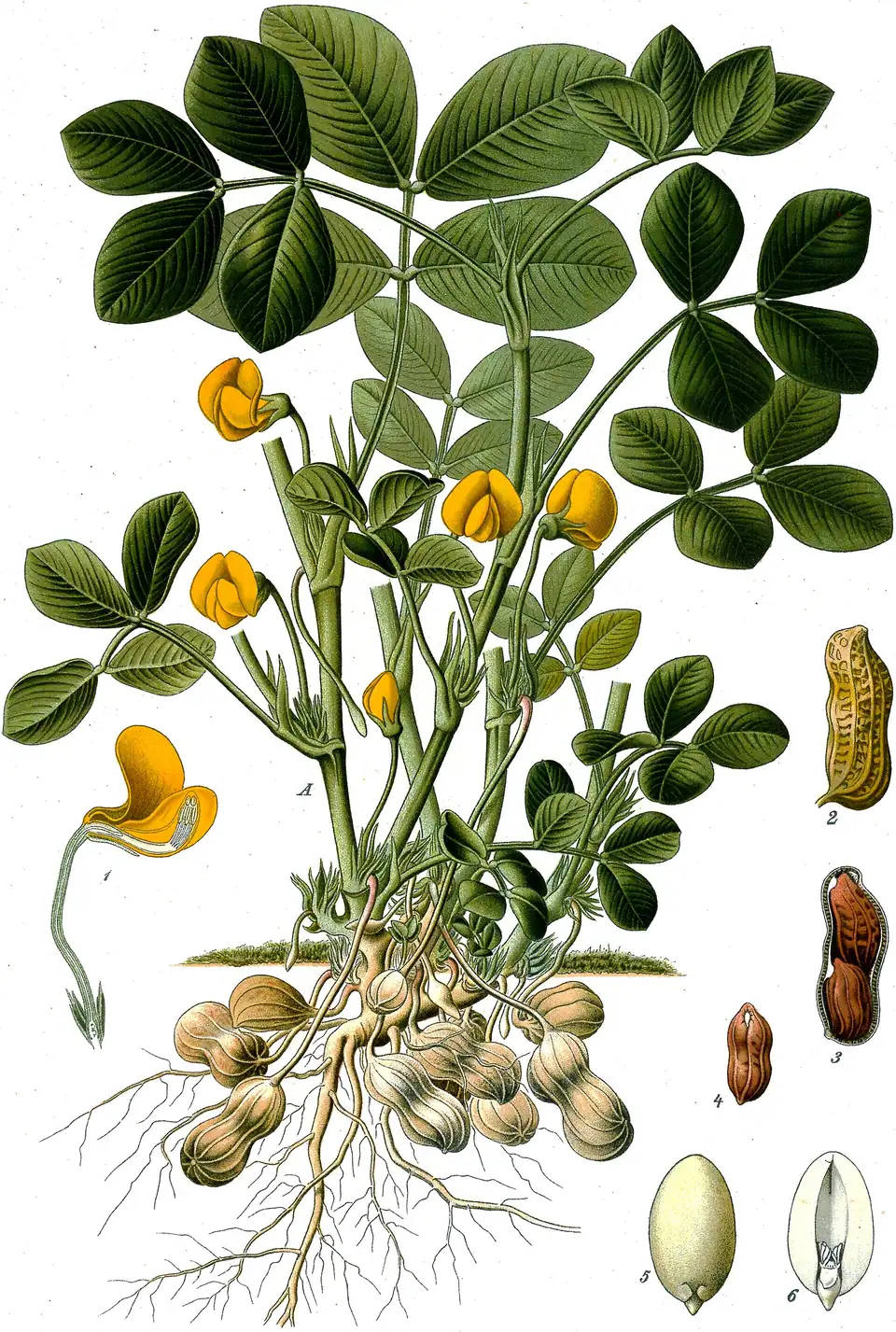


How to Grow and Care for Peanut
Arachis hypogaea
Written by Emilio Marruso · last checked
Toxic to: People · Why
At a glance
Peanuts are a fun crop: you plant raw peanuts in the shell, and the plant pushes its pegs into the soil, where the pods grow. Give them full sun and 1 inch of water a week, then lift the whole plant when the leaves start to yellow. They handle drought well, but long dry spells cut the harvest.
- Sun
Full sun: 6 or more hours a day, 8 or more for best growth
What the sources say (2)
Light: Full sun (6 or more hours of direct sunlight a day); 8 or more hours of direct sunlight daily for optimal growth
Full sun (6 or more hours of direct sunlight a day)
— Arachis hypogaea (Earthnut, Goober, Goober Peas, Groundnut, Monkey Nut, Peanut, Peanuts, Pindar, Pygmy Nut, Virginia Peanut) | North Carolina Extension Gardener Plant Toolbox [1] Peanuts need 8 or more hours of direct sunlight daily for optimal growth.
— Peanut Greauxing Guide [6] - Water
1 inch of water a week; keep the soil moist, not soaked; stop watering 10–14 days before harvest
What the sources say (4)
Watering: Keep plants well-watered during dry periods; about 1 inch [2.5 cm] of rain per week during the growing season; keep the soil moist but not saturated
Keep plants well-watered during dry periods to promote rapid, uninterrupted growth. Plants need about 1 inch of rain per week during the growing season. Keep the soil moist but not saturated.
— Peanut Greauxing Guide [6] Watering notes: Moisture is most critical from 60 to 110 days after planting as the pegs enter the soil and the pod begins to develop; avoid wetting the leaves when watering; stop irrigating 10 days to two weeks before harvest; peanuts are resistant to drought but long dry periods reduce yield
From 60 to 110 days after planting as the pegs enter the soil and the pod begins to develop. Water is most critical at this time.
— Peanut | Home & Garden Information Center [3] Avoid wetting the leaves when watering. Stop irrigating 10 days to two weeks before harvest.
— Peanut | Home & Garden Information Center [3] Peanuts are resistant to drought and can withstand long periods without water, but this will cause a reduction in yield.
— Peanut Greauxing Guide [6] - Cold
Survives winters down to −50 °F (−45.6 °C)
Very hardy · USDA 2a · RHS H7 · Z2
What the sources say (2)
Hardiness, coldest zone: 2a [winter low −45.6 to −42.8 °C (−50 to −45 °F)]
2a, 2b, 3a, 3b, 4a, 4b, 5a, 5b, 6a, 6b, 7a, 7b, 8a, 8b, 9a, 9b, 10a, 10b, 11a, 11b
— Arachis hypogaea (Earthnut, Goober, Goober Peas, Groundnut, Monkey Nut, Peanut, Peanuts, Pindar, Pygmy Nut, Virginia Peanut) | North Carolina Extension Gardener Plant Toolbox [1] Hardiness, warmest zone: 11b [winter low 7.2 to 10 °C (45 to 50 °F)]
2a, 2b, 3a, 3b, 4a, 4b, 5a, 5b, 6a, 6b, 7a, 7b, 8a, 8b, 9a, 9b, 10a, 10b, 11a, 11b
— Arachis hypogaea (Earthnut, Goober, Goober Peas, Groundnut, Monkey Nut, Peanut, Peanuts, Pindar, Pygmy Nut, Virginia Peanut) | North Carolina Extension Gardener Plant Toolbox [1] - Soil
Fertile soil rich in well-rotted compost
What the sources say (1)
Natural fertilizers: Well-composted, fertile soil
Plant seeds in the spring after the ground has warmed, in well-composted, fertile, light-textured, sandy, well-drained soils in full sun.
— Arachis hypogaea (Earthnut, Goober, Goober Peas, Groundnut, Monkey Nut, Peanut, Peanuts, Pindar, Pygmy Nut, Virginia Peanut) | North Carolina Extension Gardener Plant Toolbox [1] - Sowing
Sow in spring once frost is gone and the soil is warm; sprouts in 5–10 days
What the sources say (10)
Sowing: Spring, after frost danger is past and the ground has warmed; South Carolina: April to late June, ideal first week of May; North and Central Florida: March through May
Piedmont (South Carolina): Spring | Piedmont | May 1 – Jun 30 | Coastal | Apr 1 – May 31
— Peanut | Home & Garden Information Center [3] Coastal (South Carolina): Spring | Piedmont | May 1 – Jun 30 | Coastal | Apr 1 – May 31
— Peanut | Home & Garden Information Center [3] South Carolina: The ideal time for planting peanuts is the first week of May when the soil is warm and moist.
— Peanut | Home & Garden Information Center [3] North and Central Florida: In North and Central Florida, you can plant peanuts from March through May.
— Peanuts – Gardening Solutions [4] According to Iowa State Extension: Plant peanuts after the danger of frost is past.
— Growing Peanuts in the Home Garden | Yard and Garden [5] Plant anytime between April and late June; however, planting after June 1 will not allow enough time for dry peanuts to reach maturity.
— Peanut | Home & Garden Information Center [3] In North and Central Florida, you can plant peanuts from March through May.
— Peanuts – Gardening Solutions [4] Plant peanuts after the danger of frost is past.
— Growing Peanuts in the Home Garden | Yard and Garden [5] - Feeding
Needs little fertilizer; add gypsum beside the row after bloom; never put fertilizer in the seed furrow
What the sources say (7)
When: Relies on residual fertility from a well-fertilized previous crop; phosphorus and potassium in the previous fall; gypsum beside the row just after bloom
Peanut plants respond better to residual fertility than to directly applied spring fertilizer. If possible, plant peanuts after a well fertilized crop.
— Peanut | Home & Garden Information Center [3] If the soil test shows a need for phosphorus and potassium, apply these minerals in the previous fall.
— Peanut | Home & Garden Information Center [3] To develop properly, peanuts also need an adequate calcium supply, so apply agricultural gypsum beside the row just after the plants bloom.
— Peanuts – Gardening Solutions [4] Micronutrients: Calcium from lime or agricultural gypsum applied to the soil beside the row after bloom; foliar calcium is not effective; Virginia types need more calcium
In this case, additional calcium may be applied as agricultural gypsum. Foliar calcium applications are not effective for peanuts. Virginia type peanuts require higher levels of calcium than smaller seeded varieties.
— Peanut | Home & Garden Information Center [3] To develop properly, peanuts also need an adequate calcium supply, so apply agricultural gypsum beside the row just after the plants bloom.
— Peanuts – Gardening Solutions [4] Avoid: Fertilizer in the furrow with the seed or over the row after planting (very sensitive to fertilizer burn); high potash in the pod zone
Peanuts are extremely sensitive to fertilizer burn. Do not apply fertilizer in the furrow with the seed or over the row after planting.
— Peanut | Home & Garden Information Center [3] A high concentration of potash in the pod zone will reduce calcium uptake by the pods, resulting in pod rot and “pops” or empty pods.
— Peanut | Home & Garden Information Center [3] - Harvest
Harvest when the leaves yellow: loosen the soil, lift the whole plant and shake off the dirt
What the sources say (3)
How to harvest: Harvest when the foliage begins to yellow: loosen the soil around the plants with a fork, lift the whole plant by hand (pods attached) and shake off the loose soil.
Harvest the peanuts when the foliage begins to yellow in late summer or early fall.
— Growing Peanuts in the Home Garden | Yard and Garden [5] Peanuts ready for harvest may be dug by loosening the soil around the plants with a shovel or fork. Then lift the plant by hand, shaking all loose soil from the plants and pods.
— Peanut | Home & Garden Information Center [3] To harvest, remove the entire plant from the ground. Loosen the soil with a garden fork around the plant prior to pulling so the pods will remain attached.
— Peanut Greauxing Guide [6] - Pests
Watch for aphids, thrips and leaf spot; keep leaves dry when watering
What the sources say (13)
Pests: cowpea aphid, corn earworm, tobacco budworm, armyworms, velvetbean caterpillar, threecornered alfalfa hopper, thrips, two-spotted spider mite
Cowpea Aphid (Aphis craccivora): Cowpea aphids have a broad host range with a preference for legume crops.
— Peanut Greauxing Guide [6] Corn earworms (Helicoverpa zea) and tobacco budworms (Helicoverpa armigera) vary in color from light green to almost black.
— Peanut Greauxing Guide [6] Armyworms (Spodoptera spp.): Armyworm feeding leaves singular, or closely grouped circular to irregularly shaped holes in foliage.
— Peanut Greauxing Guide [6] Velvetbean caterpillar (Anticarsia gemmatalis): The larva causes damage to plants by feeding on leaves.
— Peanut Greauxing Guide [6] Threecornered Alfalfa Hopper (Spissistilus festinus): The threecornered alfalfa hopper adult is a green, wedge-shaped insect with clear wings.
— Peanut Greauxing Guide [6] Thrips: Thrips are tiny needle-thin insects that are black or straw colored.
— Peanut Greauxing Guide [6] Two-spotted spider mite (Tetranychus urticae): They suck on the plant juices removing chlorophyll and injecting toxins which cause white dots on the foliage.
— Peanut Greauxing Guide [6] Diseases: early leaf spot, late leaf spot, stem rot (southern blight), limb rot, rust, Sclerotinia blight, Cylindrocladium black rot, tomato spotted wilt virus
Disease suseptibility includes leaf spots, southern stem rot, Sclerotinia blight, Cylindrocladium black rot and Spotted wilt.
— Arachis hypogaea (Earthnut, Goober, Goober Peas, Groundnut, Monkey Nut, Peanut, Peanuts, Pindar, Pygmy Nut, Virginia Peanut) | North Carolina Extension Gardener Plant Toolbox [1] Late Leaf Spot (Cercosporidium personatum): Late leaf spot causes dark brown to black leaf spots (lesions) that penetrate through the leaf and are visible on both the upper and lower leaf surface.
— Peanut Greauxing Guide [6] Early Leaf Spot (Cercospora arachidicola): Early leaf spot typically causes penetrating brown lesions (spots) visible on the upper and lower leaf surface.
— Peanut Greauxing Guide [6] Limb Rot (Rhizoctonia solani): Limb rot usually appears in late August and September after the vines of runner varieties have lapped.
— Peanut Greauxing Guide [6] Rust (Puccinia arachidis): Characteristic orange pustules appear on undersides of leaves which become covered in masses of red-brown spores; pustules may form on pods.
— Peanut Greauxing Guide [6] Additionally, peanuts are vulnerable to tomato spotted wilt virus (TSWV).
— Peanuts – Gardening Solutions [4] - Safety
Peanuts can cause serious allergic reactions in some people
Overview
Peanut is a frost-tender legume grown as an annual, whose flowers are above ground and whose pods develop below ground. [1] It grows best in full sun and well-drained, light, sandy loam soil, and water is the most common limiting factor in production. [6][3] Peanut seeds contain proteins that can cause serious allergic reactions in some people. [1]
Peanut care
Measurements in square brackets are our conversion into the other unit system; the quoted text is unchanged.
How to water Peanut
Watering
Keep plants well-watered during dry periods; about 1 inch [2.5 cm] of rain per week during the growing season; keep the soil moist but not saturated
What the sources say (1)
Keep plants well-watered during dry periods to promote rapid, uninterrupted growth. Plants need about 1 inch of rain per week during the growing season. Keep the soil moist but not saturated.Watering notes
Moisture is most critical from 60 to 110 days after planting as the pegs enter the soil and the pod begins to develop; avoid wetting the leaves when watering; stop irrigating 10 days to two weeks before harvest; peanuts are resistant to drought but long dry periods reduce yield
What the sources say (3)
From 60 to 110 days after planting as the pegs enter the soil and the pod begins to develop. Water is most critical at this time.Avoid wetting the leaves when watering. Stop irrigating 10 days to two weeks before harvest.Peanuts are resistant to drought and can withstand long periods without water, but this will cause a reduction in yield.How much light Peanut needs
Full sun (6 or more hours of direct sunlight a day); 8 or more hours of direct sunlight daily for optimal growth
What the sources say (2)
Full sun (6 or more hours of direct sunlight a day)Peanuts need 8 or more hours of direct sunlight daily for optimal growth.How much cold Peanut can take
Hardiness, coldest zone
2a [winter low −45.6 to −42.8 °C (−50 to −45 °F)]
What the sources say (1)
2a, 2b, 3a, 3b, 4a, 4b, 5a, 5b, 6a, 6b, 7a, 7b, 8a, 8b, 9a, 9b, 10a, 10b, 11a, 11bHardiness, warmest zone
11b [winter low 7.2 to 10 °C (45 to 50 °F)]
What the sources say (1)
2a, 2b, 3a, 3b, 4a, 4b, 5a, 5b, 6a, 6b, 7a, 7b, 8a, 8b, 9a, 9b, 10a, 10b, 11a, 11bBest soil for Peanut
Soil pH, minimum
The sources give different values depending on region, zone or growing conditions.
What each source says
South Carolina (Clemson Extension): 5.8
According to LSU AgCenter: 5.9
Soil pH, maximum
The sources give different values depending on region, zone or growing conditions.
What each source says
South Carolina (Clemson Extension): 6.2
According to LSU AgCenter: 7.0
Where to grow Peanut
The sources give different values depending on region, zone or growing conditions.
What each source says
According to UF/IFAS Gardening Solutions: 10.2-15.2 cm (4-6 in) apart in the row; rows 61.0-91.4 cm (24-36 in) apart
According to Iowa State Extension: 15.2-20.3 cm (6-8 in) apart
after thinning (LSU AgCenter): 20.3-30.5 cm (8-12 in) apart
at sowing (LSU AgCenter): 4-6 seeds per 30.5 cm (1 ft) of row
According to NC State Extension: 15.2-22.9 cm (6-9 in) between plants in the row; rows about 91.4 cm (3 ft) apart
South Carolina (Clemson Extension): 5 seeds per 30.5 cm (1 ft) of row
What the sources say (6)
According to UF/IFAS Gardening Solutions: Plant them 4 to 6 inches apart and 2 to 4 inches deep, in rows spaced 24 to 36 inches apart.According to Iowa State Extension: Sow peanut seeds 1 to 1 1/2 inches deep and 6 to 8 inches apart.after thinning (LSU AgCenter): When plants are 2” tall, thin to 8-12” apart.at sowing (LSU AgCenter): Sow 4-6 seeds per foot of row.According to NC State Extension: deep in rows about 3 feet apart with 6-9South Carolina (Clemson Extension): Sow five seeds per foot of row.How to propagate Peanut
Seed (raw peanuts in the shell used as seed); can be started indoors and transplanted
How to grow Peanut
The plant
Life cycle
annual
What each source says
:
What the sources say (4)
: The peanut is an herbaceous perennial, but grown as an annual.Peanut plants ( Arachis hypogaea L.) are low-growing, self-pollinating annuals.The peanut is an herbaceous annual with opposite, pinnately compound leaves having four leafletsPeanuts are warm-season annuals that require a minimum of 120 frost free days to reach maturity.Family
Fabaceae (legume family)
What the sources say (1)
Arachis hypogaea is a member of the Fabaceae family commonly known as legumes.Mature height
Sowing and growth
Days to germination
5-10 (emergence after planting)
Sowing depth
The sources disagree:
Plant seeds 2 to 3 inches deep in light textured sandy soils and 1½ to 2 inches deep in clay soils.
[3]Plant them 4 to 6 inches apart and 2 to 4 inches deep, in rows spaced 24 to 36 inches apart.
[4]Sow peanut seeds 1 to 1 1/2 inches deep and 6 to 8 inches apart.
[5]Plant seeds 1.5 to 3 inches deep when soil temperatures are consistently above 65 o F.
[6]
Row spacing
Days to maturity
The sources disagree:
Pods typically ripen 120-150 days after seed is planted.
[1]Dry, roasting peanuts can be harvested in 130 to 150 days after planting or when at least 65 percent of the pods have turned dark inside the hull
[3]Depending on the variety and weather, peanuts usually reach the harvestable stage 85-130 days after planting.
[6]Runner peanuts mature in about 135 to 155 days after planting.
[4]
Harvest and storage
How to harvest
Harvest when the foliage begins to yellow: loosen the soil around the plants with a fork, lift the whole plant by hand (pods attached) and shake off the loose soil.
What the sources say (3)
Harvest the peanuts when the foliage begins to yellow in late summer or early fall.Peanuts ready for harvest may be dug by loosening the soil around the plants with a shovel or fork. Then lift the plant by hand, shaking all loose soil from the plants and pods.To harvest, remove the entire plant from the ground. Loosen the soil with a garden fork around the plant prior to pulling so the pods will remain attached.Storage
After curing, bag in loosely woven or mesh containers and hang in a cool, dry, well-ventilated place free of insects and rodents; stored this way they keep for several months without significant loss in quality. Do not let them mold.
What the sources say (2)
Peanuts can then be bagged in loosely woven containers and hung in a cool, dry area free of insects and rodents. Stored in this manner they may be kept for several months without a significant loss in quality.Once dried, place the peanuts in mesh bags and store them in cool, well-ventilated place until roasted.Pests and diseases
Pests
cowpea aphid, corn earworm, tobacco budworm, armyworms, velvetbean caterpillar, threecornered alfalfa hopper, thrips, two-spotted spider mite
What the sources say (7)
Cowpea Aphid (Aphis craccivora): Cowpea aphids have a broad host range with a preference for legume crops.Corn earworms (Helicoverpa zea) and tobacco budworms (Helicoverpa armigera) vary in color from light green to almost black.Armyworms (Spodoptera spp.): Armyworm feeding leaves singular, or closely grouped circular to irregularly shaped holes in foliage.Velvetbean caterpillar (Anticarsia gemmatalis): The larva causes damage to plants by feeding on leaves.Threecornered Alfalfa Hopper (Spissistilus festinus): The threecornered alfalfa hopper adult is a green, wedge-shaped insect with clear wings.Thrips: Thrips are tiny needle-thin insects that are black or straw colored.Two-spotted spider mite (Tetranychus urticae): They suck on the plant juices removing chlorophyll and injecting toxins which cause white dots on the foliage.Diseases
early leaf spot, late leaf spot, stem rot (southern blight), limb rot, rust, Sclerotinia blight, Cylindrocladium black rot, tomato spotted wilt virus
What the sources say (6)
Disease suseptibility includes leaf spots, southern stem rot, Sclerotinia blight, Cylindrocladium black rot and Spotted wilt.Late Leaf Spot (Cercosporidium personatum): Late leaf spot causes dark brown to black leaf spots (lesions) that penetrate through the leaf and are visible on both the upper and lower leaf surface.Early Leaf Spot (Cercospora arachidicola): Early leaf spot typically causes penetrating brown lesions (spots) visible on the upper and lower leaf surface.Limb Rot (Rhizoctonia solani): Limb rot usually appears in late August and September after the vines of runner varieties have lapped.Rust (Puccinia arachidis): Characteristic orange pustules appear on undersides of leaves which become covered in masses of red-brown spores; pustules may form on pods.Additionally, peanuts are vulnerable to tomato spotted wilt virus (TSWV).Fertilizing
When
Relies on residual fertility from a well-fertilized previous crop; phosphorus and potassium in the previous fall; gypsum beside the row just after bloom
What the sources say (3)
Peanut plants respond better to residual fertility than to directly applied spring fertilizer. If possible, plant peanuts after a well fertilized crop.If the soil test shows a need for phosphorus and potassium, apply these minerals in the previous fall.To develop properly, peanuts also need an adequate calcium supply, so apply agricultural gypsum beside the row just after the plants bloom.Natural fertilizers
Well-composted, fertile soil
What the sources say (1)
Plant seeds in the spring after the ground has warmed, in well-composted, fertile, light-textured, sandy, well-drained soils in full sun.Mineral fertilizers
0-20-20 at 34.2 g/m² in the fall on nutrient-poor land without a soil test; little nitrogen needed when roots nodulate properly, 34-0-0 at 14.6-19.5 g/m² to correct nitrogen deficiency; triple superphosphate or muriate of potash for phosphorus or potassium deficiency
What the sources say (4)
In the absence of a soil test in nutrient-poor land, apply 7 pounds of 0-20-20 per 1,000 square feet in the fall.To correct this nitrogen deficiency, apply 3 to 4 pounds of 34-0-0 per 1,000 square feet.If peanuts nodulate properly, they have little need for addition of nitrogen fertilizer. Leaf yellowing may indicate a need for nitrogen.Phosphorus or potassium deficiencies may require the addition of super triple phosphate or muriate of potash.Micronutrients
Calcium from lime or agricultural gypsum applied to the soil beside the row after bloom; foliar calcium is not effective; Virginia types need more calcium
What the sources say (2)
In this case, additional calcium may be applied as agricultural gypsum. Foliar calcium applications are not effective for peanuts. Virginia type peanuts require higher levels of calcium than smaller seeded varieties.To develop properly, peanuts also need an adequate calcium supply, so apply agricultural gypsum beside the row just after the plants bloom.Avoid
Fertilizer in the furrow with the seed or over the row after planting (very sensitive to fertilizer burn); high potash in the pod zone
What the sources say (2)
Peanuts are extremely sensitive to fertilizer burn. Do not apply fertilizer in the furrow with the seed or over the row after planting.A high concentration of potash in the pod zone will reduce calcium uptake by the pods, resulting in pod rot and “pops” or empty pods.Signs of deficiency
Calcium: unfilled pods, lower quality, more pod rot; nitrogen: yellowing leaves
What the sources say (2)
A calcium deficiency will result in unfilled pods, a lowered quality of peanuts, and an increased risk of pod rot.If peanuts nodulate properly, they have little need for addition of nitrogen fertilizer. Leaf yellowing may indicate a need for nitrogen.Signs of excess
Excess potash in the pod zone: pod rot and empty pods
What the sources say (1)
A high concentration of potash in the pod zone will reduce calcium uptake by the pods, resulting in pod rot and “pops” or empty pods.Peanut pests and problems
Leaf spot
What to do: Less susceptible varieties, earlier planting dates and keeping leaves dry when irrigating; fungicides if necessary
What the sources say (1)
Peanut leaf spot diseases produce brown to black spots on the leaves. Sometimes the spots are surrounded by a yellow halo.
— Peanut | Home & Garden Information Center [3] Stem rot (southern blight)
What to do: Fungicides are listed for control
What the sources say (1)
The fungus primarily attacks the base of stems near the soil line, but any plant part in contact with soil may be damaged.
— Peanut Greauxing Guide [6] Tomato spotted wilt virus
What to do: Thrips vector controlled with insecticidal soaps and horticultural oils
What the sources say (1)
Additionally, peanuts are vulnerable to tomato spotted wilt virus (TSWV).
— Peanuts – Gardening Solutions [4] Calcium deficiency
What to do: Soil test; apply agricultural gypsum if the soil is low in calcium
What the sources say (1)
A calcium deficiency will result in unfilled pods, a lowered quality of peanuts, and an increased risk of pod rot.
— Peanut | Home & Garden Information Center [3]
Remedies
Each remedy shows what official sources say about it; traditional remedies without an official source are marked as such. Harmful ones are listed so you know to avoid them.
Treating the plant
aphids
strong spray wash Works
ALWAYS read and follow label instructions on pesticides
— Peanut Greauxing Guide [6] How: Wash the aphids off with a strong spray.
You can also wash them off with a strong spray, or use an insecticidal soap.
— Peanut Greauxing Guide [6] What the evidence says Control: Introduce or attract natural predators into your garden such as lady beetles and wasps which feed on aphids. You can also wash them off with a strong spray, or use an insecticidal soap.
— Peanut Greauxing Guide [6] hose jet Not verified
Traditional remedy, not verified by an official source.
How: Blast them off with a jet from your hose, or leave them for ladybirds and other natural predators to find.
attracting natural predators Works
How: Introduce or attract natural predators such as lady beetles and wasps which feed on aphids.
Control: Introduce or attract natural predators into your garden such as lady beetles and wasps which feed on aphids.
— Peanut Greauxing Guide [6] What the evidence says Control: Introduce or attract natural predators into your garden such as lady beetles and wasps which feed on aphids.
— Peanut Greauxing Guide [6] insecticidal soap Works
ALWAYS read and follow label instructions on pesticides
— Peanut Greauxing Guide [6] How: Use insecticidal soap.
Aphids | Sticky leaves, curled growth | Neem oil or insecticidal soap
— leafywisdom.com [7] What the evidence says Control: Introduce or attract natural predators into your garden such as lady beetles and wasps which feed on aphids. You can also wash them off with a strong spray, or use an insecticidal soap.
— Peanut Greauxing Guide [6] neem oil Works
How: Use neem oil.
Aphids | Sticky leaves, curled growth | Neem oil or insecticidal soap
— leafywisdom.com [7] What the evidence says Neem oil is found in the seeds of the neem tree. The active component found in this biological pesticide reduces insect feeding, interferes with hormones -- making it hard to grow or lay eggs -- and acts as a repellent.
— extension.illinois.edu [8]
thrips
insecticidal soap Works
ALWAYS read and follow label instructions on pesticides
— Peanut Greauxing Guide [6] How: Insecticidal soaps and horticultural oils will work with good coverage.
Control: Insecticidal soaps and horticultural oils will work with good coverage.
— Peanut Greauxing Guide [6] What the evidence says Control: Insecticidal soaps and horticultural oils will work with good coverage.
— Peanut Greauxing Guide [6]
two-spotted spider mites
insecticidal soap Works
ALWAYS read and follow label instructions on pesticides
— Peanut Greauxing Guide [6] How: Insecticidal soaps and horticultural oil are recommended contact pesticides.
Control: Insecticidal soaps and horticultural oil are recommended contact pesticides.
— Peanut Greauxing Guide [6] What the evidence says Control: Insecticidal soaps and horticultural oil are recommended contact pesticides.
— Peanut Greauxing Guide [6]
armyworms
predators and removing grassy borders Not verified
Traditional remedy, not verified by an official source.
How: Parasitic predator insects such as beetles, wasps and flies help control armyworms; eliminate grassy borders near peanuts and separate grass crops such as corn and wheat as much as possible.
squirrels
netting or wire mesh Not verified
Traditional remedy, not verified by an official source.
How: Use physical barriers such as netting or wire mesh to protect the plants.
chilli powder or garlic spray Not verified
Traditional remedy, not verified by an official source.
The pepper spray can be very potent if it gets on your skin or in your eyes.
— extension.psu.edu [9] Penn State Extension does not recommend using home remedies for many reasons.
— extension.psu.edu [9] How: Natural repellents like chilli powder or garlic spray to deter squirrels from the growing area.
fungus gnats
grit mulch Not verified
Traditional remedy, not verified by an official source.
How: Avoid overwatering and/or use a mulch such as grit on the soil surface (indoor plants only).
calcium deficiency
crushed eggshells Not proven
How: Scatter crushed eggshells on either side of the seeds for added calcium; around the perimeter of container plants when about 4 inches tall.
I scatter crushed eggshells on either side of the seeds for added calcium.
— motherearthgardener.com [10] What the evidence says Eggshells can take anywhere from one to five years to break down and may not be readily available to plants and soil, including crushed eggshells ( Enroth 2018 ).
— extension.illinois.edu [11]
Is Peanut poisonous?
Reported by the source, quoted verbatim. This is not medical or veterinary advice: if a person or an animal may have eaten this plant, contact a poison control centre or a veterinarian.
Calendar
Sowing
Spring, after frost danger is past and the ground has warmed; South Carolina: April to late June, ideal first week of May; North and Central Florida: March through May
What each source says
Piedmont (South Carolina): May 1 to June 30
Coastal (South Carolina): April 1 to May 31
South Carolina: Anytime between April and late June; ideal first week of May
North and Central Florida: March through May
According to Iowa State Extension: After the danger of frost is past
What the sources say (8)
Piedmont (South Carolina): Spring | Piedmont | May 1 – Jun 30 | Coastal | Apr 1 – May 31Coastal (South Carolina): Spring | Piedmont | May 1 – Jun 30 | Coastal | Apr 1 – May 31South Carolina: The ideal time for planting peanuts is the first week of May when the soil is warm and moist.North and Central Florida: In North and Central Florida, you can plant peanuts from March through May.According to Iowa State Extension: Plant peanuts after the danger of frost is past.Plant anytime between April and late June; however, planting after June 1 will not allow enough time for dry peanuts to reach maturity.In North and Central Florida, you can plant peanuts from March through May.Plant peanuts after the danger of frost is past.Planting
Can be started indoors 3-4 weeks before transplanting out
What the sources say (1)
Peanuts transplant well and can be started indoors 3-4 weeks before transplanting out.Harvest
The sources give different values depending on region, zone or growing conditions.
What each source says
green boiling peanuts (Clemson Extension): 90 to 110 days after planting
dry roasting peanuts (Clemson Extension): 130 to 150 days after planting
runner types (UF/IFAS Gardening Solutions): About 135 to 155 days after planting
Valencia peanuts for boiling (UF/IFAS Gardening Solutions): As little as 75 days from planting
According to LSU AgCenter: 85-130 days after planting
According to NC State Extension: Pods typically ripen 120-150 days after seed is planted
According to Iowa State Extension: Minimum of 120 frost free days; harvest when foliage begins to yellow in late summer or early fall
What the sources say (10)
green boiling peanuts (Clemson Extension): Green, boiling peanuts typically mature from 90 to 110 days after planting.dry roasting peanuts (Clemson Extension): Dry, roasting peanuts can be harvested in 130 to 150 days after plantingrunner types (UF/IFAS Gardening Solutions): Runner peanuts mature in about 135 to 155 days after planting.Valencia peanuts for boiling (UF/IFAS Gardening Solutions): Valencia peanuts grown for boiling purposes may mature in as little as 75 days from plantingAccording to LSU AgCenter: Depending on the variety and weather, peanuts usually reach the harvestable stage 85-130 days after planting.According to NC State Extension: Pods typically ripen 120-150 days after seed is planted.According to Iowa State Extension: Peanuts are warm-season annuals that require a minimum of 120 frost free days to reach maturity.Green, boiling peanuts typically mature from 90 to 110 days after planting.Dry, roasting peanuts can be harvested in 130 to 150 days after plantingHarvest the peanuts when the foliage begins to yellow in late summer or early fall.Months as given by the sources, which are mostly from the United States (northern hemisphere). In the southern hemisphere they shift by about six months.
Relative to frost
Less precise estimate: there is no weather station within 300 km.
Find frost dates by ZIP code or city
Sow outdoors: around the last frost
Plant peanuts after the danger of frost is past. Peanuts require a soil temperature of 65 F for germination.
— Growing Peanuts in the Home Garden | Yard and Garden [5] Harvest: around the first frost
After first fall frost, dig up the plants, shake off the soil, and spread on a dry surface not touching the ground to cure before stripping the pods from the plants.
— Arachis hypogaea (Earthnut, Goober, Goober Peas, Groundnut, Monkey Nut, Peanut, Peanuts, Pindar, Pygmy Nut, Virginia Peanut) | North Carolina Extension Gardener Plant Toolbox [1]
Count from the average frost dates where you live.
Edibility
Reported by the source, quoted verbatim. Do not eat a plant on the basis of this page alone: identification mistakes can be dangerous.
The peanut is the most common edible plant part and is consumed either raw, cooked, made into oils or, with fats removed, ground into flour. Young leaves and tips may be suitable as cooked green vegetables.
[1]
Indicative values
Values from a secondary source, not checked word for word like the rest of this page. Use them as a starting point.
- Drought tolerant
- yesIndicative value, adapt it to your climate · Secondary source
- Growth rate
- LowIndicative value, adapt it to your climate · Secondary source
Similar plants
- Abyssinian banana Ensete ventricosum
- Adam's Needle Yucca flaccida
- Afghan Cherry Prunus jacquemontii
- African Blood Lily Scadoxus multiflorus
- African Blue Lily Agapanthus praecox
- African Marigold Tagetes erecta
- Agretti Soda inermis
- Alexanders Smyrnium olusatrum
Sources
Every value above is quoted from these documents. Links lead to the original publisher.
- Arachis hypogaea (Earthnut, Goober, Goober Peas, Groundnut, Monkey Nut, Peanut, Peanuts, Pindar, Pygmy Nut, Virginia Peanut) | North Carolina Extension Gardener Plant Toolbox · plants.ces.ncsu.edu, consulted
- Goober - Arachis hypogaea | North Carolina Extension Gardener Plant Toolbox · plants.ces.ncsu.edu, consulted
- Peanut | Home & Garden Information Center · hgic.clemson.edu, consulted
- Peanuts – Gardening Solutions · gardeningsolutions.ifas.ufl.edu, consulted
- Growing Peanuts in the Home Garden | Yard and Garden · yardandgarden.extension.iastate.edu, consulted
- Peanut Greauxing Guide · lsuagcenter.com, consulted
- leafywisdom.com · leafywisdom.com
- extension.illinois.edu · extension.illinois.edu
- extension.psu.edu · extension.psu.edu
- motherearthgardener.com · motherearthgardener.com
- extension.illinois.edu · extension.illinois.edu
Written by Emilio Marruso · last checked