
How to Grow and Care for African Blue Lily
Agapanthus praecox
Written by Emilio Marruso · last checked
Toxic to: People · Why
At a glance
Agapanthus is a perennial that asks for little: full sun and fertile, moist soil that drains well. It stays compact, 1 to 2 feet tall and wide, so it fits happily in a container, and you can divide it to make new plants. Go easy on fertilizer, and wear gloves when handling it, since the sap irritates skin.
- Sun
Full sun
What the sources say (1)
Light: Full sun
Plant rhizomes in well-drained fertile moist soils in full sun for best flowering. Plants will lean towards the sun, so south-facing is best.
— Agapanthus praecox (African Blue Lily, African Lily, Agapanthus, Blue Lily, Lilyof the Nile) | North Carolina Extension Gardener Plant Toolbox [1] - Cold
Survives winters down to 15 °F (−9.4 °C)
Hardy in average winters · USDA 8b · RHS H4 · Z8
What the sources say (6)
Hardiness, coldest zone: 8b [winter low −9.4 to −6.7 °C (15 to 20 °F)]
According to NC State Extension (Agapanthus praecox page): USDA Plant Hardiness Zone: 8b, 9a, 9b
— Agapanthus praecox (African Blue Lily, African Lily, Agapanthus, Blue Lily, Lilyof the Nile) | North Carolina Extension Gardener Plant Toolbox [1] According to NC State Extension (genus Agapanthus page): USDA Plant Hardiness Zone: 8a, 8b, 9a
— Agapanthus (African Lily, Lily of the Nile) | North Carolina Extension Gardener Plant Toolbox [2] Hybrid cultivars (Wisconsin Extension): numerous hybrid cultivars with a range of characteristics and sizes, hardy in zones 7a to 11b unless noted otherwise.
— Agapanthus – Wisconsin Horticulture [3] Galaxy collection (Wisconsin Extension): collection varieties are hardy to zone 6a.
— Agapanthus – Wisconsin Horticulture [3] USDA Plant Hardiness Zone: 8b, 9a, 9b, 10a, 10b, 11a, 11b
— Agapanthus praecox (African Blue Lily, African Lily, Agapanthus, Blue Lily, Lilyof the Nile) | North Carolina Extension Gardener Plant Toolbox [1] Hardiness, warmest zone: 11b [winter low 7.2 to 10 °C (45 to 50 °F)]
USDA Plant Hardiness Zone: 8b, 9a, 9b, 10a, 10b, 11a, 11b
— Agapanthus praecox (African Blue Lily, African Lily, Agapanthus, Blue Lily, Lilyof the Nile) | North Carolina Extension Gardener Plant Toolbox [1] - Soil
Fertile, moist soil that drains well
What the sources say (1)
Watering notes: Plant in well-drained, fertile, moist soil
Plant rhizomes in well-drained fertile moist soils in full sun for best flowering.
— Agapanthus praecox (African Blue Lily, African Lily, Agapanthus, Blue Lily, Lilyof the Nile) | North Carolina Extension Gardener Plant Toolbox [1] - Feeding
Feed lightly: too much fertilizer makes it grow long and floppy
What the sources say (2)
Avoid: Overfertilization, which causes lanky growth
During the growing season, containers can be fertilized lightly; overfertilization will result in lanky growth.
— Agapanthus – Wisconsin Horticulture [3] Signs of excess: Lanky growth
During the growing season, containers can be fertilized lightly; overfertilization will result in lanky growth.
— Agapanthus – Wisconsin Horticulture [3] - Pests
Aphids, scale, spider mites, mealybugs and snails; also rot and powdery mildew
What the sources say (2)
Pests: aphids, scales, spider mites, mealy bugs, snails
Diseases include Botrytis rot, root rot, powdery mildew, Verticillium wilt and Macrophoma agapanthii. Pests include aphids, scales, spider mites, mealy bugs and snails.
— Agapanthus praecox (African Blue Lily, African Lily, Agapanthus, Blue Lily, Lilyof the Nile) | North Carolina Extension Gardener Plant Toolbox [1] Diseases: Botrytis rot, root rot, powdery mildew, Verticillium wilt, Macrophoma agapanthii
Diseases include Botrytis rot, root rot, powdery mildew, Verticillium wilt and Macrophoma agapanthii. Pests include aphids, scales, spider mites, mealy bugs and snails.
— Agapanthus praecox (African Blue Lily, African Lily, Agapanthus, Blue Lily, Lilyof the Nile) | North Carolina Extension Gardener Plant Toolbox [1] - Size
1 to 2 ft tall and wide
What the sources say (2)
Mature height: 30.5-61 cm (1 ft - 2 ft)
Dimensions: Height: 1 ft. 0 in. - 2 ft. 0 in. Width: 1 ft. 0 in. - 2 ft. 0 in.
— Agapanthus praecox (African Blue Lily, African Lily, Agapanthus, Blue Lily, Lilyof the Nile) | North Carolina Extension Gardener Plant Toolbox [1] Mature width: 30.5-61 cm (1 ft - 2 ft)
Dimensions: Height: 1 ft. 0 in. - 2 ft. 0 in. Width: 1 ft. 0 in. - 2 ft. 0 in.
— Agapanthus praecox (African Blue Lily, African Lily, Agapanthus, Blue Lily, Lilyof the Nile) | North Carolina Extension Gardener Plant Toolbox [1] - Propagation
Make new plants by dividing the clump
What the sources say (2)
Propagation: Division
Plants will lean towards the sun, so south-facing is best. Propagate by division as needed.
— Agapanthus praecox (African Blue Lily, African Lily, Agapanthus, Blue Lily, Lilyof the Nile) | North Carolina Extension Gardener Plant Toolbox [1] Recommended Propagation Strategy: Division Country Or Region Of Origin: South Africa
— Agapanthus praecox (African Blue Lily, African Lily, Agapanthus, Blue Lily, Lilyof the Nile) | North Carolina Extension Gardener Plant Toolbox [1] - Containers
Grows in containers too
What the sources say (2)
In containers: Yes
This plant is best grown in a pot and brought in the house or greenhouse in the winter in zones north of 8.
— Agapanthus praecox (African Blue Lily, African Lily, Agapanthus, Blue Lily, Lilyof the Nile) | North Carolina Extension Gardener Plant Toolbox [1] They can also be grown in a large pot for the patio.
— Agapanthus praecox (African Blue Lily, African Lily, Agapanthus, Blue Lily, Lilyof the Nile) | North Carolina Extension Gardener Plant Toolbox [1] - Safety
Poisonous if eaten; the sap irritates skin and eyes, so wear gloves
Overview
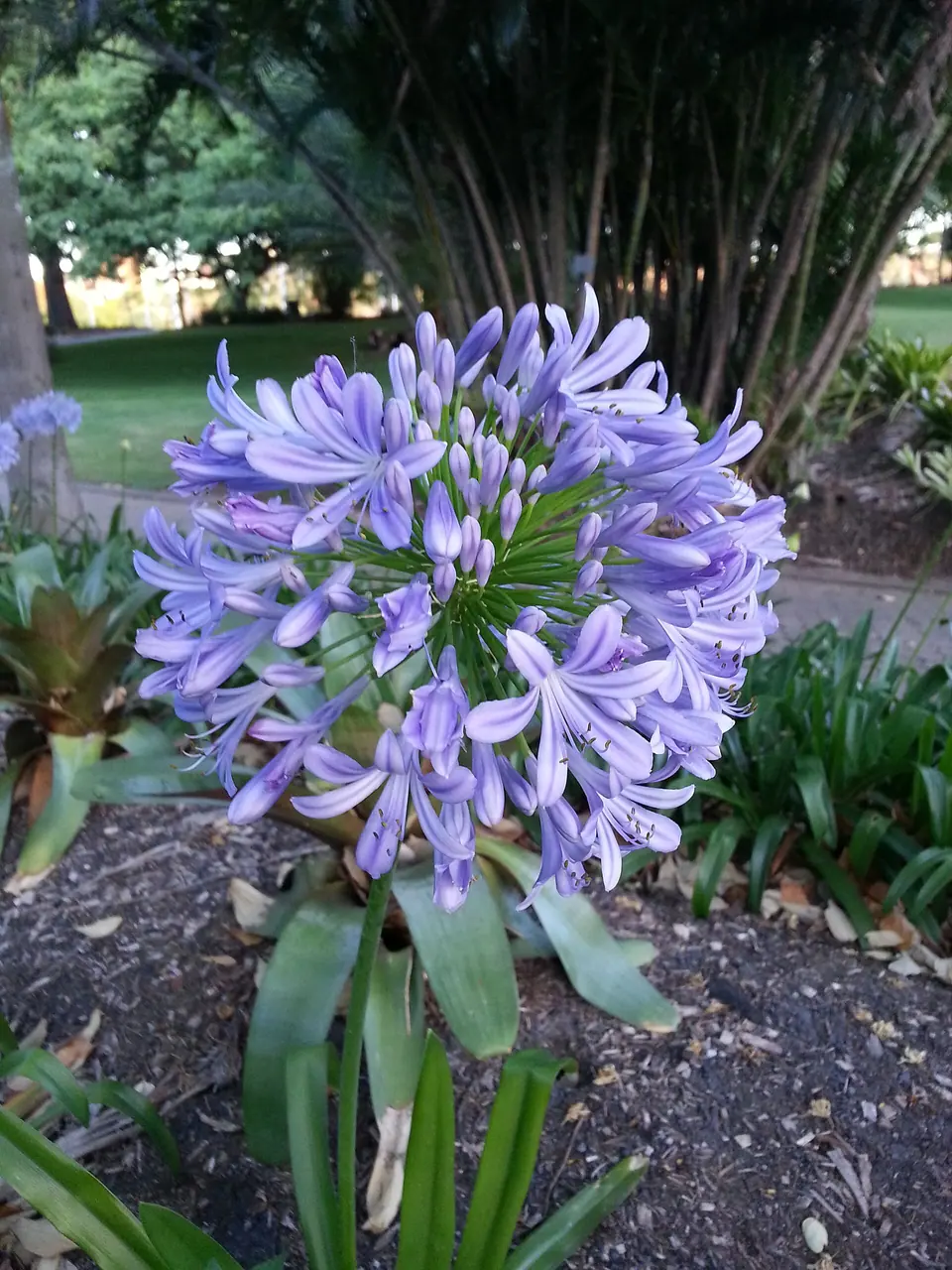
African blue lily is a clump-forming evergreen perennial native to southern South Africa, grown for blue and white summer flowers. [1] It does best in well-drained fertile moist soil in full sun and is propagated by division. [1]
This record is incomplete: the sources we read do not cover every field yet.
Not yet covered by our sources: Watering, Pruning
African Blue Lily care
How to water African Blue Lily
Watering
The sources give different values depending on region, zone or growing conditions.
What each source says
According to Wisconsin Extension (Agapanthus genus): Keep well watered when growing; allow to dry out in winter
What the sources say (1)
According to Wisconsin Extension (Agapanthus genus): Keep well watered when growing, but allow it to dry out in winter.Watering notes
Plant in well-drained, fertile, moist soil
What the sources say (1)
Plant rhizomes in well-drained fertile moist soils in full sun for best flowering.How much light African Blue Lily needs
Full sun
What the sources say (1)
Plant rhizomes in well-drained fertile moist soils in full sun for best flowering. Plants will lean towards the sun, so south-facing is best.How much cold African Blue Lily can take
Hardiness, coldest zone
8b [winter low −9.4 to −6.7 °C (15 to 20 °F)]
What each source says
According to NC State Extension (Agapanthus praecox page): 8b [winter low −9.4 to −6.7 °C (15 to 20 °F)]
According to NC State Extension (genus Agapanthus page): 8a [winter low −12.2 to −9.4 °C (10 to 15 °F)]
Hybrid cultivars (Wisconsin Extension): 7a [winter low −17.8 to −15 °C (0 to 5 °F)]
Galaxy collection (Wisconsin Extension): 6a [winter low −23.3 to −20.6 °C (−10 to −5 °F)]
What the sources say (5)
According to NC State Extension (Agapanthus praecox page): USDA Plant Hardiness Zone:
8b, 9a, 9bAccording to NC State Extension (genus Agapanthus page): USDA Plant Hardiness Zone:
8a, 8b, 9aHybrid cultivars (Wisconsin Extension): numerous hybrid cultivars with a range of characteristics and sizes, hardy in zones 7a to 11b unless noted otherwise.Galaxy collection (Wisconsin Extension): collection varieties are hardy to zone 6a.USDA Plant Hardiness Zone:
8b, 9a, 9b, 10a, 10b, 11a, 11bHardiness, warmest zone
11b [winter low 7.2 to 10 °C (45 to 50 °F)]
What the sources say (1)
USDA Plant Hardiness Zone:
8b, 9a, 9b, 10a, 10b, 11a, 11bWhere to grow African Blue Lily
In containers
Yes
What the sources say (2)
This plant is best grown in a pot and brought in the house or greenhouse in the winter in zones north of 8.They can also be grown in a large pot for the patio.Spacing
The sources give different values depending on region, zone or growing conditions.
What each source says
According to NC State Extension (genus Agapanthus page): 20.3 cm (8 in)
According to Wisconsin Extension (Agapanthus genus): 20.3 cm (8 in)
What the sources say (2)
According to NC State Extension (genus Agapanthus page): The rhizomes should be planted 1 inch deep and 8 inches apart.According to Wisconsin Extension (Agapanthus genus): Plant Agapanthus just deep enough to cover the roots, spacing them about 8 inches apart.How to propagate African Blue Lily
Division
What the sources say (2)
Plants will lean towards the sun, so south-facing is best. Propagate by division as needed.Recommended Propagation Strategy:
Division
Country Or Region Of Origin:
South AfricaHow to grow African Blue Lily
The plant
Life cycle
perennial
What the sources say (1)
African Blue Lily is a clump-forming, evergreen perennial in the amaryllis family (Amaryllidaceae) native to southern South Africa.Family
Amaryllidaceae
What the sources say (1)
African Blue Lily is a clump-forming, evergreen perennial in the amaryllis family (Amaryllidaceae) native to southern South Africa.Mature height
30.5-61 cm (1 ft - 2 ft)
What the sources say (1)
Dimensions: Height: 1 ft. 0 in. - 2 ft. 0 in. Width: 1 ft. 0 in. - 2 ft. 0 in.Mature width
30.5-61 cm (1 ft - 2 ft)
What the sources say (1)
Dimensions: Height: 1 ft. 0 in. - 2 ft. 0 in. Width: 1 ft. 0 in. - 2 ft. 0 in.Pests and diseases
Pests
aphids, scales, spider mites, mealy bugs, snails
What the sources say (1)
Diseases include Botrytis rot, root rot, powdery mildew, Verticillium wilt and Macrophoma agapanthii. Pests include aphids, scales, spider mites, mealy bugs and snails.Diseases
Botrytis rot, root rot, powdery mildew, Verticillium wilt, Macrophoma agapanthii
What the sources say (1)
Diseases include Botrytis rot, root rot, powdery mildew, Verticillium wilt and Macrophoma agapanthii. Pests include aphids, scales, spider mites, mealy bugs and snails.Fertilizing
When
The sources give different values depending on region, zone or growing conditions.
What each source says
in containers: Lightly during the growing season
What the sources say (1)
in containers: During the growing season, containers can be fertilized lightly; overfertilization will result in lanky growth.Avoid
Overfertilization, which causes lanky growth
What the sources say (1)
During the growing season, containers can be fertilized lightly; overfertilization will result in lanky growth.Signs of excess
Lanky growth
What the sources say (1)
During the growing season, containers can be fertilized lightly; overfertilization will result in lanky growth.African Blue Lily pests and problems
Diseases and pests
Symptom: Botrytis rot, root rot, powdery mildew, Verticillium wilt and Macrophoma agapanthii; aphids, scales, spider mites, mealy bugs and snails.
What to do: No control measure is given in the species document.
What the sources say (1)
Diseases include Botrytis rot, root rot, powdery mildew, Verticillium wilt and Macrophoma agapanthii. Pests include aphids, scales, spider mites, mealy bugs and snails.
— Agapanthus praecox (African Blue Lily, African Lily, Agapanthus, Blue Lily, Lilyof the Nile) | North Carolina Extension Gardener Plant Toolbox [1]
Remedies
Each remedy shows what official sources say about it; traditional remedies without an official source are marked as such. Harmful ones are listed so you know to avoid them.
First aid
First aid: not a substitute for a doctor
skin irritation from sap
rinse skin with warm water Official source, not independently tested
Seek medical attention for all ingestions.
— poisonsinfo.health.qld.gov.au [5] How: if you come into contact with an irritant, rinse the affected skin with warm water and an emollient as soon as possible
if you come into contact with an allergen or irritant, rinse the affected skin with warm water and an emollient as soon as possible
— nhs.uk [4]
Treating the plant
slugs and snails
night hand-picking Not verified
Traditional remedy, not verified by an official source.
How: use a light at night to find the slugs and snails and pick them off
beer trap Not verified
Traditional remedy, not verified by an official source.
How: set a bowl of beer with the rim level with the ground
diatomaceous earth or crushed eggshells Not verified
Traditional remedy, not verified by an official source.
How: spread around the plants
copper tape Not verified
Traditional remedy, not verified by an official source.
How: copper wire or tape around the plants
agapanthus gall midge
straw mulch Not verified
Traditional remedy, not verified by an official source.
How: apply a mulch made of straw
Getting rid of it
invasive spread
digging out rhizomes Not verified
Traditional remedy, not verified by an official source.
However, all of the rhizome must be removed and destroyed off-site, as any rhizome left in the ground will regrow.
— weeds.org.au [6] How: dig or pull out the plants, remove the whole rhizome and destroy it off-site
Is African Blue Lily poisonous?
Reported by the source, quoted verbatim. This is not medical or veterinary advice: if a person or an animal may have eaten this plant, contact a poison control centre or a veterinarian.
Poison Symptoms: Poisonous through ingestion and dermatitis. Symptoms may include irritation of skin and eyes from cell sap. Irritation and ulceration of mouth if ingested.
[1]
Calendar
Sowing
The sources give different values depending on region, zone or growing conditions.
What each source says
According to Wisconsin Extension (Agapanthus genus): Spring
What the sources say (1)
According to Wisconsin Extension (Agapanthus genus): Sow seed in spring.Pruning
Not stated in the sources we read.
Months as given by the sources, which are mostly from the United States (northern hemisphere). In the southern hemisphere they shift by about six months.
Similar plants
- Lily of the Nile Agapanthus africanus
- African Blood Lily Scadoxus multiflorus
- Allium triquetrum Allium triquetrum
- Aztec Lily Zephyranthes formosissima
- Blue Globe Onion Allium caeruleum
- Broadleaf wild leek Allium ampeloprasum
- Coastal Spiderlily Hymenocallis crassifolia
- Field Garlic Allium vineale
Sources
Every value above is quoted from these documents. Links lead to the original publisher.
- Agapanthus praecox (African Blue Lily, African Lily, Agapanthus, Blue Lily, Lilyof the Nile) | North Carolina Extension Gardener Plant Toolbox · plants.ces.ncsu.edu, consulted
- Agapanthus (African Lily, Lily of the Nile) | North Carolina Extension Gardener Plant Toolbox · plants.ces.ncsu.edu, consulted
- Agapanthus – Wisconsin Horticulture · hort.extension.wisc.edu, consulted
- nhs.uk · nhs.uk
- poisonsinfo.health.qld.gov.au · poisonsinfo.health.qld.gov.au
- weeds.org.au · weeds.org.au
Written by Emilio Marruso · last checked