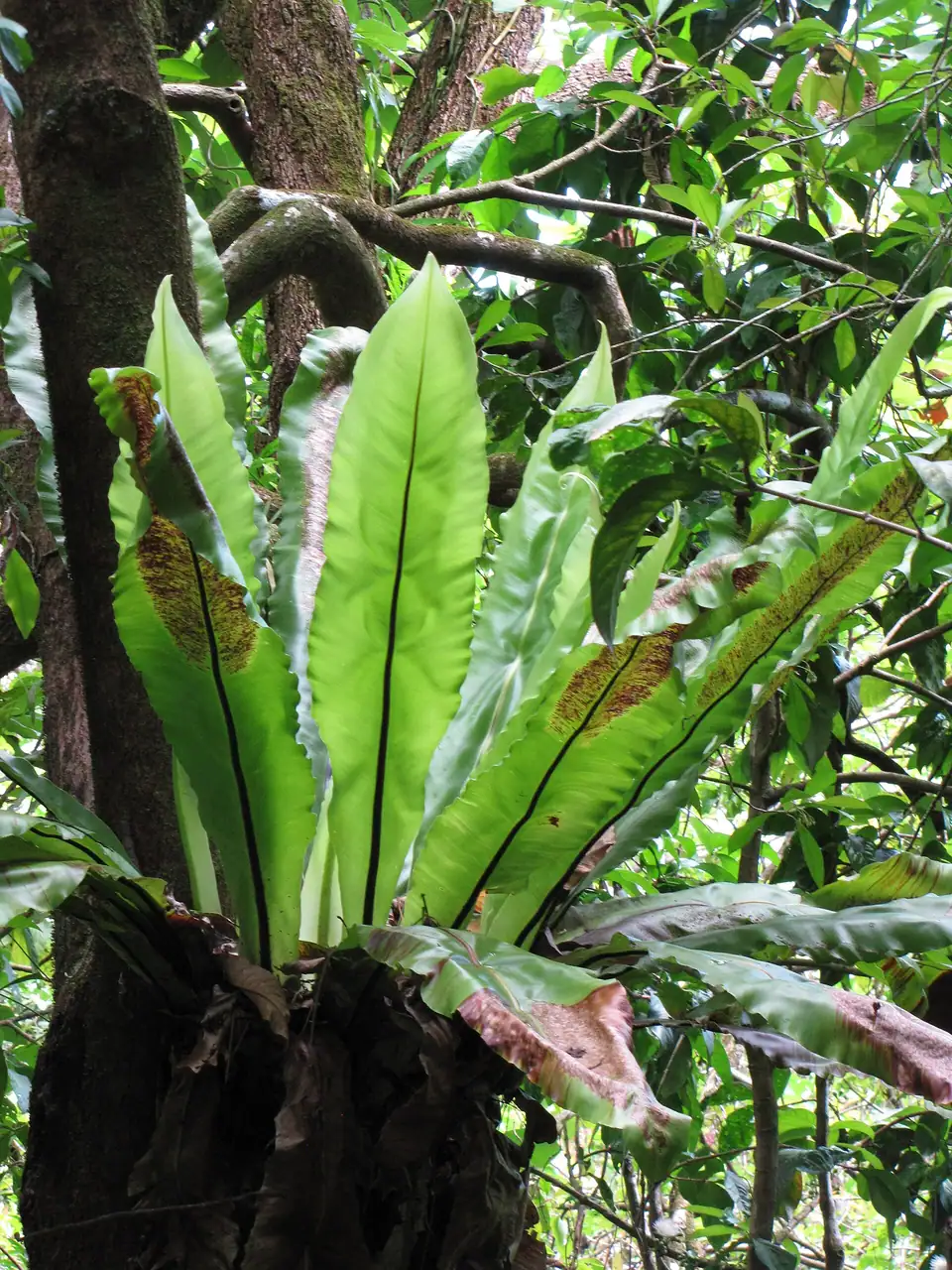
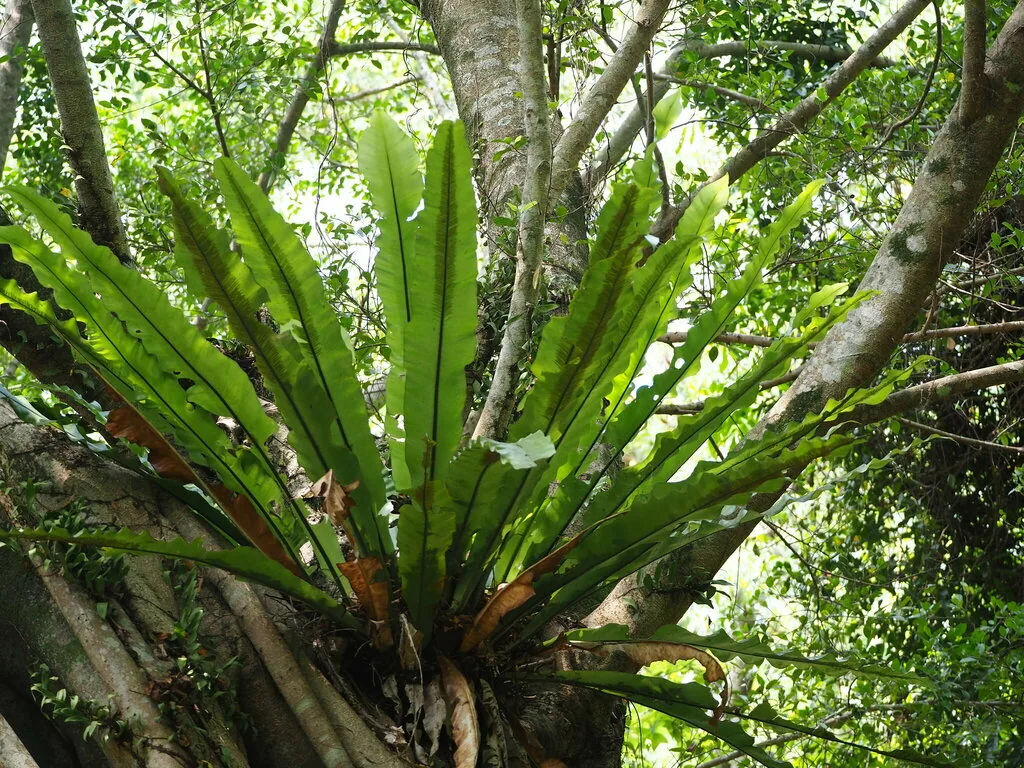

Cómo cultivar y cuidar Nest Fern
Asplenium nidus
Escrito por Emilio Marruso · última revisión
De un vistazo
El helecho nido de ave es un compañero duradero para tu casa: vive muchos años y crece feliz en interior y en maceta, con luz intensa o sombra ligera. Riega cuando los primeros 2,5 cm de tierra estén secos, echando el agua por el borde de la maceta para que el centro no se moje. De finales de primavera a verano, un abono suave cada mes lo mantiene creciendo.
- Sol
Luz intensa o sombra ligera; con demasiado sol las frondas amarillean
Qué dicen las fuentes (2)
Luz: Luz brillante o sombra ligera; semisombra a sombra completa al aire libre.
Bright light or light shade, such as a north-facing window, is suitable.
— Asplenium nidus (Bird's Nest Fern, Birds Nest Fern, Nest Fern) | North Carolina Extension Gardener Plant Toolbox [1] Plant it in an area with partial to full shade and rich soil.
— Birds Nest Fern – Gardening Solutions [2] - Riego
Riega cuando los primeros 2,5 cm estén secos, por el borde; no dejes agua en el plato
Qué dicen las fuentes (4)
Riego: Riega cuando la pulgada superior de la tierra se sienta seca; no dejes que la tierra se seque por completo entre riegos.
Water when the top inch of soil feels dry
— How To Grow and Care for Bird’s Nest Fern (Asplenium Nidus) | Home & Garden Information Center [4] Do not allow the soil in the pot to dry out completely between waterings.
— How To Grow and Care for Bird’s Nest Fern (Asplenium Nidus) | Home & Garden Information Center [4] Notas sobre el riego: Riega con cuidado para no mojar las hojas, por el borde exterior de la maceta para mantener el agua fuera del centro de la planta; no dejes que la maceta repose en un plato con agua, ya que esto puede causar pudrición de raíces.
Water along the outer edge of the pot to prevent water from entering the center of the plant.
— How To Grow and Care for Bird’s Nest Fern (Asplenium Nidus) | Home & Garden Information Center [4] Do not let the pot sit in a saucer of water as this can cause root rot.
— How To Grow and Care for Bird’s Nest Fern (Asplenium Nidus) | Home & Garden Information Center [4] - Abonado
Cada mes de finales de primavera a verano, con abono líquido para plantas de interior a media dosis
Qué dicen las fuentes (6)
Cuándo: Durante el crecimiento activo, desde finales de primavera hasta el verano.
Active growth periods may benefit from the monthly application of dilute liquid fertilizer.
— Asplenium nidus (Bird's Nest Fern, Birds Nest Fern, Nest Fern) | North Carolina Extension Gardener Plant Toolbox [1] Fertilize monthly during the growing season, from late spring through summer
— How To Grow and Care for Bird’s Nest Fern (Asplenium Nidus) | Home & Garden Information Center [4] Frecuencia: Mensual
Active growth periods may benefit from the monthly application of dilute liquid fertilizer.
— Asplenium nidus (Bird's Nest Fern, Birds Nest Fern, Nest Fern) | North Carolina Extension Gardener Plant Toolbox [1] Fertilize monthly during the growing season, from late spring through summer
— How To Grow and Care for Bird’s Nest Fern (Asplenium Nidus) | Home & Garden Information Center [4] Abonos minerales: Fertilizante líquido diluido para plantas de interior, a la mitad de la dosis indicada en la etiqueta.
Active growth periods may benefit from the monthly application of dilute liquid fertilizer.
— Asplenium nidus (Bird's Nest Fern, Birds Nest Fern, Nest Fern) | North Carolina Extension Gardener Plant Toolbox [1] Use a fertilizer specifically designed for houseplants. For ferns, use half the recommended rate on the label.
— How To Grow and Care for Bird’s Nest Fern (Asplenium Nidus) | Home & Garden Information Center [4] - Plagas
Babosas, caracoles, cochinillas y cochinilla algodonosa; las hojas también sufren enfermedades bacterianas
Qué dicen las fuentes (3)
Plagas: babosas, caracoles, cochinillas, cochinillas harinosas, nematodos de las hojas
Susceptible to slugs, snails, scale, mealybugs, bacterial leaf diseases, leaf nematodes, and chemical insecticides.
— Asplenium nidus (Bird's Nest Fern, Birds Nest Fern, Nest Fern) | North Carolina Extension Gardener Plant Toolbox [1] While few pest problems exist, gardeners can experience issues with foliar nematodes, scale, slugs, and snails.
— Birds Nest Fern – Gardening Solutions [2] Enfermedades: enfermedades bacterianas de las hojas
Susceptible to slugs, snails, scale, mealybugs, bacterial leaf diseases, leaf nematodes, and chemical insecticides.
— Asplenium nidus (Bird's Nest Fern, Birds Nest Fern, Nest Fern) | North Carolina Extension Gardener Plant Toolbox [1] - Atención
Evita los insecticidas: suelen dañar a los helechos
- Multiplicación
Se multiplica por esporas
Qué dicen las fuentes (1)
Propagación: Esporas
They do not produce flowers or fruits, rather, like all true ferns, reproduce by spores found on the undersides of fronds.
— Birds Nest Fern – Gardening Solutions [2] - Maceta
Ideal en maceta y como planta de interior
Qué dicen las fuentes (2)
En maceta: Sí
Outdoors, in tropical zones, it is attractive in containers, hanging baskets, and mass plantings or it can be allowed to grow epiphytically on tree trunks.
— Asplenium nidus (Bird's Nest Fern, Birds Nest Fern, Nest Fern) | North Carolina Extension Gardener Plant Toolbox [1] En interior: Sí
Unlike many ferns, bird’s nest makes a fairly reliable houseplant when provided indirect light.
— Birds Nest Fern – Gardening Solutions [2]
Resumen
El helecho nido de ave es una herbácea perenne, tropical, siempreverde y epífita que generalmente se cultiva como planta de interior fuera de los trópicos. [1][2] Prefiere luz indirecta brillante o semisombra y un suelo que no se deje secar por completo. [1][2]
Citado en inglés, como en la fuente.
Cuidados
Riego
Riego
Riega cuando la pulgada superior de la tierra se sienta seca; no dejes que la tierra se seque por completo entre riegos.
Qué dicen las fuentes (2)
Water when the top inch of soil feels dryDo not allow the soil in the pot to dry out completely between waterings.Notas sobre el riego
Riega con cuidado para no mojar las hojas, por el borde exterior de la maceta para mantener el agua fuera del centro de la planta; no dejes que la maceta repose en un plato con agua, ya que esto puede causar pudrición de raíces.
Qué dicen las fuentes (2)
Water along the outer edge of the pot to prevent water from entering the center of the plant.Do not let the pot sit in a saucer of water as this can cause root rot.Luz
Luz brillante o sombra ligera; semisombra a sombra completa al aire libre.
Qué dicen las fuentes (2)
Bright light or light shade, such as a north-facing window, is suitable.Plant it in an area with partial to full shade and rich soil.Clima y frío
Rusticidad, zona más fría
Las fuentes dan valores distintos según la región, la zona o las condiciones de cultivo.
Lo que dice cada fuente
Según UF/IFAS Gardening Solutions: 9 [mínima invernal de −6,7 a −1,1 °C (de 20 a 30 °F)]
Según Clemson Home & Garden Information Center: 11 [mínima invernal de 4,4 a 10 °C (de 40 a 50 °F)]
Según NC State Extension: 11a [mínima invernal de 4,4 a 7,2 °C (de 40 a 45 °F)]
Qué dicen las fuentes (3)
Según UF/IFAS Gardening Solutions: Native to tropical Asia, bird’s nest fern thrives in Florida’s humid climate in zones 9 to 11; plants in zone 9 will need freeze protection.Según Clemson Home & Garden Information Center: Bird’s nest fern is hardy in zones 11 to 12.Según NC State Extension: USDA Plant Hardiness Zone:
11a, 11b, 12a, 12bRusticidad, zona más cálida
Las fuentes dan valores distintos según la región, la zona o las condiciones de cultivo.
Lo que dice cada fuente
Según UF/IFAS Gardening Solutions: 11 [mínima invernal de 4,4 a 10 °C (de 40 a 50 °F)]
Según Clemson Home & Garden Information Center: 12 [mínima invernal de 10 a 15,6 °C (de 50 a 60 °F)]
Según NC State Extension: 12b [mínima invernal de 12,8 a 15,6 °C (de 55 a 60 °F)]
Qué dicen las fuentes (3)
Según UF/IFAS Gardening Solutions: Native to tropical Asia, bird’s nest fern thrives in Florida’s humid climate in zones 9 to 11; plants in zone 9 will need freeze protection.Según Clemson Home & Garden Information Center: Bird’s nest fern is hardy in zones 11 to 12.Según NC State Extension: USDA Plant Hardiness Zone:
11a, 11b, 12a, 12bDónde cultivarla
En interior
Sí
Qué dicen las fuentes (1)
Unlike many ferns, bird’s nest makes a fairly reliable houseplant when provided indirect light.En maceta
Sí
Qué dicen las fuentes (1)
Outdoors, in tropical zones, it is attractive in containers, hanging baskets, and mass plantings or it can be allowed to grow epiphytically on tree trunks.Propagación
Esporas
Qué dicen las fuentes (1)
They do not produce flowers or fruits, rather, like all true ferns, reproduce by spores found on the undersides of fronds.Cultivo
La planta
Ciclo de vida
perenne
Qué dicen las fuentes (1)
Genus: Asplenium Species: nidus Family: Aspleniaceae Life Cycle: Perennial Country Or Region Of Origin: Polynesia, HI, SE Asia, Australia, MadagascarFamilia
Aspleniaceae
Qué dicen las fuentes (1)
Genus: Asplenium Species: nidus Family: Aspleniaceae Life Cycle: Perennial Country Or Region Of Origin: Polynesia, HI, SE Asia, Australia, MadagascarAltura adulta
Plagas y enfermedades
Plagas
babosas, caracoles, cochinillas, cochinillas harinosas, nematodos de las hojas
Qué dicen las fuentes (2)
Susceptible to slugs, snails, scale, mealybugs, bacterial leaf diseases, leaf nematodes, and chemical insecticides.While few pest problems exist, gardeners can experience issues with foliar nematodes, scale, slugs, and snails.Enfermedades
enfermedades bacterianas de las hojas
Qué dicen las fuentes (1)
Susceptible to slugs, snails, scale, mealybugs, bacterial leaf diseases, leaf nematodes, and chemical insecticides.Abonado
Cuándo
Durante el crecimiento activo, desde finales de primavera hasta el verano.
Qué dicen las fuentes (2)
Active growth periods may benefit from the monthly application of dilute liquid fertilizer.Fertilize monthly during the growing season, from late spring through summerFrecuencia
Mensual
Qué dicen las fuentes (2)
Active growth periods may benefit from the monthly application of dilute liquid fertilizer.Fertilize monthly during the growing season, from late spring through summerAbonos minerales
Fertilizante líquido diluido para plantas de interior, a la mitad de la dosis indicada en la etiqueta.
Qué dicen las fuentes (2)
Active growth periods may benefit from the monthly application of dilute liquid fertilizer.Use a fertilizer specifically designed for houseplants. For ferns, use half the recommended rate on the label.Problemas
Amarillamiento y crecimiento detenido por exceso de sol.
Síntoma: Las frondas se vuelven amarillas y el crecimiento se detiene.
Qué hacer: Cultiva en luz brillante o sombra ligera en lugar de lugares soleados.
Qué dicen las fuentes (2)
Too much sun may turn it yellow or stop growth.
— Asplenium nidus (Bird's Nest Fern, Birds Nest Fern, Nest Fern) | North Carolina Extension Gardener Plant Toolbox [1] When grown in sunnier locations, the fronds turn yellow and the plant stops growing.
— Birds Nest Fern – Gardening Solutions [2] Plagas y daño por insecticidas.
Síntoma: Nematodos foliares, cochinillas, babosas y caracoles.
Qué hacer: Evita los insecticidas, que suelen ser dañinos para los helechos
Qué dicen las fuentes (1)
While few pest problems exist, gardeners can experience issues with foliar nematodes, scale, slugs, and snails. Insecticides are typically damaging to ferns, and bird’s nest is no exception.
— Birds Nest Fern – Gardening Solutions [2]
Remedios
Cada remedio indica qué dicen las fuentes oficiales; los remedios tradicionales sin fuente oficial aparecen marcados. Los perjudiciales están para que sepas evitarlos.
Cuidar la planta
ácaros araña
lavado con agua jabonosa suave No verificado
Remedio tradicional, no verificado por una fuente oficial.
Insecticides are typically damaging to ferns, and bird’s nest is no exception.
— Birds Nest Fern – Gardening Solutions [2] Cómo: Lava la planta con agua jabonosa suave y un paño suave
cochinillas harinosas
alcohol isopropílico No verificado
Remedio tradicional, no verificado por una fuente oficial.
Insecticides are typically damaging to ferns, and bird’s nest is no exception.
— Birds Nest Fern – Gardening Solutions [2] Cómo: Se dice que los agentes tópicos como el alcohol isopropílico erradican los insectos
quemadura de las puntas de las hojas
aire seco
bandeja de guijarros con agua Fuente oficial, sin prueba independiente
Cómo: Coloca la maceta sobre una bandeja con piedras y agua, sin dejar que el agua toque el fondo de la maceta.
Or set pot on a tray of pebbles with water. Set the pot on top of the pebbles, but don’t allow the water to touch the bottom of the pot.
— How To Grow and Care for Bird’s Nest Fern (Asplenium Nidus) | Home & Garden Information Center [4]
Valores orientativos
Valores de una fuente secundaria, no comprobados palabra por palabra como el resto de esta página. Úselos como punto de partida.
- Horas de sol
- 4-6 horasValor orientativo, adáptalo a tu clima · Fuente secundaria · Dato de la variedad Asplenium nidus 'Antiquum'
- pH del suelo
- 5.5-6.5Valor orientativo, adáptalo a tu clima · Fuente secundaria · Dato de la variedad Asplenium nidus 'Antiquum'
- Crecimiento
- BajoValor orientativo, adáptalo a tu clima · Fuente secundaria · Dato de la variedad Asplenium nidus 'Antiquum'
- Poda
- Marzo, abril, mayo, marzo, abril, mayoValor orientativo, adáptalo a tu clima · Fuente secundaria · Dato de la variedad Asplenium nidus 'Antiquum'
Plantas similares
- Culantrillo menudo Asplenium trichomanes
- Mother Spleenwort Asplenium bulbiferum
- Walking Fern Asplenium rhizophyllum
- Asplenium ceterach Asplenium ceterach
- Bazo de ébano Asplenium platyneuron
- Lengua cervina Asplenium scolopendrium
- Culantrillo blanco Cystopteris fragilis
- Broad Beech Fern Phegopteris hexagonoptera
Fuentes
Cada valor anterior se cita de estos documentos. Los enlaces llevan al editor original.
- Asplenium nidus (Bird's Nest Fern, Birds Nest Fern, Nest Fern) | North Carolina Extension Gardener Plant Toolbox · plants.ces.ncsu.edu, consultado
- Birds Nest Fern – Gardening Solutions · gardeningsolutions.ifas.ufl.edu, consultado
- Bird's Nest Fern - Asplenium nidus | North Carolina Extension Gardener Plant Toolbox · plants.ces.ncsu.edu, consultado
- How To Grow and Care for Bird’s Nest Fern (Asplenium Nidus) | Home & Garden Information Center · hgic.clemson.edu, consultado
- extension.psu.edu · extension.psu.edu
Escrito por Emilio Marruso · última revisión