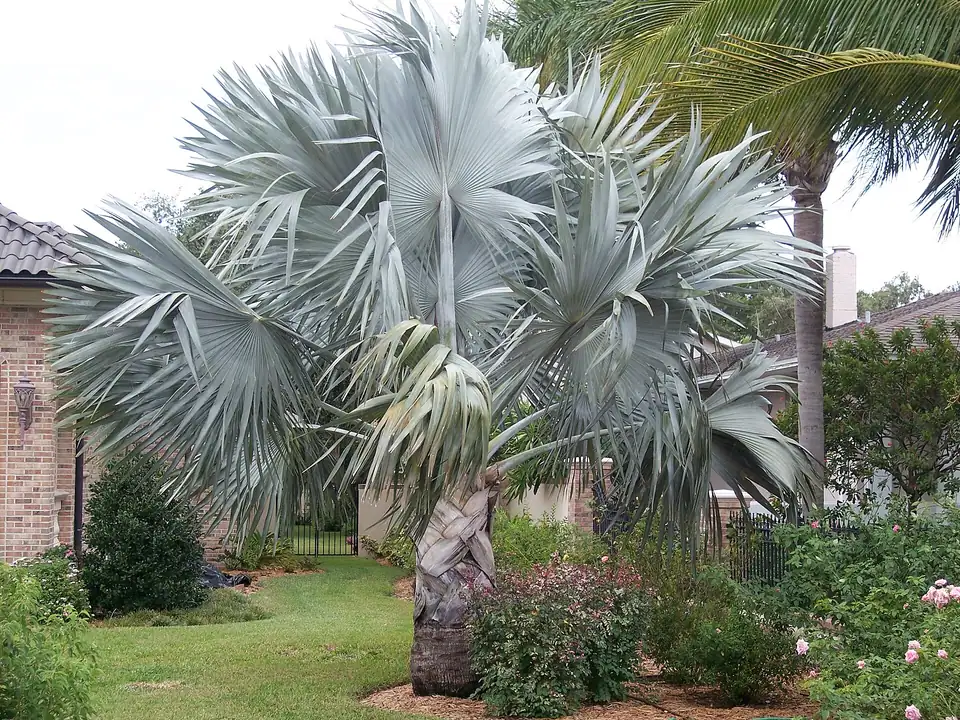


Cómo cultivar y cuidar Bismark Palm
Bismarckia nobilis
Escrito por Emilio Marruso · última revisión
De un vistazo
La bismarckia es una palmera perenne espectacular, de hojas plateadas, que adora el sol pleno y tolera algo de sequía en un suelo bien drenado. En jardín puede alcanzar 12 m de altura, todo un protagonista para tu jardín. Abónala con regularidad con abono para palmeras y deja en su sitio las hojas medio secas: todavía le aportan el potasio que necesita.
- Sol
Sol pleno
Qué dicen las fuentes (1)
Luz: Pleno sol
Plant in the full sun in well-drained soil though this palm seems to perform in clay soils.
— Bismarckia nobilis (Bismark Palm) | North Carolina Extension Gardener Plant Toolbox [1] - Riego
Tolera algo de sequía
Qué dicen las fuentes (2)
Riego: Tolera algo de sequía; suelo bien drenado
Bismarck Palms tolerate some drought, and because of their massive crowns, they need plenty of room in a landscape area.
— Bismarckia nobilis (Bismark Palm) | North Carolina Extension Gardener Plant Toolbox [1] Plant in the full sun in well-drained soil though this palm seems to perform in clay soils.
— Bismarckia nobilis (Bismark Palm) | North Carolina Extension Gardener Plant Toolbox [1] - Frío
Aguanta inviernos de hasta −9,4 °C (15 °F)
Rústica en inviernos normales · USDA 8b · RHS H4 · Z8
Qué dicen las fuentes (2)
Rusticidad, zona más fría: 8b [mínima invernal de −9,4 a −6,7 °C (de 15 a 20 °F)]
USDA Plant Hardiness Zone: 8b, 9a, 9b, 10a, 10b
— Bismarckia nobilis (Bismark Palm) | North Carolina Extension Gardener Plant Toolbox [1] Rusticidad, zona más cálida: 10b [mínima invernal de 1,7 a 4,4 °C (de 35 a 40 °F)]
USDA Plant Hardiness Zone: 8b, 9a, 9b, 10a, 10b
— Bismarckia nobilis (Bismark Palm) | North Carolina Extension Gardener Plant Toolbox [1] - Suelo
Suelo bien drenado
Qué dicen las fuentes (2)
Riego: Tolera algo de sequía; suelo bien drenado
Bismarck Palms tolerate some drought, and because of their massive crowns, they need plenty of room in a landscape area.
— Bismarckia nobilis (Bismark Palm) | North Carolina Extension Gardener Plant Toolbox [1] Plant in the full sun in well-drained soil though this palm seems to perform in clay soils.
— Bismarckia nobilis (Bismark Palm) | North Carolina Extension Gardener Plant Toolbox [1] - Abonado
Abona con regularidad con abono de liberación lenta para palmeras, con magnesio y micronutrientes
Qué dicen las fuentes (4)
Abonos minerales: Fertilizante granular de liberación controlada para palmeras con análisis 8-2-12-4Mg más micronutrientes, usado regularmente
Nutrient deficiencies in the landscape can be corrected or prevented by regular use of a controlled-release granular fertilizer having an analysis of 8-2-12-4Mg plus micronutrients.
— [3] Microelementos: Magnesio, manganeso y boro: las deficiencias ocurren en esta palmera y se previenen con un fertilizante que contenga magnesio más micronutrientes
Magnesium deficiency (see https://edis.ifas.ufl.edu/ep266) is occasionally observed in this species where it imparts an unusual light yellowish tint to the silvery leaves (Figure 4).
— [3] Chronic boron deficiency is fairly common in this species and typically results in spear leaves not opening properly, with more than one unopened spear leaf being present at any given time (Figure 7).
— [3] Nutrient deficiencies in the landscape can be corrected or prevented by regular use of a controlled-release granular fertilizer having an analysis of 8-2-12-4Mg plus micronutrients.
— [3] - Poda
No cortes las hojas medio secas: todavía aportan potasio a la palmera
Qué dicen las fuentes (1)
Evitar: Corte de las hojas parcialmente muertas, que todavía aportan potasio a la palmera
Avoid cutting leaves that are only partially dead, as these are serving as a supplemental source of potassium to the palms.
— [3] - Tamaño
Hasta 12 m de alto en jardín
Qué dicen las fuentes (1)
Altura adulta: 1219 cm (40 pies) en cultivo; hasta 2499 (82 pies) en su hábitat natural
In their natural habitat, they can reach 82 feet in height but usually get no taller than 40 feet in cultivation.
— Bismarckia nobilis (Bismark Palm) | North Carolina Extension Gardener Plant Toolbox [1]
Resumen
La palma de Bismarck es una palma nativa de Madagascar, donde crece en praderas abiertas. [1] Se planta a pleno sol en suelo bien drenado y tolera algo de sequía. [1] Se producen daños por frío, pero las plantas se recuperan rápidamente. [1]
Citado en inglés, como en la fuente.
Esta ficha está incompleta: las fuentes consultadas aún no cubren todos los campos.
Aún no cubierto por nuestras fuentes: Poda, Propagación
Cuidados
Riego
Tolera algo de sequía; suelo bien drenado
Qué dicen las fuentes (2)
Bismarck Palms tolerate some drought, and because of their massive crowns, they need plenty of room in a landscape area.Plant in the full sun in well-drained soil though this palm seems to perform in clay soils.Luz
Pleno sol
Qué dicen las fuentes (1)
Plant in the full sun in well-drained soil though this palm seems to perform in clay soils.Clima y frío
Rusticidad, zona más fría
8b [mínima invernal de −9,4 a −6,7 °C (de 15 a 20 °F)]
Qué dicen las fuentes (1)
USDA Plant Hardiness Zone:
8b, 9a, 9b, 10a, 10bRusticidad, zona más cálida
10b [mínima invernal de 1,7 a 4,4 °C (de 35 a 40 °F)]
Qué dicen las fuentes (1)
USDA Plant Hardiness Zone:
8b, 9a, 9b, 10a, 10bPropagación
No figura en las fuentes consultadas.
Cultivo
La planta
Ciclo de vida
perenne
Qué dicen las fuentes (1)
Life Cycle:
Perennial
WoodyFamilia
Arecaceae
Qué dicen las fuentes (1)
The Bismarck palm is a member of the palm family (Arecaceae) native to Madagascar, where it grows in open grassland.Altura adulta
1219 cm (40 pies) en cultivo; hasta 2499 (82 pies) en su hábitat natural
Qué dicen las fuentes (1)
In their natural habitat, they can reach 82 feet in height but usually get no taller than 40 feet in cultivation.Abonado
Abonos minerales
Fertilizante granular de liberación controlada para palmeras con análisis 8-2-12-4Mg más micronutrientes, usado regularmente
Qué dicen las fuentes (1)
Nutrient
deficiencies in the landscape can be corrected or prevented
by regular use of a controlled-release granular fertilizer
having an analysis of 8-2-12-4Mg plus micronutrients.Microelementos
Magnesio, manganeso y boro: las deficiencias ocurren en esta palmera y se previenen con un fertilizante que contenga magnesio más micronutrientes
Qué dicen las fuentes (3)
Magnesium deficiency (see https://edis.ifas.ufl.edu/ep266)
is occasionally observed in this species where it imparts an
unusual light yellowish tint to the silvery leaves (Figure 4).Chronic boron deficiency is fairly common
in this species and typically results in spear leaves not
opening properly, with more than one unopened spear leaf
being present at any given time (Figure 7).Nutrient
deficiencies in the landscape can be corrected or prevented
by regular use of a controlled-release granular fertilizer
having an analysis of 8-2-12-4Mg plus micronutrients.Evitar
Corte de las hojas parcialmente muertas, que todavía aportan potasio a la palmera
Qué dicen las fuentes (1)
Avoid cutting leaves that are
only partially dead, as these are serving as a supplemental
source of potassium to the palms.Signos de carencia
Potasio: manchas translúcidas amarillo-naranja o necróticas y necrosis de las puntas de los folíolos en las hojas más viejas, muerte prematura de las hojas; magnesio: tinte amarillento claro en las hojas plateadas; manganeso: clorosis, estrías necróticas y necrosis de las puntas en las hojas más jóvenes; boro: bandas necróticas en las hojas emergentes, varias hojas en forma de lanza que no se abren, hojas nuevas atrofiadas y deformes
Qué dicen las fuentes (6)
susceptible to potassium
deficiency (see https://edis.ifas.ufl.edu/ep269) which causes
translucent yellow-orange or necrotic spotting (Figure 2)
and/or leaflet tip necrosis on the oldest leaves (Figure 3).Potassium deficiency also causes premature leaf death and
can reduce the number of leaves that the palm can support.Magnesium deficiency (see https://edis.ifas.ufl.edu/ep266)
is occasionally observed in this species where it imparts an
unusual light yellowish tint to the silvery leaves (Figure 4).Manganese deficiency (see https://edis.ifas.ufl.edu/ep267)
has been reported on Bismarckia, but it is not common.
Symptoms include chlorosis, necrotic streaking, and leaf
tip necrosis of the youngest leavesChronic boron deficiency is fairly common
in this species and typically results in spear leaves not
opening properly, with more than one unopened spear leaf
being present at any given time (Figure 7).In more severe
cases, new leaves may be stunted and distorted.Problemas
Daño por frío
Síntoma: La variedad verde se daña a 32 F; la variedad gris plateada tolera 27 F.
Qué hacer: Las plantas se recuperan rápidamente.
Qué dicen las fuentes (1)
Bismarck palms will suffer from cold damage, but they quickly recover. The green variety is damaged at 32 °F, but the silver-gray variety will tolerate 27 °F.
— Bismarckia nobilis (Bismark Palm) | North Carolina Extension Gardener Plant Toolbox [1]
Remedios
Las fuentes consultadas no dan remedios para esta planta.
Calendario
Poda
No figura en las fuentes consultadas.
Meses tal como los dan las fuentes, en su mayoría de Estados Unidos (hemisferio norte). En el hemisferio sur se desplazan unos seis meses.
Valores orientativos
Valores de una fuente secundaria, no comprobados palabra por palabra como el resto de esta página. Úselos como punto de partida.
- Horas de sol
- 6-8 horasValor orientativo, adáptalo a tu clima · Fuente secundaria
- Resiste la sequía
- SíValor orientativo, adáptalo a tu clima · Fuente secundaria
- pH del suelo
- 6-7.5Valor orientativo, adáptalo a tu clima · Fuente secundaria
- Nivel de cuidado
- MedioValor orientativo, adáptalo a tu clima · Fuente secundaria
- Crecimiento
- AltaValor orientativo, adáptalo a tu clima · Fuente secundaria
- Poda
- AgostoValor orientativo, adáptalo a tu clima · Fuente secundaria
- Propagación
- Propagación por semillas, Hijuelos, Propagación por acodo aéreo, Propagación por injertoValor orientativo, adáptalo a tu clima · Fuente secundaria
Plantas similares
- Areca Palm Chrysalidocarpus lutescens
- California fan palm Washingtonia filifera
- Palma fénix Phoenix canariensis
- Palma de navidad Adonidia merrillii
- Double coconut Lodoicea maldivica
- Dwarf Date Palm Phoenix acaulis
- Amarilleo letal Caryota mitis
- Palmera butiá Butia odorata
Fuentes
Cada valor anterior se cita de estos documentos. Los enlaces llevan al editor original.
- Bismarckia nobilis (Bismark Palm) | North Carolina Extension Gardener Plant Toolbox · plants.ces.ncsu.edu, consultado
- Bismark Palm - Bismarckia nobilis | North Carolina Extension Gardener Plant Toolbox · plants.ces.ncsu.edu, consultado
- edis.ifas.ufl.edu · edis.ifas.ufl.edu
Escrito por Emilio Marruso · última revisión