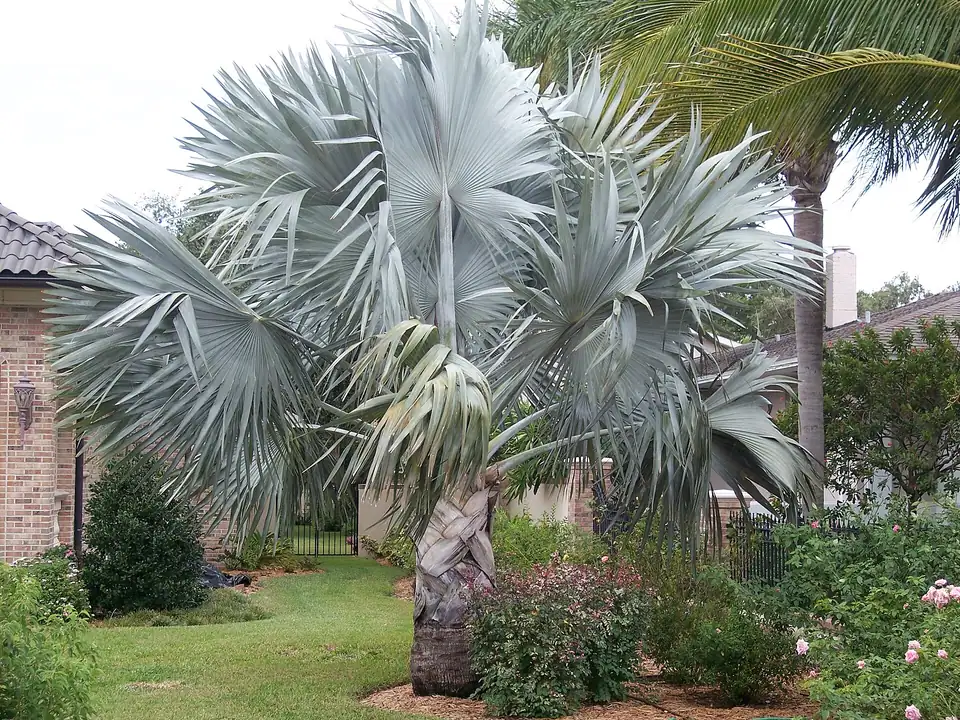


How to Grow and Care for Bismark Palm
Bismarckia nobilis
Written by Emilio Marruso · last checked
At a glance
Bismarckia is a striking perennial palm with silvery leaves that loves full sun and tolerates some drought in well-drained soil. In gardens it can grow to 40 feet tall, a true centerpiece for your yard. Feed it regularly with palm fertilizer and leave its half-dead leaves in place: they still give the palm the potassium it needs.
- Sun
Full sun
What the sources say (1)
Light: Full sun
Plant in the full sun in well-drained soil though this palm seems to perform in clay soils.
— Bismarckia nobilis (Bismark Palm) | North Carolina Extension Gardener Plant Toolbox [1] - Water
Tolerates some drought
What the sources say (2)
Watering: Tolerates some drought; well-drained soil
Bismarck Palms tolerate some drought, and because of their massive crowns, they need plenty of room in a landscape area.
— Bismarckia nobilis (Bismark Palm) | North Carolina Extension Gardener Plant Toolbox [1] Plant in the full sun in well-drained soil though this palm seems to perform in clay soils.
— Bismarckia nobilis (Bismark Palm) | North Carolina Extension Gardener Plant Toolbox [1] - Cold
Survives winters down to 15 °F (−9.4 °C)
Hardy in average winters · USDA 8b · RHS H4 · Z8
What the sources say (2)
Hardiness, coldest zone: 8b [winter low −9.4 to −6.7 °C (15 to 20 °F)]
USDA Plant Hardiness Zone: 8b, 9a, 9b, 10a, 10b
— Bismarckia nobilis (Bismark Palm) | North Carolina Extension Gardener Plant Toolbox [1] Hardiness, warmest zone: 10b [winter low 1.7 to 4.4 °C (35 to 40 °F)]
USDA Plant Hardiness Zone: 8b, 9a, 9b, 10a, 10b
— Bismarckia nobilis (Bismark Palm) | North Carolina Extension Gardener Plant Toolbox [1] - Soil
Well-drained soil
What the sources say (2)
Watering: Tolerates some drought; well-drained soil
Bismarck Palms tolerate some drought, and because of their massive crowns, they need plenty of room in a landscape area.
— Bismarckia nobilis (Bismark Palm) | North Carolina Extension Gardener Plant Toolbox [1] Plant in the full sun in well-drained soil though this palm seems to perform in clay soils.
— Bismarckia nobilis (Bismark Palm) | North Carolina Extension Gardener Plant Toolbox [1] - Feeding
Feed regularly with slow-release palm fertilizer that has magnesium and micronutrients
What the sources say (4)
Mineral fertilizers: Controlled-release granular palm fertilizer with an 8-2-12-4Mg analysis plus micronutrients, used regularly
Nutrient deficiencies in the landscape can be corrected or prevented by regular use of a controlled-release granular fertilizer having an analysis of 8-2-12-4Mg plus micronutrients.
— [3] Micronutrients: Magnesium, manganese and boron: deficiencies occur in this palm and are prevented by a fertilizer with magnesium plus micronutrients
Magnesium deficiency (see https://edis.ifas.ufl.edu/ep266) is occasionally observed in this species where it imparts an unusual light yellowish tint to the silvery leaves (Figure 4).
— [3] Chronic boron deficiency is fairly common in this species and typically results in spear leaves not opening properly, with more than one unopened spear leaf being present at any given time (Figure 7).
— [3] Nutrient deficiencies in the landscape can be corrected or prevented by regular use of a controlled-release granular fertilizer having an analysis of 8-2-12-4Mg plus micronutrients.
— [3] - Pruning
Don't cut off half-dead leaves: they still give the palm potassium
What the sources say (1)
Avoid: Cutting off partially dead leaves: they still supply potassium to the palm
Avoid cutting leaves that are only partially dead, as these are serving as a supplemental source of potassium to the palms.
— [3] - Size
Up to 40 ft tall in gardens
What the sources say (1)
Mature height: 1219 cm (40 ft) in cultivation; up to 2499 (82 ft) in its natural habitat
In their natural habitat, they can reach 82 feet in height but usually get no taller than 40 feet in cultivation.
— Bismarckia nobilis (Bismark Palm) | North Carolina Extension Gardener Plant Toolbox [1]
Overview
The Bismarck palm is a palm native to Madagascar, where it grows in open grassland. [1] It is planted in full sun in well-drained soil and tolerates some drought. [1] Cold damage occurs, but plants quickly recover. [1]
This record is incomplete: the sources we read do not cover every field yet.
Not yet covered by our sources: Pruning, Propagation
Bismark Palm care
How to water Bismark Palm
Tolerates some drought; well-drained soil
What the sources say (2)
Bismarck Palms tolerate some drought, and because of their massive crowns, they need plenty of room in a landscape area.Plant in the full sun in well-drained soil though this palm seems to perform in clay soils.How much light Bismark Palm needs
Full sun
What the sources say (1)
Plant in the full sun in well-drained soil though this palm seems to perform in clay soils.How much cold Bismark Palm can take
Hardiness, coldest zone
8b [winter low −9.4 to −6.7 °C (15 to 20 °F)]
What the sources say (1)
USDA Plant Hardiness Zone:
8b, 9a, 9b, 10a, 10bHardiness, warmest zone
10b [winter low 1.7 to 4.4 °C (35 to 40 °F)]
What the sources say (1)
USDA Plant Hardiness Zone:
8b, 9a, 9b, 10a, 10bHow to propagate Bismark Palm
Not stated in the sources we read.
How to grow Bismark Palm
The plant
Life cycle
perennial
What the sources say (1)
Life Cycle:
Perennial
WoodyFamily
Arecaceae
What the sources say (1)
The Bismarck palm is a member of the palm family (Arecaceae) native to Madagascar, where it grows in open grassland.Mature height
1219 cm (40 ft) in cultivation; up to 2499 (82 ft) in its natural habitat
What the sources say (1)
In their natural habitat, they can reach 82 feet in height but usually get no taller than 40 feet in cultivation.Fertilizing
Mineral fertilizers
Controlled-release granular palm fertilizer with an 8-2-12-4Mg analysis plus micronutrients, used regularly
What the sources say (1)
Nutrient
deficiencies in the landscape can be corrected or prevented
by regular use of a controlled-release granular fertilizer
having an analysis of 8-2-12-4Mg plus micronutrients.Micronutrients
Magnesium, manganese and boron: deficiencies occur in this palm and are prevented by a fertilizer with magnesium plus micronutrients
What the sources say (3)
Magnesium deficiency (see https://edis.ifas.ufl.edu/ep266)
is occasionally observed in this species where it imparts an
unusual light yellowish tint to the silvery leaves (Figure 4).Chronic boron deficiency is fairly common
in this species and typically results in spear leaves not
opening properly, with more than one unopened spear leaf
being present at any given time (Figure 7).Nutrient
deficiencies in the landscape can be corrected or prevented
by regular use of a controlled-release granular fertilizer
having an analysis of 8-2-12-4Mg plus micronutrients.Avoid
Cutting off partially dead leaves: they still supply potassium to the palm
What the sources say (1)
Avoid cutting leaves that are
only partially dead, as these are serving as a supplemental
source of potassium to the palms.Signs of deficiency
Potassium: translucent yellow-orange or necrotic spotting and leaflet tip necrosis on the oldest leaves, premature leaf death; magnesium: light yellowish tint on the silvery leaves; manganese: chlorosis, necrotic streaking and tip necrosis of the youngest leaves; boron: necrotic bands on emerging leaves, several spear leaves that fail to open, stunted and distorted new leaves
What the sources say (6)
susceptible to potassium
deficiency (see https://edis.ifas.ufl.edu/ep269) which causes
translucent yellow-orange or necrotic spotting (Figure 2)
and/or leaflet tip necrosis on the oldest leaves (Figure 3).Potassium deficiency also causes premature leaf death and
can reduce the number of leaves that the palm can support.Magnesium deficiency (see https://edis.ifas.ufl.edu/ep266)
is occasionally observed in this species where it imparts an
unusual light yellowish tint to the silvery leaves (Figure 4).Manganese deficiency (see https://edis.ifas.ufl.edu/ep267)
has been reported on Bismarckia, but it is not common.
Symptoms include chlorosis, necrotic streaking, and leaf
tip necrosis of the youngest leavesChronic boron deficiency is fairly common
in this species and typically results in spear leaves not
opening properly, with more than one unopened spear leaf
being present at any given time (Figure 7).In more severe
cases, new leaves may be stunted and distorted.Bismark Palm pests and problems
Cold damage
Symptom: The green variety is damaged at 32 F; the silver-gray variety tolerates 27 F.
What to do: Plants quickly recover.
What the sources say (1)
Bismarck palms will suffer from cold damage, but they quickly recover. The green variety is damaged at 32 °F, but the silver-gray variety will tolerate 27 °F.
— Bismarckia nobilis (Bismark Palm) | North Carolina Extension Gardener Plant Toolbox [1]
Remedies
The sources we checked give no remedies for this plant.
Calendar
Pruning
Not stated in the sources we read.
Months as given by the sources, which are mostly from the United States (northern hemisphere). In the southern hemisphere they shift by about six months.
Indicative values
Values from a secondary source, not checked word for word like the rest of this page. Use them as a starting point.
- Hours of sun
- 6-8 hoursIndicative value, adapt it to your climate · Secondary source
- Drought tolerant
- yesIndicative value, adapt it to your climate · Secondary source
- Soil pH
- 6-7.5Indicative value, adapt it to your climate · Secondary source
- Care level
- MediumIndicative value, adapt it to your climate · Secondary source
- Growth rate
- HighIndicative value, adapt it to your climate · Secondary source
- Pruning
- AugustIndicative value, adapt it to your climate · Secondary source
- Propagation
- Seed Propagation, Offsets, Air Layering Propagation, Grafting PropagationIndicative value, adapt it to your climate · Secondary source
Similar plants
- Areca Palm Chrysalidocarpus lutescens
- California fan palm Washingtonia filifera
- Canary Island Date Palm Phoenix canariensis
- Christmas Palm Adonidia merrillii
- Double coconut Lodoicea maldivica
- Dwarf Date Palm Phoenix acaulis
- Fishtail Palm Caryota mitis
- Jelly Palm Butia odorata
Sources
Every value above is quoted from these documents. Links lead to the original publisher.
- Bismarckia nobilis (Bismark Palm) | North Carolina Extension Gardener Plant Toolbox · plants.ces.ncsu.edu, consulted
- Bismark Palm - Bismarckia nobilis | North Carolina Extension Gardener Plant Toolbox · plants.ces.ncsu.edu, consulted
- edis.ifas.ufl.edu · edis.ifas.ufl.edu
Written by Emilio Marruso · last checked