
How to Grow and Care for Canary Island Date Palm
Phoenix canariensis
Written by Emilio Marruso · last checked
Not toxic to cats and dogs, according to the sources · Sources
At a glance
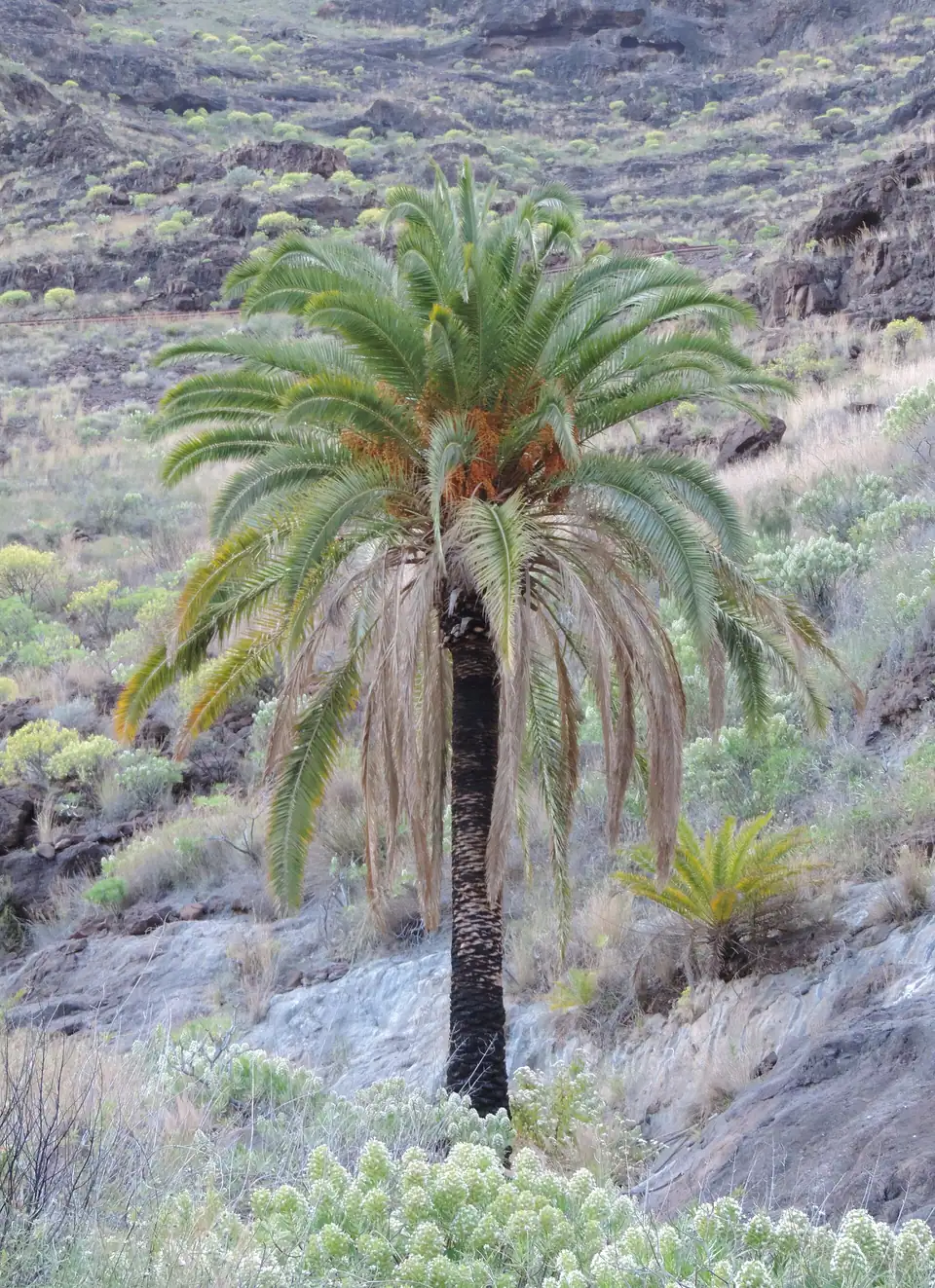
The Canary Island date palm brings a touch of the tropics: it can grow 40 to 60 feet tall and spread 20 to 40 feet wide. Give it full sun with some afternoon shade and well-drained soil, and once settled in it handles drought with ease. It also grows in containers and indoors, and it is safe for cats, dogs and horses.
- Sun
Full sun, with shade in the afternoon
What the sources say (1)
Light: Full sun with afternoon shade
This plant prefers full sun with afternoon shade and moist, well-drained, rich loam soil or potting mix with a slightly acidic to neutral pH.
— Phoenix canariensis (Canary Date Palm, Canary Island Date Palm) | North Carolina Extension Gardener Plant Toolbox [1] - Water
Handles drought once settled; too much water blackens leaf tips, too little makes leaves droop
What the sources say (2)
Watering: Drought tolerant once established; moist, well-drained soil
This plant prefers full sun with afternoon shade and moist, well-drained, rich loam soil or potting mix with a slightly acidic to neutral pH. Once established it is drought tolerant.
— Phoenix canariensis (Canary Date Palm, Canary Island Date Palm) | North Carolina Extension Gardener Plant Toolbox [1] Watering notes: Overwatering blackens the leaf tips; underwatering makes the leaves droop
If the plant is overwatered, the leaf tips will blacken. If underwatered, the plant's leaves will droop.
— Phoenix canariensis (Canary Date Palm, Canary Island Date Palm) | North Carolina Extension Gardener Plant Toolbox [1] - Cold
Survives winters down to 20 °F (−6.7 °C)
Hardy in average winters · USDA 9 · RHS H4 · Z9
What the sources say (2)
Hardiness, coldest zone: 9 [winter low −6.7 to −1.1 °C (20 to 30 °F)]
The tree is hardy to USDA Zones 9 to 11. It is intolerant of temperatures below 20 degrees Fahrenheit that can cause damage to the leaves or death of the tree.
— Phoenix canariensis (Canary Date Palm, Canary Island Date Palm) | North Carolina Extension Gardener Plant Toolbox [1] Hardiness, warmest zone: 11 [winter low 4.4 to 10 °C (40 to 50 °F)]
The tree is hardy to USDA Zones 9 to 11. It is intolerant of temperatures below 20 degrees Fahrenheit that can cause damage to the leaves or death of the tree.
— Phoenix canariensis (Canary Date Palm, Canary Island Date Palm) | North Carolina Extension Gardener Plant Toolbox [1] - Soil
Moist soil that drains well
What the sources say (1)
Watering: Drought tolerant once established; moist, well-drained soil
This plant prefers full sun with afternoon shade and moist, well-drained, rich loam soil or potting mix with a slightly acidic to neutral pH. Once established it is drought tolerant.
— Phoenix canariensis (Canary Date Palm, Canary Island Date Palm) | North Carolina Extension Gardener Plant Toolbox [1] - Harvest
The fruits are edible, but they don't taste pleasant
- Pests
Mealybugs, scale, thrips and spider mites; leaf spot, rots and lethal yellowing
What the sources say (2)
Pests: mealybugs, scale, thrips, spider mites
Monitor for mealybugs, scale, and thrips. Spider mites are problematic for container plants.
— Phoenix canariensis (Canary Date Palm, Canary Island Date Palm) | North Carolina Extension Gardener Plant Toolbox [1] Diseases: leaf spot, rots, lethal yellowing
Leaf spot, rots, and lethal yellowing can occur.
— Phoenix canariensis (Canary Date Palm, Canary Island Date Palm) | North Carolina Extension Gardener Plant Toolbox [1] - Size
40 to 60 ft tall and 20 to 40 ft wide
What the sources say (2)
Mature height: 1219-1829 cm (40 to 60 feet)
Dimensions: Height: 40 ft. 0 in. - 60 ft. 0 in. Width: 20 ft. 0 in. - 40 ft. 0 in.
— Phoenix canariensis (Canary Date Palm, Canary Island Date Palm) | North Carolina Extension Gardener Plant Toolbox [1] Mature width: 610-1219 cm (20 to 40 feet)
Dimensions: Height: 40 ft. 0 in. - 60 ft. 0 in. Width: 20 ft. 0 in. - 40 ft. 0 in.
— Phoenix canariensis (Canary Date Palm, Canary Island Date Palm) | North Carolina Extension Gardener Plant Toolbox [1] - Propagation
Grows from seed
What the sources say (1)
Propagation: Seed
The plant will naturalize where conditions are appropriate and is considered weedy in some areas of California and Australis. It is propagated by seed.
— Phoenix canariensis (Canary Date Palm, Canary Island Date Palm) | North Carolina Extension Gardener Plant Toolbox [1] - Containers
Grows in containers and indoors too
What the sources say (2)
In containers: Yes
In colder climates, it is an excellent houseplant or container plant.
— Phoenix canariensis (Canary Date Palm, Canary Island Date Palm) | North Carolina Extension Gardener Plant Toolbox [1] Indoors: Yes
In colder climates, it is an excellent houseplant or container plant.
— Phoenix canariensis (Canary Date Palm, Canary Island Date Palm) | North Carolina Extension Gardener Plant Toolbox [1] - Safety
Not toxic to cats, dogs or horses
Overview
Canary Island date palm is a slow-growing evergreen palm native to the Canary Islands, used as a street tree, accent or specimen. [1] It prefers full sun with afternoon shade and is drought tolerant once established. [1] In colder climates it can be grown as a houseplant or container plant, where it stays more compact. [1]
This record is incomplete: the sources we read do not cover every field yet.
Not yet covered by our sources: Pruning
Canary Island Date Palm care
How to water Canary Island Date Palm
Watering
Drought tolerant once established; moist, well-drained soil
What the sources say (1)
This plant prefers full sun with afternoon shade and moist, well-drained, rich loam soil or potting mix with a slightly acidic to neutral pH. Once established it is drought tolerant.Watering notes
Overwatering blackens the leaf tips; underwatering makes the leaves droop
What the sources say (1)
If the plant is overwatered, the leaf tips will blacken. If underwatered, the plant's leaves will droop.How much light Canary Island Date Palm needs
Full sun with afternoon shade
What the sources say (1)
This plant prefers full sun with afternoon shade and moist, well-drained, rich loam soil or potting mix with a slightly acidic to neutral pH.How much cold Canary Island Date Palm can take
Hardiness, coldest zone
9 [winter low −6.7 to −1.1 °C (20 to 30 °F)]
What the sources say (1)
The tree is hardy to USDA Zones 9 to 11. It is intolerant of temperatures below 20 degrees Fahrenheit that can cause damage to the leaves or death of the tree.Hardiness, warmest zone
11 [winter low 4.4 to 10 °C (40 to 50 °F)]
What the sources say (1)
The tree is hardy to USDA Zones 9 to 11. It is intolerant of temperatures below 20 degrees Fahrenheit that can cause damage to the leaves or death of the tree.Where to grow Canary Island Date Palm
Indoors
Yes
What the sources say (1)
In colder climates, it is an excellent houseplant or container plant.In containers
Yes
What the sources say (1)
In colder climates, it is an excellent houseplant or container plant.How to propagate Canary Island Date Palm
Seed
What the sources say (1)
The plant will naturalize where conditions are appropriate and is considered weedy in some areas of California and Australis. It is propagated by seed.How to grow Canary Island Date Palm
The plant
Life cycle
perennial
What the sources say (1)
Whole Plant Traits: Plant Type: Edible Houseplant Perennial Tree Woody Plant Leaf Characteristics: Broadleaf EvergreenFamily
Arecaceae
What the sources say (1)
The Canary Island Date Palm is a slow-growing, evergreen tree in the palm family (Arecaceae) that is native to the Canary Islands.Mature height
1219-1829 cm (40 to 60 feet)
What the sources say (1)
Dimensions: Height: 40 ft. 0 in. - 60 ft. 0 in. Width: 20 ft. 0 in. - 40 ft. 0 in.Mature width
610-1219 cm (20 to 40 feet)
What the sources say (1)
Dimensions: Height: 40 ft. 0 in. - 60 ft. 0 in. Width: 20 ft. 0 in. - 40 ft. 0 in.Pests and diseases
Pests
mealybugs, scale, thrips, spider mites
What the sources say (1)
Monitor for mealybugs, scale, and thrips. Spider mites are problematic for container plants.Diseases
leaf spot, rots, lethal yellowing
What the sources say (1)
Leaf spot, rots, and lethal yellowing can occur.Canary Island Date Palm pests and problems
Blackened leaf tips or drooping leaves
Symptom: Leaf tips blacken when overwatered; leaves droop when underwatered
What to do: Adjust watering
What the sources say (1)
If the plant is overwatered, the leaf tips will blacken. If underwatered, the plant's leaves will droop.
— Phoenix canariensis (Canary Date Palm, Canary Island Date Palm) | North Carolina Extension Gardener Plant Toolbox [1] Insect pests and diseases
Symptom: Mealybugs, scale and thrips; spider mites on container plants; leaf spot, rots and lethal yellowing
What to do: Monitor for pests
What the sources say (1)
Monitor for mealybugs, scale, and thrips. Spider mites are problematic for container plants. Leaf spot, rots, and lethal yellowing can occur.
— Phoenix canariensis (Canary Date Palm, Canary Island Date Palm) | North Carolina Extension Gardener Plant Toolbox [1]
Remedies
Each remedy shows what official sources say about it; traditional remedies without an official source are marked as such. Harmful ones are listed so you know to avoid them.
Treating the plant
mealybugs
manual cleaning Not verified
Traditional remedy, not verified by an official source.
How: Physical control (manual cleaning) of the leaves
spider mites
neem oil spray Works
How: Treat the plant with neem oil as recommended by the manufacturers
Treat it with neem oil or an insecticidal soap as recommended by the manufacturers.
— homeplantsguide.com [2] What the evidence says Neem oil is found in the seeds of the neem tree. The active component found in this biological pesticide reduces insect feeding
— extension.illinois.edu [3] insecticidal soap Works
How: Treat the plant with an insecticidal soap as recommended by the manufacturers
Treat it with neem oil or an insecticidal soap as recommended by the manufacturers.
— homeplantsguide.com [2] What the evidence says For example, insecticidal soap is a safe, effective organic insecticide with minimal environmental impact.
— extension.psu.edu [4]
pests
strong jet of water on the leaves Not verified
Traditional remedy, not verified by an official source.
How: Occasionally clean the mature leaves by spraying with a strong jet of running water to get rid of dust and discourage pest infestations
salt buildup
flushing the soil with water Works
How: Regularly flush the soil: run a stream of water through the soil until water comes out through the drainage hole
To prevent salts build up which is indicated by leaf burn and brown spots, regularly flush the soil. Run a stream of water through the soil until water comes out through the drainage hole.
— homeplantsguide.com [2] What the evidence says One remedy to high salt levels in your garden bed is to leach the material out of the top layer of soil with repeated soakings of water.
— extension.illinois.edu [5]
Is Canary Island Date Palm poisonous?
Reported by the source, quoted verbatim. This is not medical or veterinary advice: if a person or an animal may have eaten this plant, contact a poison control centre or a veterinarian.
#non-toxic for cats #non-toxic for horses #non-toxic for dogs
[1]The source flags the risk for this animal but does not explain why.
Calendar
Pruning
Not stated in the sources we read.
Months as given by the sources, which are mostly from the United States (northern hemisphere). In the southern hemisphere they shift by about six months.
Edibility
Reported by the source, quoted verbatim. Do not eat a plant on the basis of this page alone: identification mistakes can be dangerous.
The ornamental fruits are edible, but they do not have a pleasant taste.
[1]
Indicative values
Values from a secondary source, not checked word for word like the rest of this page. Use them as a starting point.
- Drought tolerant
- yesIndicative value, adapt it to your climate · Secondary source
- Soil pH
- 6-7.5Indicative value, adapt it to your climate · Secondary source
- Care level
- HighIndicative value, adapt it to your climate · Secondary source
- Growth rate
- HighIndicative value, adapt it to your climate · Secondary source
- Pruning
- March, April, MayIndicative value, adapt it to your climate · Secondary source
Similar plants
- Dwarf Date Palm Phoenix acaulis
- Pygmy Date Palm Phoenix roebelenii
- Areca Palm Chrysalidocarpus lutescens
- Bismark Palm Bismarckia nobilis
- California fan palm Washingtonia filifera
- Christmas Palm Adonidia merrillii
- Double coconut Lodoicea maldivica
- Fishtail Palm Caryota mitis
Sources
Every value above is quoted from these documents. Links lead to the original publisher.
- Phoenix canariensis (Canary Date Palm, Canary Island Date Palm) | North Carolina Extension Gardener Plant Toolbox · plants.ces.ncsu.edu, consulted
- homeplantsguide.com · homeplantsguide.com
- extension.illinois.edu · extension.illinois.edu
- extension.psu.edu · extension.psu.edu
- extension.illinois.edu · extension.illinois.edu
Written by Emilio Marruso · last checked