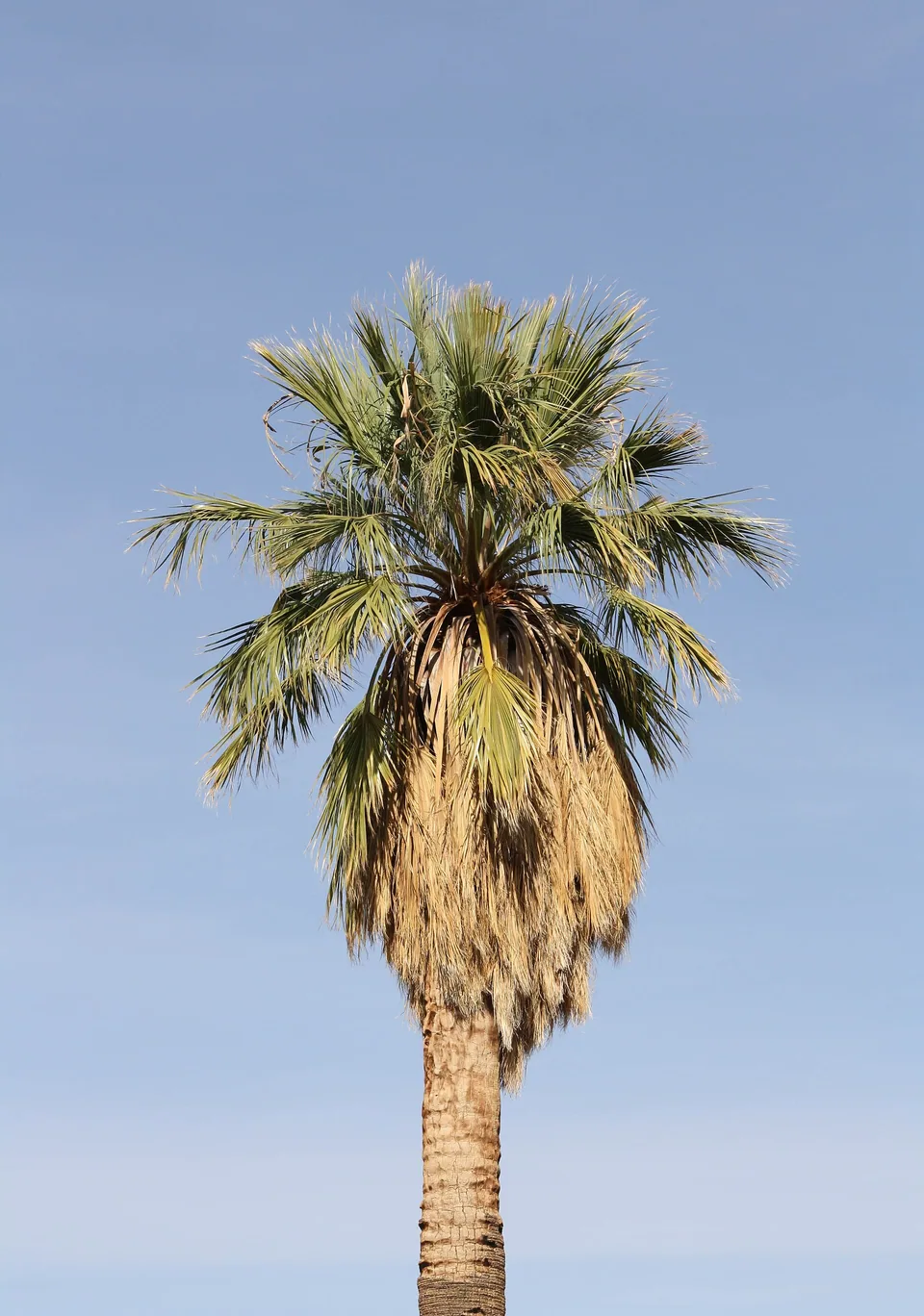
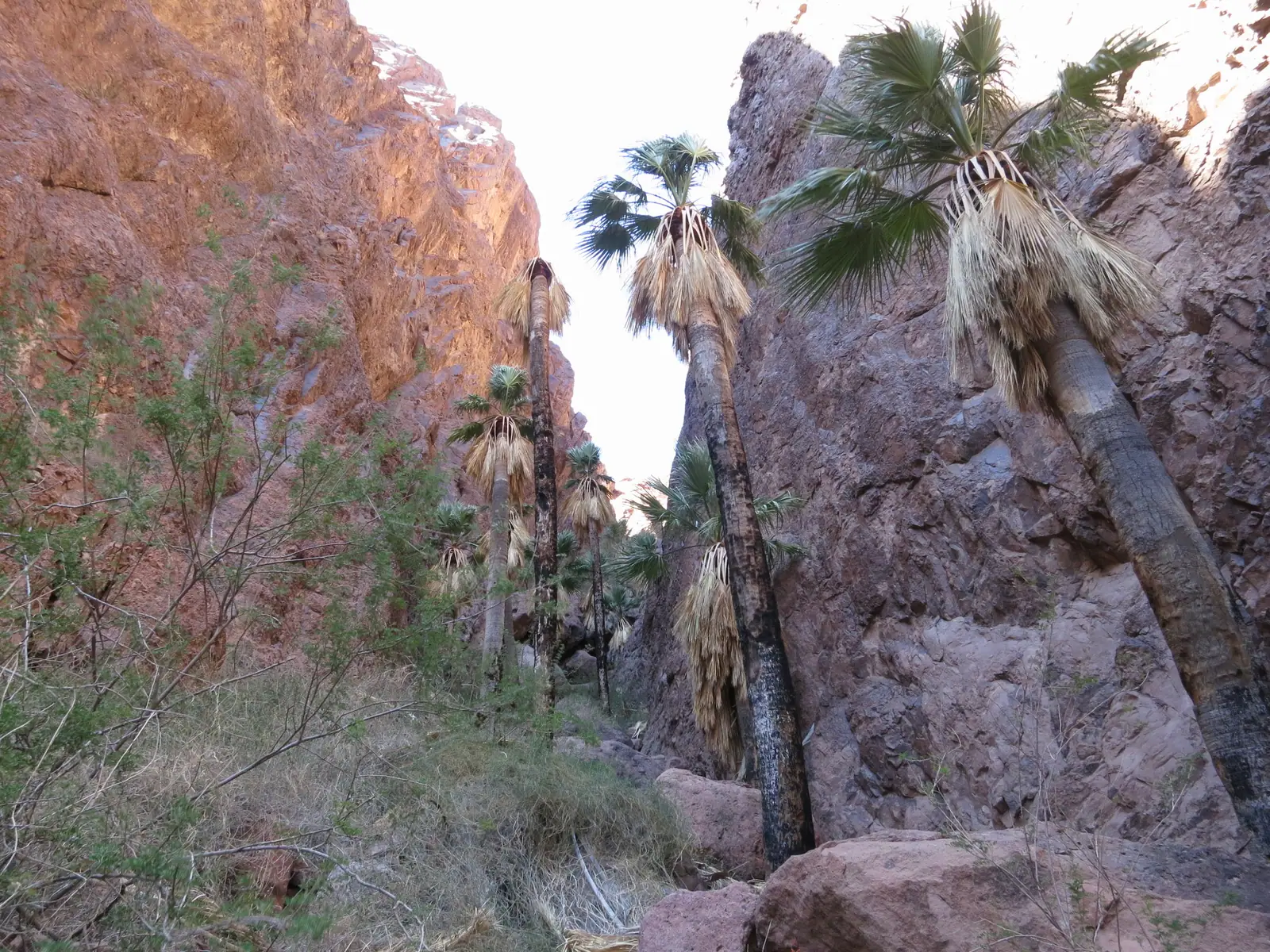

How to Grow and Care for California fan palm
Washingtonia filifera
Written by Emilio Marruso · last checked
At a glance
This palm grows commonly 40–50 feet tall, and up to 80 feet, in full sun or part shade. It asks for little: deep, infrequent watering, very well-drained soil and one feeding a year in spring or summer. It even grows in containers, and its seeds are edible: Native American peoples make flour, drinks and jams from them.
- Sun
Full sun to part shade
What the sources say (2)
Light: Full sun to part shade
Culture Light requirement: full sun Soil tolerances: clay; sand; loam; acidic; alkaline; well-drained Drought tolerance: high
— ENH-826 [1] Light Exposure: Part shade to full sun Spread: 15'-20' Water Use: Low to medium Growth Rate: Moderate to fast
— Cooperative Extension [3] - Water
Deep watering, regular but infrequent; too much water rots the trunk and roots
What the sources say (3)
Watering: Regular, infrequent, deep irrigation
Some drought tolerance is shown but prefers regular, infrequent, deep irrigation. Good soil drainage is important.
— Cooperative Extension [3] Watering notes: Avoid over-irrigation and wet soils, which cause trunk or root rot; plant only on extremely well-drained soil
Plant this palm only on soil which is extremely well-drained to prevent trunk or root rot.
— ENH-826 [1] It does not grow well when it is over-irrigated in Florida because it frequently develops trunk or root rot.
— ENH-826 [1] - Cold
Survives winters down to 20 °F (−6.7 °C)
Hardy in average winters · USDA 9a · RHS H4 · Z9
- Soil
Plant only in very well-drained soil; wet soil causes rot
What the sources say (2)
Watering notes: Avoid over-irrigation and wet soils, which cause trunk or root rot; plant only on extremely well-drained soil
Plant this palm only on soil which is extremely well-drained to prevent trunk or root rot.
— ENH-826 [1] It does not grow well when it is over-irrigated in Florida because it frequently develops trunk or root rot.
— ENH-826 [1] - Feeding
Palm fertilizer once a year in spring or summer, spread under the canopy, not by the trunk
What the sources say (4)
When: Spring or summer
Good soil drainage is important. Periodic grooming im-proves appearance. Fertilize annually in spring or summer.
— Cooperative Extension [3] How often: Once a year
Good soil drainage is important. Periodic grooming im-proves appearance. Fertilize annually in spring or summer.
— Cooperative Extension [3] Mineral fertilizers: Palm fertilizer supplying 10 to 20% N, 5% P and 10 to 20% K, plus 1 to 3% Mg and micronutrients, at label rates for the tree size
Look for a product that supplies 10-20% N, 5%P, and 10-20% K (roughly equal to N), and also includes 1-3% Mg, .5% Mn , .5% Fe, and S, Zn, Cu, and B (micronutrients that are often lacking).
— Cooperative Extension [3] Avoid: Spreading fertilizer next to the trunk: spread it under the canopy; no feeding before the first establishment summer
(micronutrients that are often lacking). Apply this product to palms after their first establishment summer, following directions on the label for the tree’s size. Spread the product under the canopy (avoiding the area next to the trunk)
— Cooperative Extension [3] - Harvest
The seeds are edible: Native Americans make flour, drinks and jams from them
- Pests
Scale insects, palm weevils and leaf skeletonizers; wet soil rots the trunk and roots
What the sources say (2)
Pests: scales, palm weevil, palm leaf skeletonizer
Scales while young, palm weevil in old age, palm leaf skeletonizer and a variety of scales at any time can infest this palm.
— ENH-826 [1] Diseases: trunk or root rot
Trunk or root rot in wet soils may infect this tree.
— ENH-826 [1] - Size
Commonly 40–50 ft tall, up to 80 ft
What the sources say (1)
Mature height: 1219.2-1524 cm (40-50 ft) commonly; up to 2438.4 (80 ft)
Commonly seen at 40 to 50 feet but capable of soaring to 80 feet in height, desert fan palm is quickly recognized as related to the much-overused, straight, single-trunked street palm
— ENH-826 [1] - Propagation
Grows from seed
What the sources say (1)
Propagation: Seed
Select Washingtonia robusta in an irrigated landscape and for the eastern US. Propagation is by seed.
— ENH-826 [1] - Containers
Grows in containers too
What the sources say (1)
In containers: Yes
This also allows it to be used in more garden applications, such as containers or grouped together as a mass planting.
— ENH-826 [1]
Overview
Desert fan palm is a single-trunked palm listed for USDA zones 9A through 11 that is better suited to the home landscape than Washingtonia robusta. [1] It needs very well-drained soil because over-irrigation and wet soils lead to trunk or root rot. [1]
This record is incomplete: the sources we read do not cover every field yet.
Not yet covered by our sources: Pruning
California fan palm care
How to water California fan palm
Watering
Regular, infrequent, deep irrigation
What the sources say (1)
Some drought tolerance is shown but prefers regular, infrequent, deep irrigation. Good soil drainage is important.Watering notes
Avoid over-irrigation and wet soils, which cause trunk or root rot; plant only on extremely well-drained soil
How much light California fan palm needs
Full sun to part shade
How much cold California fan palm can take
Hardiness, coldest zone
9a [winter low −6.7 to −3.9 °C (20 to 25 °F)]
What the sources say (1)
USDA hardiness zones: 9A through 11 (Figure 2)Hardiness, warmest zone
11 [winter low 4.4 to 10 °C (40 to 50 °F)]
What the sources say (1)
USDA hardiness zones: 9A through 11 (Figure 2)Where to grow California fan palm
Yes
What the sources say (1)
This also allows it to be used in more garden applications, such as containers or grouped together as a mass planting.How to propagate California fan palm
Seed
What the sources say (1)
Select Washingtonia robusta in an irrigated landscape and for the eastern US. Propagation is by seed.How to grow California fan palm
The plant
Family
Arecaceae
What the sources say (1)
Scientific name: Washingtonia filifera Pronunciation: wosh-ing-TOE-nee-uh fill-LIFF-er-uh Common name(s): Desert palm, California washingtonia palm Family: ArecaceaeMature height
1219.2-1524 cm (40-50 ft) commonly; up to 2438.4 (80 ft)
What the sources say (1)
Commonly seen at 40 to 50 feet but capable of soaring to 80 feet in height, desert fan palm is quickly recognized as related to the much-overused, straight, single-trunked street palmPests and diseases
Pests
scales, palm weevil, palm leaf skeletonizer
What the sources say (1)
Scales while young, palm weevil in old age, palm leaf skeletonizer and a variety of scales at any time can infest this palm.Diseases
trunk or root rot
What the sources say (1)
Trunk or root rot in wet soils may infect this tree.Fertilizing
When
Spring or summer
What the sources say (1)
Good soil drainage is important. Periodic grooming im-proves appearance. Fertilize annually in spring or summer.How often
Once a year
What the sources say (1)
Good soil drainage is important. Periodic grooming im-proves appearance. Fertilize annually in spring or summer.Mineral fertilizers
Palm fertilizer supplying 10 to 20% N, 5% P and 10 to 20% K, plus 1 to 3% Mg and micronutrients, at label rates for the tree size
What the sources say (1)
Look for a product that supplies 10-20% N, 5%P, and 10-20% K (roughly equal to N), and also includes 1-3% Mg, .5% Mn , .5% Fe, and S, Zn, Cu, and B (micronutrients that are often lacking).Micronutrients
Magnesium, manganese, iron, sulfur, zinc, copper and boron, supplied with the palm fertilizer (1 to 3% Mg, 0.5% Mn, 0.5% Fe)
What the sources say (1)
Look for a product that supplies 10-20% N, 5%P, and 10-20% K (roughly equal to N), and also includes 1-3% Mg, .5% Mn , .5% Fe, and S, Zn, Cu, and B (micronutrients that are often lacking).Avoid
Spreading fertilizer next to the trunk: spread it under the canopy; no feeding before the first establishment summer
What the sources say (1)
(micronutrients that are often lacking). Apply this product to palms after their first establishment summer, following directions on the label for the tree’s size. Spread the product under the canopy (avoiding the area next to the trunk)Signs of deficiency
Nitrogen: older fronds turn pale green or yellow; potassium: yellowing of older leaves including the midrib; magnesium: yellow band on older leaves with the central vein still green. Discolored leaves do not recover
What the sources say (2)
In Arizona landscapes, nitrogen is the most commonly deficient nutrient; when it is lacking, older fronds turn pale green or yellow. Many palms in certain soils also suffer from potassium deficiency (yellowing of older leaves, including midrib).Some trees show Magnesium deficiencies (yellow band on older leaves, with central vein remaining green). In all cases preventative fertiliza-tion is best, since the discolored leaves don’t recover.California fan palm pests and problems
Trunk or root rot
Symptom: Trunk or root rot in wet soils
What to do: Plant only on extremely well-drained soil
What the sources say (1)
Diseases Trunk or root rot in wet soils may infect this tree.
— ENH-826 [1]
Remedies
Each remedy shows what official sources say about it; traditional remedies without an official source are marked as such. Harmful ones are listed so you know to avoid them.
Treating the plant
diamond scale
regular irrigation and fertilizing to keep the palm vigorous Official source, not independently tested
The fungal spores that cause diamond scale are everywhere and can travel by wind and water; therefore, removing and disposing of infected leaves is probably not a viable management strategy.
— ipm.ucanr.edu [4] How: Keep existing California fan palms as vigorous as possible by irrigating regularly, especially in summer and in winters with little rainfall, and fertilize regularly to encourage rapid growth.
Keep existing California fan palms as vigorous as possible by irrigating regularly, especially in the summer and during winters with little rainfall. Fertilize regularly to encourage rapid growth.
— ipm.ucanr.edu [4]
giant palm borer
dispose of dead and dying palms Official source, not independently tested
How: Provide palms with good growing conditions and proper cultural care, and dispose of dead and dying palms, in which the beetles breed.
Dispose of dead and dying palms, in which the beetles breed. No control other than good preventive care of palms is known.
— ipm.ucanr.edu [5]
Calendar
Pruning
Not stated in the sources we read.
Months as given by the sources, which are mostly from the United States (northern hemisphere). In the southern hemisphere they shift by about six months.
Edibility
Reported by the source, quoted verbatim. Do not eat a plant on the basis of this page alone: identification mistakes can be dangerous.
Les graines comestibles sont consommées par les populations autochtones amérindiennes (farine, boissons, confitures).
[2]
Similar plants
- Mexican Fan Palm Washingtonia robusta
- Areca Palm Chrysalidocarpus lutescens
- Bamboo Palm Chamaedorea seifrizii
- Bismark Palm Bismarckia nobilis
- Canary Island Date Palm Phoenix canariensis
- Christmas Palm Adonidia merrillii
- Cyrtostachys renda Cyrtostachys renda
- Double coconut Lodoicea maldivica
Sources
Every value above is quoted from these documents. Links lead to the original publisher.
- ENH-826 · edis.ifas.ufl.edu, consulted
-  · jardin-thuret.hub.inrae.fr, consulted
- Cooperative Extension · extension.arizona.edu, consulted
- ipm.ucanr.edu · ipm.ucanr.edu
- ipm.ucanr.edu · ipm.ucanr.edu
Written by Emilio Marruso · last checked