
How to Grow and Care for Pygmy Date Palm
Phoenix roebelenii
Written by Emilio Marruso · last checked
Not toxic to cats and dogs, according to the sources · Sources
At a glance
This little palm is happy almost anywhere you put it: indoors, on the patio or in a pot. Give it bright light away from the hot afternoon sun, keep the soil slightly moist, and it slowly grows to 5–6 ft indoors. It's safe for cats, dogs and horses, and female plants even bear edible purple fruits.
- Sun
Full sun to part shade; shield it from hot afternoon sun
What the sources say (2)
Light: Medium to high light, protected from hot afternoon sun; full sun to partial shade
give it protection from the hot afternoon sun since this plant prefers medium to high light.
— Phoenix roebelenii (Dwarf Date Palm, Miniature Date Palm, Pygmy Date Palm, Robellini Palm, Roebelin Palm) | North Carolina Extension Gardener Plant Toolbox [1] Full sun (6 or more hours of direct sunlight a day) Partial Shade (Direct sunlight only part of the day, 2-6 hours) Soil Texture
— Phoenix roebelenii (Dwarf Date Palm, Miniature Date Palm, Pygmy Date Palm, Robellini Palm, Roebelin Palm) | North Carolina Extension Gardener Plant Toolbox [1] - Water
Keep the soil slightly moist in the growing season; too much water rots the roots
What the sources say (3)
Watering: Keep the growing medium slightly moist during the growing season; do not overwater
Keep the growing medium slightly moist during the growing season but do not overwater as doing so can cause root rot.
— Phoenix roebelenii (Dwarf Date Palm, Miniature Date Palm, Pygmy Date Palm, Robellini Palm, Roebelin Palm) | North Carolina Extension Gardener Plant Toolbox [1] Watering notes: Overwatering can cause root rot; plant in moist, well-drained potting mix
Plant in moist, well-drained potting mix and give it protection from the hot afternoon sun
— Phoenix roebelenii (Dwarf Date Palm, Miniature Date Palm, Pygmy Date Palm, Robellini Palm, Roebelin Palm) | North Carolina Extension Gardener Plant Toolbox [1] but do not overwater as doing so can cause root rot.
— Phoenix roebelenii (Dwarf Date Palm, Miniature Date Palm, Pygmy Date Palm, Robellini Palm, Roebelin Palm) | North Carolina Extension Gardener Plant Toolbox [1] - Cold
Survives winters down to 30 °F (−1.1 °C)
Half hardy: mild winters or an unheated greenhouse · USDA 10a · RHS H3 · Z10
What the sources say (2)
Hardiness, coldest zone: 10a [winter low −1.1 to 1.7 °C (30 to 35 °F)]
USDA Plant Hardiness Zone: 10a, 10b, 11a, 11b
— Phoenix roebelenii (Dwarf Date Palm, Miniature Date Palm, Pygmy Date Palm, Robellini Palm, Roebelin Palm) | North Carolina Extension Gardener Plant Toolbox [1] Hardiness, warmest zone: 11b [winter low 7.2 to 10 °C (45 to 50 °F)]
USDA Plant Hardiness Zone: 10a, 10b, 11a, 11b
— Phoenix roebelenii (Dwarf Date Palm, Miniature Date Palm, Pygmy Date Palm, Robellini Palm, Roebelin Palm) | North Carolina Extension Gardener Plant Toolbox [1] - Soil
Moist, well-drained potting mix
What the sources say (2)
Watering notes: Overwatering can cause root rot; plant in moist, well-drained potting mix
Plant in moist, well-drained potting mix and give it protection from the hot afternoon sun
— Phoenix roebelenii (Dwarf Date Palm, Miniature Date Palm, Pygmy Date Palm, Robellini Palm, Roebelin Palm) | North Carolina Extension Gardener Plant Toolbox [1] but do not overwater as doing so can cause root rot.
— Phoenix roebelenii (Dwarf Date Palm, Miniature Date Palm, Pygmy Date Palm, Robellini Palm, Roebelin Palm) | North Carolina Extension Gardener Plant Toolbox [1] - Feeding
Use a slow-release palm fertilizer; avoid ones high in nitrogen or potassium but low in magnesium
What the sources say (3)
Mineral fertilizers: Landscape palm fertilizer 8-2-12 (or 8-0-12) with all the nitrogen, potassium and magnesium in controlled-release form
Landscape palm fertilizers should have an analysis of 8-2-12 (or 8-0-12) with 100% of the nitrogen (N), K, and magnesium (Mg) in controlled release form,
— [4] Avoid: Removing potassium-deficient leaves before they are completely dead; fertilizers high in nitrogen or potassium with little or no magnesium, on the palm or on nearby turf
Potassium-deficient leaves, though unsightly, should not be removed until they are completely dead, as they serve as a supplementary source of K in the absence of sufficient K in the soil.
— [4] Fertilizers with high N or K, but little or no Mg, applied to the palm or nearby turfgrass can result in imbalances between N and Mg or K and Mg that can result in Mg deficiency.
— [4] - Pruning
Don't cut off yellowing old leaves until they are completely dead
What the sources say (2)
Avoid: Removing potassium-deficient leaves before they are completely dead; fertilizers high in nitrogen or potassium with little or no magnesium, on the palm or on nearby turf
Potassium-deficient leaves, though unsightly, should not be removed until they are completely dead, as they serve as a supplementary source of K in the absence of sufficient K in the soil.
— [4] Fertilizers with high N or K, but little or no Mg, applied to the palm or nearby turfgrass can result in imbalances between N and Mg or K and Mg that can result in Mg deficiency.
— [4] - Harvest
Female plants bear purple fruits you can eat
- Pests
Watch for scale insects and leaf spot
What the sources say (2)
Pests: scales
Insects, Diseases, and Other Plant Problems: Susceptible to scales and leaf spot.
— Phoenix roebelenii (Dwarf Date Palm, Miniature Date Palm, Pygmy Date Palm, Robellini Palm, Roebelin Palm) | North Carolina Extension Gardener Plant Toolbox [1] Diseases: leaf spot
Insects, Diseases, and Other Plant Problems: Susceptible to scales and leaf spot.
— Phoenix roebelenii (Dwarf Date Palm, Miniature Date Palm, Pygmy Date Palm, Robellini Palm, Roebelin Palm) | North Carolina Extension Gardener Plant Toolbox [1] - Size
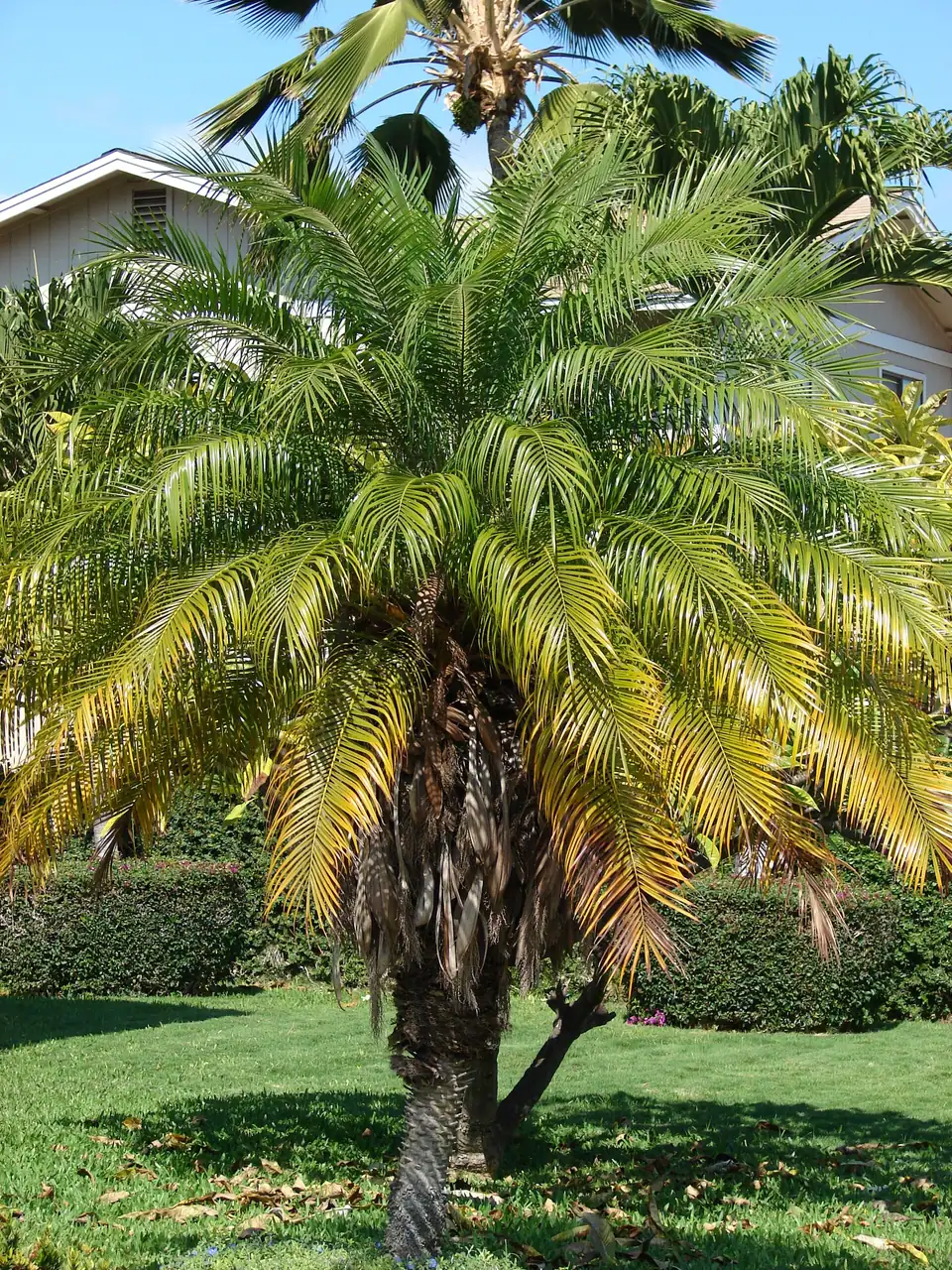
6.5 ft tall and 5 ft wide outdoors; 5–6 ft tall indoors
What the sources say (2)
Mature height: 198 cm (6.5 ft) outdoors; 152-183 cm (5 ft - 6 ft) as an indoor plant
Outdoors it grows to 6.5 feet high and 5 feet wide. As an indoor plant, it typically reaches only 5 to 6 feet tall.
— Phoenix roebelenii (Dwarf Date Palm, Miniature Date Palm, Pygmy Date Palm, Robellini Palm, Roebelin Palm) | North Carolina Extension Gardener Plant Toolbox [1] Mature width: 152 cm (5 ft) outdoors
Outdoors it grows to 6.5 feet high and 5 feet wide. As an indoor plant, it typically reaches only 5 to 6 feet tall.
— Phoenix roebelenii (Dwarf Date Palm, Miniature Date Palm, Pygmy Date Palm, Robellini Palm, Roebelin Palm) | North Carolina Extension Gardener Plant Toolbox [1] - Containers
Grows well in containers, indoors too
What the sources say (3)
In containers: Yes
Plant in moist, well-drained potting mix and give it protection from the hot afternoon sun
— Phoenix roebelenii (Dwarf Date Palm, Miniature Date Palm, Pygmy Date Palm, Robellini Palm, Roebelin Palm) | North Carolina Extension Gardener Plant Toolbox [1] growers frequently put three or five plants in one pot to make a fuller specimen.
— Phoenix roebelenii (Dwarf Date Palm, Miniature Date Palm, Pygmy Date Palm, Robellini Palm, Roebelin Palm) | North Carolina Extension Gardener Plant Toolbox [1] Indoors: Yes
Elsewhere the palm can be grown as houseplant. It can spend the summers outside in a shady patio
— Phoenix roebelenii (Dwarf Date Palm, Miniature Date Palm, Pygmy Date Palm, Robellini Palm, Roebelin Palm) | North Carolina Extension Gardener Plant Toolbox [1] - Safety
Not toxic to cats, dogs or horses, but it has spines
Overview
Pygmy date palm is a tropical evergreen palm from southern China and Southeast Asia that can be grown outdoors in warm climates or as a houseplant. [1] It prefers medium to high light, a slightly moist growing medium and medium to high humidity, and should be kept away from cold drafts in winter. [1] The fruits are edible and the lower leaflets are modified into sharp spines. [1]
This record is incomplete: the sources we read do not cover every field yet.
Not yet covered by our sources: Propagation
Pygmy Date Palm care
How to water Pygmy Date Palm
Watering
Keep the growing medium slightly moist during the growing season; do not overwater
What the sources say (1)
Keep the growing medium slightly moist during the growing season but do not overwater as doing so can cause root rot.Watering notes
Overwatering can cause root rot; plant in moist, well-drained potting mix
What the sources say (2)
Plant in moist, well-drained potting mix and give it protection from the hot afternoon sunbut do not overwater as doing so can cause root rot.How much light Pygmy Date Palm needs
Medium to high light, protected from hot afternoon sun; full sun to partial shade
What the sources say (2)
give it protection from the hot afternoon sun since this plant prefers medium to high light.Full sun (6 or more hours of direct sunlight a day)
Partial Shade (Direct sunlight only part of the day, 2-6 hours)
Soil TextureHow much cold Pygmy Date Palm can take
Hardiness, coldest zone
10a [winter low −1.1 to 1.7 °C (30 to 35 °F)]
What the sources say (1)
USDA Plant Hardiness Zone:
10a, 10b, 11a, 11bHardiness, warmest zone
11b [winter low 7.2 to 10 °C (45 to 50 °F)]
What the sources say (1)
USDA Plant Hardiness Zone:
10a, 10b, 11a, 11bWhere to grow Pygmy Date Palm
Indoors
Yes
What the sources say (1)
Elsewhere the palm can be grown as houseplant. It can spend the summers outside in a shady patioIn containers
Yes
What the sources say (2)
Plant in moist, well-drained potting mix and give it protection from the hot afternoon sungrowers frequently put three or five plants in one pot to make a fuller specimen.How to propagate Pygmy Date Palm
Not stated in the sources we read.
How to grow Pygmy Date Palm
The plant
Life cycle
perennial
What the sources say (1)
Pygmy date palm is a tropical, evergreen perennial in the palm family (Arecaceae).Family
Arecaceae
What the sources say (1)
Pygmy date palm is a tropical, evergreen perennial in the palm family (Arecaceae).Mature height
198 cm (6.5 ft) outdoors; 152-183 cm (5 ft - 6 ft) as an indoor plant
What the sources say (1)
Outdoors it grows to 6.5 feet high and 5 feet wide. As an indoor plant, it typically reaches only 5 to 6 feet tall.Mature width
152 cm (5 ft) outdoors
What the sources say (1)
Outdoors it grows to 6.5 feet high and 5 feet wide. As an indoor plant, it typically reaches only 5 to 6 feet tall.Pests and diseases
Pests
scales
What the sources say (1)
Insects, Diseases, and Other Plant Problems: Susceptible to scales and leaf spot.Diseases
leaf spot
What the sources say (1)
Insects, Diseases, and Other Plant Problems: Susceptible to scales and leaf spot.Fertilizing
Mineral fertilizers
Landscape palm fertilizer 8-2-12 (or 8-0-12) with all the nitrogen, potassium and magnesium in controlled-release form
What the sources say (1)
Landscape palm fertilizers should have an analysis of 8-2-12 (or 8-0-12) with 100% of the nitrogen (N), K, and magnesium (Mg) in controlled release form,Micronutrients
Manganese and iron in water-soluble (sulfate or chelate) form; magnesium in controlled-release form; manganese sulfate for severe manganese deficiency
What the sources say (3)
and micronutrients such as manganese (Mn) and iron (Fe) in water soluble (sulfate or chelate) form in order to be effective.Landscape palm fertilizers should have an analysis of 8-2-12 (or 8-0-12) with 100% of the nitrogen (N), K, and magnesium (Mg) in controlled release form,should prevent most Mn deficiencies, but severe cases may require supplemental applications of manganese sulfate.Avoid
Removing potassium-deficient leaves before they are completely dead; fertilizers high in nitrogen or potassium with little or no magnesium, on the palm or on nearby turf
What the sources say (2)
Potassium-deficient leaves, though unsightly, should not be removed until they are completely dead, as they serve as a supplementary source of K in the absence of sufficient K in the soil.Fertilizers with high N or K, but little or no Mg, applied to the palm or nearby turfgrass can result in imbalances between N and Mg or K and Mg that can result in Mg deficiency.Signs of deficiency
Potassium: yellow-orange leaflets with necrotic tips on the oldest leaves, fewer leaves in the crown; magnesium: broad yellow band along the outer margin of older leaves, center dark green; iron: uniform chlorosis of new leaves; manganese: necrotic streaks on chlorotic new leaflets, then withered, frizzled tips; boron: spear leaves that do not open, crumpled new leaves
What the sources say (5)
Most pygmy date palms in Florida exhibit potassium (K) deficiency symptoms on their oldest leaves. Symptoms are most severe towards the tips of affected leaves and appear as a yellow-orange discoloration of the leaflets and necrosis of the leaflet tipsMg-deficient leaves have a broad yellow band along the outer margin of each leaf, with the center of the leaf sharply transitioning to dark greenSymptoms appear on the new leaves as a uniform chlorosis (yellowing of the leaflets). In severe chronic situ- ations, the entire palm may be yellow-green in color.Symptoms begin as longitudinal necrotic streaks on slightly chlorotic leaflets (Figure 5). As the deficiency progresses, leaflet tips become withered and curled, giving the leaves a frizzled appearanceBoron (B) deficiency is fairly common on pygmy date palms. Although a wide range of symptoms are possible, the most common is the production of several spear leaves that do not open normally, if at allPygmy Date Palm pests and problems
Scales and leaf spot
Symptom: Susceptible to scales and leaf spot
What to do: Not stated in the source
What the sources say (1)
Insects, Diseases, and Other Plant Problems: Susceptible to scales and leaf spot.
— Phoenix roebelenii (Dwarf Date Palm, Miniature Date Palm, Pygmy Date Palm, Robellini Palm, Roebelin Palm) | North Carolina Extension Gardener Plant Toolbox [1] Root rot from overwatering
Symptom: Root rot
What to do: Do not overwater; keep the growing medium slightly moist
What the sources say (1)
Keep the growing medium slightly moist during the growing season but do not overwater as doing so can cause root rot.
— Phoenix roebelenii (Dwarf Date Palm, Miniature Date Palm, Pygmy Date Palm, Robellini Palm, Roebelin Palm) | North Carolina Extension Gardener Plant Toolbox [1]
Remedies
Each remedy shows what official sources say about it; traditional remedies without an official source are marked as such. Harmful ones are listed so you know to avoid them.
Treating the plant
spider mites
dish soap and water spray Partly works
How: Fill a spray bottle with water and add a tablespoon of dish soap; shake or swirl gently to mix thoroughly. Spray the plant wherever you see spider mites, including the undersides of the leaves.
You can kill spider mites by spraying your palm with a solution of regular dish soap and water.
— plantcaretoday.com [5] What the evidence says Despite being made of common household materials like dish soap and vinegar and having seemingly fewer risks, these concoctions may have unforeseen consequences and cannot be relied upon to have the same effectiveness as a registered pesticide.
— extension.unh.edu [6] rubbing alcohol and water wipe Not verified
Traditional remedy, not verified by an official source.
How: Add two or three ounces of rubbing alcohol to an eight-ounce glass of water, dip a paper towel or cloth and wipe leaves and stems where mites are.
Is Pygmy Date Palm poisonous?
Reported by the source, quoted verbatim. This is not medical or veterinary advice: if a person or an animal may have eaten this plant, contact a poison control centre or a veterinarian.
#edible fruits #houseplant #fantz #non-toxic for cats #non-toxic for horses #non-toxic for dogs #container plant #patio #spines
[1]The source flags the risk for this animal but does not explain why.
Edibility
Reported by the source, quoted verbatim. Do not eat a plant on the basis of this page alone: identification mistakes can be dangerous.
The fruits are purple drupes that are produced on female plants and are edible.
[1]
Similar plants
- Canary Island Date Palm Phoenix canariensis
- Dwarf Date Palm Phoenix acaulis
- Areca Palm Chrysalidocarpus lutescens
- Bamboo Palm Chamaedorea seifrizii
- Bismark Palm Bismarckia nobilis
- California fan palm Washingtonia filifera
- Christmas Palm Adonidia merrillii
- Cyrtostachys renda Cyrtostachys renda
Sources
Every value above is quoted from these documents. Links lead to the original publisher.
- Phoenix roebelenii (Dwarf Date Palm, Miniature Date Palm, Pygmy Date Palm, Robellini Palm, Roebelin Palm) | North Carolina Extension Gardener Plant Toolbox · plants.ces.ncsu.edu, consulted
- Robellini Palm - Phoenix roebelenii | North Carolina Extension Gardener Plant Toolbox · plants.ces.ncsu.edu, consulted
- Roebelin Palm - Phoenix roebelenii | North Carolina Extension Gardener Plant Toolbox · plants.ces.ncsu.edu, consulted
- edis.ifas.ufl.edu · edis.ifas.ufl.edu
- plantcaretoday.com · plantcaretoday.com
- extension.unh.edu · extension.unh.edu
Written by Emilio Marruso · last checked