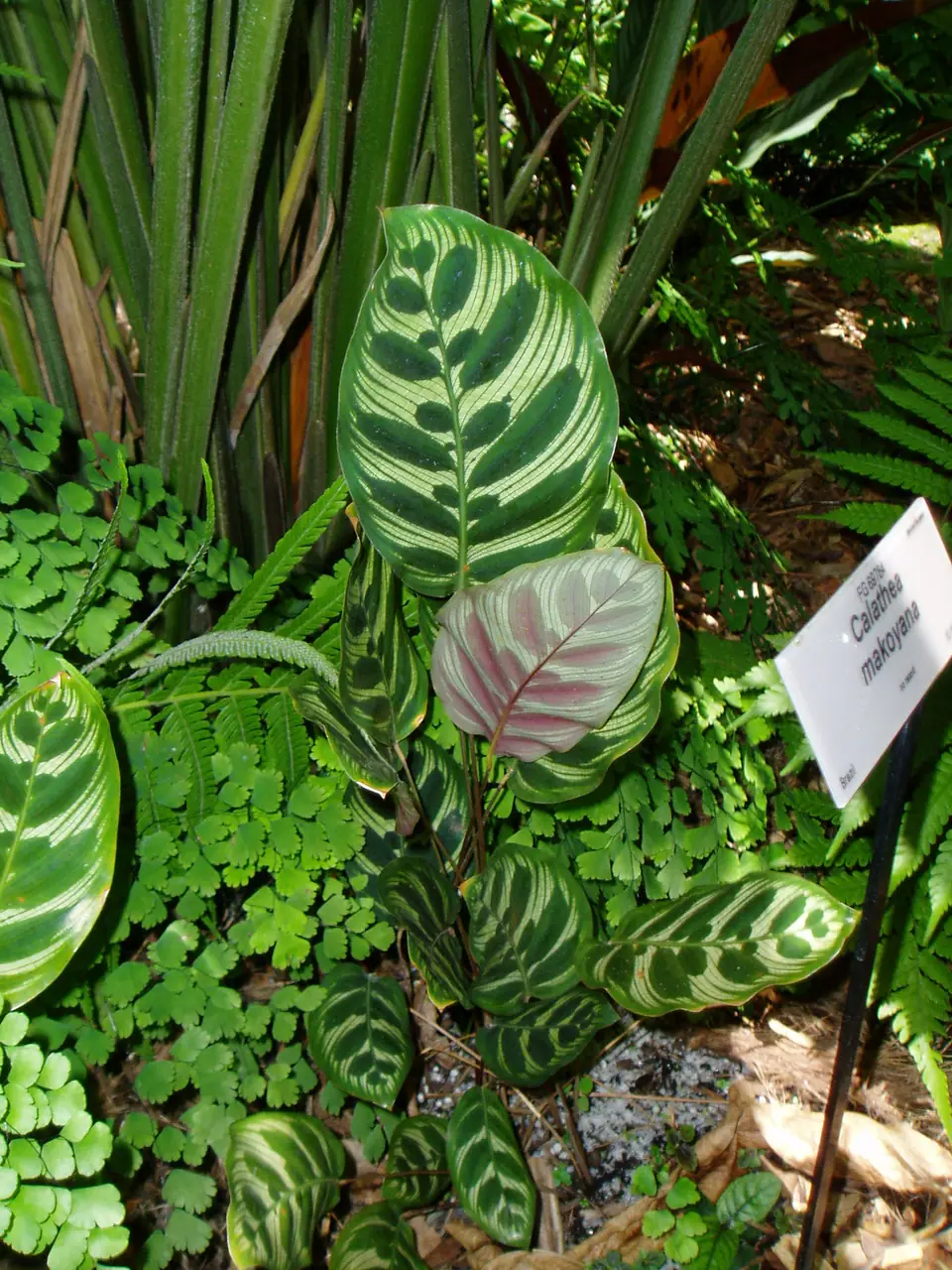

Cómo cultivar y cuidar Peacock Plant
Calathea makoyana
Escrito por Emilio Marruso · última revisión
No tóxica para gatos y perros, según las fuentes · Fuentes
De un vistazo
Esta calathea es una perenne que vive feliz en interior y en maceta, y no es tóxica para gatos, perros ni caballos: perfecta si tienes mascotas. Mantén la tierra húmeda pero nunca encharcada, riégala con agua de lluvia o destilada y procura una humedad del 60 %. Con estos cuidados, sus hojas no se enrollan ni se ponen marrones.
- Riego
Tierra húmeda, nunca encharcada; usa agua de lluvia o destilada y riega menos en invierno
Qué dicen las fuentes (5)
Riego: Mantén el suelo húmedo pero no mojado ni empapado
The soil needs to be moist but not wet or soggy.
— Goeppertia makoyana (Brain Plant, Cathedral Windows, Peacock Calathea, Peacock Plant) | North Carolina Extension Gardener Plant Toolbox [1] Peacock plant care includes keeping the soil consistently moist.
— Peacock Plant Care - Taking Care Of Calathea Peacock Houseplants | Gardening Know How [5] Riego regular, de modo que el terreno esté constantemente húmedo
— Calatea pavo real - EcuRed [6] Notas sobre el riego: Se recomienda agua destilada o de lluvia porque el fluoruro del agua del grifo puede causar el oscurecimiento de las hojas; reduce el riego en invierno
Distilled water or rain water is recommended for watering since the fluoride in tap water can cause browning of the leaves.
— Goeppertia makoyana (Brain Plant, Cathedral Windows, Peacock Calathea, Peacock Plant) | North Carolina Extension Gardener Plant Toolbox [1] Decrease watering and stop fertilizing during the winter months.
— Goeppertia makoyana (Brain Plant, Cathedral Windows, Peacock Calathea, Peacock Plant) | North Carolina Extension Gardener Plant Toolbox [1] - Frío
Aguanta inviernos de hasta 4,4 °C (40 °F)
Delicada: necesita invernadero sin heladas · USDA 11a · RHS H2 · Z11
Qué dicen las fuentes (2)
Rusticidad, zona más fría: 11a [mínima invernal de 4,4 a 7,2 °C (de 40 a 45 °F)]
USDA Plant Hardiness Zone: 11a, 11b, 12a, 12b
— Goeppertia makoyana (Brain Plant, Cathedral Windows, Peacock Calathea, Peacock Plant) | North Carolina Extension Gardener Plant Toolbox [1] Rusticidad, zona más cálida: 12b [mínima invernal de 12,8 a 15,6 °C (de 55 a 60 °F)]
USDA Plant Hardiness Zone: 11a, 11b, 12a, 12b
— Goeppertia makoyana (Brain Plant, Cathedral Windows, Peacock Calathea, Peacock Plant) | North Carolina Extension Gardener Plant Toolbox [1] - Abonado
Abono equilibrado cada 4 semanas mientras crece; nada en invierno
Qué dicen las fuentes (5)
Cuándo: Durante la temporada de crecimiento; deténla en invierno
It is best to fertilize this plant every 4 weeks with a balanced fertilizer during its growing season. Decrease watering and stop fertilizing during the winter months.
— Goeppertia makoyana (Brain Plant, Cathedral Windows, Peacock Calathea, Peacock Plant) | North Carolina Extension Gardener Plant Toolbox [1] Frecuencia: Cada 4 semanas
It is best to fertilize this plant every 4 weeks with a balanced fertilizer during its growing season. Decrease watering and stop fertilizing during the winter months.
— Goeppertia makoyana (Brain Plant, Cathedral Windows, Peacock Calathea, Peacock Plant) | North Carolina Extension Gardener Plant Toolbox [1] Abonos minerales: Fertilizante equilibrado
producción comercial, fertirrigación: This solution can be made using a water-soluble fertilizer with N-P2O5-K2O at a 3-1-2 ratio, such as a 24-8-16 or 18-6-12 with micronutrients.
— ENH1030 [7] producción comercial, liberación controlada: If a controlled-release fertilizer with the N-P2O5-K2O ratio of 3-1-2 is used, apply it at rate of 3 lb N per 1,000 square feet on a monthly basis.
— ENH1030 [7] It is best to fertilize this plant every 4 weeks with a balanced fertilizer during its growing season. Decrease watering and stop fertilizing during the winter months.
— Goeppertia makoyana (Brain Plant, Cathedral Windows, Peacock Calathea, Peacock Plant) | North Carolina Extension Gardener Plant Toolbox [1] - Plagas
Pulgón, cochinilla, cochinilla algodonosa y araña roja; el exceso de agua pudre las raíces
Qué dicen las fuentes (2)
Plagas: pulgones, cochinillas, cochinillas harinosas, arañitas rojas
Monitor for aphids, scale, mealybugs, and spider mites.
— Goeppertia makoyana (Brain Plant, Cathedral Windows, Peacock Calathea, Peacock Plant) | North Carolina Extension Gardener Plant Toolbox [1] Enfermedades: pudrición de raíz (por exceso de riego)
Overwatering can cause root rot, and low humidity causes leaves to roll or brown.
— Goeppertia makoyana (Brain Plant, Cathedral Windows, Peacock Calathea, Peacock Plant) | North Carolina Extension Gardener Plant Toolbox [1] - Atención
El aire seco y el agua del grifo ponen marrones las hojas: mantén la humedad al 60 %
Qué dicen las fuentes (2)
Notas sobre el riego: Se recomienda agua destilada o de lluvia porque el fluoruro del agua del grifo puede causar el oscurecimiento de las hojas; reduce el riego en invierno
Distilled water or rain water is recommended for watering since the fluoride in tap water can cause browning of the leaves.
— Goeppertia makoyana (Brain Plant, Cathedral Windows, Peacock Calathea, Peacock Plant) | North Carolina Extension Gardener Plant Toolbox [1] Decrease watering and stop fertilizing during the winter months.
— Goeppertia makoyana (Brain Plant, Cathedral Windows, Peacock Calathea, Peacock Plant) | North Carolina Extension Gardener Plant Toolbox [1] - Tamaño
30–61 cm de alto y 20–30 cm de ancho
Qué dicen las fuentes (2)
Altura adulta: 30-61 cm (1-2 pies)
The peacock plant has a clumping habit and grows up to 1 to 2 feet tall and 8 to 12 inches wide.
— Goeppertia makoyana (Brain Plant, Cathedral Windows, Peacock Calathea, Peacock Plant) | North Carolina Extension Gardener Plant Toolbox [1] Anchura adulta: 20-30 cm (8-12 pulgadas)
The peacock plant has a clumping habit and grows up to 1 to 2 feet tall and 8 to 12 inches wide.
— Goeppertia makoyana (Brain Plant, Cathedral Windows, Peacock Calathea, Peacock Plant) | North Carolina Extension Gardener Plant Toolbox [1] - Multiplicación
Divide los rizomas a finales de primavera o haz esquejes de tallo
Qué dicen las fuentes (3)
Propagación: División de rizomas a fines de primavera; esquejes de tallo
Division of its rhizomatous roots in the late spring is the preferred method of propagation.
— Goeppertia makoyana (Brain Plant, Cathedral Windows, Peacock Calathea, Peacock Plant) | North Carolina Extension Gardener Plant Toolbox [1] Para multiplicarla se divide la mata al final de la primavera
— Calatea pavo real - EcuRed [6] También puede hacerse mediante esquejes en un substrato similar al de cultivo
— Calatea pavo real - EcuRed [6] - Maceta
Crece en interior y en maceta
Qué dicen las fuentes (2)
En interior: Sí
the peacock plant can be used as specimen or atrium plant for a home or office setting provided there is high humidity.
— Goeppertia makoyana (Brain Plant, Cathedral Windows, Peacock Calathea, Peacock Plant) | North Carolina Extension Gardener Plant Toolbox [1] En maceta: Sí
Indoor Plant, Small Gardens, Container Planting
— NParks | Goeppertia makoyana [3] - Seguridad
No es tóxica para gatos, perros ni caballos
Resumen
La planta del pavo real es una herbácea perenne de hoja perenne originaria de las selvas tropicales del sureste de Brasil. [1] La división de los rizomas a fines de primavera es el método preferido de propagación. [1]
Citado en inglés, como en la fuente.
Cuidados
Riego
Riego
Mantén el suelo húmedo pero no mojado ni empapado
Qué dicen las fuentes (3)
The soil needs to be moist but not wet or soggy.Peacock plant care includes keeping the soil consistently moist.Riego regular, de modo que el terreno esté constantemente húmedoNotas sobre el riego
Se recomienda agua destilada o de lluvia porque el fluoruro del agua del grifo puede causar el oscurecimiento de las hojas; reduce el riego en invierno
Qué dicen las fuentes (2)
Distilled water or rain water is recommended for watering since the fluoride in tap water can cause browning of the leaves.Decrease watering and stop fertilizing during the winter months.Luz
Las fuentes no coinciden:
Semi-Shade, Full Shade
[3]
Qué dicen las fuentes (2)
This plant prefers bright, indirect sun or partial shadePlace this plant in a low to moderate light environment.Clima y frío
Rusticidad, zona más fría
11a [mínima invernal de 4,4 a 7,2 °C (de 40 a 45 °F)]
Qué dicen las fuentes (1)
USDA Plant Hardiness Zone:
11a, 11b, 12a, 12bRusticidad, zona más cálida
12b [mínima invernal de 12,8 a 15,6 °C (de 55 a 60 °F)]
Qué dicen las fuentes (1)
USDA Plant Hardiness Zone:
11a, 11b, 12a, 12bDónde cultivarla
En interior
Sí
Qué dicen las fuentes (1)
the peacock plant can be used as specimen or atrium plant for a home or office setting provided there is high humidity.En maceta
Sí
Qué dicen las fuentes (1)
Indoor Plant, Small Gardens, Container PlantingPropagación
División de rizomas a fines de primavera; esquejes de tallo
Qué dicen las fuentes (3)
Division of its rhizomatous roots in the late spring is the preferred method of propagation.Para multiplicarla se divide la mata al final de la primaveraTambién puede hacerse mediante esquejes en un substrato similar al de cultivoCultivo
La planta
Ciclo de vida
perenne
Qué dicen las fuentes (1)
The peacock plant is an evergreen herbaceous perennial species native to the tropical rainforests of southeastern Brazil.Familia
Marantaceae
Qué dicen las fuentes (1)
It is a member of the prayer plant family (Marantaceae).Altura adulta
30-61 cm (1-2 pies)
Qué dicen las fuentes (1)
The peacock plant has a clumping habit and grows up to 1 to 2 feet tall and 8 to 12 inches wide.Anchura adulta
20-30 cm (8-12 pulgadas)
Qué dicen las fuentes (1)
The peacock plant has a clumping habit and grows up to 1 to 2 feet tall and 8 to 12 inches wide.Plagas y enfermedades
Plagas
pulgones, cochinillas, cochinillas harinosas, arañitas rojas
Qué dicen las fuentes (1)
Monitor for aphids, scale, mealybugs, and spider mites.Enfermedades
pudrición de raíz (por exceso de riego)
Qué dicen las fuentes (1)
Overwatering can cause root rot, and low humidity causes leaves to roll or brown.Abonado
Cuándo
Durante la temporada de crecimiento; deténla en invierno
Qué dicen las fuentes (1)
It is best to fertilize this plant every 4 weeks with a balanced fertilizer during its growing season. Decrease watering and stop fertilizing during the winter months.Frecuencia
Cada 4 semanas
Qué dicen las fuentes (1)
It is best to fertilize this plant every 4 weeks with a balanced fertilizer during its growing season. Decrease watering and stop fertilizing during the winter months.Abonos minerales
Fertilizante equilibrado
Lo que dice cada fuente
producción comercial, fertirrigación: Fertilizante soluble en agua con una proporción 3-1-2, como 24-8-16 o 18-6-12 con micronutrientes
producción comercial, liberación controlada: Fertilizante de liberación controlada con una proporción 3-1-2 a 14.6 g/m² de nitrógeno mensual
Qué dicen las fuentes (3)
producción comercial, fertirrigación: This solution can be made using a water-soluble fertilizer with N-P2O5-K2O at a 3-1-2 ratio, such as a 24-8-16 or 18-6-12 with micronutrients.producción comercial, liberación controlada: If a controlled-release fertilizer with the N-P2O5-K2O ratio of 3-1-2 is used, apply it at rate of 3 lb N per 1,000 square feet on a monthly basis.It is best to fertilize this plant every 4 weeks with a balanced fertilizer during its growing season. Decrease watering and stop fertilizing during the winter months.Microelementos
Hierro, con nitrógeno, cuando las hojas se vuelven cloróticas por falta de fertilizante
Qué dicen las fuentes (1)
Leaf chlorosis Low fertilizer, over-watering, or high light levels Increase fertilizer, particularly nitrogen and iron; reduce watering frequency, reduce light levels.Evitar
Fertilizar en invierno; agua y fertilizante que contengan fluoruro
Qué dicen las fuentes (2)
Decrease watering and stop fertilizing during the winter months.Dead spots near leaf margins Fluoride toxicity Avoid using water and fertilizer containing fluoride.Signos de carencia
Clorosis foliar (también causada por exceso de riego o luz intensa): aumenta el fertilizante, especialmente nitrógeno y hierro
Qué dicen las fuentes (1)
Leaf chlorosis Low fertilizer, over-watering, or high light levels Increase fertilizer, particularly nitrogen and iron; reduce watering frequency, reduce light levels.Signos de exceso
Necrosis en el margen o la punta de la hoja por exceso de fertilizante, especialmente manganeso
Qué dicen las fuentes (1)
Leaf marginal or tip necrosis Low pH, excess fertilizer, particularly high Mn Keep pH close to 6 and soluble salts between 1–2.5 dS/m in production and 1.0–1.5 in interiorscape.Problemas
Podredumbre de la raíz
Síntoma: Pudrición de raíces por exceso de riego
Qué hacer: Mantén el suelo húmedo pero no mojado ni empapado
Qué dicen las fuentes (2)
Overwatering can cause root rot
— Goeppertia makoyana (Brain Plant, Cathedral Windows, Peacock Calathea, Peacock Plant) | North Carolina Extension Gardener Plant Toolbox [1] The soil needs to be moist but not wet or soggy.
— Goeppertia makoyana (Brain Plant, Cathedral Windows, Peacock Calathea, Peacock Plant) | North Carolina Extension Gardener Plant Toolbox [1] Oscurecimiento y enrollamiento de las hojas
Síntoma: Las hojas se enrollan o se ponen marrones con poca humedad; el flúor del agua del grifo pone las hojas marrones
Qué hacer: Usa agua destilada o de lluvia y mantén un nivel de humedad del 60%
Qué dicen las fuentes (3)
low humidity causes leaves to roll or brown.
— Goeppertia makoyana (Brain Plant, Cathedral Windows, Peacock Calathea, Peacock Plant) | North Carolina Extension Gardener Plant Toolbox [1] Distilled water or rain water is recommended for watering since the fluoride in tap water can cause browning of the leaves.
— Goeppertia makoyana (Brain Plant, Cathedral Windows, Peacock Calathea, Peacock Plant) | North Carolina Extension Gardener Plant Toolbox [1] a humidity level of 60% need to be maintained in order for the plant to thrive.
— Goeppertia makoyana (Brain Plant, Cathedral Windows, Peacock Calathea, Peacock Plant) | North Carolina Extension Gardener Plant Toolbox [1] insectos chupadores
Síntoma: Posible infestación de pulgones, cochinillas, cochinillas harinosas y arañas rojas
Qué dicen las fuentes (1)
Monitor for aphids, scale, mealybugs, and spider mites.
— Goeppertia makoyana (Brain Plant, Cathedral Windows, Peacock Calathea, Peacock Plant) | North Carolina Extension Gardener Plant Toolbox [1]
Remedios
Las fuentes consultadas no dan remedios para esta planta.
Toxicidad
Según la fuente, citada textualmente. No es un consejo médico ni veterinario: si una persona o un animal pudo haber ingerido esta planta, contacta con un centro de toxicología o con un veterinario.
#non-toxic for cats #non-toxic for horses #non-toxic for dogs
[1]La fuente señala el riesgo para este animal pero no explica por qué.
Valores orientativos
Valores de una fuente secundaria, no comprobados palabra por palabra como el resto de esta página. Úselos como punto de partida.
- Horas de sol
- 4-6 horasValor orientativo, adáptalo a tu clima · Fuente secundaria
- pH del suelo
- 6-7Valor orientativo, adáptalo a tu clima · Fuente secundaria
- Crecimiento
- ModeradoValor orientativo, adáptalo a tu clima · Fuente secundaria
- Poda
- marzo, abril, mayoValor orientativo, adáptalo a tu clima · Fuente secundaria
Plantas similares
- Berijao Calathea crotalifera
- Rattlesnake Plant Calathea lancifolia
- Zebra Plant Calathea zebrina
- Ctenanthe Ctenanthe lubbersiana
- Giant Bamburanta Ctenanthe oppenheimiana
- Hardy Canna Thalia dealbata
- Planta de la oración Maranta leuconeura
- Rose-Painted Calathea Goeppertia roseopicta
Fuentes
Cada valor anterior se cita de estos documentos. Los enlaces llevan al editor original.
- Goeppertia makoyana (Brain Plant, Cathedral Windows, Peacock Calathea, Peacock Plant) | North Carolina Extension Gardener Plant Toolbox · plants.ces.ncsu.edu, consultado
- HortFlora · hortflora.rbg.vic.gov.au, consultado
- NParks | Goeppertia makoyana · nparks.gov.sg, consultado
- Cathedral Windows - Goeppertia makoyana | North Carolina Extension Gardener Plant Toolbox · plants.ces.ncsu.edu, consultado
- Peacock Plant Care - Taking Care Of Calathea Peacock Houseplants | Gardening Know How · gardeningknowhow.com, consultado
- Calatea pavo real - EcuRed · ecured.cu, consultado
- ENH1030 · edis.ifas.ufl.edu, consultado
Escrito por Emilio Marruso · última revisión