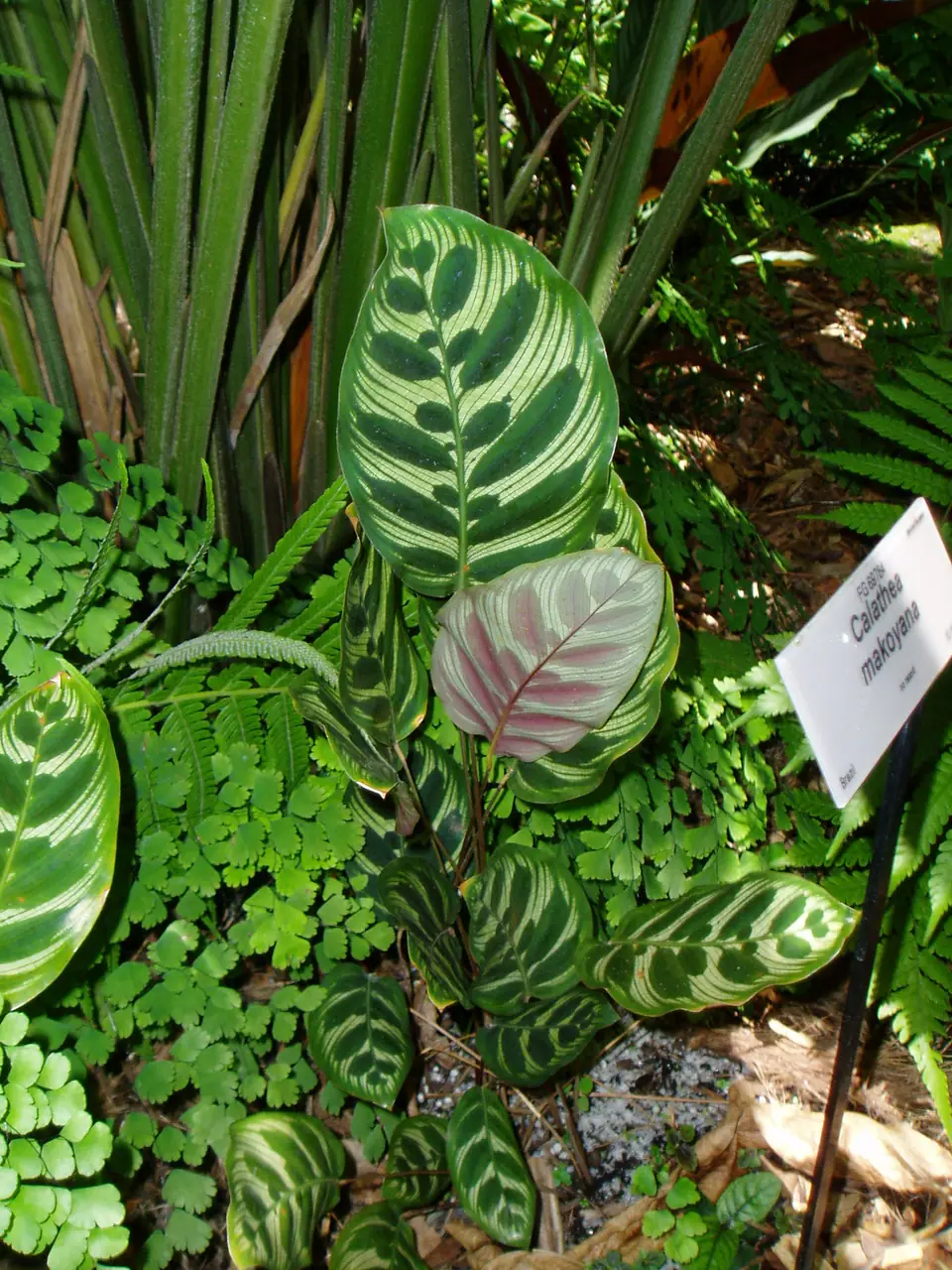

How to Grow and Care for Peacock Plant
Calathea makoyana
Written by Emilio Marruso · last checked
Not toxic to cats and dogs, according to the sources · Sources
At a glance
This calathea is a perennial that's happy indoors and in containers, and it's non-toxic to cats, dogs and horses, so it's a safe pick for homes with pets. Keep its soil moist but never soggy, give it rain or distilled water, and aim for 60% humidity. Treat it this way and its leaves stay flat and free of brown edges.
- Water
Keep the soil moist, never soggy; use rain or distilled water and water less in winter
What the sources say (5)
Watering: Keep the soil moist but not wet or soggy
The soil needs to be moist but not wet or soggy.
— Goeppertia makoyana (Brain Plant, Cathedral Windows, Peacock Calathea, Peacock Plant) | North Carolina Extension Gardener Plant Toolbox [1] Peacock plant care includes keeping the soil consistently moist.
— Peacock Plant Care - Taking Care Of Calathea Peacock Houseplants | Gardening Know How [5] Riego regular, de modo que el terreno esté constantemente húmedo
— Calatea pavo real - EcuRed [6] Watering notes: Distilled or rain water recommended because fluoride in tap water can brown the leaves; decrease watering in winter
Distilled water or rain water is recommended for watering since the fluoride in tap water can cause browning of the leaves.
— Goeppertia makoyana (Brain Plant, Cathedral Windows, Peacock Calathea, Peacock Plant) | North Carolina Extension Gardener Plant Toolbox [1] Decrease watering and stop fertilizing during the winter months.
— Goeppertia makoyana (Brain Plant, Cathedral Windows, Peacock Calathea, Peacock Plant) | North Carolina Extension Gardener Plant Toolbox [1] - Cold
Survives winters down to 40 °F (4.4 °C)
Tender: needs a frost-free greenhouse · USDA 11a · RHS H2 · Z11
What the sources say (2)
Hardiness, coldest zone: 11a [winter low 4.4 to 7.2 °C (40 to 45 °F)]
USDA Plant Hardiness Zone: 11a, 11b, 12a, 12b
— Goeppertia makoyana (Brain Plant, Cathedral Windows, Peacock Calathea, Peacock Plant) | North Carolina Extension Gardener Plant Toolbox [1] Hardiness, warmest zone: 12b [winter low 12.8 to 15.6 °C (55 to 60 °F)]
USDA Plant Hardiness Zone: 11a, 11b, 12a, 12b
— Goeppertia makoyana (Brain Plant, Cathedral Windows, Peacock Calathea, Peacock Plant) | North Carolina Extension Gardener Plant Toolbox [1] - Feeding
Balanced fertilizer every 4 weeks while it grows; none in winter
What the sources say (5)
When: During the growing season; stop in winter
It is best to fertilize this plant every 4 weeks with a balanced fertilizer during its growing season. Decrease watering and stop fertilizing during the winter months.
— Goeppertia makoyana (Brain Plant, Cathedral Windows, Peacock Calathea, Peacock Plant) | North Carolina Extension Gardener Plant Toolbox [1] How often: Every 4 weeks
It is best to fertilize this plant every 4 weeks with a balanced fertilizer during its growing season. Decrease watering and stop fertilizing during the winter months.
— Goeppertia makoyana (Brain Plant, Cathedral Windows, Peacock Calathea, Peacock Plant) | North Carolina Extension Gardener Plant Toolbox [1] Mineral fertilizers: Balanced fertilizer
commercial production, fertigation: This solution can be made using a water-soluble fertilizer with N-P2O5-K2O at a 3-1-2 ratio, such as a 24-8-16 or 18-6-12 with micronutrients.
— ENH1030 [7] commercial production, controlled-release: If a controlled-release fertilizer with the N-P2O5-K2O ratio of 3-1-2 is used, apply it at rate of 3 lb N per 1,000 square feet on a monthly basis.
— ENH1030 [7] It is best to fertilize this plant every 4 weeks with a balanced fertilizer during its growing season. Decrease watering and stop fertilizing during the winter months.
— Goeppertia makoyana (Brain Plant, Cathedral Windows, Peacock Calathea, Peacock Plant) | North Carolina Extension Gardener Plant Toolbox [1] - Pests
Aphids, scale, mealybugs and spider mites; too much water rots the roots
What the sources say (2)
Pests: aphids, scale, mealybugs, spider mites
Monitor for aphids, scale, mealybugs, and spider mites.
— Goeppertia makoyana (Brain Plant, Cathedral Windows, Peacock Calathea, Peacock Plant) | North Carolina Extension Gardener Plant Toolbox [1] Diseases: root rot (from overwatering)
Overwatering can cause root rot, and low humidity causes leaves to roll or brown.
— Goeppertia makoyana (Brain Plant, Cathedral Windows, Peacock Calathea, Peacock Plant) | North Carolina Extension Gardener Plant Toolbox [1] - Watch out
Dry air and tap water brown the leaves: keep the humidity at 60%
What the sources say (2)
Watering notes: Distilled or rain water recommended because fluoride in tap water can brown the leaves; decrease watering in winter
Distilled water or rain water is recommended for watering since the fluoride in tap water can cause browning of the leaves.
— Goeppertia makoyana (Brain Plant, Cathedral Windows, Peacock Calathea, Peacock Plant) | North Carolina Extension Gardener Plant Toolbox [1] Decrease watering and stop fertilizing during the winter months.
— Goeppertia makoyana (Brain Plant, Cathedral Windows, Peacock Calathea, Peacock Plant) | North Carolina Extension Gardener Plant Toolbox [1] - Size
1–2 ft tall and 8–12 in wide
What the sources say (2)
Mature height: 30-61 cm (1-2 ft)
The peacock plant has a clumping habit and grows up to 1 to 2 feet tall and 8 to 12 inches wide.
— Goeppertia makoyana (Brain Plant, Cathedral Windows, Peacock Calathea, Peacock Plant) | North Carolina Extension Gardener Plant Toolbox [1] Mature width: 20-30 cm (8-12 in)
The peacock plant has a clumping habit and grows up to 1 to 2 feet tall and 8 to 12 inches wide.
— Goeppertia makoyana (Brain Plant, Cathedral Windows, Peacock Calathea, Peacock Plant) | North Carolina Extension Gardener Plant Toolbox [1] - Propagation
Divide the roots in late spring, or take stem cuttings
What the sources say (3)
Propagation: Division of rhizomes in late spring; stem cuttings
Division of its rhizomatous roots in the late spring is the preferred method of propagation.
— Goeppertia makoyana (Brain Plant, Cathedral Windows, Peacock Calathea, Peacock Plant) | North Carolina Extension Gardener Plant Toolbox [1] Para multiplicarla se divide la mata al final de la primavera
— Calatea pavo real - EcuRed [6] También puede hacerse mediante esquejes en un substrato similar al de cultivo
— Calatea pavo real - EcuRed [6] - Containers
Grows indoors and in containers
What the sources say (2)
Indoors: Yes
the peacock plant can be used as specimen or atrium plant for a home or office setting provided there is high humidity.
— Goeppertia makoyana (Brain Plant, Cathedral Windows, Peacock Calathea, Peacock Plant) | North Carolina Extension Gardener Plant Toolbox [1] In containers: Yes
Indoor Plant, Small Gardens, Container Planting
— NParks | Goeppertia makoyana [3] - Safety
Safe for cats, dogs and horses
Overview
The peacock plant is an evergreen herbaceous perennial native to the tropical rainforests of southeastern Brazil. [1] Division of the rhizomes in late spring is the preferred method of propagation. [1]
Peacock Plant care
How to water Peacock Plant
Watering
Keep the soil moist but not wet or soggy
What the sources say (3)
The soil needs to be moist but not wet or soggy.Peacock plant care includes keeping the soil consistently moist.Riego regular, de modo que el terreno esté constantemente húmedoWatering notes
Distilled or rain water recommended because fluoride in tap water can brown the leaves; decrease watering in winter
What the sources say (2)
Distilled water or rain water is recommended for watering since the fluoride in tap water can cause browning of the leaves.Decrease watering and stop fertilizing during the winter months.How much light Peacock Plant needs
The sources disagree:
Semi-Shade, Full Shade
[3]
What the sources say (2)
This plant prefers bright, indirect sun or partial shadePlace this plant in a low to moderate light environment.How much cold Peacock Plant can take
Hardiness, coldest zone
11a [winter low 4.4 to 7.2 °C (40 to 45 °F)]
What the sources say (1)
USDA Plant Hardiness Zone:
11a, 11b, 12a, 12bHardiness, warmest zone
12b [winter low 12.8 to 15.6 °C (55 to 60 °F)]
What the sources say (1)
USDA Plant Hardiness Zone:
11a, 11b, 12a, 12bWhere to grow Peacock Plant
Indoors
Yes
What the sources say (1)
the peacock plant can be used as specimen or atrium plant for a home or office setting provided there is high humidity.In containers
Yes
What the sources say (1)
Indoor Plant, Small Gardens, Container PlantingHow to propagate Peacock Plant
Division of rhizomes in late spring; stem cuttings
What the sources say (3)
Division of its rhizomatous roots in the late spring is the preferred method of propagation.Para multiplicarla se divide la mata al final de la primaveraTambién puede hacerse mediante esquejes en un substrato similar al de cultivoHow to grow Peacock Plant
The plant
Life cycle
perennial
What the sources say (1)
The peacock plant is an evergreen herbaceous perennial species native to the tropical rainforests of southeastern Brazil.Family
Marantaceae
What the sources say (1)
It is a member of the prayer plant family (Marantaceae).Mature height
30-61 cm (1-2 ft)
What the sources say (1)
The peacock plant has a clumping habit and grows up to 1 to 2 feet tall and 8 to 12 inches wide.Mature width
20-30 cm (8-12 in)
What the sources say (1)
The peacock plant has a clumping habit and grows up to 1 to 2 feet tall and 8 to 12 inches wide.Pests and diseases
Pests
aphids, scale, mealybugs, spider mites
What the sources say (1)
Monitor for aphids, scale, mealybugs, and spider mites.Diseases
root rot (from overwatering)
What the sources say (1)
Overwatering can cause root rot, and low humidity causes leaves to roll or brown.Fertilizing
When
During the growing season; stop in winter
What the sources say (1)
It is best to fertilize this plant every 4 weeks with a balanced fertilizer during its growing season. Decrease watering and stop fertilizing during the winter months.How often
Every 4 weeks
What the sources say (1)
It is best to fertilize this plant every 4 weeks with a balanced fertilizer during its growing season. Decrease watering and stop fertilizing during the winter months.Mineral fertilizers
Balanced fertilizer
What each source says
commercial production, fertigation: Water-soluble fertilizer with a 3-1-2 ratio, such as 24-8-16 or 18-6-12 with micronutrients
commercial production, controlled-release: Controlled-release fertilizer with a 3-1-2 ratio at 14.6 g/m² of nitrogen monthly
What the sources say (3)
commercial production, fertigation: This solution can be made using a water-soluble fertilizer with N-P2O5-K2O at a 3-1-2 ratio, such as a 24-8-16 or 18-6-12 with micronutrients.commercial production, controlled-release: If a controlled-release fertilizer with the N-P2O5-K2O ratio of 3-1-2 is used, apply it at rate of 3 lb N per 1,000 square feet on a monthly basis.It is best to fertilize this plant every 4 weeks with a balanced fertilizer during its growing season. Decrease watering and stop fertilizing during the winter months.Micronutrients
Iron, with nitrogen, when leaves turn chlorotic from low fertilizer
What the sources say (1)
Leaf chlorosis Low fertilizer, over-watering, or high light levels Increase fertilizer, particularly nitrogen and iron; reduce watering frequency, reduce light levels.Avoid
Fertilizing in winter; water and fertilizer containing fluoride
What the sources say (2)
Decrease watering and stop fertilizing during the winter months.Dead spots near leaf margins Fluoride toxicity Avoid using water and fertilizer containing fluoride.Signs of deficiency
Leaf chlorosis (also caused by over-watering or high light): increase fertilizer, particularly nitrogen and iron
What the sources say (1)
Leaf chlorosis Low fertilizer, over-watering, or high light levels Increase fertilizer, particularly nitrogen and iron; reduce watering frequency, reduce light levels.Signs of excess
Leaf margin or tip necrosis from excess fertilizer, particularly high manganese
What the sources say (1)
Leaf marginal or tip necrosis Low pH, excess fertilizer, particularly high Mn Keep pH close to 6 and soluble salts between 1–2.5 dS/m in production and 1.0–1.5 in interiorscape.Peacock Plant pests and problems
Root rot
Symptom: Root rot from overwatering
What to do: Keep the soil moist but not wet or soggy
What the sources say (2)
Overwatering can cause root rot
— Goeppertia makoyana (Brain Plant, Cathedral Windows, Peacock Calathea, Peacock Plant) | North Carolina Extension Gardener Plant Toolbox [1] The soil needs to be moist but not wet or soggy.
— Goeppertia makoyana (Brain Plant, Cathedral Windows, Peacock Calathea, Peacock Plant) | North Carolina Extension Gardener Plant Toolbox [1] Leaf browning and rolling
Symptom: Leaves roll or brown with low humidity; tap-water fluoride browns the leaves
What to do: Use distilled or rain water and maintain a humidity level of 60%
What the sources say (3)
low humidity causes leaves to roll or brown.
— Goeppertia makoyana (Brain Plant, Cathedral Windows, Peacock Calathea, Peacock Plant) | North Carolina Extension Gardener Plant Toolbox [1] Distilled water or rain water is recommended for watering since the fluoride in tap water can cause browning of the leaves.
— Goeppertia makoyana (Brain Plant, Cathedral Windows, Peacock Calathea, Peacock Plant) | North Carolina Extension Gardener Plant Toolbox [1] a humidity level of 60% need to be maintained in order for the plant to thrive.
— Goeppertia makoyana (Brain Plant, Cathedral Windows, Peacock Calathea, Peacock Plant) | North Carolina Extension Gardener Plant Toolbox [1] Sucking insects
Symptom: Possible infestation by aphids, scale, mealybugs and spider mites
What the sources say (1)
Monitor for aphids, scale, mealybugs, and spider mites.
— Goeppertia makoyana (Brain Plant, Cathedral Windows, Peacock Calathea, Peacock Plant) | North Carolina Extension Gardener Plant Toolbox [1]
Remedies
The sources we checked give no remedies for this plant.
Is Peacock Plant poisonous?
Reported by the source, quoted verbatim. This is not medical or veterinary advice: if a person or an animal may have eaten this plant, contact a poison control centre or a veterinarian.
#non-toxic for cats #non-toxic for horses #non-toxic for dogs
[1]The source flags the risk for this animal but does not explain why.
Indicative values
Values from a secondary source, not checked word for word like the rest of this page. Use them as a starting point.
- Hours of sun
- 4-6 hoursIndicative value, adapt it to your climate · Secondary source
- Soil pH
- 6-7Indicative value, adapt it to your climate · Secondary source
- Growth rate
- ModerateIndicative value, adapt it to your climate · Secondary source
- Pruning
- March, April, MayIndicative value, adapt it to your climate · Secondary source
Similar plants
- Rattle Snake Plant Calathea crotalifera
- Rattlesnake Plant Calathea lancifolia
- Zebra Plant Calathea zebrina
- Ctenanthe Ctenanthe lubbersiana
- Giant Bamburanta Ctenanthe oppenheimiana
- Hardy Canna Thalia dealbata
- Prayer Plant Maranta leuconeura
- Rose-Painted Calathea Goeppertia roseopicta
Sources
Every value above is quoted from these documents. Links lead to the original publisher.
- Goeppertia makoyana (Brain Plant, Cathedral Windows, Peacock Calathea, Peacock Plant) | North Carolina Extension Gardener Plant Toolbox · plants.ces.ncsu.edu, consulted
- HortFlora · hortflora.rbg.vic.gov.au, consulted
- NParks | Goeppertia makoyana · nparks.gov.sg, consulted
- Cathedral Windows - Goeppertia makoyana | North Carolina Extension Gardener Plant Toolbox · plants.ces.ncsu.edu, consulted
- Peacock Plant Care - Taking Care Of Calathea Peacock Houseplants | Gardening Know How · gardeningknowhow.com, consulted
- Calatea pavo real - EcuRed · ecured.cu, consulted
- ENH1030 · edis.ifas.ufl.edu, consulted
Written by Emilio Marruso · last checked