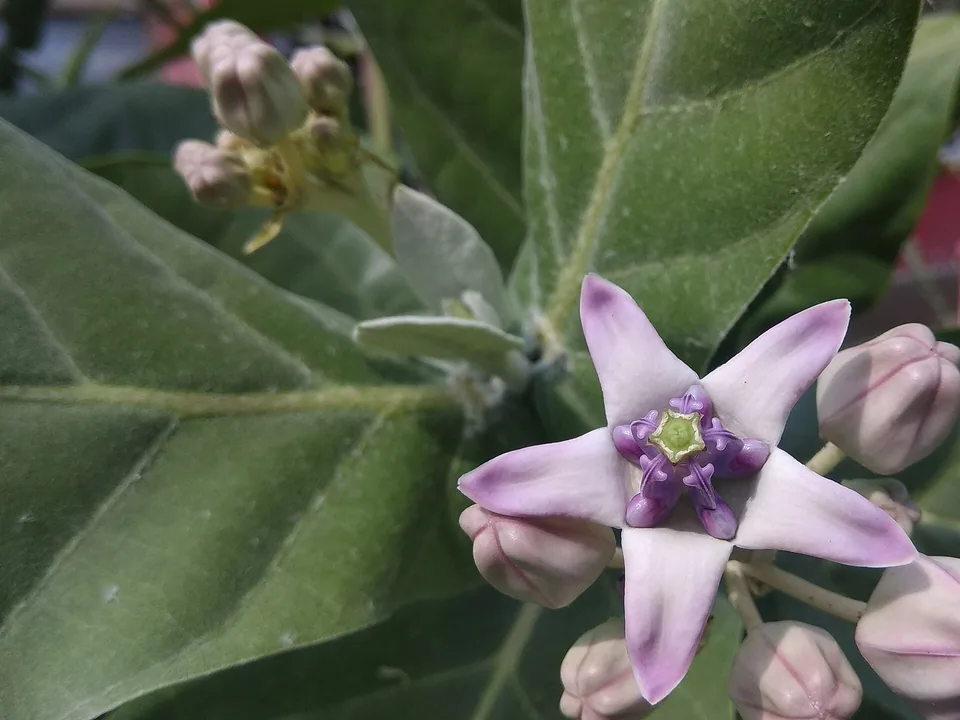

Cómo cultivar y cuidar Algodón de seda
Calotropis gigantea
Escrito por Emilio Marruso · última revisión
Tóxica para: Ganado vacuno, Personas · Por qué
De un vistazo
La flor de corona es una amante del sol muy agradecida: dale sol pleno y un riego profundo solo cuando la tierra se haya secado. También crece feliz en maceta, y puedes sacar nuevas plantas de semilla, de esquejes de tallo o por acodo. Eso sí, usa guantes y gafas al podarla, porque toda la planta es tóxica y su savia lechosa irrita la piel y los ojos.
- Sol
Sol pleno
Qué dicen las fuentes (2)
- Riego
Riego moderado: riega a fondo pero poco a menudo y deja secar la tierra entre riegos
Qué dicen las fuentes (3)
Riego: Riego moderado; riegos profundos poco frecuentes, dejando que el suelo se seque entre riegos.
Cultivation | Tolerates drought and saline sites. Allow soil to dry out before watering. Give space for plant to grow. Propagate by seeds or cuttings.
— NParks | Calotropis gigantea [1] Watering: Relatively drough intolerant, infrequent deep waterings are needed especially during summer needed to maintain a healthy appearance.
— [3] Soil Moisture: Average water needs, medium moisture, but do not overwater.
— Giant Milk Weed – Port St. Lucie Botanical Gardens [4] - Multiplicación
Por semilla, esquejes de tallo o acodo
Qué dicen las fuentes (3)
Propagación: Semilla; esquejes de tallo; acodo.
Cultivation | Tolerates drought and saline sites. Allow soil to dry out before watering. Give space for plant to grow. Propagate by seeds or cuttings.
— NParks | Calotropis gigantea [1] Propagation: Seed (soak in warm water 24 hours before planting), asexually by stem cuttings, easy.
— [3] Propagation: Stem cuttings and layering. - Wildlife: Attracts butterflies, bees and birds.
— Giant Milk Weed – Port St. Lucie Botanical Gardens [4] - Maceta
Crece también en maceta
Qué dicen las fuentes (1)
En maceta: Sí
Is suitable for 3 galllon pots or larger with excellent drainage for your patio or along your driveway.
— Giant Milk Weed – Port St. Lucie Botanical Gardens [4] - Seguridad
Toda la planta es tóxica; la savia lechosa irrita piel y ojos: usa guantes y gafas al podar
Resumen
La flor de corona es un gran arbusto de hoja perenne cultivado en climas cálidos como ornamental y planta hospedera de mariposas. [6] Todas las partes de la planta son tóxicas debido a los glucósidos cardíacos, y el látex lechoso irrita la piel, los ojos y las membranas mucosas. [3][5] Prefiere pleno sol y riego moderado, y se propaga por semilla o esquejes. [1]
Citado en inglés, como en la fuente.
Esta ficha está incompleta: las fuentes consultadas aún no cubren todos los campos.
Aún no cubierto por nuestras fuentes: Rusticidad, zona más fría, Poda
Cuidados
Riego
Riego moderado; riegos profundos poco frecuentes, dejando que el suelo se seque entre riegos.
Qué dicen las fuentes (3)
Cultivation
| Tolerates drought and saline sites. Allow soil to dry out before watering. Give space for plant to grow. Propagate by seeds or cuttings.Watering: Relatively drough intolerant, infrequent deep waterings are needed especially during summer needed to maintain a healthy appearance.Soil Moisture: Average water needs, medium moisture, but do not overwater.Luz
Clima y frío
Rusticidad, zona más fría
No figura en las fuentes consultadas.
Rusticidad, zona más cálida
11 [mínima invernal de 4,4 a 10 °C (de 40 a 50 °F)]
Dónde cultivarla
Sí
Qué dicen las fuentes (1)
Is suitable for 3 galllon pots or larger with excellent drainage for your patio or along your driveway.Propagación
Semilla; esquejes de tallo; acodo.
Qué dicen las fuentes (3)
Cultivation
| Tolerates drought and saline sites. Allow soil to dry out before watering. Give space for plant to grow. Propagate by seeds or cuttings.Propagation: Seed (soak in warm water 24 hours before planting), asexually by stem cuttings, easy.Propagation: Stem cuttings and layering.
- Wildlife: Attracts butterflies, bees and birds.Remedios
Cada remedio indica qué dicen las fuentes oficiales; los remedios tradicionales sin fuente oficial aparecen marcados. Los perjudiciales están para que sepas evitarlos.
Primeros auxilios
Primeros auxilios: no sustituyen al médico
contacto de la piel con el veneno
retira la ropa tocada y enjuaga la piel con agua corriente Fuente oficial, sin prueba independiente
For poison that has been swallowed, do not give the person activated charcoal. Do not give children ipecac syrup. Do not give the person anything before talking with the Poison Control Center.
— medlineplus.gov [7] Cómo: Para veneno en la piel, quita cualquier ropa tocada por el veneno. Enjuaga la piel de la persona con agua corriente durante 15 a 20 minutos.
For poison on the skin, take off any clothing touched by the poison. Rinse the person's skin with running water for 15 to 20 minutes.
— medlineplus.gov [7]
contacto de los ojos con el veneno
enjuaga los ojos con agua corriente Fuente oficial, sin prueba independiente
If the person has passed out, call 911 or the local emergency number right away.
— medlineplus.gov [7] Cómo: Si el veneno entra en los ojos, enjuaga los ojos de la persona con agua corriente durante 15 a 20 minutos.
For poison in the eyes, rinse the person's eyes with running water for 15 to 20 minutes.
— medlineplus.gov [7]
Venenosa para los animales
Según la fuente, citada textualmente. No es un consejo médico ni veterinario: si una persona o un animal pudo haber ingerido esta planta, contacta con un centro de toxicología o con un veterinario.
Animales
Sap is toxic to mammals, and causes vomitting and intestinal irritation when ingested. Known to have caused poisoning in grazing cattle.
[1]- Síntomas
Sap is toxic to mammals, and causes vomitting and intestinal irritation when ingested. Known to have caused poisoning in grazing cattle.
[1]
Personas
More about toxicity : All parts of the crown flower are toxic containing cardioactive glycosides including calotropin, a highly potent cardiac stimulant.
[3]- Partes venenosas
POISONOUS PARTS Whole plant. 2 ## TOXICITY - ## Toxic Constituents Cardiac glycosides such as calotropin , calatoxin and uscharin . 1–3
[5]- Principio tóxico
POISONOUS PARTS Whole plant. 2 ## TOXICITY - ## Toxic Constituents Cardiac glycosides such as calotropin , calatoxin and uscharin . 1–3
[5]- Síntomas
Poisoning Features Skin contact: irritant contact dermatitis . Ingestion: patient may present with digitalis-like toxicity .
[5]
Great care MUST be practiced (aka proper PPE) when pruning crown flower because of the inherent toxicity of its milky latex exudate, which can cause a mild skin dermititis , severe eye inflammation, or irritation of mucus membranes.
[3]- Partes venenosas
because of the inherent toxicity of its milky latex exudate, which can cause a mild skin dermititis , severe eye inflammation, or irritation of mucus membranes.
[3]- Síntomas
because of the inherent toxicity of its milky latex exudate, which can cause a mild skin dermititis , severe eye inflammation, or irritation of mucus membranes.
[3]
Calendario
Poda
No figura en las fuentes consultadas.
Meses tal como los dan las fuentes, en su mayoría de Estados Unidos (hemisferio norte). En el hemisferio sur se desplazan unos seis meses.
Comestibilidad
Según la fuente, citada textualmente. No comas una planta basándote solo en esta página: los errores de identificación pueden ser peligrosos.
Ethnobotanical Uses | Edible Plant Parts : Edible Flowers Food (Herb or Spice)
[1]
Valores orientativos
Valores de una fuente secundaria, no comprobados palabra por palabra como el resto de esta página. Úselos como punto de partida.
- Ciclo de vida
- PerenneValor orientativo, adáptalo a tu clima · Fuente secundaria
- Altura adulta
- 243.8-457.2 cm (8-15 pies)Valor orientativo, adáptalo a tu clima · Fuente secundaria
- Horas de sol
- 5-6 horasValor orientativo, adáptalo a tu clima · Fuente secundaria
- Resiste la sequía
- SíValor orientativo, adáptalo a tu clima · Fuente secundaria
- pH del suelo
- 6-7.5Valor orientativo, adáptalo a tu clima · Fuente secundaria
- Nivel de cuidado
- MedioValor orientativo, adáptalo a tu clima · Fuente secundaria
- Crecimiento
- BajoValor orientativo, adáptalo a tu clima · Fuente secundaria
- Poda
- Mayo, agosto, mayo, junio, julio, agosto, mayo, agosto, mayoValor orientativo, adáptalo a tu clima · Fuente secundaria
Plantas similares
- Mudar de la India Calotropis procera
- Abeto de Vancuver Abies grandis
- Abraham Trachystemon orientalis
- Bananero de Etiopía Ensete ventricosum
- Acacia longifolia Acacia longifolia
- Acanthus hungaricus Acanthus hungaricus
- Acónito común Aconitum napellus
- Palma de aguja Yucca flaccida
Fuentes
Cada valor anterior se cita de estos documentos. Los enlaces llevan al editor original.
- NParks | Calotropis gigantea · nparks.gov.sg, consultado
- Digital Garden :: UoK · keralauniversity.ac.in, consultado
- · asu.edu, consultado
- Giant Milk Weed – Port St. Lucie Botanical Gardens · pslbg.org, consultado
- Atlas of Poisonous Plants in Hong Kong - A Clinical Toxicology Perspective 香港有毒植物圖鑑 - 臨床毒理學透視 · www3.ha.org.hk, consultado
- Giant Milkweed - Calotropis gigantea · uforest.org, consultado
- medlineplus.gov · medlineplus.gov
Escrito por Emilio Marruso · última revisión