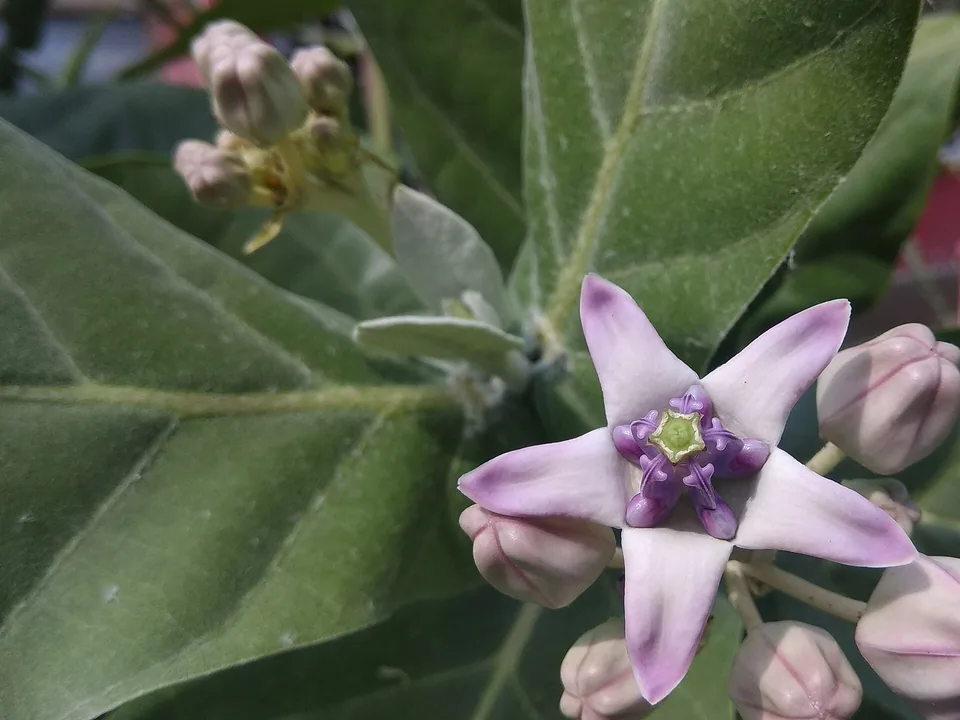

How to Grow and Care for Giant milkweed
Calotropis gigantea
Written by Emilio Marruso · last checked
Toxic to: Cattle, People · Why
At a glance
Crown flower is an easygoing sun lover: give it full sun and a deep drink only once the soil has dried out. It grows happily in containers too, and you can start new plants from seed, stem cuttings or layering. Just wear gloves and eye protection when pruning, because every part is toxic and its milky sap irritates skin and eyes.
- Sun
Full sun
What the sources say (2)
- Water
Moderate water: water deeply but rarely, letting the soil dry out in between
What the sources say (3)
Watering: Moderate water; infrequent deep waterings, allowing the soil to dry out between waterings
Cultivation | Tolerates drought and saline sites. Allow soil to dry out before watering. Give space for plant to grow. Propagate by seeds or cuttings.
— NParks | Calotropis gigantea [1] Watering: Relatively drough intolerant, infrequent deep waterings are needed especially during summer needed to maintain a healthy appearance.
— [3] Soil Moisture: Average water needs, medium moisture, but do not overwater.
— Giant Milk Weed – Port St. Lucie Botanical Gardens [4] - Propagation
From seed, stem cuttings or layering
What the sources say (3)
Propagation: Seed; stem cuttings; layering
Cultivation | Tolerates drought and saline sites. Allow soil to dry out before watering. Give space for plant to grow. Propagate by seeds or cuttings.
— NParks | Calotropis gigantea [1] Propagation: Seed (soak in warm water 24 hours before planting), asexually by stem cuttings, easy.
— [3] Propagation: Stem cuttings and layering. - Wildlife: Attracts butterflies, bees and birds.
— Giant Milk Weed – Port St. Lucie Botanical Gardens [4] - Containers
Grows in containers too
What the sources say (1)
In containers: Yes
Is suitable for 3 galllon pots or larger with excellent drainage for your patio or along your driveway.
— Giant Milk Weed – Port St. Lucie Botanical Gardens [4] - Safety
All parts are toxic; the milky sap irritates skin and eyes, so wear gloves and goggles to prune
Overview
Crown flower is a large evergreen shrub grown in warm climates as an ornamental and butterfly host plant. [6] All parts of the plant are toxic because of cardiac glycosides, and the milky latex irritates skin, eyes and mucous membranes. [3][5] It prefers full sun and moderate water, and propagates from seed or cuttings. [1]
This record is incomplete: the sources we read do not cover every field yet.
Not yet covered by our sources: Hardiness, coldest zone, Pruning
Giant milkweed care
How to water Giant milkweed
Moderate water; infrequent deep waterings, allowing the soil to dry out between waterings
What the sources say (3)
Cultivation
| Tolerates drought and saline sites. Allow soil to dry out before watering. Give space for plant to grow. Propagate by seeds or cuttings.Watering: Relatively drough intolerant, infrequent deep waterings are needed especially during summer needed to maintain a healthy appearance.Soil Moisture: Average water needs, medium moisture, but do not overwater.How much light Giant milkweed needs
How much cold Giant milkweed can take
Hardiness, coldest zone
Not stated in the sources we read.
Hardiness, warmest zone
11 [winter low 4.4 to 10 °C (40 to 50 °F)]
Where to grow Giant milkweed
Yes
What the sources say (1)
Is suitable for 3 galllon pots or larger with excellent drainage for your patio or along your driveway.How to propagate Giant milkweed
Seed; stem cuttings; layering
What the sources say (3)
Cultivation
| Tolerates drought and saline sites. Allow soil to dry out before watering. Give space for plant to grow. Propagate by seeds or cuttings.Propagation: Seed (soak in warm water 24 hours before planting), asexually by stem cuttings, easy.Propagation: Stem cuttings and layering.
- Wildlife: Attracts butterflies, bees and birds.Remedies
Each remedy shows what official sources say about it; traditional remedies without an official source are marked as such. Harmful ones are listed so you know to avoid them.
First aid
First aid: not a substitute for a doctor
skin contact with poison
remove touched clothing and rinse skin with running water Official source, not independently tested
For poison that has been swallowed, do not give the person activated charcoal. Do not give children ipecac syrup. Do not give the person anything before talking with the Poison Control Center.
— medlineplus.gov [7] How: For poison on the skin, take off any clothing touched by the poison. Rinse the person's skin with running water for 15 to 20 minutes.
For poison on the skin, take off any clothing touched by the poison. Rinse the person's skin with running water for 15 to 20 minutes.
— medlineplus.gov [7]
eye contact with poison
rinse eyes with running water Official source, not independently tested
If the person has passed out, call 911 or the local emergency number right away.
— medlineplus.gov [7] How: For poison in the eyes, rinse the person's eyes with running water for 15 to 20 minutes.
For poison in the eyes, rinse the person's eyes with running water for 15 to 20 minutes.
— medlineplus.gov [7]
Is Giant milkweed toxic to pets?
Reported by the source, quoted verbatim. This is not medical or veterinary advice: if a person or an animal may have eaten this plant, contact a poison control centre or a veterinarian.
Animals
Sap is toxic to mammals, and causes vomitting and intestinal irritation when ingested. Known to have caused poisoning in grazing cattle.
[1]- Symptoms
Sap is toxic to mammals, and causes vomitting and intestinal irritation when ingested. Known to have caused poisoning in grazing cattle.
[1]
People
More about toxicity : All parts of the crown flower are toxic containing cardioactive glycosides including calotropin, a highly potent cardiac stimulant.
[3]- Poisonous parts
POISONOUS PARTS Whole plant. 2 ## TOXICITY - ## Toxic Constituents Cardiac glycosides such as calotropin , calatoxin and uscharin . 1–3
[5]- Toxic principle
POISONOUS PARTS Whole plant. 2 ## TOXICITY - ## Toxic Constituents Cardiac glycosides such as calotropin , calatoxin and uscharin . 1–3
[5]- Symptoms
Poisoning Features Skin contact: irritant contact dermatitis . Ingestion: patient may present with digitalis-like toxicity .
[5]
Great care MUST be practiced (aka proper PPE) when pruning crown flower because of the inherent toxicity of its milky latex exudate, which can cause a mild skin dermititis , severe eye inflammation, or irritation of mucus membranes.
[3]- Poisonous parts
because of the inherent toxicity of its milky latex exudate, which can cause a mild skin dermititis , severe eye inflammation, or irritation of mucus membranes.
[3]- Symptoms
because of the inherent toxicity of its milky latex exudate, which can cause a mild skin dermititis , severe eye inflammation, or irritation of mucus membranes.
[3]
Calendar
Pruning
Not stated in the sources we read.
Months as given by the sources, which are mostly from the United States (northern hemisphere). In the southern hemisphere they shift by about six months.
Edibility
Reported by the source, quoted verbatim. Do not eat a plant on the basis of this page alone: identification mistakes can be dangerous.
Ethnobotanical Uses | Edible Plant Parts : Edible Flowers Food (Herb or Spice)
[1]
Indicative values
Values from a secondary source, not checked word for word like the rest of this page. Use them as a starting point.
- Life cycle
- PerennialIndicative value, adapt it to your climate · Secondary source
- Mature height
- 243.8-457.2 cm (8-15 ft)Indicative value, adapt it to your climate · Secondary source
- Hours of sun
- 5-6 hoursIndicative value, adapt it to your climate · Secondary source
- Drought tolerant
- yesIndicative value, adapt it to your climate · Secondary source
- Soil pH
- 6-7.5Indicative value, adapt it to your climate · Secondary source
- Care level
- MediumIndicative value, adapt it to your climate · Secondary source
- Growth rate
- LowIndicative value, adapt it to your climate · Secondary source
- Pruning
- May, August, May, June, July, August, May, August, MayIndicative value, adapt it to your climate · Secondary source
Similar plants
- Roostertree Calotropis procera
- Abies grandis Abies grandis
- Abraham Trachystemon orientalis
- Abyssinian banana Ensete ventricosum
- Acacia longifolia Acacia longifolia
- Acanthus hungaricus Acanthus hungaricus
- Aconite Aconitum napellus
- Adam's Needle Yucca flaccida
Sources
Every value above is quoted from these documents. Links lead to the original publisher.
- NParks | Calotropis gigantea · nparks.gov.sg, consulted
- Digital Garden :: UoK · keralauniversity.ac.in, consulted
- · asu.edu, consulted
- Giant Milk Weed – Port St. Lucie Botanical Gardens · pslbg.org, consulted
- Atlas of Poisonous Plants in Hong Kong - A Clinical Toxicology Perspective 香港有毒植物圖鑑 - 臨床毒理學透視 · www3.ha.org.hk, consulted
- Giant Milkweed - Calotropis gigantea · uforest.org, consulted
- medlineplus.gov · medlineplus.gov
Written by Emilio Marruso · last checked