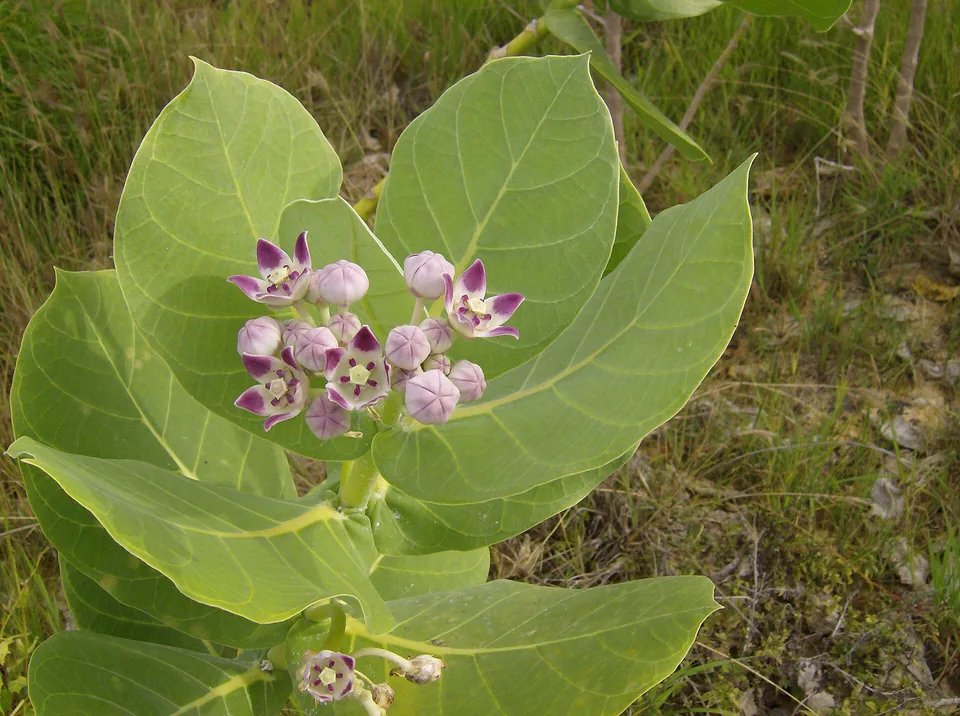

How to Grow and Care for Roostertree
Calotropis procera
Written by Emilio Marruso · last checked
Toxic to: Cattle · Why
At a glance
This is a tough plant that shrugs off drought and even copes with somewhat salty soil, getting by on just 12–16 inches of rain a year. It grows easily from seed with no special treatment, and goats happily nibble its young pods, older leaves and flowers. Just plan its spot with care: once cut, it bounces back fast from its big root.
- Water
Handles drought well; gets by on 12–16 inches of rain a year
What the sources say (2)
Watering notes: Drought-resistant and relatively salt-tolerant; mean annual rainfall of 300-400 mm [11.8–15.7 in] in its biophysical limits
C. procera is drought-resistant, salt-tolerant to a relatively high degree, and through its wind and animal
— Calotropis procera [1] Mean annual rainfall: 300-400 mm Soil type: Prefers
— Calotropis procera [1] - Soil
Copes with somewhat salty soil
What the sources say (2)
Watering notes: Drought-resistant and relatively salt-tolerant; mean annual rainfall of 300-400 mm [11.8–15.7 in] in its biophysical limits
C. procera is drought-resistant, salt-tolerant to a relatively high degree, and through its wind and animal
— Calotropis procera [1] Mean annual rainfall: 300-400 mm Soil type: Prefers
— Calotropis procera [1] - Spacing
3–5 ft between plants
What the sources say (1)
Spacing: 100-150 cm (1-1.5 m), as used in cultivation for fibre production
C. procera has been cultivated in South America and on the Caribbean Islands for the production of fibres at a spacing of 1-1.5 m.
— Calotropis procera [1] - Harvest
Goats eat its young pods, older leaves and flowers
- Pests
Aphids, grasshoppers and other insects feed on the leaves
- Watch out
Cut it to the ground and it quickly grows back from its big root
- Propagation
Grows from seed, no special treatment needed
What the sources say (2)
- Safety
Slightly toxic to cattle and other livestock, which rarely eat it
Overview
Calotropis procera is a shrub or small tree that is drought-resistant and relatively salt-tolerant and prefers disturbed sandy soils. [1] It quickly becomes established as a weed along degraded roadsides and in overgrazed pastures, and regrows from its root system when the above-ground plant is removed. [1][5] Its latex is cardiotoxic, the active ingredient being calotropin. [1]
This record is incomplete: the sources we read do not cover every field yet.
Not yet covered by our sources: Light, Hardiness, coldest zone, Hardiness, warmest zone
Roostertree care
Measurements in square brackets are our conversion into the other unit system; the quoted text is unchanged.
How to water Roostertree
Drought-resistant and relatively salt-tolerant; mean annual rainfall of 300-400 mm [11.8–15.7 in] in its biophysical limits
How much light Roostertree needs
Not stated in the sources we read.
How much cold Roostertree can take
Hardiness, coldest zone
Not stated in the sources we read.
Hardiness, warmest zone
Not stated in the sources we read.
Where to grow Roostertree
100-150 cm (1-1.5 m), as used in cultivation for fibre production
What the sources say (1)
C. procera has been cultivated in South America and on the Caribbean Islands for the production of fibres at a spacing of 1-1.5 m.How to propagate Roostertree
Seed (no treatment required)
Roostertree pests and problems
Regrowth after cutting
Symptom: New plants grow quickly from the large taproot when the plant is cut off at ground level
What to do: Machinery able to cut plants 10-20 cm below ground gives high kill rates; large-scale seedling regrowth should be expected afterwards
What the sources say (1)
Roots are large and spongy; new plants quickly grow from large taproot if plant is cut off at ground level.
— Calotrope | Business Queensland [5] Insect pests
Symptom: Aphids, grasshoppers and other insects eat or suck the leaves despite the toxic latex
What the sources say (1)
Aphids, grasshoppers and other insect pests eat or suck the leaves despite the toxic latex within.
— Calotropis procera [1]
Remedies
Each remedy shows what official sources say about it; traditional remedies without an official source are marked as such. Harmful ones are listed so you know to avoid them.
Getting rid of it
calotrope regrowth from taproot
cutting roots 10-20 cm below ground Works
With mechanical disturbance, large-scale seedling regrowth should be expected afterwards.
— Calotrope | Business Queensland [5] How: Machinery capable of cutting plants off 10-20cm below ground (e.g. blade ploughs or cutter bars) can cause high kill rates.
Roots are large and spongy; new plants quickly grow from large taproot if plant is cut off at ground level. Machinery capable of cutting plants off 10-20cm below ground (e.g. blade ploughs or cutter bars) can cause high kill rates.
— Calotrope | Business Queensland [5] What the evidence says Machinery capable of cutting plants off 10-20cm below ground (e.g. blade ploughs or cutter bars) can cause high kill rates.
— Calotrope | Business Queensland [5]
calotrope regrowth after fire
fire Not proven
How: Calotrope appears to tolerate fire; the above-ground portion is often killed but plants vigorously reshoot from the base.
Calotrope appears to tolerate fire and, although above-ground portion is often killed, plants will vigorously reshoot from base.
— Calotrope | Business Queensland [5] What the evidence says Calotrope appears to tolerate fire and, although above-ground portion is often killed, plants will vigorously reshoot from base.
— Calotrope | Business Queensland [5]
Is Roostertree toxic to pets?
Reported by the source, quoted verbatim. This is not medical or veterinary advice: if a person or an animal may have eaten this plant, contact a poison control centre or a veterinarian.
Edibility
Reported by the source, quoted verbatim. Do not eat a plant on the basis of this page alone: identification mistakes can be dangerous.
Indicative values
Values from a secondary source, not checked word for word like the rest of this page. Use them as a starting point.
- Life cycle
- PerennialIndicative value, adapt it to your climate · Secondary source
- Mature height
- 182.9-243.8 cm (6-8 ft)Indicative value, adapt it to your climate · Secondary source
- Light
- Full sun, part shadeIndicative value, adapt it to your climate · Secondary source
- Hours of sun
- 6-8 hoursIndicative value, adapt it to your climate · Secondary source
- Watering
- MinimumIndicative value, adapt it to your climate · Secondary source
- Drought tolerant
- yesIndicative value, adapt it to your climate · Secondary source
- Soil pH
- 6-8Indicative value, adapt it to your climate · Secondary source
- USDA hardiness zones
- 10-11 [winter low −1.1 to 10 °C (30 to 50 °F)]Indicative value, adapt it to your climate · Secondary source
- Growth rate
- LowIndicative value, adapt it to your climate · Secondary source
- Pruning
- February, March, April, AugustIndicative value, adapt it to your climate · Secondary source
Similar plants
- Giant milkweed Calotropis gigantea
- Aaron's Beard Hypericum calycinum
- Abraham Trachystemon orientalis
- Acacia longifolia Acacia longifolia
- Aconite Aconitum napellus
- Adam's Needle Yucca flaccida
- Afghan Cherry Prunus jacquemontii
- African Blood Lily Scadoxus multiflorus
Sources
Every value above is quoted from these documents. Links lead to the original publisher.
- Calotropis procera · apps.worldagroforestry.org, consulted
- Calotropis procera (PROSEA) - Pl@ntUse · uses.plantnet-project.org, consulted
- Calotropis procera | TRAMIL · tramil.net, consulted
- Calotropis procera Asclepiadaceae · apps.worldagroforestry.org, consulted
- Calotrope | Business Queensland · business.qld.gov.au, consulted
- Distribution, invasiveness, biology and control of rubber bush (Calotropis procera) in northern Australia - FutureBeef · futurebeef.com.au, consulted
Written by Emilio Marruso · last checked