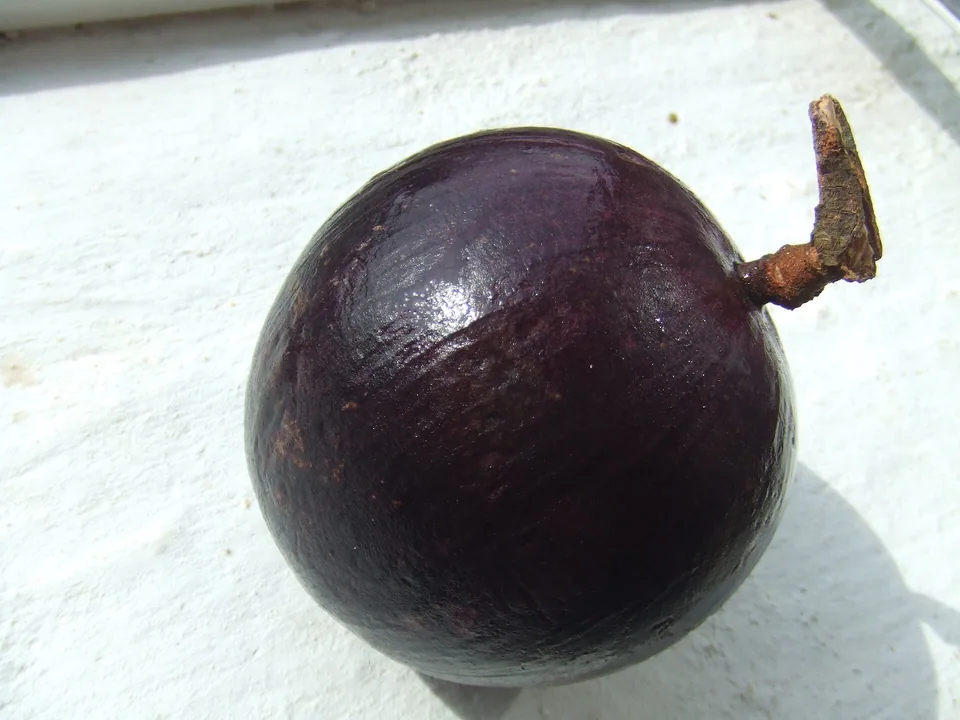

Cómo cultivar y cuidar Caimito
Chrysophyllum cainito
Escrito por Emilio Marruso · última revisión
De un vistazo
El caimito es un árbol de sol pleno cuyo fruto se come fresco o en macedonias y sorbetes. Los árboles injertados o acodados pueden dar fruto en solo 1–2 años, mientras que los de semilla tardan 5–10. Cosecha los frutos maduros de febrero a mayo, déjalos terminar de madurar a temperatura ambiente y disfruta de la pulpa, porque la piel no se come.
- Sol
Sol pleno
Qué dicen las fuentes (1)
Luz: Pleno sol
In general, caimito trees should be planted in full sun for best growth and fruit production.
— HS1069/HS309: Caimito (Star Apple) Growing in the Florida Home Landscape [3] - Riego
Riega los árboles jóvenes dos veces por semana en sequías largas; el exceso de agua pudre las raíces
Qué dicen las fuentes (3)
Riego: El riego es beneficioso durante períodos secos prolongados una vez que los árboles tienen 4 o más años
Once caimito trees are 4 or more years old, irrigation will be beneficial to plant growth and crop yields during prolonged dry periods.
— HS1069/HS309: Caimito (Star Apple) Growing in the Florida Home Landscape [3] Notas sobre el riego: Los árboles jóvenes (primeros 3 años) deben regarse bien dos veces por semana durante períodos prolongados de sequía; demasiada agua aplicada con demasiada frecuencia causa pudrición de raíces
During prolonged dry periods (e.g., 5 or more days of little to no rainfall), newly planted and young caimito trees (first 3 years) should be well watered twice a week.
— HS1069/HS309: Caimito (Star Apple) Growing in the Florida Home Landscape [3] The use of lawn sprinkler systems on a timer may result in over watering and cause caimito trees to decline. This is because too much water too often applied causes root rot.
— HS1069/HS309: Caimito (Star Apple) Growing in the Florida Home Landscape [3] - Suelo
En suelos alcalinos le falta hierro: aporta quelato de hierro al suelo
Qué dicen las fuentes (3)
Microelementos: Cobre, zinc, manganeso y boro en 3 a 4 aspersiones foliares al año desde la primavera hasta el verano durante los primeros 4 a 5 años; drenajes de suelo con quelato de hierro en suelos alcalinos con pH alto, de abril a septiembre; sulfato ferroso en suelos con pH bajo; magnesio en la mezcla de fertilizante
From spring through summer, trees should receive 3 to 4 annual nutritional sprays of copper, zinc, manganese, and boron for the first 4 to 5 years.
— HS1069/HS309: Caimito (Star Apple) Growing in the Florida Home Landscape [3] Iron deficiency can be prevented or corrected by periodic soil applications of iron chelates formulated for alkaline and high soil pH conditions. Periodic applications of ferrous (iron) sulfate may be made to trees growing in low-pH soils.
— HS1069/HS309: Caimito (Star Apple) Growing in the Florida Home Landscape [3] Iron chelated soil drenches (iron plus water) will prevent iron deficiency in high-pH, calcareous soils; foliar iron sprays are generally not effective. Apply soil drenches from April through September.
— HS1069/HS309: Caimito (Star Apple) Growing in the Florida Home Landscape [3] - Abonado
Abona 3 o 4 veces al año con un abono con magnesio; reduce a finales de verano y principios de otoño
Qué dicen las fuentes (9)
Cuándo: Durante el año en 3 o 4 aplicaciones granulares, reducido a fines del verano y principios del otoño para frenar el crecimiento antes de la floración de fines del otoño; pulverizaciones de micronutrientes desde el verano hasta el otoño
apply granular fertilizer 3–4 times per year. Reduce the amount of NPK application during late summer, early fall to slow plant growth in preparation for flowering in the late fall.
— HS1069/HS309: Caimito (Star Apple) Growing in the Florida Home Landscape [3] From spring through summer, trees should receive 3 to 4 annual nutritional sprays of copper, zinc, manganese, and boron for the first 4 to 5 years.
— HS1069/HS309: Caimito (Star Apple) Growing in the Florida Home Landscape [3] Frecuencia: Cada 1 a 2 meses durante el primer año, luego 3 o 4 veces al año
In Florida, young trees should be fertilized every 1 to 2 months during the first year, beginning with 1/4 lb (114 g) of fertilizer and increasing to 1 lb (455 g) per tree
— HS1069/HS309: Caimito (Star Apple) Growing in the Florida Home Landscape [3] Thereafter, 3 or 4 applications per year in amounts proportionate to the increasing size of the tree are sufficient, not to exceed 20 lbs per tree per year.
— HS1069/HS309: Caimito (Star Apple) Growing in the Florida Home Landscape [3] Abonos minerales: Fertilizante granulado con magnesio, como 6-6-6-2 o 8-3-9-2, no más de 9.07 kg [20 lb] por árbol al año
árboles jóvenes: Fertilizer mixtures containing 6 to 10% nitrogen (N), 6 to 10% available phosphate (P 2 O 5 ), 6 to 10% potash (K 2 O), and 4 to 6% magnesium (Mg) give satisfactory results with young trees.
— HS1069/HS309: Caimito (Star Apple) Growing in the Florida Home Landscape [3] árboles en producción: For bearing trees, potash should be increased to 9 to 15% and available phosphoric acid reduced to 2 to 4%.
— HS1069/HS309: Caimito (Star Apple) Growing in the Florida Home Landscape [3] primer año: In Florida, young trees should be fertilized every 1 to 2 months during the first year, beginning with 1/4 lb (114 g) of fertilizer and increasing to 1 lb (455 g) per tree
— HS1069/HS309: Caimito (Star Apple) Growing in the Florida Home Landscape [3] Examples of commonly available fertilizer mixes include 6-6-6-2 [6 (N)-6 (P 2 O 5 )-6 (K 2 O)-2 (Mg)] and 8-3-9-2 [8 (N)-3 (P 2 O 5 )-6 (K 2 O)-3 (Mg)].
— HS1069/HS309: Caimito (Star Apple) Growing in the Florida Home Landscape [3] Thereafter, 3 or 4 applications per year in amounts proportionate to the increasing size of the tree are sufficient, not to exceed 20 lbs per tree per year.
— HS1069/HS309: Caimito (Star Apple) Growing in the Florida Home Landscape [3] - Poda
Poda después de la cosecha
Qué dicen las fuentes (1)
Poda: Después de la temporada de cosecha
Selectively prune trees after the harvest season. | | | Follow-up pruning
— HS1069/HS309: Caimito (Star Apple) Growing in the Florida Home Landscape [3] - Cosecha
De febrero a mayo; deja madurar a temperatura ambiente y come la pulpa, no la piel
Qué dicen las fuentes (4)
Cosecha: De febrero a mayo
Florida (UF/IFAS EDIS): Caimito bloom from August to October in Florida, and fruit are generally harvested from February to May.
— HS1069/HS309: Caimito (Star Apple) Growing in the Florida Home Landscape [3] Florida Suncoast (condado de Sarasota): typically in season from late March to early May in Florida, is where the Caimito earns its stellar name.
— Suncoast Grown and Gathered: April is for Star Apple (Caimito) - UF/IFAS Extension Sarasota County [2] Caimito bloom from August to October in Florida, and fruit are generally harvested from February to May.
— HS1069/HS309: Caimito (Star Apple) Growing in the Florida Home Landscape [3] Cómo cosechar: Recoge el fruto maduro y déjalo madurar por completo a temperatura ambiente
Once mature fruit are picked, they may be allowed to fully ripen at room temperature.
— HS1069/HS309: Caimito (Star Apple) Growing in the Florida Home Landscape [3] - Plagas
Las orugas de polilla pueden atacar las flores
Qué dicen las fuentes (1)
Plagas: Larvas de lepidópteros (polillas) en las flores
However, recently some type of Lepidoptera (moth) larvae has been observed to attack the flowers.
— HS1069/HS309: Caimito (Star Apple) Growing in the Florida Home Landscape [3] - Atención
No abones mucho el césped cercano: las raíces llegan hasta allí y da menos fruta
Qué dicen las fuentes (3)
Evitar: Fertilización intensa del césped junto al árbol, donde sus raíces se extienden más allá de la línea de goteo; compost o tierra vegetal colocados en el fondo del hoyo de plantación
Roots of mature caimito trees spread beyond the drip-line of the tree canopy and heavy fertilization of the lawn next to caimito trees is not recommended and may reduce fruiting and or fruit quality.
— HS1069/HS309: Caimito (Star Apple) Growing in the Florida Home Landscape [3] In fact, placing topsoil or compost in the hole first and then planting on top of it is not desirable.
— HS1069/HS309: Caimito (Star Apple) Growing in the Florida Home Landscape [3] Signos de exceso: Reducción de la fructificación y calidad de la fruta por la fertilización intensa del césped cercano
Roots of mature caimito trees spread beyond the drip-line of the tree canopy and heavy fertilization of the lawn next to caimito trees is not recommended and may reduce fruiting and or fruit quality.
— HS1069/HS309: Caimito (Star Apple) Growing in the Florida Home Landscape [3] - Tamaño
De 8 a 30 m de alto
Qué dicen las fuentes (1)
Altura adulta: 762-3048 cm (25-100 pies)
Caimito trees are medium to large trees, 25 to 100 ft tall (7.9 to 30.5 m) with a round to oval canopy.
— HS1069/HS309: Caimito (Star Apple) Growing in the Florida Home Landscape [3] - Multiplicación
Por semilla, injerto o acodo aéreo; los injertados dan fruto en 1–2 años, los de semilla en 5–10
Qué dicen las fuentes (2)
Propagación: Semilla, injerto, brotación y acodo aéreo
Caimito may be propagated by seed, grafting, budding, and air-layering.
— HS1069/HS309: Caimito (Star Apple) Growing in the Florida Home Landscape [3] Años hasta el primer fruto: 5-10 (árboles de plántula); 1-2 (árboles propagados vegetativamente)
Seedling trees bear in 5 to 10 years, whereas vegetatively propagated trees may begin fruit production in 1 to 2 years.
— HS1069/HS309: Caimito (Star Apple) Growing in the Florida Home Landscape [3]
Resumen
El caimito es un árbol de tamaño mediano a grande que se cultiva principalmente como árbol frutal en paisajes domésticos. [3] Se planta a pleno sol en la parte más cálida del paisaje. [3] Los frutos generalmente se cosechan de febrero a mayo en Florida. [3]
Citado en inglés, como en la fuente.
Esta ficha está incompleta: las fuentes consultadas aún no cubren todos los campos.
Aún no cubierto por nuestras fuentes: Plantación, Distancia de plantación
Cuidados
Riego
Riego
El riego es beneficioso durante períodos secos prolongados una vez que los árboles tienen 4 o más años
Qué dicen las fuentes (1)
Once caimito trees are 4 or more years old, irrigation will be beneficial to plant growth and crop yields during prolonged dry periods.Notas sobre el riego
Los árboles jóvenes (primeros 3 años) deben regarse bien dos veces por semana durante períodos prolongados de sequía; demasiada agua aplicada con demasiada frecuencia causa pudrición de raíces
Qué dicen las fuentes (2)
During prolonged dry periods (e.g., 5 or more days of little to no rainfall), newly planted and young caimito trees (first 3 years) should be well watered twice a week.The use of lawn sprinkler systems on a timer may result in over watering and cause caimito trees to decline. This is because too much water too often applied causes root rot.Luz
Pleno sol
Qué dicen las fuentes (1)
In general, caimito trees should be planted in full sun for best growth and fruit production.Dónde cultivarla
No figura en las fuentes consultadas.
Propagación
Semilla, injerto, brotación y acodo aéreo
Qué dicen las fuentes (1)
Caimito may be propagated by seed, grafting, budding, and air-layering.Cultivo
La planta
Familia
Sapotaceae
Qué dicen las fuentes (1)
Family : Sapotaceae
Relatives of Caimito : mamey sapote, green sapote, abiu, and canistel.Altura adulta
762-3048 cm (25-100 pies)
Qué dicen las fuentes (1)
Caimito trees are medium to large trees, 25 to 100 ft tall (7.9 to 30.5 m) with a round to oval canopy.Años hasta el primer fruto
5-10 (árboles de plántula); 1-2 (árboles propagados vegetativamente)
Qué dicen las fuentes (1)
Seedling trees bear in 5 to 10 years, whereas vegetatively propagated trees may begin fruit production in 1 to 2 years.Cosecha y conservación
Cómo cosechar
Recoge el fruto maduro y déjalo madurar por completo a temperatura ambiente
Qué dicen las fuentes (1)
Once mature fruit are picked, they may be allowed to fully ripen at room temperature.Conservación
Una vez maduro, en una bolsa de plástico en el refrigerador
Qué dicen las fuentes (1)
Once ripe, fruit may be stored in a plastic bag in the refrigerator until consumed.Plagas y enfermedades
Plagas
Larvas de lepidópteros (polillas) en las flores
Qué dicen las fuentes (1)
However, recently some type of Lepidoptera (moth) larvae has been observed to attack the flowers.Abonado
Cuándo
Durante el año en 3 o 4 aplicaciones granulares, reducido a fines del verano y principios del otoño para frenar el crecimiento antes de la floración de fines del otoño; pulverizaciones de micronutrientes desde el verano hasta el otoño
Qué dicen las fuentes (2)
apply granular fertilizer 3–4 times per year. Reduce the amount of NPK application during late summer, early fall to slow plant growth in preparation for flowering in the late fall.From spring through summer, trees should receive 3 to 4 annual nutritional sprays of copper, zinc, manganese, and boron for the first 4 to 5 years.Frecuencia
Cada 1 a 2 meses durante el primer año, luego 3 o 4 veces al año
Qué dicen las fuentes (2)
In Florida, young trees should be fertilized every 1 to 2 months during the first year, beginning with 1/4 lb (114 g) of fertilizer and increasing to 1 lb (455 g) per treeThereafter, 3 or 4 applications per year in amounts proportionate to the increasing size of the tree are sufficient, not to exceed 20 lbs per tree per year.Abonos naturales
Compost al plantar, mezclado solo con la tierra excavada en una proporción máxima de 1:1, nunca colocado en el hoyo
Qué dicen las fuentes (2)
If you wish to add topsoil or compost to the native soil, mix it with the excavated soil in no more than a 1:1 ratio.In fact, placing topsoil or compost in the hole first and then planting on top of it is not desirable.Abonos minerales
Fertilizante granulado con magnesio, como 6-6-6-2 o 8-3-9-2, no más de 9.07 kg [20 lb] por árbol al año
Lo que dice cada fuente
árboles jóvenes: Mezcla con 6-10% de nitrógeno, 6-10% de fosfato, 6-10% de potasa y 4-6% de magnesio
árboles en producción: Potasa elevada al 9-15% y fosfato reducido al 2-4%
primer año: 114 g por árbol al principio, aumentando hasta 455 g por árbol
Qué dicen las fuentes (5)
árboles jóvenes: Fertilizer mixtures containing 6 to 10% nitrogen (N), 6 to 10% available phosphate (P 2 O 5 ), 6 to 10% potash (K 2 O), and 4 to 6% magnesium (Mg) give satisfactory results with young trees.árboles en producción: For bearing trees, potash should be increased to 9 to 15% and available phosphoric acid reduced to 2 to 4%.primer año: In Florida, young trees should be fertilized every 1 to 2 months during the first year, beginning with 1/4 lb (114 g) of fertilizer and increasing to 1 lb (455 g) per treeExamples of commonly available fertilizer mixes include 6-6-6-2 [6 (N)-6 (P 2 O 5 )-6 (K 2 O)-2 (Mg)] and 8-3-9-2 [8 (N)-3 (P 2 O 5 )-6 (K 2 O)-3 (Mg)].Thereafter, 3 or 4 applications per year in amounts proportionate to the increasing size of the tree are sufficient, not to exceed 20 lbs per tree per year.Microelementos
Cobre, zinc, manganeso y boro en 3 a 4 aspersiones foliares al año desde la primavera hasta el verano durante los primeros 4 a 5 años; drenajes de suelo con quelato de hierro en suelos alcalinos con pH alto, de abril a septiembre; sulfato ferroso en suelos con pH bajo; magnesio en la mezcla de fertilizante
Qué dicen las fuentes (3)
From spring through summer, trees should receive 3 to 4 annual nutritional sprays of copper, zinc, manganese, and boron for the first 4 to 5 years.Iron deficiency can be prevented or corrected by periodic soil applications of iron chelates formulated for alkaline and high soil pH conditions. Periodic applications of ferrous (iron) sulfate may be made to trees growing in low-pH soils.Iron chelated soil drenches (iron plus water) will prevent iron deficiency in high-pH, calcareous soils; foliar iron sprays are generally not effective. Apply soil drenches from April through September.Evitar
Fertilización intensa del césped junto al árbol, donde sus raíces se extienden más allá de la línea de goteo; compost o tierra vegetal colocados en el fondo del hoyo de plantación
Qué dicen las fuentes (2)
Roots of mature caimito trees spread beyond the drip-line of the tree canopy and heavy fertilization of the lawn next to caimito trees is not recommended and may reduce fruiting and or fruit quality.In fact, placing topsoil or compost in the hole first and then planting on top of it is not desirable.Signos de exceso
Reducción de la fructificación y calidad de la fruta por la fertilización intensa del césped cercano
Qué dicen las fuentes (1)
Roots of mature caimito trees spread beyond the drip-line of the tree canopy and heavy fertilization of the lawn next to caimito trees is not recommended and may reduce fruiting and or fruit quality.Problemas
Deficiencia de hierro en suelos alcalinos
Síntoma: Los árboles de caimito son susceptibles a la deficiencia de hierro en condiciones de suelo alcalino y con pH alto.
Qué hacer: La deficiencia de hierro se puede prevenir o corregir con aplicaciones periódicas al suelo de quelatos de hierro formulados para condiciones de suelo alcalino y pH alto.
Qué dicen las fuentes (2)
Caimito trees are susceptible to iron deficiency under alkaline and high-pH soil conditions.
— HS1069/HS309: Caimito (Star Apple) Growing in the Florida Home Landscape [3] Iron deficiency can be prevented or corrected by periodic soil applications of iron chelates formulated for alkaline and high soil pH conditions.
— HS1069/HS309: Caimito (Star Apple) Growing in the Florida Home Landscape [3]
Remedios
Cada remedio indica qué dicen las fuentes oficiales; los remedios tradicionales sin fuente oficial aparecen marcados. Los perjudiciales están para que sepas evitarlos.
Cuidar la planta
moscas de la fruta
Envuelve la fruta joven y destruye la fruta infestada. No verificado
Remedio tradicional, no verificado por una fuente oficial.
Cómo: Envuelve la fruta joven y recolecta y destruye la fruta infestada.
Calendario
No figura en las fuentes consultadas.
De febrero a mayo
Lo que dice cada fuente
Florida (UF/IFAS EDIS): De febrero a mayo
Florida Suncoast (condado de Sarasota): Finales de marzo hasta principios de mayo
Qué dicen las fuentes (3)
Florida (UF/IFAS EDIS): Caimito bloom from August to October in Florida, and fruit are generally harvested from February to May.Florida Suncoast (condado de Sarasota): typically in season from late March to early May in Florida, is where the Caimito earns its stellar name.Caimito bloom from August to October in Florida, and fruit are generally harvested from February to May.Después de la temporada de cosecha
Qué dicen las fuentes (1)
Selectively prune trees after the harvest season.
| | |
Follow-up pruningMeses tal como los dan las fuentes, en su mayoría de Estados Unidos (hemisferio norte). En el hemisferio sur se desplazan unos seis meses.
Comestibilidad
Según la fuente, citada textualmente. No comas una planta basándote solo en esta página: los errores de identificación pueden ser peligrosos.
Valores orientativos
Valores de una fuente secundaria, no comprobados palabra por palabra como el resto de esta página. Úselos como punto de partida.
- Ciclo de vida
- PerenneValor orientativo, adáptalo a tu clima · Fuente secundaria
- Horas de sol
- 6-8 horasValor orientativo, adáptalo a tu clima · Fuente secundaria
- pH del suelo
- 5.5-7.5Valor orientativo, adáptalo a tu clima · Fuente secundaria
- Zonas de rusticidad USDA
- 10-12 [mínima invernal de −1,1 a 15,6 °C (de 30 a 60 °F)]Valor orientativo, adáptalo a tu clima · Fuente secundaria
- Nivel de cuidado
- MedioValor orientativo, adáptalo a tu clima · Fuente secundaria
- Crecimiento
- AltaValor orientativo, adáptalo a tu clima · Fuente secundaria
Plantas similares
- Chicle Manilkara zapota
- Abeto de Vancuver Abies grandis
- Abraham Trachystemon orientalis
- Bananero de Etiopía Ensete ventricosum
- Acacia longifolia Acacia longifolia
- Acanthus hungaricus Acanthus hungaricus
- Acónito común Aconitum napellus
- Palma de aguja Yucca flaccida
Fuentes
Cada valor anterior se cita de estos documentos. Los enlaces llevan al editor original.
- HS1069 · edis.ifas.ufl.edu, consultado
- Suncoast Grown and Gathered: April is for Star Apple (Caimito) - UF/IFAS Extension Sarasota County · blogs.ifas.ufl.edu, consultado
- HS1069/HS309: Caimito (Star Apple) Growing in the Florida Home Landscape · ask.ifas.ufl.edu, consultado
Escrito por Emilio Marruso · última revisión