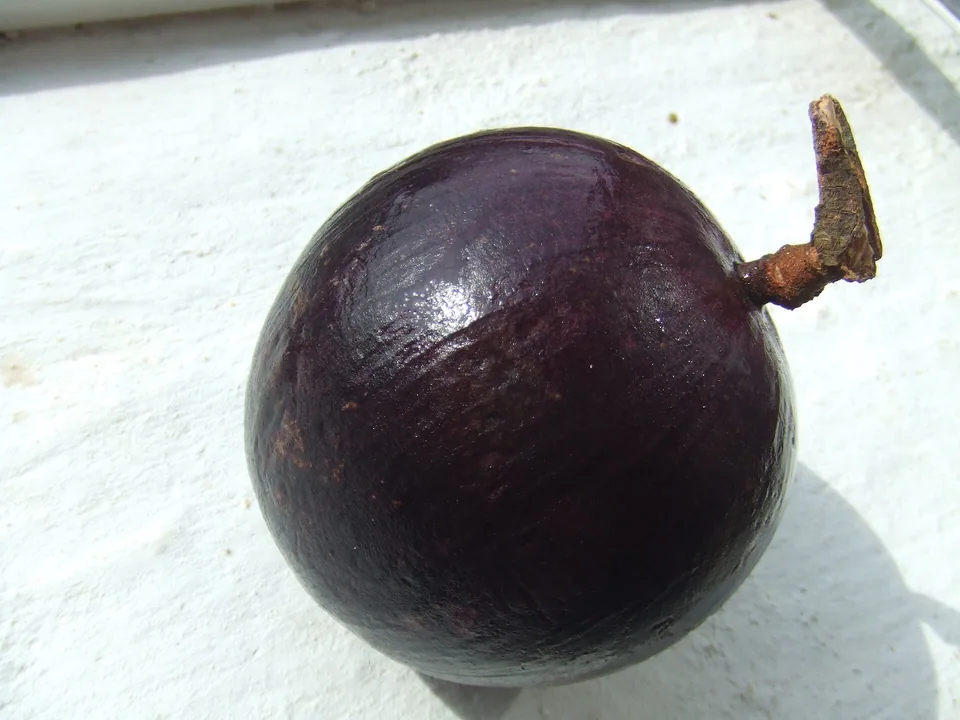

How to Grow and Care for Star apple
Chrysophyllum cainito
Written by Emilio Marruso · last checked
At a glance
The caimito is a full-sun tree whose fruit is eaten fresh or in fruit salads and sorbets. Grafted or air-layered trees can bear fruit in just 1–2 years, while seedlings take 5–10. Pick mature fruit from February to May and let it ripen at room temperature, then enjoy the flesh, since the peel is not edible.
- Sun
Full sun
What the sources say (1)
Light: Full sun
In general, caimito trees should be planted in full sun for best growth and fruit production.
— HS1069/HS309: Caimito (Star Apple) Growing in the Florida Home Landscape [3] - Water
Water young trees twice a week in long dry spells; too much water rots the roots
What the sources say (3)
Watering: Irrigation is beneficial during prolonged dry periods once trees are 4 or more years old
Once caimito trees are 4 or more years old, irrigation will be beneficial to plant growth and crop yields during prolonged dry periods.
— HS1069/HS309: Caimito (Star Apple) Growing in the Florida Home Landscape [3] Watering notes: Young trees (first 3 years) should be well watered twice a week during prolonged dry periods; too much water applied too often causes root rot
During prolonged dry periods (e.g., 5 or more days of little to no rainfall), newly planted and young caimito trees (first 3 years) should be well watered twice a week.
— HS1069/HS309: Caimito (Star Apple) Growing in the Florida Home Landscape [3] The use of lawn sprinkler systems on a timer may result in over watering and cause caimito trees to decline. This is because too much water too often applied causes root rot.
— HS1069/HS309: Caimito (Star Apple) Growing in the Florida Home Landscape [3] - Soil
In alkaline soils it runs short of iron: give the soil iron chelate
What the sources say (3)
Micronutrients: Copper, zinc, manganese and boron as 3 to 4 foliar sprays a year from spring through summer for the first 4 to 5 years; iron chelate soil drenches on alkaline, high-pH soils, from April through September; ferrous sulfate on low-pH soils; magnesium in the fertilizer mix
From spring through summer, trees should receive 3 to 4 annual nutritional sprays of copper, zinc, manganese, and boron for the first 4 to 5 years.
— HS1069/HS309: Caimito (Star Apple) Growing in the Florida Home Landscape [3] Iron deficiency can be prevented or corrected by periodic soil applications of iron chelates formulated for alkaline and high soil pH conditions. Periodic applications of ferrous (iron) sulfate may be made to trees growing in low-pH soils.
— HS1069/HS309: Caimito (Star Apple) Growing in the Florida Home Landscape [3] Iron chelated soil drenches (iron plus water) will prevent iron deficiency in high-pH, calcareous soils; foliar iron sprays are generally not effective. Apply soil drenches from April through September.
— HS1069/HS309: Caimito (Star Apple) Growing in the Florida Home Landscape [3] - Feeding
Feed 3 or 4 times a year with a fertilizer that has magnesium; ease off in late summer and early fall
What the sources say (9)
When: Through the year in 3 or 4 granular applications, reduced in late summer and early fall to slow growth before the late-fall flowering; micronutrient sprays from spring through summer
apply granular fertilizer 3–4 times per year. Reduce the amount of NPK application during late summer, early fall to slow plant growth in preparation for flowering in the late fall.
— HS1069/HS309: Caimito (Star Apple) Growing in the Florida Home Landscape [3] From spring through summer, trees should receive 3 to 4 annual nutritional sprays of copper, zinc, manganese, and boron for the first 4 to 5 years.
— HS1069/HS309: Caimito (Star Apple) Growing in the Florida Home Landscape [3] How often: Every 1 to 2 months in the first year, then 3 or 4 times a year
In Florida, young trees should be fertilized every 1 to 2 months during the first year, beginning with 1/4 lb (114 g) of fertilizer and increasing to 1 lb (455 g) per tree
— HS1069/HS309: Caimito (Star Apple) Growing in the Florida Home Landscape [3] Thereafter, 3 or 4 applications per year in amounts proportionate to the increasing size of the tree are sufficient, not to exceed 20 lbs per tree per year.
— HS1069/HS309: Caimito (Star Apple) Growing in the Florida Home Landscape [3] Mineral fertilizers: Granular fertilizer with magnesium, such as 6-6-6-2 or 8-3-9-2, no more than 9.07 kg [20 lb] per tree per year
young trees: Fertilizer mixtures containing 6 to 10% nitrogen (N), 6 to 10% available phosphate (P 2 O 5 ), 6 to 10% potash (K 2 O), and 4 to 6% magnesium (Mg) give satisfactory results with young trees.
— HS1069/HS309: Caimito (Star Apple) Growing in the Florida Home Landscape [3] bearing trees: For bearing trees, potash should be increased to 9 to 15% and available phosphoric acid reduced to 2 to 4%.
— HS1069/HS309: Caimito (Star Apple) Growing in the Florida Home Landscape [3] first year: In Florida, young trees should be fertilized every 1 to 2 months during the first year, beginning with 1/4 lb (114 g) of fertilizer and increasing to 1 lb (455 g) per tree
— HS1069/HS309: Caimito (Star Apple) Growing in the Florida Home Landscape [3] Examples of commonly available fertilizer mixes include 6-6-6-2 [6 (N)-6 (P 2 O 5 )-6 (K 2 O)-2 (Mg)] and 8-3-9-2 [8 (N)-3 (P 2 O 5 )-6 (K 2 O)-3 (Mg)].
— HS1069/HS309: Caimito (Star Apple) Growing in the Florida Home Landscape [3] Thereafter, 3 or 4 applications per year in amounts proportionate to the increasing size of the tree are sufficient, not to exceed 20 lbs per tree per year.
— HS1069/HS309: Caimito (Star Apple) Growing in the Florida Home Landscape [3] - Pruning
Prune after the harvest season
What the sources say (1)
Pruning: After the harvest season
Selectively prune trees after the harvest season. | | | Follow-up pruning
— HS1069/HS309: Caimito (Star Apple) Growing in the Florida Home Landscape [3] - Harvest
February to May; ripen at room temperature and eat the flesh, not the peel
What the sources say (4)
Harvest: February to May
Florida (UF/IFAS EDIS): Caimito bloom from August to October in Florida, and fruit are generally harvested from February to May.
— HS1069/HS309: Caimito (Star Apple) Growing in the Florida Home Landscape [3] Florida Suncoast (Sarasota County): typically in season from late March to early May in Florida, is where the Caimito earns its stellar name.
— Suncoast Grown and Gathered: April is for Star Apple (Caimito) - UF/IFAS Extension Sarasota County [2] Caimito bloom from August to October in Florida, and fruit are generally harvested from February to May.
— HS1069/HS309: Caimito (Star Apple) Growing in the Florida Home Landscape [3] How to harvest: Pick mature fruit and let it ripen fully at room temperature
Once mature fruit are picked, they may be allowed to fully ripen at room temperature.
— HS1069/HS309: Caimito (Star Apple) Growing in the Florida Home Landscape [3] - Pests
Moth caterpillars can feed on the flowers
What the sources say (1)
Pests: Lepidoptera (moth) larvae on the flowers
However, recently some type of Lepidoptera (moth) larvae has been observed to attack the flowers.
— HS1069/HS309: Caimito (Star Apple) Growing in the Florida Home Landscape [3] - Watch out
Don't heavily feed the nearby lawn: the roots spread there and fruiting suffers
What the sources say (3)
Avoid: Heavy fertilization of the lawn next to the tree, where its roots spread beyond the drip line; compost or topsoil placed in the bottom of the planting hole
Roots of mature caimito trees spread beyond the drip-line of the tree canopy and heavy fertilization of the lawn next to caimito trees is not recommended and may reduce fruiting and or fruit quality.
— HS1069/HS309: Caimito (Star Apple) Growing in the Florida Home Landscape [3] In fact, placing topsoil or compost in the hole first and then planting on top of it is not desirable.
— HS1069/HS309: Caimito (Star Apple) Growing in the Florida Home Landscape [3] Signs of excess: Reduced fruiting and fruit quality from heavy fertilization of the nearby lawn
Roots of mature caimito trees spread beyond the drip-line of the tree canopy and heavy fertilization of the lawn next to caimito trees is not recommended and may reduce fruiting and or fruit quality.
— HS1069/HS309: Caimito (Star Apple) Growing in the Florida Home Landscape [3] - Size
25 to 100 ft tall
What the sources say (1)
Mature height: 762-3048 cm (25-100 ft)
Caimito trees are medium to large trees, 25 to 100 ft tall (7.9 to 30.5 m) with a round to oval canopy.
— HS1069/HS309: Caimito (Star Apple) Growing in the Florida Home Landscape [3] - Propagation
By seed, grafting or air-layering; grafted trees fruit in 1–2 years, seedlings in 5–10
What the sources say (2)
Propagation: Seed, grafting, budding and air-layering
Caimito may be propagated by seed, grafting, budding, and air-layering.
— HS1069/HS309: Caimito (Star Apple) Growing in the Florida Home Landscape [3] Years to first fruit: 5-10 (seedling trees); 1-2 (vegetatively propagated trees)
Seedling trees bear in 5 to 10 years, whereas vegetatively propagated trees may begin fruit production in 1 to 2 years.
— HS1069/HS309: Caimito (Star Apple) Growing in the Florida Home Landscape [3]
Overview
Caimito is a medium to large tree grown mostly as a fruit tree in home landscapes. [3] It is planted in full sun in the warmest part of the landscape. [3] Fruit are generally harvested from February to May in Florida. [3]
This record is incomplete: the sources we read do not cover every field yet.
Not yet covered by our sources: Planting, Spacing
Star apple care
How to water Star apple
Watering
Irrigation is beneficial during prolonged dry periods once trees are 4 or more years old
What the sources say (1)
Once caimito trees are 4 or more years old, irrigation will be beneficial to plant growth and crop yields during prolonged dry periods.Watering notes
Young trees (first 3 years) should be well watered twice a week during prolonged dry periods; too much water applied too often causes root rot
What the sources say (2)
During prolonged dry periods (e.g., 5 or more days of little to no rainfall), newly planted and young caimito trees (first 3 years) should be well watered twice a week.The use of lawn sprinkler systems on a timer may result in over watering and cause caimito trees to decline. This is because too much water too often applied causes root rot.How much light Star apple needs
Full sun
What the sources say (1)
In general, caimito trees should be planted in full sun for best growth and fruit production.Where to grow Star apple
Not stated in the sources we read.
How to propagate Star apple
Seed, grafting, budding and air-layering
What the sources say (1)
Caimito may be propagated by seed, grafting, budding, and air-layering.How to grow Star apple
The plant
Family
Sapotaceae
What the sources say (1)
Family : Sapotaceae
Relatives of Caimito : mamey sapote, green sapote, abiu, and canistel.Mature height
762-3048 cm (25-100 ft)
What the sources say (1)
Caimito trees are medium to large trees, 25 to 100 ft tall (7.9 to 30.5 m) with a round to oval canopy.Years to first fruit
5-10 (seedling trees); 1-2 (vegetatively propagated trees)
What the sources say (1)
Seedling trees bear in 5 to 10 years, whereas vegetatively propagated trees may begin fruit production in 1 to 2 years.Harvest and storage
How to harvest
Pick mature fruit and let it ripen fully at room temperature
What the sources say (1)
Once mature fruit are picked, they may be allowed to fully ripen at room temperature.Storage
Once ripe, in a plastic bag in the refrigerator
What the sources say (1)
Once ripe, fruit may be stored in a plastic bag in the refrigerator until consumed.Pests and diseases
Pests
Lepidoptera (moth) larvae on the flowers
What the sources say (1)
However, recently some type of Lepidoptera (moth) larvae has been observed to attack the flowers.Fertilizing
When
Through the year in 3 or 4 granular applications, reduced in late summer and early fall to slow growth before the late-fall flowering; micronutrient sprays from spring through summer
What the sources say (2)
apply granular fertilizer 3–4 times per year. Reduce the amount of NPK application during late summer, early fall to slow plant growth in preparation for flowering in the late fall.From spring through summer, trees should receive 3 to 4 annual nutritional sprays of copper, zinc, manganese, and boron for the first 4 to 5 years.How often
Every 1 to 2 months in the first year, then 3 or 4 times a year
What the sources say (2)
In Florida, young trees should be fertilized every 1 to 2 months during the first year, beginning with 1/4 lb (114 g) of fertilizer and increasing to 1 lb (455 g) per treeThereafter, 3 or 4 applications per year in amounts proportionate to the increasing size of the tree are sufficient, not to exceed 20 lbs per tree per year.Natural fertilizers
Compost at planting, only mixed with the excavated soil at no more than 1:1, never placed in the hole
What the sources say (2)
If you wish to add topsoil or compost to the native soil, mix it with the excavated soil in no more than a 1:1 ratio.In fact, placing topsoil or compost in the hole first and then planting on top of it is not desirable.Mineral fertilizers
Granular fertilizer with magnesium, such as 6-6-6-2 or 8-3-9-2, no more than 9.07 kg [20 lb] per tree per year
What each source says
young trees: Mix with 6-10% nitrogen, 6-10% phosphate, 6-10% potash and 4-6% magnesium
bearing trees: Potash raised to 9-15% and phosphate reduced to 2-4%
first year: 114 g per tree at first, rising to 455 g per tree
What the sources say (5)
young trees: Fertilizer mixtures containing 6 to 10% nitrogen (N), 6 to 10% available phosphate (P 2 O 5 ), 6 to 10% potash (K 2 O), and 4 to 6% magnesium (Mg) give satisfactory results with young trees.bearing trees: For bearing trees, potash should be increased to 9 to 15% and available phosphoric acid reduced to 2 to 4%.first year: In Florida, young trees should be fertilized every 1 to 2 months during the first year, beginning with 1/4 lb (114 g) of fertilizer and increasing to 1 lb (455 g) per treeExamples of commonly available fertilizer mixes include 6-6-6-2 [6 (N)-6 (P 2 O 5 )-6 (K 2 O)-2 (Mg)] and 8-3-9-2 [8 (N)-3 (P 2 O 5 )-6 (K 2 O)-3 (Mg)].Thereafter, 3 or 4 applications per year in amounts proportionate to the increasing size of the tree are sufficient, not to exceed 20 lbs per tree per year.Micronutrients
Copper, zinc, manganese and boron as 3 to 4 foliar sprays a year from spring through summer for the first 4 to 5 years; iron chelate soil drenches on alkaline, high-pH soils, from April through September; ferrous sulfate on low-pH soils; magnesium in the fertilizer mix
What the sources say (3)
From spring through summer, trees should receive 3 to 4 annual nutritional sprays of copper, zinc, manganese, and boron for the first 4 to 5 years.Iron deficiency can be prevented or corrected by periodic soil applications of iron chelates formulated for alkaline and high soil pH conditions. Periodic applications of ferrous (iron) sulfate may be made to trees growing in low-pH soils.Iron chelated soil drenches (iron plus water) will prevent iron deficiency in high-pH, calcareous soils; foliar iron sprays are generally not effective. Apply soil drenches from April through September.Avoid
Heavy fertilization of the lawn next to the tree, where its roots spread beyond the drip line; compost or topsoil placed in the bottom of the planting hole
What the sources say (2)
Roots of mature caimito trees spread beyond the drip-line of the tree canopy and heavy fertilization of the lawn next to caimito trees is not recommended and may reduce fruiting and or fruit quality.In fact, placing topsoil or compost in the hole first and then planting on top of it is not desirable.Signs of excess
Reduced fruiting and fruit quality from heavy fertilization of the nearby lawn
What the sources say (1)
Roots of mature caimito trees spread beyond the drip-line of the tree canopy and heavy fertilization of the lawn next to caimito trees is not recommended and may reduce fruiting and or fruit quality.Star apple pests and problems
Iron deficiency in alkaline soils
Symptom: Caimito trees are susceptible to iron deficiency under alkaline and high-pH soil conditions.
What to do: Iron deficiency can be prevented or corrected by periodic soil applications of iron chelates formulated for alkaline and high soil pH conditions.
What the sources say (2)
Caimito trees are susceptible to iron deficiency under alkaline and high-pH soil conditions.
— HS1069/HS309: Caimito (Star Apple) Growing in the Florida Home Landscape [3] Iron deficiency can be prevented or corrected by periodic soil applications of iron chelates formulated for alkaline and high soil pH conditions.
— HS1069/HS309: Caimito (Star Apple) Growing in the Florida Home Landscape [3]
Remedies
Each remedy shows what official sources say about it; traditional remedies without an official source are marked as such. Harmful ones are listed so you know to avoid them.
Treating the plant
fruit flies
wrapping young fruit and destroying infested fruit Not verified
Traditional remedy, not verified by an official source.
How: Wrap young fruit and collect and destroy the infested fruit.
Calendar
Not stated in the sources we read.
February to May
What each source says
Florida (UF/IFAS EDIS): February to May
Florida Suncoast (Sarasota County): Late March to early May
What the sources say (3)
Florida (UF/IFAS EDIS): Caimito bloom from August to October in Florida, and fruit are generally harvested from February to May.Florida Suncoast (Sarasota County): typically in season from late March to early May in Florida, is where the Caimito earns its stellar name.Caimito bloom from August to October in Florida, and fruit are generally harvested from February to May.After the harvest season
What the sources say (1)
Selectively prune trees after the harvest season.
| | |
Follow-up pruningMonths as given by the sources, which are mostly from the United States (northern hemisphere). In the southern hemisphere they shift by about six months.
Edibility
Reported by the source, quoted verbatim. Do not eat a plant on the basis of this page alone: identification mistakes can be dangerous.
Indicative values
Values from a secondary source, not checked word for word like the rest of this page. Use them as a starting point.
- Life cycle
- PerennialIndicative value, adapt it to your climate · Secondary source
- Hours of sun
- 6-8 hoursIndicative value, adapt it to your climate · Secondary source
- Soil pH
- 5.5-7.5Indicative value, adapt it to your climate · Secondary source
- USDA hardiness zones
- 10-12 [winter low −1.1 to 15.6 °C (30 to 60 °F)]Indicative value, adapt it to your climate · Secondary source
- Care level
- MediumIndicative value, adapt it to your climate · Secondary source
- Growth rate
- HighIndicative value, adapt it to your climate · Secondary source
Similar plants
- Manilkara zapota Manilkara zapota
- Abies grandis Abies grandis
- Abraham Trachystemon orientalis
- Abyssinian banana Ensete ventricosum
- Acacia longifolia Acacia longifolia
- Acanthus hungaricus Acanthus hungaricus
- Aconite Aconitum napellus
- Adam's Needle Yucca flaccida
Sources
Every value above is quoted from these documents. Links lead to the original publisher.
- HS1069 · edis.ifas.ufl.edu, consulted
- Suncoast Grown and Gathered: April is for Star Apple (Caimito) - UF/IFAS Extension Sarasota County · blogs.ifas.ufl.edu, consulted
- HS1069/HS309: Caimito (Star Apple) Growing in the Florida Home Landscape · ask.ifas.ufl.edu, consulted
Written by Emilio Marruso · last checked