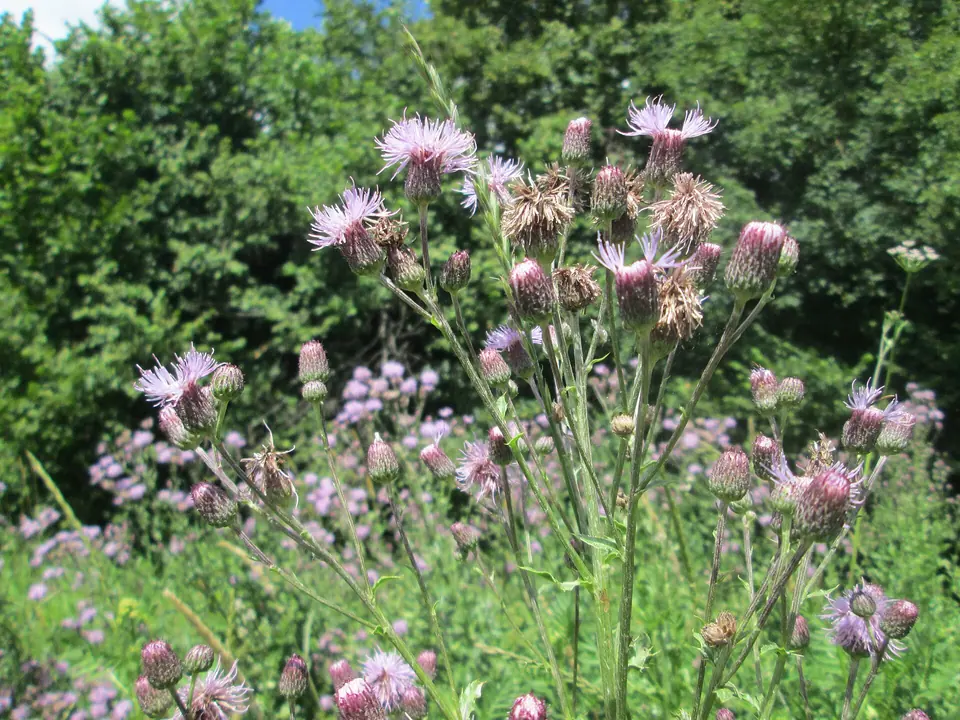


Cómo cultivar y cuidar Thistle
Cirsium arvense
Escrito por Emilio Marruso · última revisión
De un vistazo
El cardo cundidor es una perenne resistente que crece a pleno sol o en semisombra, y sus semillas, ricas en aceite, son un alimento importante para los pájaros que comen semillas. Pero es invasora: se extiende por sus raíces y por semillas que lleva el viento, y forma matas densas que dan sombra a las plantas autóctonas. Cultívala solo donde puedas controlarla segando o arrancándola a mano una y otra vez.
- Sol
Sol pleno o semisombra
Qué dicen las fuentes (1)
Luz: Pleno sol a semisombra
Light: Full sun (6 or more hours of direct sunlight a day) Partial Shade (Direct sunlight only part of the day, 2-6 hours)
— Cirsium arvense (Canada thistle, Creeping Thistle, Field Thistle, Swamp Thistle, Thistle) | North Carolina Extension Gardener Plant Toolbox [1] - Frío
Aguanta inviernos de hasta −34,4 °C (−30 °F)
Muy rústica · USDA 4a · RHS H7 · Z4
Qué dicen las fuentes (2)
Rusticidad, zona más fría: 4a [mínima invernal de −34,4 a −31,7 °C (de −30 a −25 °F)]
USDA Plant Hardiness Zone: 4a, 4b, 5a, 5b, 6a, 6b, 7a, 7b
— Cirsium arvense (Canada thistle, Creeping Thistle, Field Thistle, Swamp Thistle, Thistle) | North Carolina Extension Gardener Plant Toolbox [1] Rusticidad, zona más cálida: 7b [mínima invernal de −15 a −12,2 °C (de 5 a 10 °F)]
USDA Plant Hardiness Zone: 4a, 4b, 5a, 5b, 6a, 6b, 7a, 7b
— Cirsium arvense (Canada thistle, Creeping Thistle, Field Thistle, Swamp Thistle, Thistle) | North Carolina Extension Gardener Plant Toolbox [1] - Cosecha
Sus semillas, ricas en aceite, son un alimento importante para los pájaros que comen semillas
- Atención
Invasora: se extiende por raíces y semillas que lleva el viento; siégala o arráncala a mano una y otra vez durante años
- Multiplicación
Se multiplica por semilla y yemas de la raíz; al cavar, los trozos de raíz vuelven a brotar
Qué dicen las fuentes (2)
Propagación: Semilla; también se propaga por crecimiento lateral de raíces y yemas radicales
Recommended Propagation Strategy: Seed Country Or Region Of Origin: Eurasia, Northwestern Africa
— Cirsium arvense (Canada thistle, Creeping Thistle, Field Thistle, Swamp Thistle, Thistle) | North Carolina Extension Gardener Plant Toolbox [1] The root system of Canada thistle is unique in that it forms buds that give rise to new shoots.
— Lawn and Turfgrass Weeds: Canada Thistle [Cirsium arvense (L.) Scop.] [4]
Resumen
El cardo canadiense es una maleza herbácea perenne erecta de la familia de las margaritas. [1] Se propaga rápidamente por raíces laterales y semillas dispersadas por el viento y forma densos rodales. [1] La guía de la fuente aconseja no introducirla en el jardín. [1]
Citado en inglés, como en la fuente.
Cuidados
Luz
Pleno sol a semisombra
Qué dicen las fuentes (1)
Light:
Full sun (6 or more hours of direct sunlight a day)
Partial Shade (Direct sunlight only part of the day, 2-6 hours)Clima y frío
Rusticidad, zona más fría
4a [mínima invernal de −34,4 a −31,7 °C (de −30 a −25 °F)]
Qué dicen las fuentes (1)
USDA Plant Hardiness Zone:
4a, 4b, 5a, 5b, 6a, 6b, 7a, 7bRusticidad, zona más cálida
7b [mínima invernal de −15 a −12,2 °C (de 5 a 10 °F)]
Qué dicen las fuentes (1)
USDA Plant Hardiness Zone:
4a, 4b, 5a, 5b, 6a, 6b, 7a, 7bPropagación
Semilla; también se propaga por crecimiento lateral de raíces y yemas radicales
Qué dicen las fuentes (2)
Recommended Propagation Strategy:
Seed
Country Or Region Of Origin:
Eurasia, Northwestern AfricaThe root system of Canada thistle is unique in that it forms buds that give rise to new shoots.Cultivo
La planta
Ciclo de vida
perenne
Qué dicen las fuentes (2)
Life Cycle:
Perennial
Recommended Propagation Strategy:
Seed
Country Or Region Of Origin:
Eurasia, Northwestern AfricaCanada thistle is a member of the aster family (Asteraceae) and has a perennial life cycle.Familia
Asteraceae
Qué dicen las fuentes (2)
Genus:
Cirsium
Species:
arvense
Family:
Asteraceae
Uses (Ethnobotany):
The feathery pappus from the fruits was used by the Cherokee as fletching on their blow darts.Canada thistle is a member of the aster family (Asteraceae) and has a perennial life cycle.Problemas
Propagación invasiva
Síntoma: Se propaga por crecimiento lateral de raíces y semillas dispersadas por el viento, formando densos rodales que dan sombra a las plantas nativas; clasificada como maleza nociva de clase B en Carolina del Norte
Qué hacer: La siega repetida constante o el arranque manual durante varios años pueden agotar las reservas de energía de las raíces; puede ser necesario combinarlos con manejo biológico y químico
Qué dicen las fuentes (2)
It rapidly spreads by lateral root growth and wind-dispersed seeds, allowing it to form dense stands that can shade out native plants.
— Cirsium arvense (Canada thistle, Creeping Thistle, Field Thistle, Swamp Thistle, Thistle) | North Carolina Extension Gardener Plant Toolbox [1] Consistent repeated mowing or hand pulling can deplete the root system’s energy storage over a series of years. Biological and chemical management may need to be used in conjunction with these mechanical measures.
— Cirsium arvense (Canada thistle, Creeping Thistle, Field Thistle, Swamp Thistle, Thistle) | North Carolina Extension Gardener Plant Toolbox [1] Rebrote a partir de fragmentos de raíz
Síntoma: El cultivo dispersa las yemas radicales y rompe su latencia
Qué hacer: Cultiva en el punto de compensación, alrededor de cinco hojas verdaderas, cortando la raíz por debajo del suelo
Qué dicen las fuentes (1)
Cultivation simply distributes these buds and breaks their dormancy, resulting in spreading the plant.
— Integrated Pest Management of Canada Thistle (Cirsium arvense) [5]
Remedios
Cada remedio indica qué dicen las fuentes oficiales; los remedios tradicionales sin fuente oficial aparecen marcados. Los perjudiciales están para que sepas evitarlos.
Cómo eliminarla
cardo canadiense
Corta o siega repetidamente Funciona en parte
definitely do not let it flower and go to seed (if it does flower/seed, remove that specimen by hand as mowing will simply spread the seed around)
— extension.umaine.edu [7] Cómo: Corta cada dos o tres semanas durante la temporada de crecimiento para agotar las reservas de la raíz; usa tijeras de jardín afiladas o un recortador de hilo cerca del suelo.
Cut every two to three weeks during the growing season. - The goal is to deplete the root reserves by not letting them photosynthesize, allowing regrowth and carbohydrate use, but not allowing root reserves to build up again.
— extension.psu.edu [6] Qué dicen las pruebas Consistent repeated mowing or hand pulling can deplete the root system’s energy storage over a series of years.
— Cirsium arvense (Canada thistle, Creeping Thistle, Field Thistle, Swamp Thistle, Thistle) | North Carolina Extension Gardener Plant Toolbox [1] Arranca repetidamente a mano. Funciona en parte
Avoid pulling or excessive root disturbance. Damaging the roots by pulling can stimulate the remaining root segments to send up new shoots from underground buds, increasing the number of plants in the area.
— extension.psu.edu [6] Cómo: El arranque manual de los brotes ocasionales, repetido a lo largo de varios años, puede agotar el almacenamiento de energía de la raíz.
Consistent repeated mowing or hand pulling can deplete the root system’s energy storage over a series of years.
— Cirsium arvense (Canada thistle, Creeping Thistle, Field Thistle, Swamp Thistle, Thistle) | North Carolina Extension Gardener Plant Toolbox [1] Qué dicen las pruebas Generally, hand-pulling is used for the occasional thistle shoot, but established plants will continue to grow from roots.
— Canada Thistle (Cirsium arvense) Identification and Control | USU [3] Excava las raíces Fuente oficial, sin prueba independiente
Cómo: Excava plantas individuales y parches pequeños y retira las raíces; corta y retira los tallos para acceder a las raíces y desentiérralas con herramientas.
Dig out individual plants and small patches. Remove the roots. Canada thistle will regrow if all the roots
— solvepestproblems.oregonstate.edu [8] sofocación con mantillo grueso Funciona en parte
Cómo: Cubre con mantillo grueso (5 a 6 pulgadas) con astillas de madera, cartón y compost, o tela de jardinería para bloquear la luz solar.
Mulch thickly (5 to 6 inches) - Use wood chips, cardboard and compost, or landscape fabric. - This blocks sunlight and weakens the plant.
— extension.psu.edu [6] Qué dicen las pruebas Mulch thickly (5 to 6 inches) - Use wood chips, cardboard and compost, or landscape fabric. - This blocks sunlight and weakens the plant.
— extension.psu.edu [6] solarización con plástico transparente Funciona
Cómo: Cubre el área con plástico transparente durante cuatro a seis semanas en clima caluroso.
Solarization (in summer) - Cover the area withclear plastic for four to six weeks during hot weather. - Kills roots by heating the soil to 120 to 140°F.
— extension.psu.edu [6] Qué dicen las pruebas Solarization (in summer) - Cover the area withclear plastic for four to six weeks during hot weather. - Kills roots by heating the soil to 120 to 140°F.
— extension.psu.edu [6] rociador de vinagre, sal y jabón para platos Perjudicial
Since most homemade recipes need repeated application to be effective, the salts will build up. However, increased salts concentration in the soil can harm desired plants nearby.
— extension.uconn.edu [11] Vinegar contains acetic acid that in concentrations over 11 percent can cause burns if it gets on your skin and permanent corneal injury if it comes in contact with your eyes.
— extension.illinois.edu [12] Cómo: Mezcla 3 tazas de vinagre blanco y 1/2 taza de sal de mesa hasta que la sal se disuelva, agrega 1 cucharada de detergente líquido o jabón, rocía sobre las hojas verdes en crecimiento; repite según sea necesario.
Mix vinegar and salt until the salt is completely dissolved. Stir in liquid dish soap, and pour into a spray bottle.
— countrylivinginacariboovalley.com [9] Qué dicen las pruebas Salt is soluble and thus highly mobile in your soil allowing it to spread to areas planted with desirable vegetables and ornamentals, damaging them along with your weeds.
— extension.illinois.edu [10]
Comestibilidad
Según la fuente, citada textualmente. No comas una planta basándote solo en esta página: los errores de identificación pueden ser peligrosos.
The seeds are rich in oil, an important food source for seed-eating birds.
[1]Mature sheep will immediately graze thistles after mowing, but when dry, they are no longer palatable.
[3]Goats and cows are also known to graze the plant but prefer younger ones.
[3]Goats and cows are also known to graze the plant but prefer younger ones.
[3]
Valores orientativos
Valores de una fuente secundaria, no comprobados palabra por palabra como el resto de esta página. Úselos como punto de partida.
- Horas de sol
- 6-8 horasValor orientativo, adáptalo a tu clima · Fuente secundaria
- Riego
- PromedioValor orientativo, adáptalo a tu clima · Fuente secundaria
- Suelo
- Arcilla, ArenaValor orientativo, adáptalo a tu clima · Fuente secundaria
- pH del suelo
- 5.5-7Valor orientativo, adáptalo a tu clima · Fuente secundaria
- Nivel de cuidado
- MedioValor orientativo, adáptalo a tu clima · Fuente secundaria
- Crecimiento
- AltaValor orientativo, adáptalo a tu clima · Fuente secundaria
- Poda
- diciembre, eneroValor orientativo, adáptalo a tu clima · Fuente secundaria
Plantas similares
- Cardo borriquero Cirsium vulgare
- Field Thistle Cirsium discolor
- Purple Thistle Cirsium horridulum
- Swamp Thistle Cirsium muticum
- Tall Thistle Cirsium altissimum
- Pasture Thistle Cirsium pumilum
- American Burnweed Erechtites hieraciifolius
- Autumn Goldenrod Solidago sphacelata
Fuentes
Cada valor anterior se cita de estos documentos. Los enlaces llevan al editor original.
- Cirsium arvense (Canada thistle, Creeping Thistle, Field Thistle, Swamp Thistle, Thistle) | North Carolina Extension Gardener Plant Toolbox · plants.ces.ncsu.edu, consultado
- Field Thistle - Cirsium arvense | North Carolina Extension Gardener Plant Toolbox · plants.ces.ncsu.edu, consultado
- Canada Thistle (Cirsium arvense) Identification and Control | USU · extension.usu.edu, consultado
- Lawn and Turfgrass Weeds: Canada Thistle [Cirsium arvense (L.) Scop.] · extension.psu.edu, consultado
- Integrated Pest Management of Canada Thistle (Cirsium arvense) · extension.psu.edu, consultado
- extension.psu.edu · extension.psu.edu
- extension.umaine.edu · extension.umaine.edu
- solvepestproblems.oregonstate.edu · solvepestproblems.oregonstate.edu
- countrylivinginacariboovalley.com · countrylivinginacariboovalley.com
- extension.illinois.edu · extension.illinois.edu
- extension.uconn.edu · extension.uconn.edu
- extension.illinois.edu · extension.illinois.edu
Escrito por Emilio Marruso · última revisión