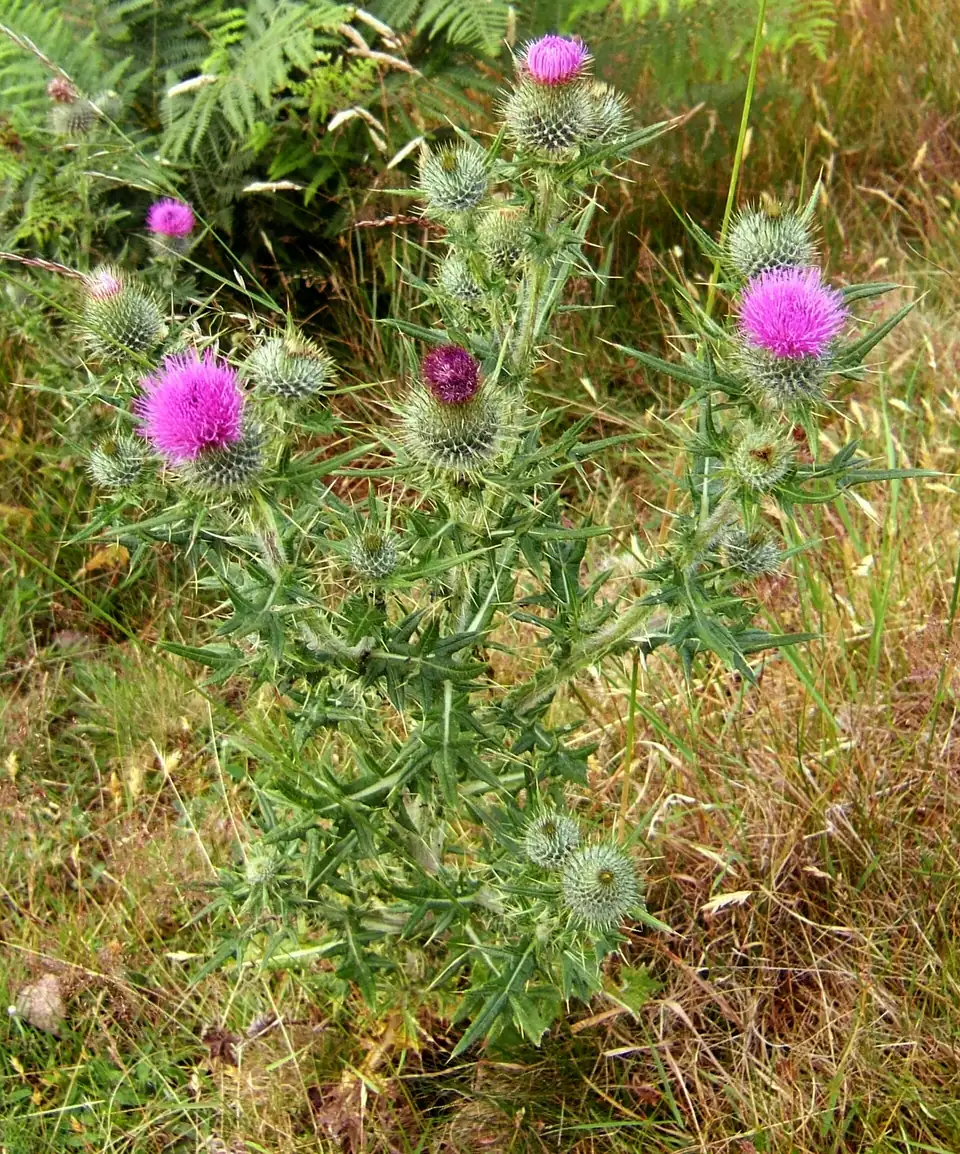


Cómo cultivar y cuidar Cardo borriquero
Cirsium vulgare
Escrito por Emilio Marruso · última revisión
De un vistazo
Este cardo es una bienal resistente que adora el sol pleno, 6 horas o más al día, y alcanza de 61 cm a 1,5 m de alto. Sus semillas, ricas en aceite, son un alimento importante para los pájaros que comen semillas, y estos usan sus vilanos para hacer sus nidos. Eso sí, contrólalo: cada planta puede dar 4.000 semillas o más y formar matorrales densos.
- Sol
Sol pleno: 6 horas o más al día
Qué dicen las fuentes (1)
Luz: Pleno sol (6 o más horas de luz solar directa al día)
Cultural Conditions: Light: Full sun (6 or more hours of direct sunlight a day) Soil Texture: Clay Loam (Silt) Sand
— Cirsium vulgare (Bull Thistle, Common Thistle) | North Carolina Extension Gardener Plant Toolbox [1] - Frío
Aguanta inviernos de hasta −40 °C (−40 °F)
Muy rústica · USDA 3a · RHS H7 · Z3
Qué dicen las fuentes (2)
Rusticidad, zona más fría: 3a [mínima invernal de −40 a −37,2 °C (de −40 a −35 °F)]
USDA Plant Hardiness Zone: 3a, 3b, 4a, 4b, 5a, 5b, 6a, 6b, 7a, 7b, 8a, 8b
— Cirsium vulgare (Bull Thistle, Common Thistle) | North Carolina Extension Gardener Plant Toolbox [1] Rusticidad, zona más cálida: 8b [mínima invernal de −9,4 a −6,7 °C (de 15 a 20 °F)]
USDA Plant Hardiness Zone: 3a, 3b, 4a, 4b, 5a, 5b, 6a, 6b, 7a, 7b, 8a, 8b
— Cirsium vulgare (Bull Thistle, Common Thistle) | North Carolina Extension Gardener Plant Toolbox [1] - Atención
Invasora: más de 4.000 semillas por planta; siega a menudo y arranca la raíz principal entera
- Tamaño
De 61 cm a 1,5 m de alto
Qué dicen las fuentes (2)
Altura adulta: 61-152 cm (2-5 pies)
Bull thistle grows 2 to 5 feet tall, with leaves 8 to 24 inches long.
— Cirsium vulgare (Bull Thistle, Common Thistle) | North Carolina Extension Gardener Plant Toolbox [1] In the second year flower stalk elongates up to 5 ft tall; numerous pink to purple flower heads up to 2 in wide
— Bull thistle | Integrated Crop Management [3] - Multiplicación
Se multiplica por semilla y vive dos años
Qué dicen las fuentes (4)
Propagación: Semilla
Life Cycle: Biennial Recommended Propagation Strategy: Seed Country Or Region Of Origin: Europe to Siberia and Arabian Peninsula
— Cirsium vulgare (Bull Thistle, Common Thistle) | North Carolina Extension Gardener Plant Toolbox [1] Bull thistle reproduces only from seeds which germinate in the spring.
— Bull Thistle Identification and Management [2] Ciclo de vida: bienal
Bull thistle is an upright, branching, biennial weed in the daisy family (Asteraceae)
— Cirsium vulgare (Bull Thistle, Common Thistle) | North Carolina Extension Gardener Plant Toolbox [1] Family: Asteraceae (Composite family) Life cycle: Biennial
— Bull thistle | Integrated Crop Management [3]
Resumen
El cardo toro es una maleza bienal erecta y ramificada de la familia de las margaritas, nativa de Europa, Siberia y la Península Arábiga. [1] Es una especie invasora en Carolina del Norte y no se recomienda para uso paisajístico. [1]
Citado en inglés, como en la fuente.
Cuidados
Luz
Pleno sol (6 o más horas de luz solar directa al día)
Qué dicen las fuentes (1)
Cultural Conditions:
Light:
Full sun (6 or more hours of direct sunlight a day)
Soil Texture:
Clay
Loam (Silt)
SandClima y frío
Rusticidad, zona más fría
3a [mínima invernal de −40 a −37,2 °C (de −40 a −35 °F)]
Qué dicen las fuentes (1)
USDA Plant Hardiness Zone:
3a, 3b, 4a, 4b, 5a, 5b, 6a, 6b, 7a, 7b, 8a, 8bRusticidad, zona más cálida
8b [mínima invernal de −9,4 a −6,7 °C (de 15 a 20 °F)]
Qué dicen las fuentes (1)
USDA Plant Hardiness Zone:
3a, 3b, 4a, 4b, 5a, 5b, 6a, 6b, 7a, 7b, 8a, 8bPropagación
Semilla
Qué dicen las fuentes (2)
Life Cycle:
Biennial
Recommended Propagation Strategy:
Seed
Country Or Region Of Origin:
Europe to Siberia and Arabian PeninsulaBull thistle reproduces only from seeds which germinate in the spring.Cultivo
La planta
Ciclo de vida
bienal
Qué dicen las fuentes (2)
Bull thistle is an upright, branching, biennial weed in the daisy family (Asteraceae)Family: Asteraceae (Composite family) Life cycle: BiennialFamilia
Asteraceae
Altura adulta
61-152 cm (2-5 pies)
Qué dicen las fuentes (2)
Bull thistle grows 2 to 5 feet tall, with leaves 8 to 24 inches long.In the second year flower stalk elongates up to 5 ft tall; numerous pink to purple flower heads up to 2 in wideProblemas
Maleza invasora
Síntoma: Puede invadir casi cualquier tipo de área perturbada y formar matorrales densos que desplazan a las plantas nativas; cada planta puede producir 4,000 semillas o más.
Qué hacer: En césped, la siega regular previene la floración; las plantas individuales pueden desenterrarse de los lechos de jardín, profundizando lo necesario para eliminar la raíz principal.
Qué dicen las fuentes (3)
It can invade almost any type of disturbed area and form dense thickets that crowd out native plants.
— Cirsium vulgare (Bull Thistle, Common Thistle) | North Carolina Extension Gardener Plant Toolbox [1] When encountered in turf, bull thistle can be managed through regular mowing which prevents the plant from developing flowers.
— Bull Thistle Identification and Management [2] individual plants can be dug out of landscape beds. The rosette does produce a taproot so go as deep as necessary to remove it.
— Bull Thistle Identification and Management [2]
Remedios
Cada remedio indica qué dicen las fuentes oficiales; los remedios tradicionales sin fuente oficial aparecen marcados. Los perjudiciales están para que sepas evitarlos.
Cómo eliminarla
maleza invasora
Excava la raíz principal. Funciona en parte
Cómo: Excava la planta con una pala o una hori hori y retira toda la raíz principal carnosa; en los lechos del paisaje, excava tan profundo como sea necesario para eliminarla.
Digging the plant out with a spade or hori hori is the best approach to mechanical bull thistle control. Take care to remove the entire fleshy taproot for best results.
— gardeningknowhow.com [4] Qué dicen las pruebas Careful digging is useful to manage weed populations. However, digging can carry undesirable weed seed to the surface and foster further germination.
— hortsense.cahnrs.wsu.edu [5] Arranca a mano antes de la floración. Funciona en parte
This stubborn plant can arise like Lazarus from the ashes if hand pulling leaves behind any of the root.
— gardeningknowhow.com [4] Cómo: Arranca a mano o cultiva justo antes de la floración; embolsa las cabezas florales cortadas para que las semillas no se dispersen.
Cultivating, mowing or hand-pulling just before flowering can reduce infestations. Cut flower heads can still develop viable seeds, so bag them to prevent seed from dispersing.
— extension.oregonstate.edu [6] Qué dicen las pruebas Cultivating, mowing or hand-pulling just before flowering can reduce infestations.
— extension.oregonstate.edu [6] Desentierra las rosetas del primer año. Funciona
Cómo: Desentierra las rosetas del primer año de 1 a 2 pulgadas por debajo del suelo.
Grubbing first-year rosettes 1 to 2 inches below the ground is sufficient to prevent resprouting.
— extension.oregonstate.edu [6] Qué dicen las pruebas Grubbing first-year rosettes 1 to 2 inches below the ground is sufficient to prevent resprouting.
— extension.oregonstate.edu [6] siega regular Funciona en parte
Cómo: Siega regularmente para evitar la floración; en campo abierto, se ha informado que segar dos veces al año reduce la población al impedir que se formen cabezas de semillas.
For widespread control, mowing twice per year has been effective in reducing the population by preventing seed heads.
— gardeningknowhow.com [4] Qué dicen las pruebas When encountered in turf, bull thistle can be managed through regular mowing which prevents the plant from developing flowers. This does not prevent bull thistle seeds from blowing in from other areas
— Bull Thistle Identification and Management [2] escarda o rotocultivo Funciona
Cómo: Cultiva con una azada o un motocultor.
Cultivation (rototilling or hoeing) will effectively eliminate plants.
— hortsense.cahnrs.wsu.edu [5] Qué dicen las pruebas Cultivation (rototilling or hoeing) will effectively eliminate plants.
— hortsense.cahnrs.wsu.edu [5] Rociado con vinagre al 30% Funciona en parte
vinegar with concentrations greater than 11% can cause severe eye injury and burn the skin if applied unsafely
— extension.illinois.edu [8] If the plant is in the ground, it does NOT get the root; many plants will grow back.
— extension.uconn.edu [9] Cómo: Rocía vinagre al 30% sobre las partes verdes de los cardos, luego rocía de nuevo una semana después; no es vinagre de ensalada, así que usa guantes y no rocíes en un día ventoso.
use 30% vinegar and spray on green parts of the thistle plants. note 30% is not salad vinegar so take care, wear gloves and dont spray on a windy day.
— ask.extension.org [7] Qué dicen las pruebas Vinegar can treat and kill weeds, but it must be herbicidal vinegar or acetic acid, not household vinegar
— extension.illinois.edu [8] cultivo de cobertura de sorgo y pasto sudán Fuente oficial, sin prueba independiente
Cómo: Retira las flores antes de que produzcan semillas, luego planta un cultivo de cobertura de sorgo y sudán en el lado pesado.
The other approach is to remove flowers before they set seed then plant sorghum sudan grass cover crop on the heavy side.
— ask.extension.org [7]
Comestibilidad
Según la fuente, citada textualmente. No comas una planta basándote solo en esta página: los errores de identificación pueden ser peligrosos.
The seeds are rich in oil, an important food source for seed-eating birds and use the tufts of the seeds for their nests.
[1]
Valores orientativos
Valores de una fuente secundaria, no comprobados palabra por palabra como el resto de esta página. Úselos como punto de partida.
- Riego
- PromedioValor orientativo, adáptalo a tu clima · Fuente secundaria
- Resiste la sequía
- SíValor orientativo, adáptalo a tu clima · Fuente secundaria
- Suelo
- Arcilla, ArenaValor orientativo, adáptalo a tu clima · Fuente secundaria
- pH del suelo
- 6-7.5Valor orientativo, adáptalo a tu clima · Fuente secundaria
- Nivel de cuidado
- MedioValor orientativo, adáptalo a tu clima · Fuente secundaria
- Crecimiento
- BajoValor orientativo, adáptalo a tu clima · Fuente secundaria
- Poda
- marzo, abril, mayo, junio, julio, agosto, septiembre, agostoValor orientativo, adáptalo a tu clima · Fuente secundaria
Plantas similares
- Field Thistle Cirsium discolor
- Purple Thistle Cirsium horridulum
- Thistle Cirsium arvense
- Swamp Thistle Cirsium muticum
- Tall Thistle Cirsium altissimum
- Pasture Thistle Cirsium pumilum
- American Burnweed Erechtites hieraciifolius
- Autumn Goldenrod Solidago sphacelata
Fuentes
Cada valor anterior se cita de estos documentos. Los enlaces llevan al editor original.
- Cirsium vulgare (Bull Thistle, Common Thistle) | North Carolina Extension Gardener Plant Toolbox · plants.ces.ncsu.edu, consultado
- Bull Thistle Identification and Management · extension.psu.edu, consultado
- Bull thistle | Integrated Crop Management · crops.extension.iastate.edu, consultado
- gardeningknowhow.com · gardeningknowhow.com
- hortsense.cahnrs.wsu.edu · hortsense.cahnrs.wsu.edu
- extension.oregonstate.edu · extension.oregonstate.edu
- ask.extension.org · ask.extension.org
- extension.illinois.edu · extension.illinois.edu
- extension.uconn.edu · extension.uconn.edu
Escrito por Emilio Marruso · última revisión