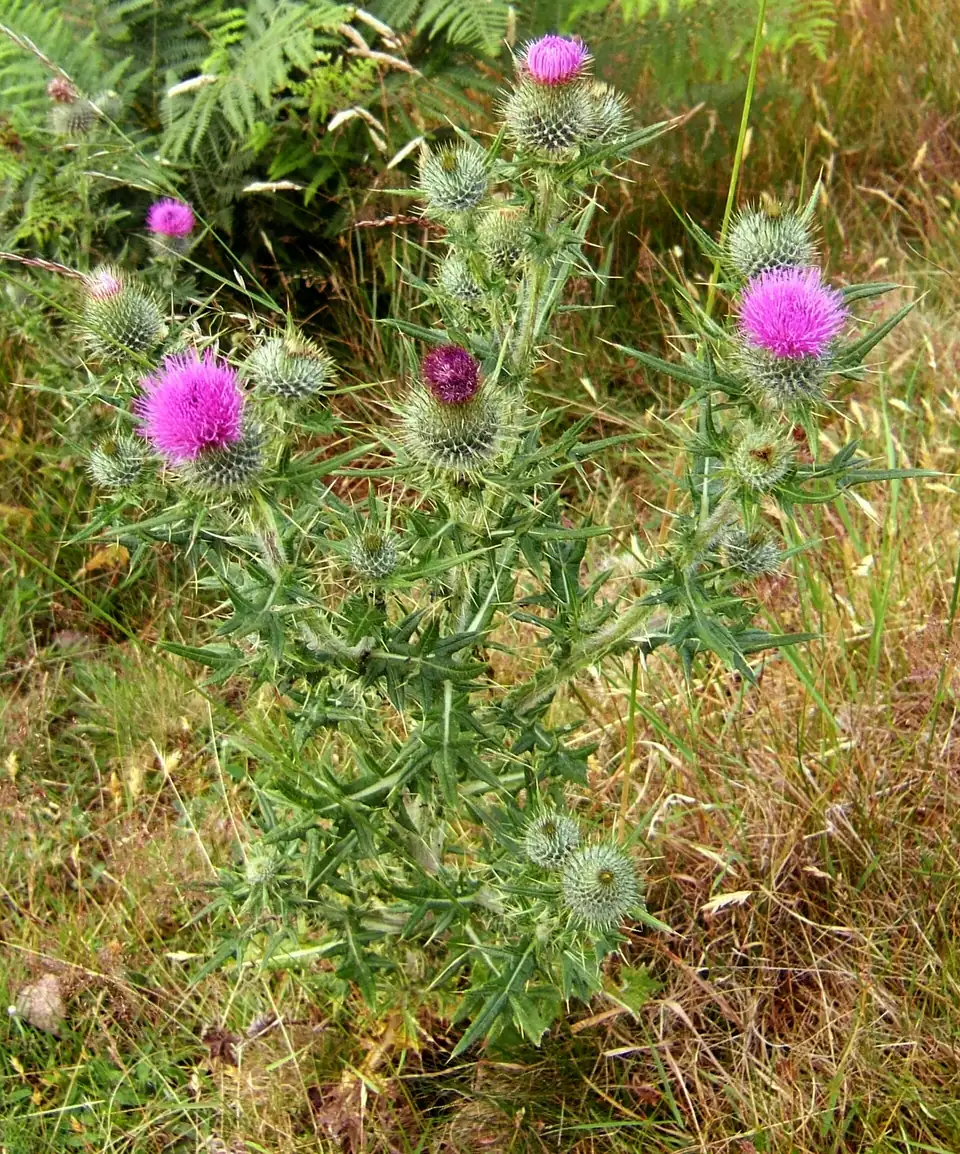


How to Grow and Care for Bull Thistle
Cirsium vulgare
Written by Emilio Marruso · last checked
At a glance
This thistle is a tough biennial that loves full sun, 6 or more hours a day, and grows 2–5 ft tall. Its oil-rich seeds are an important food for seed-eating birds, which also use the fluffy seed tufts to build their nests. Just keep it in check: each plant can make 4,000 seeds or more and spread into dense thickets.
- Sun
Full sun: 6 or more hours a day
What the sources say (1)
Light: Full sun (6 or more hours of direct sunlight a day)
Cultural Conditions: Light: Full sun (6 or more hours of direct sunlight a day) Soil Texture: Clay Loam (Silt) Sand
— Cirsium vulgare (Bull Thistle, Common Thistle) | North Carolina Extension Gardener Plant Toolbox [1] - Cold
Survives winters down to −40 °F (−40 °C)
Very hardy · USDA 3a · RHS H7 · Z3
What the sources say (2)
Hardiness, coldest zone: 3a [winter low −40 to −37.2 °C (−40 to −35 °F)]
USDA Plant Hardiness Zone: 3a, 3b, 4a, 4b, 5a, 5b, 6a, 6b, 7a, 7b, 8a, 8b
— Cirsium vulgare (Bull Thistle, Common Thistle) | North Carolina Extension Gardener Plant Toolbox [1] Hardiness, warmest zone: 8b [winter low −9.4 to −6.7 °C (15 to 20 °F)]
USDA Plant Hardiness Zone: 3a, 3b, 4a, 4b, 5a, 5b, 6a, 6b, 7a, 7b, 8a, 8b
— Cirsium vulgare (Bull Thistle, Common Thistle) | North Carolina Extension Gardener Plant Toolbox [1] - Watch out
Invasive: 4,000+ seeds per plant; mow lawns often and dig out the whole taproot
- Size
2–5 ft tall
What the sources say (2)
Mature height: 61-152 cm (2-5 ft)
Bull thistle grows 2 to 5 feet tall, with leaves 8 to 24 inches long.
— Cirsium vulgare (Bull Thistle, Common Thistle) | North Carolina Extension Gardener Plant Toolbox [1] In the second year flower stalk elongates up to 5 ft tall; numerous pink to purple flower heads up to 2 in wide
— Bull thistle | Integrated Crop Management [3] - Propagation
Grows from seed and lives two years
What the sources say (4)
Propagation: Seed
Life Cycle: Biennial Recommended Propagation Strategy: Seed Country Or Region Of Origin: Europe to Siberia and Arabian Peninsula
— Cirsium vulgare (Bull Thistle, Common Thistle) | North Carolina Extension Gardener Plant Toolbox [1] Bull thistle reproduces only from seeds which germinate in the spring.
— Bull Thistle Identification and Management [2] Life cycle: biennial
Bull thistle is an upright, branching, biennial weed in the daisy family (Asteraceae)
— Cirsium vulgare (Bull Thistle, Common Thistle) | North Carolina Extension Gardener Plant Toolbox [1] Family: Asteraceae (Composite family) Life cycle: Biennial
— Bull thistle | Integrated Crop Management [3]
Overview
Bull thistle is an upright, branching, biennial weed in the daisy family, native to Europe, Siberia and the Arabian Peninsula. [1] It is an invasive species in North Carolina and is not recommended for landscape use. [1]
Bull Thistle care
How much light Bull Thistle needs
Full sun (6 or more hours of direct sunlight a day)
What the sources say (1)
Cultural Conditions:
Light:
Full sun (6 or more hours of direct sunlight a day)
Soil Texture:
Clay
Loam (Silt)
SandHow much cold Bull Thistle can take
Hardiness, coldest zone
3a [winter low −40 to −37.2 °C (−40 to −35 °F)]
What the sources say (1)
USDA Plant Hardiness Zone:
3a, 3b, 4a, 4b, 5a, 5b, 6a, 6b, 7a, 7b, 8a, 8bHardiness, warmest zone
8b [winter low −9.4 to −6.7 °C (15 to 20 °F)]
What the sources say (1)
USDA Plant Hardiness Zone:
3a, 3b, 4a, 4b, 5a, 5b, 6a, 6b, 7a, 7b, 8a, 8bHow to propagate Bull Thistle
Seed
What the sources say (2)
Life Cycle:
Biennial
Recommended Propagation Strategy:
Seed
Country Or Region Of Origin:
Europe to Siberia and Arabian PeninsulaBull thistle reproduces only from seeds which germinate in the spring.How to grow Bull Thistle
The plant
Life cycle
biennial
What the sources say (2)
Bull thistle is an upright, branching, biennial weed in the daisy family (Asteraceae)Family: Asteraceae (Composite family) Life cycle: BiennialFamily
Asteraceae
Mature height
61-152 cm (2-5 ft)
What the sources say (2)
Bull thistle grows 2 to 5 feet tall, with leaves 8 to 24 inches long.In the second year flower stalk elongates up to 5 ft tall; numerous pink to purple flower heads up to 2 in wideBull Thistle pests and problems
Invasive weed
Symptom: Can invade almost any type of disturbed area and form dense thickets that crowd out native plants; each plant can produce 4,000 seeds or more.
What to do: In turf, regular mowing prevents flowering; individual plants can be dug out of landscape beds, going as deep as necessary to remove the taproot.
What the sources say (3)
It can invade almost any type of disturbed area and form dense thickets that crowd out native plants.
— Cirsium vulgare (Bull Thistle, Common Thistle) | North Carolina Extension Gardener Plant Toolbox [1] When encountered in turf, bull thistle can be managed through regular mowing which prevents the plant from developing flowers.
— Bull Thistle Identification and Management [2] individual plants can be dug out of landscape beds. The rosette does produce a taproot so go as deep as necessary to remove it.
— Bull Thistle Identification and Management [2]
Remedies
Each remedy shows what official sources say about it; traditional remedies without an official source are marked as such. Harmful ones are listed so you know to avoid them.
Getting rid of it
invasive-weed
digging out the taproot Partly works
How: Dig the plant out with a spade or hori hori and remove the entire fleshy taproot; in landscape beds go as deep as necessary to remove it.
Digging the plant out with a spade or hori hori is the best approach to mechanical bull thistle control. Take care to remove the entire fleshy taproot for best results.
— gardeningknowhow.com [4] What the evidence says Careful digging is useful to manage weed populations. However, digging can carry undesirable weed seed to the surface and foster further germination.
— hortsense.cahnrs.wsu.edu [5] hand pulling before flowering Partly works
This stubborn plant can arise like Lazarus from the ashes if hand pulling leaves behind any of the root.
— gardeningknowhow.com [4] How: Hand-pull or cultivate just before flowering; bag cut flower heads so seed does not disperse.
Cultivating, mowing or hand-pulling just before flowering can reduce infestations. Cut flower heads can still develop viable seeds, so bag them to prevent seed from dispersing.
— extension.oregonstate.edu [6] What the evidence says Cultivating, mowing or hand-pulling just before flowering can reduce infestations.
— extension.oregonstate.edu [6] grubbing first-year rosettes Works
How: Grub first-year rosettes 1 to 2 inches below the ground.
Grubbing first-year rosettes 1 to 2 inches below the ground is sufficient to prevent resprouting.
— extension.oregonstate.edu [6] What the evidence says Grubbing first-year rosettes 1 to 2 inches below the ground is sufficient to prevent resprouting.
— extension.oregonstate.edu [6] regular mowing Partly works
How: Mow regularly to prevent flowering; in the open, mowing twice per year has been reported to reduce the population by preventing seed heads.
For widespread control, mowing twice per year has been effective in reducing the population by preventing seed heads.
— gardeningknowhow.com [4] What the evidence says When encountered in turf, bull thistle can be managed through regular mowing which prevents the plant from developing flowers. This does not prevent bull thistle seeds from blowing in from other areas
— Bull Thistle Identification and Management [2] hoeing or rototilling Works
How: Cultivate with a hoe or rototiller.
Cultivation (rototilling or hoeing) will effectively eliminate plants.
— hortsense.cahnrs.wsu.edu [5] What the evidence says Cultivation (rototilling or hoeing) will effectively eliminate plants.
— hortsense.cahnrs.wsu.edu [5] 30% vinegar spray Partly works
vinegar with concentrations greater than 11% can cause severe eye injury and burn the skin if applied unsafely
— extension.illinois.edu [8] If the plant is in the ground, it does NOT get the root; many plants will grow back.
— extension.uconn.edu [9] How: Spray 30% vinegar on the green parts of the thistle plants, then spray again a week later; it is not salad vinegar, so wear gloves and do not spray on a windy day.
use 30% vinegar and spray on green parts of the thistle plants. note 30% is not salad vinegar so take care, wear gloves and dont spray on a windy day.
— ask.extension.org [7] What the evidence says Vinegar can treat and kill weeds, but it must be herbicidal vinegar or acetic acid, not household vinegar
— extension.illinois.edu [8] sorghum-sudan grass cover crop Official source, not independently tested
How: Remove flowers before they set seed, then plant a sorghum sudan grass cover crop on the heavy side.
The other approach is to remove flowers before they set seed then plant sorghum sudan grass cover crop on the heavy side.
— ask.extension.org [7]
Edibility
Reported by the source, quoted verbatim. Do not eat a plant on the basis of this page alone: identification mistakes can be dangerous.
The seeds are rich in oil, an important food source for seed-eating birds and use the tufts of the seeds for their nests.
[1]
Indicative values
Values from a secondary source, not checked word for word like the rest of this page. Use them as a starting point.
- Watering
- AverageIndicative value, adapt it to your climate · Secondary source
- Drought tolerant
- yesIndicative value, adapt it to your climate · Secondary source
- Soil
- Clay, SandIndicative value, adapt it to your climate · Secondary source
- Soil pH
- 6-7.5Indicative value, adapt it to your climate · Secondary source
- Care level
- MediumIndicative value, adapt it to your climate · Secondary source
- Growth rate
- LowIndicative value, adapt it to your climate · Secondary source
- Pruning
- March, April, May, June, July, August, September, AugustIndicative value, adapt it to your climate · Secondary source
Similar plants
- Field Thistle Cirsium discolor
- Purple Thistle Cirsium horridulum
- Thistle Cirsium arvense
- Swamp Thistle Cirsium muticum
- Tall Thistle Cirsium altissimum
- Pasture Thistle Cirsium pumilum
- American Burnweed Erechtites hieraciifolius
- Autumn Goldenrod Solidago sphacelata
Sources
Every value above is quoted from these documents. Links lead to the original publisher.
- Cirsium vulgare (Bull Thistle, Common Thistle) | North Carolina Extension Gardener Plant Toolbox · plants.ces.ncsu.edu, consulted
- Bull Thistle Identification and Management · extension.psu.edu, consulted
- Bull thistle | Integrated Crop Management · crops.extension.iastate.edu, consulted
- gardeningknowhow.com · gardeningknowhow.com
- hortsense.cahnrs.wsu.edu · hortsense.cahnrs.wsu.edu
- extension.oregonstate.edu · extension.oregonstate.edu
- ask.extension.org · ask.extension.org
- extension.illinois.edu · extension.illinois.edu
- extension.uconn.edu · extension.uconn.edu
Written by Emilio Marruso · last checked