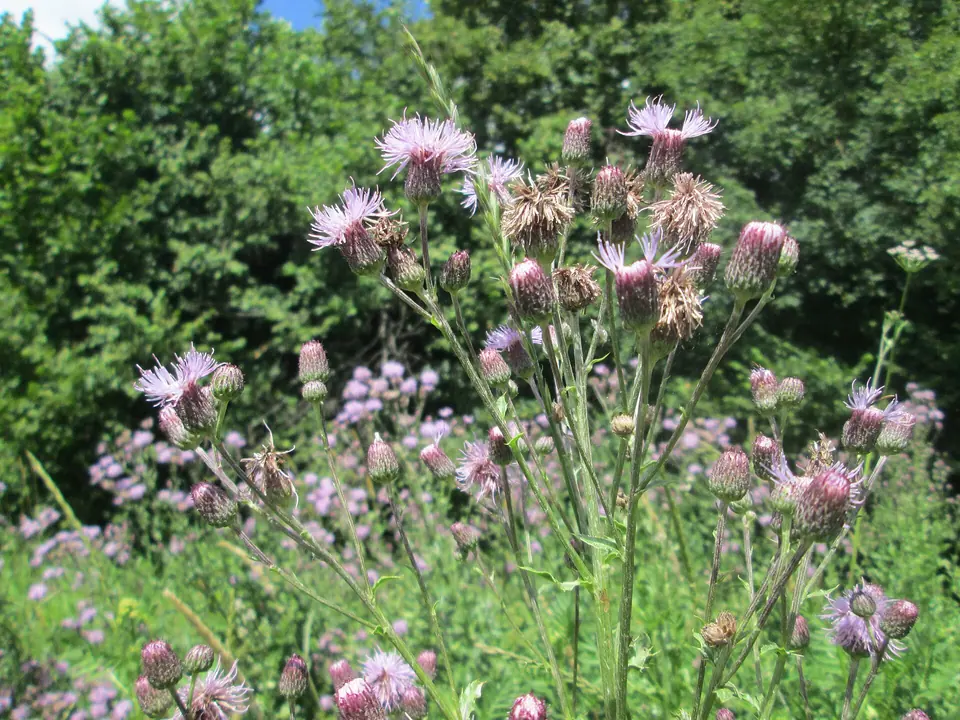


How to Grow and Care for Thistle
Cirsium arvense
Written by Emilio Marruso · last checked
At a glance
Canada thistle is a tough perennial that grows in full sun to partial shade, and its oil-rich seeds are an important food for seed-eating birds. But it is invasive: it spreads by its roots and wind-blown seeds, forming dense stands that shade out native plants. Grow it only where you can keep it in check with repeated mowing or hand pulling.
- Sun
Full sun to partial shade
What the sources say (1)
Light: Full sun to partial shade
Light: Full sun (6 or more hours of direct sunlight a day) Partial Shade (Direct sunlight only part of the day, 2-6 hours)
— Cirsium arvense (Canada thistle, Creeping Thistle, Field Thistle, Swamp Thistle, Thistle) | North Carolina Extension Gardener Plant Toolbox [1] - Cold
Survives winters down to −30 °F (−34.4 °C)
Very hardy · USDA 4a · RHS H7 · Z4
What the sources say (2)
Hardiness, coldest zone: 4a [winter low −34.4 to −31.7 °C (−30 to −25 °F)]
USDA Plant Hardiness Zone: 4a, 4b, 5a, 5b, 6a, 6b, 7a, 7b
— Cirsium arvense (Canada thistle, Creeping Thistle, Field Thistle, Swamp Thistle, Thistle) | North Carolina Extension Gardener Plant Toolbox [1] Hardiness, warmest zone: 7b [winter low −15 to −12.2 °C (5 to 10 °F)]
USDA Plant Hardiness Zone: 4a, 4b, 5a, 5b, 6a, 6b, 7a, 7b
— Cirsium arvense (Canada thistle, Creeping Thistle, Field Thistle, Swamp Thistle, Thistle) | North Carolina Extension Gardener Plant Toolbox [1] - Harvest
Its oil-rich seeds are an important food for seed-eating birds
- Watch out
Invasive: spreads by roots and wind-blown seeds; mow or hand-pull it again and again for years
- Propagation
Spreads by seed and root buds; digging breaks the roots into pieces that grow back
What the sources say (2)
Propagation: Seed; also spreads by lateral root growth and root buds
Recommended Propagation Strategy: Seed Country Or Region Of Origin: Eurasia, Northwestern Africa
— Cirsium arvense (Canada thistle, Creeping Thistle, Field Thistle, Swamp Thistle, Thistle) | North Carolina Extension Gardener Plant Toolbox [1] The root system of Canada thistle is unique in that it forms buds that give rise to new shoots.
— Lawn and Turfgrass Weeds: Canada Thistle [Cirsium arvense (L.) Scop.] [4]
Overview
Canada thistle is an upright herbaceous perennial weed in the daisy family. [1] It spreads rapidly by lateral roots and wind-dispersed seeds and forms dense stands. [1] Source guidance advises against introducing it into the garden. [1]
Thistle care
How much light Thistle needs
Full sun to partial shade
What the sources say (1)
Light:
Full sun (6 or more hours of direct sunlight a day)
Partial Shade (Direct sunlight only part of the day, 2-6 hours)How much cold Thistle can take
Hardiness, coldest zone
4a [winter low −34.4 to −31.7 °C (−30 to −25 °F)]
What the sources say (1)
USDA Plant Hardiness Zone:
4a, 4b, 5a, 5b, 6a, 6b, 7a, 7bHardiness, warmest zone
7b [winter low −15 to −12.2 °C (5 to 10 °F)]
What the sources say (1)
USDA Plant Hardiness Zone:
4a, 4b, 5a, 5b, 6a, 6b, 7a, 7bHow to propagate Thistle
Seed; also spreads by lateral root growth and root buds
What the sources say (2)
Recommended Propagation Strategy:
Seed
Country Or Region Of Origin:
Eurasia, Northwestern AfricaThe root system of Canada thistle is unique in that it forms buds that give rise to new shoots.How to grow Thistle
The plant
Life cycle
perennial
What the sources say (2)
Life Cycle:
Perennial
Recommended Propagation Strategy:
Seed
Country Or Region Of Origin:
Eurasia, Northwestern AfricaCanada thistle is a member of the aster family (Asteraceae) and has a perennial life cycle.Family
Asteraceae
What the sources say (2)
Genus:
Cirsium
Species:
arvense
Family:
Asteraceae
Uses (Ethnobotany):
The feathery pappus from the fruits was used by the Cherokee as fletching on their blow darts.Canada thistle is a member of the aster family (Asteraceae) and has a perennial life cycle.Thistle pests and problems
Invasive spread
Symptom: Spreads by lateral root growth and wind-dispersed seeds, forming dense stands that shade out native plants; classified as a Class B noxious weed in North Carolina
What to do: Consistent repeated mowing or hand pulling over a series of years can deplete root energy storage; biological and chemical management may be needed in conjunction
What the sources say (2)
It rapidly spreads by lateral root growth and wind-dispersed seeds, allowing it to form dense stands that can shade out native plants.
— Cirsium arvense (Canada thistle, Creeping Thistle, Field Thistle, Swamp Thistle, Thistle) | North Carolina Extension Gardener Plant Toolbox [1] Consistent repeated mowing or hand pulling can deplete the root system’s energy storage over a series of years. Biological and chemical management may need to be used in conjunction with these mechanical measures.
— Cirsium arvense (Canada thistle, Creeping Thistle, Field Thistle, Swamp Thistle, Thistle) | North Carolina Extension Gardener Plant Toolbox [1] Regrowth from root fragments
Symptom: Cultivation spreads root buds and breaks their dormancy
What to do: Cultivate at the compensation point, about five true leaves, cutting the root below ground
What the sources say (1)
Cultivation simply distributes these buds and breaks their dormancy, resulting in spreading the plant.
— Integrated Pest Management of Canada Thistle (Cirsium arvense) [5]
Remedies
Each remedy shows what official sources say about it; traditional remedies without an official source are marked as such. Harmful ones are listed so you know to avoid them.
Getting rid of it
canada thistle
repeated cutting or mowing Partly works
definitely do not let it flower and go to seed (if it does flower/seed, remove that specimen by hand as mowing will simply spread the seed around)
— extension.umaine.edu [7] How: Cut every two to three weeks during the growing season to deplete the root reserves; use sharp garden shears or a string trimmer close to the ground.
Cut every two to three weeks during the growing season. - The goal is to deplete the root reserves by not letting them photosynthesize, allowing regrowth and carbohydrate use, but not allowing root reserves to build up again.
— extension.psu.edu [6] What the evidence says Consistent repeated mowing or hand pulling can deplete the root system’s energy storage over a series of years.
— Cirsium arvense (Canada thistle, Creeping Thistle, Field Thistle, Swamp Thistle, Thistle) | North Carolina Extension Gardener Plant Toolbox [1] repeated hand pulling Partly works
Avoid pulling or excessive root disturbance. Damaging the roots by pulling can stimulate the remaining root segments to send up new shoots from underground buds, increasing the number of plants in the area.
— extension.psu.edu [6] How: Hand pulling of the occasional shoot, repeated over a series of years, can deplete the root energy storage.
Consistent repeated mowing or hand pulling can deplete the root system’s energy storage over a series of years.
— Cirsium arvense (Canada thistle, Creeping Thistle, Field Thistle, Swamp Thistle, Thistle) | North Carolina Extension Gardener Plant Toolbox [1] What the evidence says Generally, hand-pulling is used for the occasional thistle shoot, but established plants will continue to grow from roots.
— Canada Thistle (Cirsium arvense) Identification and Control | USU [3] digging out the roots Official source, not independently tested
How: Dig out individual plants and small patches and remove the roots; cut and remove stems to access the roots and dig them out with tools.
Dig out individual plants and small patches. Remove the roots. Canada thistle will regrow if all the roots
— solvepestproblems.oregonstate.edu [8] thick mulch smothering Partly works
How: Mulch thickly (5 to 6 inches) with wood chips, cardboard and compost, or landscape fabric to block sunlight.
Mulch thickly (5 to 6 inches) - Use wood chips, cardboard and compost, or landscape fabric. - This blocks sunlight and weakens the plant.
— extension.psu.edu [6] What the evidence says Mulch thickly (5 to 6 inches) - Use wood chips, cardboard and compost, or landscape fabric. - This blocks sunlight and weakens the plant.
— extension.psu.edu [6] solarization with clear plastic Works
How: Cover the area with clear plastic for four to six weeks during hot weather.
Solarization (in summer) - Cover the area withclear plastic for four to six weeks during hot weather. - Kills roots by heating the soil to 120 to 140°F.
— extension.psu.edu [6] What the evidence says Solarization (in summer) - Cover the area withclear plastic for four to six weeks during hot weather. - Kills roots by heating the soil to 120 to 140°F.
— extension.psu.edu [6] vinegar, salt and dish soap spray Harmful
Since most homemade recipes need repeated application to be effective, the salts will build up. However, increased salts concentration in the soil can harm desired plants nearby.
— extension.uconn.edu [11] Vinegar contains acetic acid that in concentrations over 11 percent can cause burns if it gets on your skin and permanent corneal injury if it comes in contact with your eyes.
— extension.illinois.edu [12] How: Mix 3 cups white vinegar and 1/2 cup table salt until the salt dissolves, stir in 1 tablespoon liquid detergent or soap, spray on the green growing leaves; repeat as needed.
Mix vinegar and salt until the salt is completely dissolved. Stir in liquid dish soap, and pour into a spray bottle.
— countrylivinginacariboovalley.com [9] What the evidence says Salt is soluble and thus highly mobile in your soil allowing it to spread to areas planted with desirable vegetables and ornamentals, damaging them along with your weeds.
— extension.illinois.edu [10]
Edibility
Reported by the source, quoted verbatim. Do not eat a plant on the basis of this page alone: identification mistakes can be dangerous.
The seeds are rich in oil, an important food source for seed-eating birds.
[1]Mature sheep will immediately graze thistles after mowing, but when dry, they are no longer palatable.
[3]Goats and cows are also known to graze the plant but prefer younger ones.
[3]Goats and cows are also known to graze the plant but prefer younger ones.
[3]
Indicative values
Values from a secondary source, not checked word for word like the rest of this page. Use them as a starting point.
- Hours of sun
- 6-8 hoursIndicative value, adapt it to your climate · Secondary source
- Watering
- AverageIndicative value, adapt it to your climate · Secondary source
- Soil
- Clay, SandIndicative value, adapt it to your climate · Secondary source
- Soil pH
- 5.5-7Indicative value, adapt it to your climate · Secondary source
- Care level
- MediumIndicative value, adapt it to your climate · Secondary source
- Growth rate
- HighIndicative value, adapt it to your climate · Secondary source
- Pruning
- December, JanuaryIndicative value, adapt it to your climate · Secondary source
Similar plants
- Bull Thistle Cirsium vulgare
- Field Thistle Cirsium discolor
- Purple Thistle Cirsium horridulum
- Swamp Thistle Cirsium muticum
- Tall Thistle Cirsium altissimum
- Pasture Thistle Cirsium pumilum
- American Burnweed Erechtites hieraciifolius
- Autumn Goldenrod Solidago sphacelata
Sources
Every value above is quoted from these documents. Links lead to the original publisher.
- Cirsium arvense (Canada thistle, Creeping Thistle, Field Thistle, Swamp Thistle, Thistle) | North Carolina Extension Gardener Plant Toolbox · plants.ces.ncsu.edu, consulted
- Field Thistle - Cirsium arvense | North Carolina Extension Gardener Plant Toolbox · plants.ces.ncsu.edu, consulted
- Canada Thistle (Cirsium arvense) Identification and Control | USU · extension.usu.edu, consulted
- Lawn and Turfgrass Weeds: Canada Thistle [Cirsium arvense (L.) Scop.] · extension.psu.edu, consulted
- Integrated Pest Management of Canada Thistle (Cirsium arvense) · extension.psu.edu, consulted
- extension.psu.edu · extension.psu.edu
- extension.umaine.edu · extension.umaine.edu
- solvepestproblems.oregonstate.edu · solvepestproblems.oregonstate.edu
- countrylivinginacariboovalley.com · countrylivinginacariboovalley.com
- extension.illinois.edu · extension.illinois.edu
- extension.uconn.edu · extension.uconn.edu
- extension.illinois.edu · extension.illinois.edu
Written by Emilio Marruso · last checked