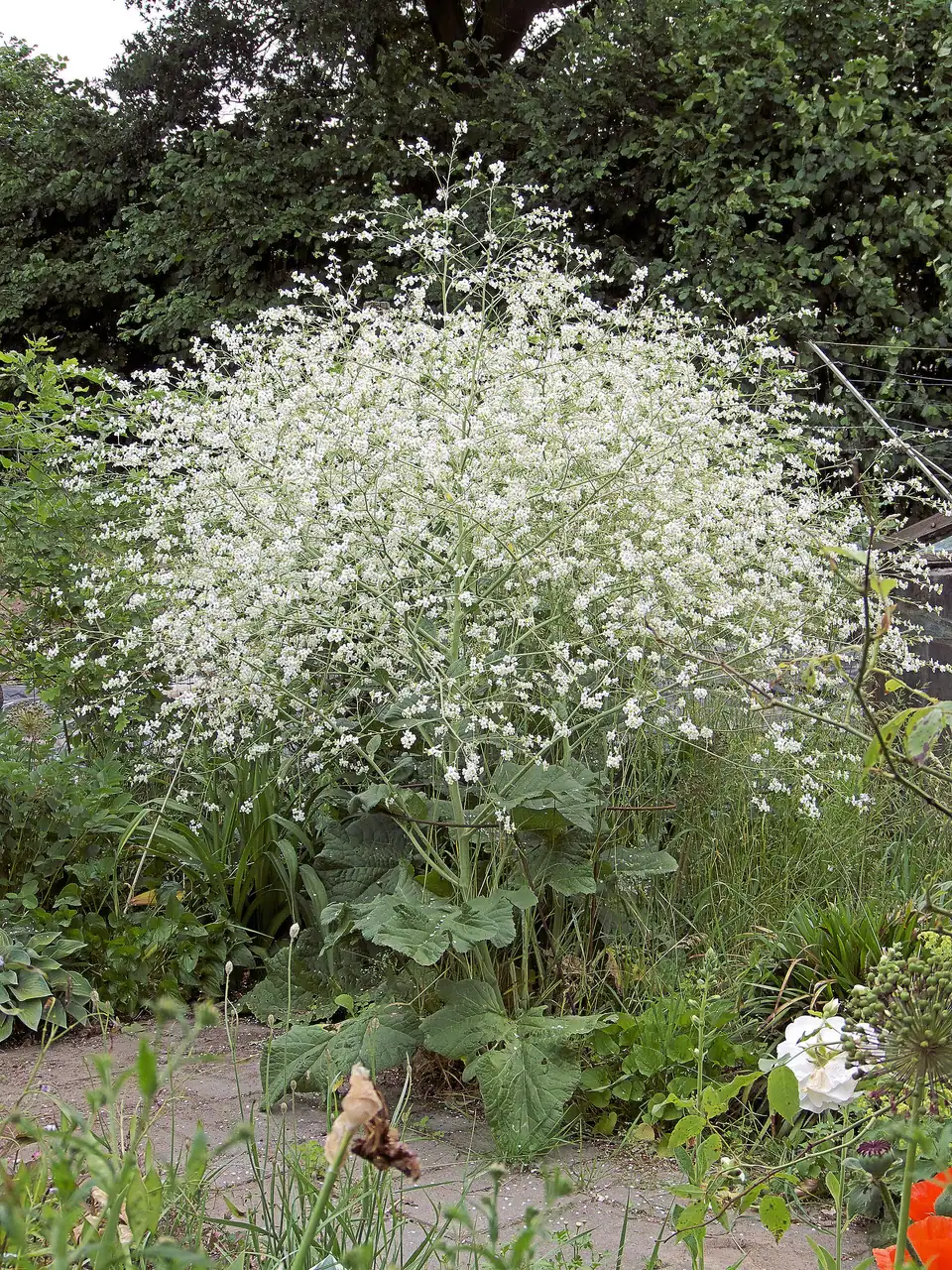

Cómo cultivar y cuidar Crambe cordifolia
Crambe cordifolia
Escrito por Emilio Marruso · última revisión
Tóxica para: Gatos, Perros, Caballos · Por qué
De un vistazo
La crambe cordifolia crece a gusto a pleno sol o en semisombra y, una vez asentada, aguanta bien la sequía. Dale un suelo bien drenado y 1,2 m de espacio. Además es un regalo en la cocina: las hojas jóvenes cocinadas tienen un sabor delicado a col o kale, y los brotes nuevos, las raíces y las flores también son comestibles.
- Sol
Pleno sol o semisombra
Qué dicen las fuentes (4)
Luz: Pleno sol a semisombra
For best results, grow Crambe cordifolia in full sun or partial shade in moist, fertile and well-drained soil.
— Crambe cordifolia (Flowering Sea Kale) | BBC Gardeners World Magazine [2] Light : Full Sun to Partial Shade - Maintenance : Low
— Colewort - Fine Gardening [3] The plant prefers full sun but tolerates light shade.
— Cordifolia Sea Kale Plants: Information About Greater Sea Kale Growing | Gardening Know How [4] Light full sun Shade tolerance light shade
— Crambe cordifolia — Practical Plants [1] - Riego
Aguanta la sequía una vez asentada; el suelo encharcado la pudre
Qué dicen las fuentes (6)
Riego: Tolerante a la sequía una vez establecido
Según Fine Gardening: Moisture : Dry to Medium - Bloom Time : Early Summer, Late Spring
— Colewort - Fine Gardening [3] Según BBC Gardeners World: For best results, grow Crambe cordifolia in full sun or partial shade in moist, fertile and well-drained soil.
— Crambe cordifolia (Flowering Sea Kale) | BBC Gardeners World Magazine [2] Dislikes acid soils [1] . Established plants are drought tolerant [11] .
— Crambe cordifolia — Practical Plants [1] During periods of low rainfall, mature sea kale plants are able to withstand periods of drought.
— Cordifolia Sea Kale Plants: Information About Greater Sea Kale Growing | Gardening Know How [4] Notas sobre el riego: Susceptible a la pudrición en suelos húmedos; prefiere suelo húmedo y bien drenado y un sitio con lluvias adecuadas.
It is susceptible to rot in moist soils, and may be short-lived.
— Colewort - Fine Gardening [3] prefers moist, well-draining neutral to alkaline soils. Chose a sheltered location away from strong winds with adequate rainfall.
— Cordifolia Sea Kale Plants: Information About Greater Sea Kale Growing | Gardening Know How [4] - Suelo
Suelo bien drenado
Qué dicen las fuentes (2)
Notas sobre el riego: Susceptible a la pudrición en suelos húmedos; prefiere suelo húmedo y bien drenado y un sitio con lluvias adecuadas.
It is susceptible to rot in moist soils, and may be short-lived.
— Colewort - Fine Gardening [3] prefers moist, well-draining neutral to alkaline soils. Chose a sheltered location away from strong winds with adequate rainfall.
— Cordifolia Sea Kale Plants: Information About Greater Sea Kale Growing | Gardening Know How [4] - Distancia
1,2 m entre plantas
Qué dicen las fuentes (2)
Distancia de plantación: 120 cm (1.2 m)
cobertura del suelo (fuente: Practical Plants / PFAF): Plants can be used for ground cover when planted about 1.2 metres apart each way.
— Crambe cordifolia — Practical Plants [1] Plants can be used for ground cover when planted about 1.2 metres apart each way. They form large clumps [14] .
— Crambe cordifolia — Practical Plants [1] - Plantación
Planta las plántulas cuando midan 10 cm; las divisiones, a principios de primavera u otoño
Qué dicen las fuentes (3)
Plantación: Cuando las plántulas miden unos 10 cm [3,9 in] de alto; divisiones a principios de primavera o en otoño
Prick out the seedlings into individual pots as soon as they are large enough to handle and plant out into their permanent positions when they are at least 10cm tall.
— Crambe cordifolia — Practical Plants [1] Transplant seedlings to their permanent home when they are about 4 inches (10 cm.) tall.
— Cordifolia Sea Kale Plants: Information About Greater Sea Kale Growing | Gardening Know How [4] To divide, dig up the entire root in the early spring or fall. Make sure each division has at least one growing point.
— Cordifolia Sea Kale Plants: Information About Greater Sea Kale Growing | Gardening Know How [4] - Cosecha
Cocina las hojas jóvenes, saben a col suave; brotes, raíces y flores también se comen
- Plagas
Babosas y caracoles se comen los brotes jóvenes; también orugas, hernia de la col y podredumbre negra
- Seguridad
No se conocen efectos tóxicos para gatos, perros ni caballos
Resumen
La col marina mayor es una herbácea perenne grande de la familia de las coles que produce nubes de pequeñas flores blancas perfumadas a principios del verano. [2][4] Crece mejor en suelo fértil, bien drenado y profundo a pleno sol y necesita suelo profundo para su raíz principal larga. [2] Las plantas jóvenes son atacadas por babosas y las plantas altas pueden necesitar tutores. [4]
Citado en inglés, como en la fuente.
Esta ficha está incompleta: las fuentes consultadas aún no cubren todos los campos.
Aún no cubierto por nuestras fuentes: Poda
Cuidados
Las medidas entre corchetes son nuestra conversión al otro sistema de unidades; el texto citado no cambia.
Riego
Riego
Tolerante a la sequía una vez establecido
Lo que dice cada fuente
Según Fine Gardening: De seco a humedad media
Según BBC Gardeners World: Suelo húmedo, fértil y bien drenado
Qué dicen las fuentes (4)
Según Fine Gardening: Moisture :
Dry to Medium
-
Bloom Time :
Early Summer, Late SpringSegún BBC Gardeners World: For best results, grow Crambe cordifolia in full sun or partial shade in moist, fertile and well-drained soil.Dislikes acid soils [1] . Established plants are drought tolerant [11] .During periods of low rainfall, mature sea kale plants are able to withstand periods of drought.Notas sobre el riego
Susceptible a la pudrición en suelos húmedos; prefiere suelo húmedo y bien drenado y un sitio con lluvias adecuadas.
Qué dicen las fuentes (2)
It is susceptible to rot in moist soils, and may be short-lived.prefers moist, well-draining neutral to alkaline soils. Chose a sheltered location away from strong winds with adequate rainfall.Luz
Pleno sol a semisombra
Qué dicen las fuentes (4)
For best results, grow Crambe cordifolia in full sun or partial shade in moist, fertile and well-drained soil.Light :
Full Sun to Partial Shade
-
Maintenance :
LowThe plant prefers full sun but tolerates light shade.Light
full sun
Shade tolerance
light shadeClima y frío
Rusticidad, zona más fría
Las fuentes dan valores distintos según la región, la zona o las condiciones de cultivo.
Lo que dice cada fuente
Según Fine Gardening: 6-9 [mínima invernal de −23,3 a −1,1 °C (de −10 a 30 °F)]
Según Gardening Know How: 5-8 [mínima invernal de −28,9 a −6,7 °C (de −20 a 20 °F)]
Según Practical Plants (PFAF): 6 [mínima invernal de −23,3 a −17,8 °C (de −10 a 0 °F)]+
Qué dicen las fuentes (3)
Según Fine Gardening: Zones :
6, 7, 8, 9
-
Plant Height :
6 to 10 feetSegún Gardening Know How: Although frost tolerant and hardy to USDA zones 5 to 8, Cordifolia sea kale dislikes and performs poorly with the heat and humiditySegún Practical Plants (PFAF): Water
moderate
Hardiness
Zone 6+
Soil textures
sandy, loamy, clayRusticidad, zona más cálida
Las fuentes dan valores distintos según la región, la zona o las condiciones de cultivo.
Lo que dice cada fuente
Según Fine Gardening: 6-9 [mínima invernal de −23,3 a −1,1 °C (de −10 a 30 °F)]
Según Gardening Know How: 5-8 [mínima invernal de −28,9 a −6,7 °C (de −20 a 20 °F)]
Según Practical Plants (PFAF): 6 [mínima invernal de −23,3 a −17,8 °C (de −10 a 0 °F)]+
Qué dicen las fuentes (3)
Según Fine Gardening: Zones :
6, 7, 8, 9
-
Plant Height :
6 to 10 feetSegún Gardening Know How: Although frost tolerant and hardy to USDA zones 5 to 8, Cordifolia sea kale dislikes and performs poorly with the heat and humiditySegún Practical Plants (PFAF): Water
moderate
Hardiness
Zone 6+
Soil textures
sandy, loamy, clayDónde cultivarla
120 cm (1.2 m)
Lo que dice cada fuente
cobertura del suelo (fuente: Practical Plants / PFAF): 120 cm (1.2 m)
Qué dicen las fuentes (2)
cobertura del suelo (fuente: Practical Plants / PFAF): Plants can be used for ground cover when planted about 1.2 metres apart each way.Plants can be used for ground cover when planted about 1.2 metres apart each way. They form large clumps [14] .Propagación
Las fuentes no coinciden:
Qué dicen las fuentes (3)
Division in spring or autumn [1] [4] . Dig up the root clump and cut off as many sections as you requireTo divide, dig up the entire root in the early spring or fall. Make sure each division has at least one growing point.Propagation Sow seed in a cold frame in spring or fall.Problemas
Babosas y caracoles
Síntoma: Crecimiento joven comestible
Qué hacer: Protege las plantas jóvenes
Raíz de nabo, podredumbre negra
Qué dicen las fuentes (1)
Problems Clubroot, black rot, slugs, snails.
— Colewort - Fine Gardening [3] Orugas
Qué dicen las fuentes (1)
Slugs and caterpillars can be problematic with young plants.
— Cordifolia Sea Kale Plants: Information About Greater Sea Kale Growing | Gardening Know How [4] Podredumbre en suelos húmedos
Qué dicen las fuentes (1)
It is susceptible to rot in moist soils, and may be short-lived.
— Colewort - Fine Gardening [3]
Remedios
Las fuentes consultadas no dan remedios para esta planta.
Venenosa para los animales
Según la fuente, citada textualmente. No es un consejo médico ni veterinario: si una persona o un animal pudo haber ingerido esta planta, contacta con un centro de toxicología o con un veterinario.
Crambe ‘Cordifolia’ has no toxic effects reported. No reported toxicity to: Is not known to attract Birds Birds Is not known to attract Cats
[2]La fuente señala el riesgo para este animal pero no explica por qué.
No reported toxicity to: Is not known to attract Birds Birds Is not known to attract Cats Cats Is not known to attract Dogs
[2]La fuente señala el riesgo para este animal pero no explica por qué.
No reported toxicity to: Is not known to attract Birds Birds Is not known to attract Cats Cats Is not known to attract Dogs Dogs Is not known to attract Horses
[2]La fuente señala el riesgo para este animal pero no explica por qué.
Calendario
Siembra
Las fuentes dan valores distintos según la región, la zona o las condiciones de cultivo.
Lo que dice cada fuente
semillero al aire libre (fuente: Practical Plants / PFAF): Marzo-abril
marco frío (fuente: Fine Gardening): Primavera u otoño
al aire libre (fuente: Gardening Know How): Principios de primavera
Qué dicen las fuentes (6)
semillero al aire libre (fuente: Practical Plants / PFAF): Seed - sow March/April in a seedbed outdoors and either thin the plants out or move them to their permanent positions when about 10cm tall [4] .marco frío (fuente: Fine Gardening): Propagation Sow seed in a cold frame in spring or fall.al aire libre (fuente: Gardening Know How): Seeds can be sowed outdoors in early spring. Germination is slow, so starting seeds in a cold frame or pots is recommended.Seed - sow March/April in a seedbed outdoors and either thin the plants out or move them to their permanent positions when about 10cm tall [4] .Propagation Sow seed in a cold frame in spring or fall.Seeds can be sowed outdoors in early spring. Germination is slow, so starting seeds in a cold frame or pots is recommended.Plantación
Cuando las plántulas miden unos 10 cm [3,9 in] de alto; divisiones a principios de primavera o en otoño
Qué dicen las fuentes (3)
Prick out the seedlings into individual pots as soon as they are large enough to handle and plant out into their permanent positions when they are at least 10cm tall.Transplant seedlings to their permanent home when they are about 4 inches (10 cm.) tall.To divide, dig up the entire root in the early spring or fall. Make sure each division has at least one growing point.Poda
No figura en las fuentes consultadas.
Meses tal como los dan las fuentes, en su mayoría de Estados Unidos (hemisferio norte). En el hemisferio sur se desplazan unos seis meses.
Comestibilidad
Según la fuente, citada textualmente. No comas una planta basándote solo en esta página: los errores de identificación pueden ser peligrosos.
Leaves - cooked [12] [3] [7] . Used as a potherb [8] . Young leaves have a pleasant cabbage-like flavour, though older leaves are rather tough[K].
[1]Root - cooked [12] [5] [7] . Plant part Leaves Plant part Root
[1]When cooked, the leaves have a delicate kale or cabbage-like flavor. Young leaves are preferred for consumption
[4]Many parts of the plant are edible, including the newly sprouted shoots, roots, and flowers.
[4]
Valores orientativos
Valores de una fuente secundaria, no comprobados palabra por palabra como el resto de esta página. Úselos como punto de partida.
- Ciclo de vida
- Perenne herbáceaValor orientativo, adáptalo a tu clima · Fuente secundaria
- Altura adulta
- 121.9-213.4 cm (4-7 pies)Valor orientativo, adáptalo a tu clima · Fuente secundaria
- Horas de sol
- 5-6 horasValor orientativo, adáptalo a tu clima · Fuente secundaria
- pH del suelo
- 6-7.5Valor orientativo, adáptalo a tu clima · Fuente secundaria
- Nivel de cuidado
- MedioValor orientativo, adáptalo a tu clima · Fuente secundaria
- Crecimiento
- BajoValor orientativo, adáptalo a tu clima · Fuente secundaria
- Poda
- Febrero, marzo, abrilValor orientativo, adáptalo a tu clima · Fuente secundaria
Plantas similares
- Col marina Crambe maritima
- Abeto de Vancuver Abies grandis
- Abraham Trachystemon orientalis
- Bananero de Etiopía Ensete ventricosum
- Acacia longifolia Acacia longifolia
- Acanthus hungaricus Acanthus hungaricus
- Achlys triphylla Achlys triphylla
- Acónito común Aconitum napellus
Fuentes
Cada valor anterior se cita de estos documentos. Los enlaces llevan al editor original.
- Crambe cordifolia — Practical Plants · practicalplants.org, consultado
- Crambe cordifolia (Flowering Sea Kale) | BBC Gardeners World Magazine · gardenersworld.com, consultado
- Colewort - Fine Gardening · finegardening.com, consultado
- Cordifolia Sea Kale Plants: Information About Greater Sea Kale Growing | Gardening Know How · gardeningknowhow.com, consultado
Escrito por Emilio Marruso · última revisión