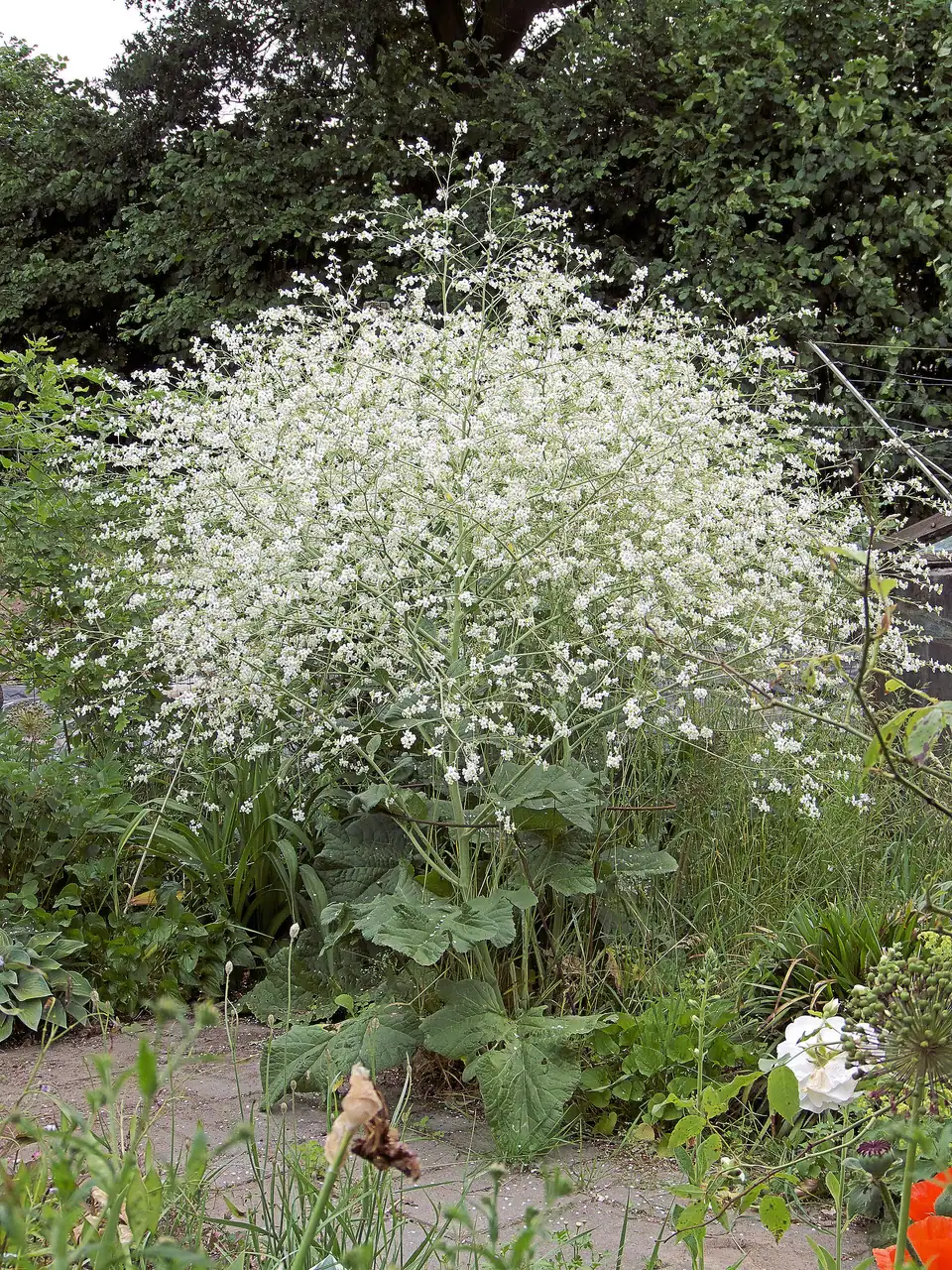

How to Grow and Care for Crambe cordifolia
Crambe cordifolia
Written by Emilio Marruso · last checked
Toxic to: Cats, Dogs, Horses · Why
At a glance
Crambe cordifolia grows happily in full sun or partial shade, and once established it handles dry spells with ease. Give it well-drained soil and 4 feet of room. It's a treat in the kitchen too: cooked young leaves have a delicate cabbage or kale flavor, and the new shoots, roots and flowers are edible as well.
- Sun
Full sun to partial shade
What the sources say (4)
Light: Full sun to partial shade
For best results, grow Crambe cordifolia in full sun or partial shade in moist, fertile and well-drained soil.
— Crambe cordifolia (Flowering Sea Kale) | BBC Gardeners World Magazine [2] Light : Full Sun to Partial Shade - Maintenance : Low
— Colewort - Fine Gardening [3] The plant prefers full sun but tolerates light shade.
— Cordifolia Sea Kale Plants: Information About Greater Sea Kale Growing | Gardening Know How [4] Light full sun Shade tolerance light shade
— Crambe cordifolia — Practical Plants [1] - Water
Handles drought once established; soggy soil makes it rot
What the sources say (6)
Watering: Drought tolerant once established
According to Fine Gardening: Moisture : Dry to Medium - Bloom Time : Early Summer, Late Spring
— Colewort - Fine Gardening [3] According to BBC Gardeners World: For best results, grow Crambe cordifolia in full sun or partial shade in moist, fertile and well-drained soil.
— Crambe cordifolia (Flowering Sea Kale) | BBC Gardeners World Magazine [2] Dislikes acid soils [1] . Established plants are drought tolerant [11] .
— Crambe cordifolia — Practical Plants [1] During periods of low rainfall, mature sea kale plants are able to withstand periods of drought.
— Cordifolia Sea Kale Plants: Information About Greater Sea Kale Growing | Gardening Know How [4] Watering notes: Susceptible to rot in moist soils; prefers moist, well-draining soil and a site with adequate rainfall
It is susceptible to rot in moist soils, and may be short-lived.
— Colewort - Fine Gardening [3] prefers moist, well-draining neutral to alkaline soils. Chose a sheltered location away from strong winds with adequate rainfall.
— Cordifolia Sea Kale Plants: Information About Greater Sea Kale Growing | Gardening Know How [4] - Soil
Well-drained soil
What the sources say (2)
Watering notes: Susceptible to rot in moist soils; prefers moist, well-draining soil and a site with adequate rainfall
It is susceptible to rot in moist soils, and may be short-lived.
— Colewort - Fine Gardening [3] prefers moist, well-draining neutral to alkaline soils. Chose a sheltered location away from strong winds with adequate rainfall.
— Cordifolia Sea Kale Plants: Information About Greater Sea Kale Growing | Gardening Know How [4] - Spacing
4 ft between plants
What the sources say (2)
Spacing: 120 cm (1.2 m)
ground cover (fonte: Practical Plants / PFAF): Plants can be used for ground cover when planted about 1.2 metres apart each way.
— Crambe cordifolia — Practical Plants [1] Plants can be used for ground cover when planted about 1.2 metres apart each way. They form large clumps [14] .
— Crambe cordifolia — Practical Plants [1] - Planting
Plant seedlings out at 4 in tall; plant divisions in early spring or fall
What the sources say (3)
Planting: When seedlings are about 10 cm [3.9 in] tall; divisions in early spring or fall
Prick out the seedlings into individual pots as soon as they are large enough to handle and plant out into their permanent positions when they are at least 10cm tall.
— Crambe cordifolia — Practical Plants [1] Transplant seedlings to their permanent home when they are about 4 inches (10 cm.) tall.
— Cordifolia Sea Kale Plants: Information About Greater Sea Kale Growing | Gardening Know How [4] To divide, dig up the entire root in the early spring or fall. Make sure each division has at least one growing point.
— Cordifolia Sea Kale Plants: Information About Greater Sea Kale Growing | Gardening Know How [4] - Harvest
Cook the young leaves, they taste like mild cabbage; shoots, roots and flowers are edible too
- Pests
Slugs and snails eat young growth; also caterpillars, clubroot and black rot
- Safety
No toxic effects reported for cats, dogs or horses
Overview
Greater sea kale is a large herbaceous perennial of the cabbage family that produces clouds of small scented white flowers in early summer. [2][4] It grows best in fertile, well-drained, deep soil in full sun and needs deep soil for its long taproot. [2] Young plants are attacked by slugs and tall plants may need staking. [4]
This record is incomplete: the sources we read do not cover every field yet.
Not yet covered by our sources: Pruning
Crambe cordifolia care
Measurements in square brackets are our conversion into the other unit system; the quoted text is unchanged.
How to water Crambe cordifolia
Watering
Drought tolerant once established
What each source says
According to Fine Gardening: Dry to medium moisture
According to BBC Gardeners World: Moist, fertile, well-drained soil
What the sources say (4)
According to Fine Gardening: Moisture :
Dry to Medium
-
Bloom Time :
Early Summer, Late SpringAccording to BBC Gardeners World: For best results, grow Crambe cordifolia in full sun or partial shade in moist, fertile and well-drained soil.Dislikes acid soils [1] . Established plants are drought tolerant [11] .During periods of low rainfall, mature sea kale plants are able to withstand periods of drought.Watering notes
Susceptible to rot in moist soils; prefers moist, well-draining soil and a site with adequate rainfall
What the sources say (2)
It is susceptible to rot in moist soils, and may be short-lived.prefers moist, well-draining neutral to alkaline soils. Chose a sheltered location away from strong winds with adequate rainfall.How much light Crambe cordifolia needs
Full sun to partial shade
What the sources say (4)
For best results, grow Crambe cordifolia in full sun or partial shade in moist, fertile and well-drained soil.Light :
Full Sun to Partial Shade
-
Maintenance :
LowThe plant prefers full sun but tolerates light shade.Light
full sun
Shade tolerance
light shadeHow much cold Crambe cordifolia can take
Hardiness, coldest zone
The sources give different values depending on region, zone or growing conditions.
What each source says
According to Fine Gardening: 6-9 [winter low −23.3 to −1.1 °C (−10 to 30 °F)]
According to Gardening Know How: 5-8 [winter low −28.9 to −6.7 °C (−20 to 20 °F)]
According to Practical Plants (PFAF): 6 [winter low −23.3 to −17.8 °C (−10 to 0 °F)]+
What the sources say (3)
According to Fine Gardening: Zones :
6, 7, 8, 9
-
Plant Height :
6 to 10 feetAccording to Gardening Know How: Although frost tolerant and hardy to USDA zones 5 to 8, Cordifolia sea kale dislikes and performs poorly with the heat and humidityAccording to Practical Plants (PFAF): Water
moderate
Hardiness
Zone 6+
Soil textures
sandy, loamy, clayHardiness, warmest zone
The sources give different values depending on region, zone or growing conditions.
What each source says
According to Fine Gardening: 6-9 [winter low −23.3 to −1.1 °C (−10 to 30 °F)]
According to Gardening Know How: 5-8 [winter low −28.9 to −6.7 °C (−20 to 20 °F)]
According to Practical Plants (PFAF): 6 [winter low −23.3 to −17.8 °C (−10 to 0 °F)]+
What the sources say (3)
According to Fine Gardening: Zones :
6, 7, 8, 9
-
Plant Height :
6 to 10 feetAccording to Gardening Know How: Although frost tolerant and hardy to USDA zones 5 to 8, Cordifolia sea kale dislikes and performs poorly with the heat and humidityAccording to Practical Plants (PFAF): Water
moderate
Hardiness
Zone 6+
Soil textures
sandy, loamy, clayWhere to grow Crambe cordifolia
120 cm (1.2 m)
What each source says
ground cover (fonte: Practical Plants / PFAF): 120 cm (1.2 m)
What the sources say (2)
ground cover (fonte: Practical Plants / PFAF): Plants can be used for ground cover when planted about 1.2 metres apart each way.Plants can be used for ground cover when planted about 1.2 metres apart each way. They form large clumps [14] .How to propagate Crambe cordifolia
The sources disagree:
What the sources say (3)
Division in spring or autumn [1] [4] . Dig up the root clump and cut off as many sections as you requireTo divide, dig up the entire root in the early spring or fall. Make sure each division has at least one growing point.Propagation Sow seed in a cold frame in spring or fall.Crambe cordifolia pests and problems
Slugs and snails
Symptom: Young growth eaten
What to do: Protect young plants
Clubroot, black rot
What the sources say (1)
Problems Clubroot, black rot, slugs, snails.
— Colewort - Fine Gardening [3] Caterpillars
What the sources say (1)
Slugs and caterpillars can be problematic with young plants.
— Cordifolia Sea Kale Plants: Information About Greater Sea Kale Growing | Gardening Know How [4] Rot in moist soils
What the sources say (1)
It is susceptible to rot in moist soils, and may be short-lived.
— Colewort - Fine Gardening [3]
Remedies
The sources we checked give no remedies for this plant.
Is Crambe cordifolia toxic to pets?
Reported by the source, quoted verbatim. This is not medical or veterinary advice: if a person or an animal may have eaten this plant, contact a poison control centre or a veterinarian.
Crambe ‘Cordifolia’ has no toxic effects reported. No reported toxicity to: Is not known to attract Birds Birds Is not known to attract Cats
[2]The source flags the risk for this animal but does not explain why.
No reported toxicity to: Is not known to attract Birds Birds Is not known to attract Cats Cats Is not known to attract Dogs
[2]The source flags the risk for this animal but does not explain why.
No reported toxicity to: Is not known to attract Birds Birds Is not known to attract Cats Cats Is not known to attract Dogs Dogs Is not known to attract Horses
[2]The source flags the risk for this animal but does not explain why.
Calendar
Sowing
The sources give different values depending on region, zone or growing conditions.
What each source says
outdoor seedbed (fonte: Practical Plants / PFAF): March-April
cold frame (fonte: Fine Gardening): Spring or fall
outdoors (fonte: Gardening Know How): Early spring
What the sources say (6)
outdoor seedbed (fonte: Practical Plants / PFAF): Seed - sow March/April in a seedbed outdoors and either thin the plants out or move them to their permanent positions when about 10cm tall [4] .cold frame (fonte: Fine Gardening): Propagation Sow seed in a cold frame in spring or fall.outdoors (fonte: Gardening Know How): Seeds can be sowed outdoors in early spring. Germination is slow, so starting seeds in a cold frame or pots is recommended.Seed - sow March/April in a seedbed outdoors and either thin the plants out or move them to their permanent positions when about 10cm tall [4] .Propagation Sow seed in a cold frame in spring or fall.Seeds can be sowed outdoors in early spring. Germination is slow, so starting seeds in a cold frame or pots is recommended.Planting
When seedlings are about 10 cm [3.9 in] tall; divisions in early spring or fall
What the sources say (3)
Prick out the seedlings into individual pots as soon as they are large enough to handle and plant out into their permanent positions when they are at least 10cm tall.Transplant seedlings to their permanent home when they are about 4 inches (10 cm.) tall.To divide, dig up the entire root in the early spring or fall. Make sure each division has at least one growing point.Pruning
Not stated in the sources we read.
Months as given by the sources, which are mostly from the United States (northern hemisphere). In the southern hemisphere they shift by about six months.
Edibility
Reported by the source, quoted verbatim. Do not eat a plant on the basis of this page alone: identification mistakes can be dangerous.
Leaves - cooked [12] [3] [7] . Used as a potherb [8] . Young leaves have a pleasant cabbage-like flavour, though older leaves are rather tough[K].
[1]Root - cooked [12] [5] [7] . Plant part Leaves Plant part Root
[1]When cooked, the leaves have a delicate kale or cabbage-like flavor. Young leaves are preferred for consumption
[4]Many parts of the plant are edible, including the newly sprouted shoots, roots, and flowers.
[4]
Indicative values
Values from a secondary source, not checked word for word like the rest of this page. Use them as a starting point.
- Life cycle
- Herbaceous PerennialIndicative value, adapt it to your climate · Secondary source
- Mature height
- 121.9-213.4 cm (4-7 ft)Indicative value, adapt it to your climate · Secondary source
- Hours of sun
- 5-6 hoursIndicative value, adapt it to your climate · Secondary source
- Soil pH
- 6-7.5Indicative value, adapt it to your climate · Secondary source
- Care level
- MediumIndicative value, adapt it to your climate · Secondary source
- Growth rate
- LowIndicative value, adapt it to your climate · Secondary source
- Pruning
- February, March, AprilIndicative value, adapt it to your climate · Secondary source
Similar plants
- Sea kale Crambe maritima
- Abies grandis Abies grandis
- Abraham Trachystemon orientalis
- Abyssinian banana Ensete ventricosum
- Acacia longifolia Acacia longifolia
- Acanthus hungaricus Acanthus hungaricus
- Achlys triphylla Achlys triphylla
- Aconite Aconitum napellus
Sources
Every value above is quoted from these documents. Links lead to the original publisher.
- Crambe cordifolia — Practical Plants · practicalplants.org, consulted
- Crambe cordifolia (Flowering Sea Kale) | BBC Gardeners World Magazine · gardenersworld.com, consulted
- Colewort - Fine Gardening · finegardening.com, consulted
- Cordifolia Sea Kale Plants: Information About Greater Sea Kale Growing | Gardening Know How · gardeningknowhow.com, consulted
Written by Emilio Marruso · last checked