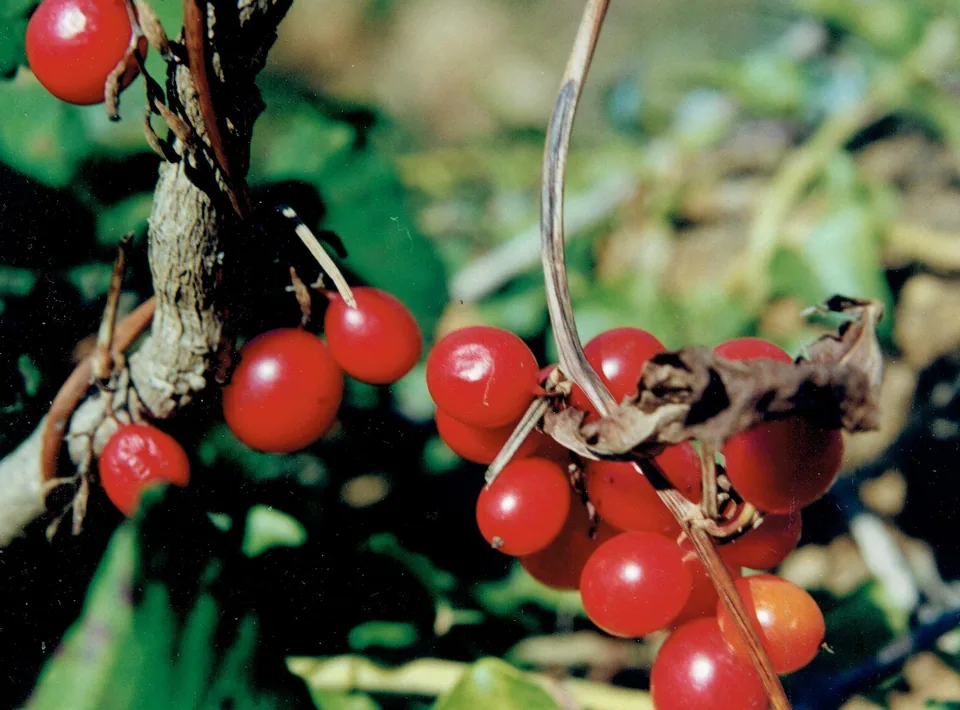
Cómo cultivar y cuidar Nueza negra
Dioscorea communis
Escrito por Emilio Marruso · última revisión
Tóxica para: Personas · Por qué
De un vistazo
La nueza negra es una perenne que crece a gusto desde el sol pleno hasta la sombra ligera. Dale un suelo húmedo, fértil y con buen drenaje y un riego moderado, y te acompañará temporada tras temporada. Puedes cultivarla a partir de semillas sembradas a principios de primavera, o en otoño en cuanto estén maduras, y trasplantar las plántulas en verano.
- Sol
De sol pleno a sombra ligera
Qué dicen las fuentes (1)
Luz: Pleno sol a semisombra
Light full sun Shade tolerance light shade Water moderate Hardiness Zone 5+
— Black Bryony (Tamus communis) — Practical Plants [5] - Riego
Riego moderado; mantén la tierra húmeda pero nunca encharcada
Qué dicen las fuentes (2)
Riego: Moderado
Light full sun Shade tolerance light shade Water moderate Hardiness Zone 5+
— Black Bryony (Tamus communis) — Practical Plants [5] Notas sobre el riego: Requiere un suelo húmedo, bien drenado y fértil
Requires a moist well-drained fertile soil [3] . A climbing plant, the weak stems support themselves by twining around other plants
— Black Bryony (Tamus communis) — Practical Plants [5] - Frío
Aguanta inviernos de hasta −28,9 °C (−20 °F)
Muy rústica · USDA 5 · RHS H7 · Z5
Qué dicen las fuentes (1)
Rusticidad, zona más fría: 5 [mínima invernal de −28,9 a −23,3 °C (de −20 a −10 °F)]
Light full sun Shade tolerance light shade Water moderate Hardiness Zone 5+
— Black Bryony (Tamus communis) — Practical Plants [5] - Suelo
Suelo húmedo, fértil y con buen drenaje
Qué dicen las fuentes (1)
Notas sobre el riego: Requiere un suelo húmedo, bien drenado y fértil
Requires a moist well-drained fertile soil [3] . A climbing plant, the weak stems support themselves by twining around other plants
— Black Bryony (Tamus communis) — Practical Plants [5] - Plantación
Trasplanta las plántulas en verano o a finales de la primavera del año siguiente
Qué dicen las fuentes (1)
Plantación: Verano, o finales de primavera del año siguiente (plántulas trasplantadas)
Prick out the seedlings into individual pots once they are large enough to handle, and plant out in the summer or in late spring of the following year.
— Tamus communis - Useful Temperate Plants [4] - Cosecha
Los brotes jóvenes se comen cocidos como espárragos; muy amargos, cambia el agua una vez
- Multiplicación
Se multiplica por semilla
Qué dicen las fuentes (1)
Propagación: Semilla
Seed - sow in a cold frame in early spring or as soon as the seed is ripe in the autumn.
— Tamus communis - Useful Temperate Plants [4] - Siembra
Siembra a principios de primavera, o en otoño en cuanto la semilla madure, en cajonera fría
Qué dicen las fuentes (1)
Siembra: Principios de primavera, o tan pronto como la semilla esté madura en otoño (marco frío)
Seed - sow in a cold frame in early spring or as soon as the seed is ripe in the autumn.
— Tamus communis - Useful Temperate Plants [4] - Seguridad
Toda la planta es tóxica; nunca comas la raíz, puede causar daños graves
Resumen
La nueza negra es una trepadora perenne dioica que crece a partir de tubérculos y se enrosca alrededor de otras plantas. [5] Requiere un suelo húmedo, bien drenado y fértil y se propaga por semilla. [5][4] Toda la planta se describe como venenosa. [5]
Citado en inglés, como en la fuente.
Esta ficha está incompleta: las fuentes consultadas aún no cubren todos los campos.
Aún no cubierto por nuestras fuentes: Rusticidad, zona más cálida, Poda
Cuidados
Riego
Riego
Moderado
Qué dicen las fuentes (1)
Light
full sun
Shade tolerance
light shade
Water
moderate
Hardiness
Zone 5+Notas sobre el riego
Requiere un suelo húmedo, bien drenado y fértil
Qué dicen las fuentes (1)
Requires a moist well-drained fertile soil [3] .
A climbing plant, the weak stems support themselves by twining around other plantsLuz
Pleno sol a semisombra
Qué dicen las fuentes (1)
Light
full sun
Shade tolerance
light shade
Water
moderate
Hardiness
Zone 5+Clima y frío
Rusticidad, zona más fría
5 [mínima invernal de −28,9 a −23,3 °C (de −20 a −10 °F)]
Qué dicen las fuentes (1)
Light
full sun
Shade tolerance
light shade
Water
moderate
Hardiness
Zone 5+Rusticidad, zona más cálida
No figura en las fuentes consultadas.
Propagación
Semilla
Qué dicen las fuentes (1)
Seed - sow in a cold frame in early spring or as soon as the seed is ripe in the autumn.Cultivo
La planta
Ciclo de vida
perenne
Qué dicen las fuentes (1)
Perennial herb, glabrous. Stem striated, branched. Leaves cordate, rarely trilobed, up to 180 × 150 mmRemedios
Cada remedio indica qué dicen las fuentes oficiales; los remedios tradicionales sin fuente oficial aparecen marcados. Los perjudiciales están para que sepas evitarlos.
Primeros auxilios
Primeros auxilios: no sustituyen al médico
ingestión de la planta
retira los trozos de planta de la boca Fuente oficial, sin prueba independiente
If you know what a plant is, you can call the poison center at 1-800-222-1222 to find out whether it may be poisonous.
— nnepc.org [8] Cómo: Saca todos los trozos de la planta de la boca de la persona.
Take all pieces of the plant out of the person’s mouth.
— nnepc.org [8] sorbos de agua o leche Fuente oficial, sin prueba independiente
If you know what a plant is, you can call the poison center at 1-800-222-1222 to find out whether it may be poisonous.
— nnepc.org [8] Cómo: Da unos sorbos de agua o leche.
Give them a few sips of water or milk.
— nnepc.org [8]
contacto de la piel con la planta
Lava la piel con agua y jabón Fuente oficial, sin prueba independiente
If you know what a plant is, you can call the poison center at 1-800-222-1222 to find out whether it may be poisonous.
— nnepc.org [8] Cómo: Lava suavemente la piel de la persona con jabón y agua.
Wash the person’s skin gently with soap and water.
— nnepc.org [8]
Cómo eliminarla
brionia negra no deseada
extracción de plántulas con horca Fuente oficial, sin prueba independiente
Don't add bryony fruits or pieces of root or tuber to your home compost bin , as it is unlikely to get hot enough to kill them off completely.
— rhs.org.uk [9] Cómo: En la primera temporada de crecimiento, se puede sacar toda la raíz con un tenedor de mano o una pala, colocada en la base de los tallos.
in their first growing season, the tuberous roots of bryony are small and the whole root can be lifted out easily with a hand fork or trowel.
— rhs.org.uk [9] excavación del tubérculo Fuente oficial, sin prueba independiente
Don't add bryony fruits or pieces of root or tuber to your home compost bin , as it is unlikely to get hot enough to kill them off completely.
— rhs.org.uk [9] Cómo: Usa una pala para desenterrar la raíz tuberosa; cuando sea posible, desentierra la raíz completa.
Dig out plants – use a spade to dig out the tuberous root. This may be up to 10cm (4in) below the soil where the stems emerge from the ground.
— rhs.org.uk [9] Elimina los brotes nuevos con regularidad. Fuente oficial, sin prueba independiente
Cómo: Si aparecen brotes nuevos después de desenterrar, sigue eliminándolos con regularidad para debilitar la planta.
If it isn’t, and you see new shoots appearing, keep removing these regularly to weaken the plant.
— rhs.org.uk [9] eliminando las bayas antes de que maduren Fuente oficial, sin prueba independiente
Don't add bryony fruits or pieces of root or tuber to your home compost bin , as it is unlikely to get hot enough to kill them off completely.
— rhs.org.uk [9] Cómo: Retira las bayas antes de que maduren para evitar que la planta se propague por semilla.
so if you have bryony in your garden and don’t want it to spread, be sure to remove the berries before they ripen.
— rhs.org.uk [9]
Toxicidad
Según la fuente, citada textualmente. No es un consejo médico ni veterinario: si una persona o un animal pudo haber ingerido esta planta, contacta con un centro de toxicología o con un veterinario.
The whole plant is poisonous due to its saponin content [8] . Although toxic, saponins are very poorly absorbed by the body and so tend to pass through without causing harm.
[5]- Partes venenosas
The whole plant is poisonous due to its saponin content [8] . Although toxic, saponins are very poorly absorbed by the body
[5]- Principio tóxico
The toxic effect of this plant is not caused by saponins, but by calcium oxalate crystals which are found mainly in the fruit [7] .
[5]- Síntomas
It can cause serious side effects including severe irritation of the stomach and intestines, seizures, kidney failure, and dangerously slowed breathing.
[7]- Gravedad
Use with caution, the plant is rich in saponins, has a very powerful cathartic affect and ranks as a dangerous irritant poison [5] [8] .
[5]
Black bryony root is UNSAFE for anyone when taken by mouth. It can cause serious side effects including severe irritation of the stomach and intestines, seizures, kidney failure, and dangerously slowed breathing.
[7]- Partes venenosas
Applying fresh black bryony root directly to the skin is POSSIBLY UNSAFE . It can cause severe skin irritation, rashes, swelling, and welts.
[7]- Síntomas
It can cause serious side effects including severe irritation of the stomach and intestines, seizures, kidney failure, and dangerously slowed breathing.
[7]
Calendario
Siembra
Principios de primavera, o tan pronto como la semilla esté madura en otoño (marco frío)
Qué dicen las fuentes (1)
Seed - sow in a cold frame in early spring or as soon as the seed is ripe in the autumn.Plantación
Verano, o finales de primavera del año siguiente (plántulas trasplantadas)
Qué dicen las fuentes (1)
Prick out the seedlings into individual pots once they are large enough to handle, and plant out in the summer or in late spring of the following year.Poda
No figura en las fuentes consultadas.
Meses tal como los dan las fuentes, en su mayoría de Estados Unidos (hemisferio norte). En el hemisferio sur se desplazan unos seis meses.
Comestibilidad
Según la fuente, citada textualmente. No comas una planta basándote solo en esta página: los errores de identificación pueden ser peligrosos.
Young shoots - cooked [4] [5] [6] [7] . A decidedly bitter flavour [8] . An asparagus substitute, it is best if the water is changed once whilst cooking [2] .
[5]
Plantas similares
- Chinese yam Dioscorea polystachya
- Air Potato Dioscorea bulbifera
- Wild Yam Dioscorea villosa
- Acónito común Aconitum napellus
- Palma de aguja Yucca flaccida
- Afghan Cherry Prunus jacquemontii
- African Blood Lily Scadoxus multiflorus
- Agapanto Agapanthus praecox
Fuentes
Cada valor anterior se cita de estos documentos. Los enlaces llevan al editor original.
- Dioscorea communis (L.) Caddick & Wilkin | Plants of the World Online | Kew Science · powo.science.kew.org, consultado
- Annals of Botany XX: 1–20, 2023 · zaguan.unizar.es, consultado
- Dioscorea communis • New Zealand Plant Conservation Network · nzpcn.org.nz, consultado
- Tamus communis - Useful Temperate Plants · temperate.theferns.info, consultado
- Black Bryony (Tamus communis) — Practical Plants · practicalplants.org, consultado
- Plant Encyclopedia · climbingplants.netlify.app, consultado
- Black Bryony: Health Benefits, Side Effects, Uses, Dose & Precautions · rxlist.com, consultado
- nnepc.org · nnepc.org
- rhs.org.uk · rhs.org.uk
Escrito por Emilio Marruso · última revisión