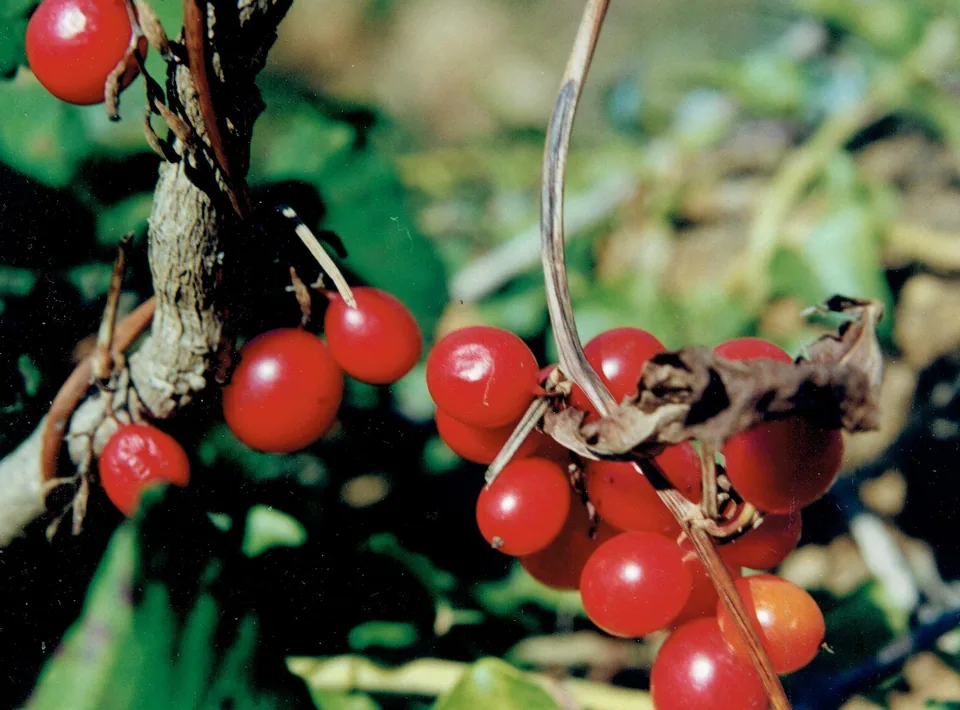
How to Grow and Care for Black bryony
Dioscorea communis
Written by Emilio Marruso · last checked
Toxic to: People · Why
At a glance
Black bryony is a perennial that grows happily from full sun to light shade. Give it moist, well-drained, fertile soil and moderate watering, and it settles in season after season. You can grow it from seed sown in early spring, or in autumn as soon as the seed is ripe, then plant the young seedlings out in summer.
- Sun
Full sun to light shade
What the sources say (1)
Light: Full sun to light shade
Light full sun Shade tolerance light shade Water moderate Hardiness Zone 5+
— Black Bryony (Tamus communis) — Practical Plants [5] - Water
Moderate watering; keep the soil moist but never soggy
What the sources say (2)
Watering: Moderate
Light full sun Shade tolerance light shade Water moderate Hardiness Zone 5+
— Black Bryony (Tamus communis) — Practical Plants [5] Watering notes: Requires a moist, well-drained, fertile soil
Requires a moist well-drained fertile soil [3] . A climbing plant, the weak stems support themselves by twining around other plants
— Black Bryony (Tamus communis) — Practical Plants [5] - Cold
Survives winters down to −20 °F (−28.9 °C)
Very hardy · USDA 5 · RHS H7 · Z5
What the sources say (1)
Hardiness, coldest zone: 5 [winter low −28.9 to −23.3 °C (−20 to −10 °F)]
Light full sun Shade tolerance light shade Water moderate Hardiness Zone 5+
— Black Bryony (Tamus communis) — Practical Plants [5] - Soil
Moist, fertile soil that drains well
What the sources say (1)
Watering notes: Requires a moist, well-drained, fertile soil
Requires a moist well-drained fertile soil [3] . A climbing plant, the weak stems support themselves by twining around other plants
— Black Bryony (Tamus communis) — Practical Plants [5] - Planting
Plant seedlings out in summer, or in late spring of the following year
What the sources say (1)
Planting: Summer, or late spring of the following year (seedlings planted out)
Prick out the seedlings into individual pots once they are large enough to handle, and plant out in the summer or in late spring of the following year.
— Tamus communis - Useful Temperate Plants [4] - Harvest
Young shoots are eaten cooked like asparagus; very bitter, so change the water once
- Propagation
Grows from seed
What the sources say (1)
Propagation: Seed
Seed - sow in a cold frame in early spring or as soon as the seed is ripe in the autumn.
— Tamus communis - Useful Temperate Plants [4] - Sowing
Sow in early spring, or in autumn as soon as the seed is ripe, in a cold frame
What the sources say (1)
Sowing: Early spring, or as soon as the seed is ripe in autumn (cold frame)
Seed - sow in a cold frame in early spring or as soon as the seed is ripe in the autumn.
— Tamus communis - Useful Temperate Plants [4] - Safety
The whole plant is poisonous; never eat the root, it can cause serious harm
Overview
Black bryony is a dioecious climbing perennial that grows from tubers and twines around other plants. [5] It requires a moist, well-drained, fertile soil and is propagated by seed. [5][4] The whole plant is described as poisonous. [5]
This record is incomplete: the sources we read do not cover every field yet.
Not yet covered by our sources: Hardiness, warmest zone, Pruning
Black bryony care
How to water Black bryony
Watering
Moderate
What the sources say (1)
Light
full sun
Shade tolerance
light shade
Water
moderate
Hardiness
Zone 5+Watering notes
Requires a moist, well-drained, fertile soil
What the sources say (1)
Requires a moist well-drained fertile soil [3] .
A climbing plant, the weak stems support themselves by twining around other plantsHow much light Black bryony needs
Full sun to light shade
What the sources say (1)
Light
full sun
Shade tolerance
light shade
Water
moderate
Hardiness
Zone 5+How much cold Black bryony can take
Hardiness, coldest zone
5 [winter low −28.9 to −23.3 °C (−20 to −10 °F)]
What the sources say (1)
Light
full sun
Shade tolerance
light shade
Water
moderate
Hardiness
Zone 5+Hardiness, warmest zone
Not stated in the sources we read.
How to propagate Black bryony
Seed
What the sources say (1)
Seed - sow in a cold frame in early spring or as soon as the seed is ripe in the autumn.How to grow Black bryony
The plant
Life cycle
perennial
What the sources say (1)
Perennial herb, glabrous. Stem striated, branched. Leaves cordate, rarely trilobed, up to 180 × 150 mmRemedies
Each remedy shows what official sources say about it; traditional remedies without an official source are marked as such. Harmful ones are listed so you know to avoid them.
First aid
First aid: not a substitute for a doctor
plant ingestion
remove plant pieces from the mouth Official source, not independently tested
If you know what a plant is, you can call the poison center at 1-800-222-1222 to find out whether it may be poisonous.
— nnepc.org [8] How: Take all pieces of the plant out of the person’s mouth.
Take all pieces of the plant out of the person’s mouth.
— nnepc.org [8] sips of water or milk Official source, not independently tested
If you know what a plant is, you can call the poison center at 1-800-222-1222 to find out whether it may be poisonous.
— nnepc.org [8] How: Give a few sips of water or milk.
Give them a few sips of water or milk.
— nnepc.org [8]
skin contact with the plant
wash skin with soap and water Official source, not independently tested
If you know what a plant is, you can call the poison center at 1-800-222-1222 to find out whether it may be poisonous.
— nnepc.org [8] How: Wash the person’s skin gently with soap and water.
Wash the person’s skin gently with soap and water.
— nnepc.org [8]
Getting rid of it
unwanted black bryony
forking out seedlings Official source, not independently tested
Don't add bryony fruits or pieces of root or tuber to your home compost bin , as it is unlikely to get hot enough to kill them off completely.
— rhs.org.uk [9] How: In the first growing season the whole root can be lifted out with a hand fork or trowel, positioned at the base of the stems.
in their first growing season, the tuberous roots of bryony are small and the whole root can be lifted out easily with a hand fork or trowel.
— rhs.org.uk [9] digging out the tuber Official source, not independently tested
Don't add bryony fruits or pieces of root or tuber to your home compost bin , as it is unlikely to get hot enough to kill them off completely.
— rhs.org.uk [9] How: Use a spade to dig out the tuberous root; where possible dig out the entire root.
Dig out plants – use a spade to dig out the tuberous root. This may be up to 10cm (4in) below the soil where the stems emerge from the ground.
— rhs.org.uk [9] removing new shoots regularly Official source, not independently tested
How: If new shoots appear after digging, keep removing them regularly to weaken the plant.
If it isn’t, and you see new shoots appearing, keep removing these regularly to weaken the plant.
— rhs.org.uk [9] removing berries before they ripen Official source, not independently tested
Don't add bryony fruits or pieces of root or tuber to your home compost bin , as it is unlikely to get hot enough to kill them off completely.
— rhs.org.uk [9] How: Remove the berries before they ripen to stop the plant spreading by seed.
so if you have bryony in your garden and don’t want it to spread, be sure to remove the berries before they ripen.
— rhs.org.uk [9]
Is Black bryony poisonous?
Reported by the source, quoted verbatim. This is not medical or veterinary advice: if a person or an animal may have eaten this plant, contact a poison control centre or a veterinarian.
The whole plant is poisonous due to its saponin content [8] . Although toxic, saponins are very poorly absorbed by the body and so tend to pass through without causing harm.
[5]- Poisonous parts
The whole plant is poisonous due to its saponin content [8] . Although toxic, saponins are very poorly absorbed by the body
[5]- Toxic principle
The toxic effect of this plant is not caused by saponins, but by calcium oxalate crystals which are found mainly in the fruit [7] .
[5]- Symptoms
It can cause serious side effects including severe irritation of the stomach and intestines, seizures, kidney failure, and dangerously slowed breathing.
[7]- Severity
Use with caution, the plant is rich in saponins, has a very powerful cathartic affect and ranks as a dangerous irritant poison [5] [8] .
[5]
Black bryony root is UNSAFE for anyone when taken by mouth. It can cause serious side effects including severe irritation of the stomach and intestines, seizures, kidney failure, and dangerously slowed breathing.
[7]- Poisonous parts
Applying fresh black bryony root directly to the skin is POSSIBLY UNSAFE . It can cause severe skin irritation, rashes, swelling, and welts.
[7]- Symptoms
It can cause serious side effects including severe irritation of the stomach and intestines, seizures, kidney failure, and dangerously slowed breathing.
[7]
Calendar
Sowing
Early spring, or as soon as the seed is ripe in autumn (cold frame)
What the sources say (1)
Seed - sow in a cold frame in early spring or as soon as the seed is ripe in the autumn.Planting
Summer, or late spring of the following year (seedlings planted out)
What the sources say (1)
Prick out the seedlings into individual pots once they are large enough to handle, and plant out in the summer or in late spring of the following year.Pruning
Not stated in the sources we read.
Months as given by the sources, which are mostly from the United States (northern hemisphere). In the southern hemisphere they shift by about six months.
Edibility
Reported by the source, quoted verbatim. Do not eat a plant on the basis of this page alone: identification mistakes can be dangerous.
Young shoots - cooked [4] [5] [6] [7] . A decidedly bitter flavour [8] . An asparagus substitute, it is best if the water is changed once whilst cooking [2] .
[5]
Similar plants
- Chinese yam Dioscorea polystachya
- Air Potato Dioscorea bulbifera
- Wild Yam Dioscorea villosa
- Aconite Aconitum napellus
- Adam's Needle Yucca flaccida
- Afghan Cherry Prunus jacquemontii
- African Blood Lily Scadoxus multiflorus
- African Blue Lily Agapanthus praecox
Sources
Every value above is quoted from these documents. Links lead to the original publisher.
- Dioscorea communis (L.) Caddick & Wilkin | Plants of the World Online | Kew Science · powo.science.kew.org, consulted
- Annals of Botany XX: 1–20, 2023 · zaguan.unizar.es, consulted
- Dioscorea communis • New Zealand Plant Conservation Network · nzpcn.org.nz, consulted
- Tamus communis - Useful Temperate Plants · temperate.theferns.info, consulted
- Black Bryony (Tamus communis) — Practical Plants · practicalplants.org, consulted
- Plant Encyclopedia · climbingplants.netlify.app, consulted
- Black Bryony: Health Benefits, Side Effects, Uses, Dose & Precautions · rxlist.com, consulted
- nnepc.org · nnepc.org
- rhs.org.uk · rhs.org.uk
Written by Emilio Marruso · last checked