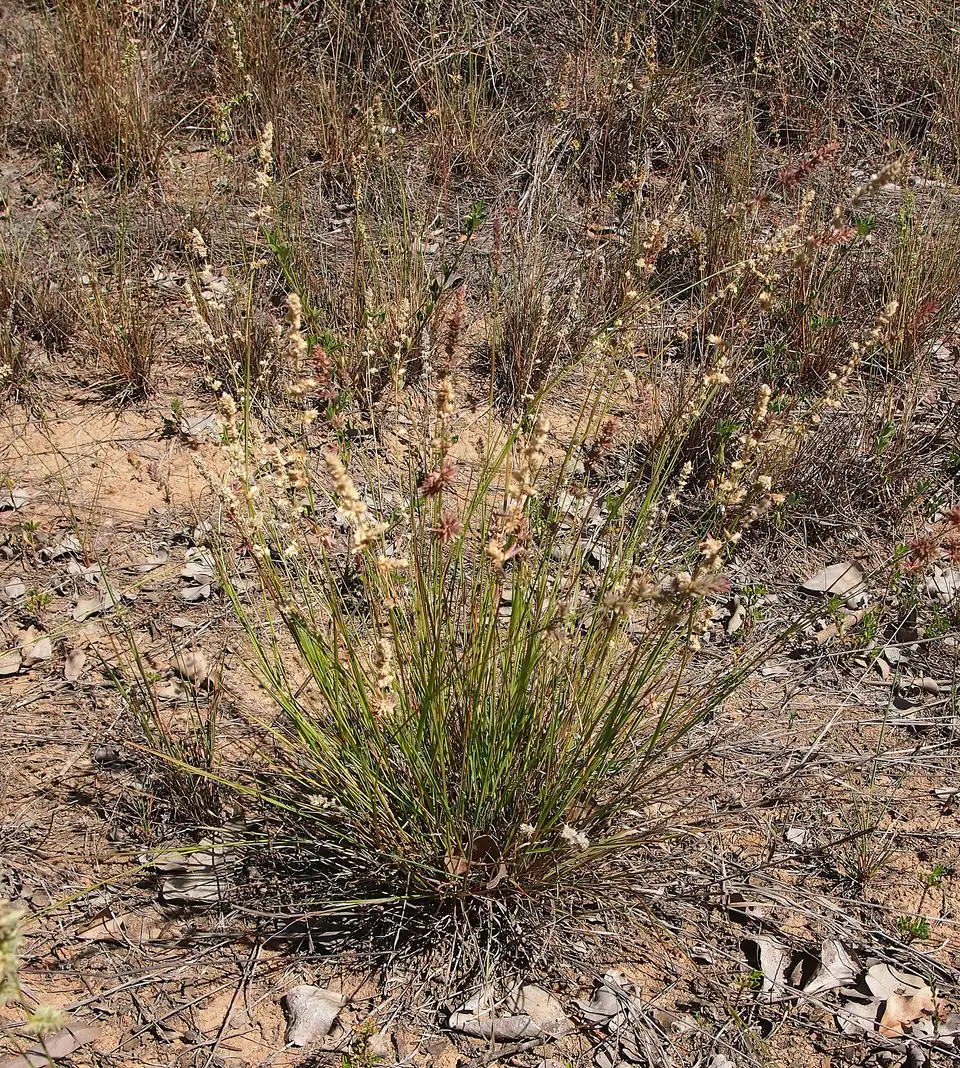


Cómo cultivar y cuidar Purple Lovegrass
Eragrostis spectabilis
Escrito por Emilio Marruso · última revisión
De un vistazo
Esta gramínea perenne y agradecida adora el sol pleno, aunque también tolera la semisombra. Riégala con regularidad un par de semanas mientras arraiga; después aguanta el calor y el suelo seco sin regar más, incluso en épocas de sequía. Mide de 30 a 90 cm de alto y puedes plantarla en cualquier momento de la temporada de crecimiento.
- Sol
Sol pleno; también tolera la semisombra
Qué dicen las fuentes (2)
Luz: Pleno sol; tolera semisombra
Light: Full sun (6 or more hours of direct sunlight a day) Soil Texture:
— Eragrostis spectabilis (Purple Lovegrass, Purple Love Grass, Tumble Grass) | North Carolina Extension Gardener Plant Toolbox [1] They perform best in full sun, but both can tolerate partial shade as well.
— Lovegrass – Gardening Solutions [4] - Riego
Riega con regularidad las dos primeras semanas; después, sin riego extra ni en sequía
Qué dicen las fuentes (3)
Riego: Tolera condiciones calurosas y secas; no se necesita riego adicional incluso en sequías
It is tolerant of hot dry conditions.
— Eragrostis spectabilis (Purple Lovegrass, Purple Love Grass, Tumble Grass) | North Carolina Extension Gardener Plant Toolbox [1] Even in droughts lovegrass shouldn’t require any extra irrigation.
— Lovegrass – Gardening Solutions [4] Notas sobre el riego: Riega regularmente durante un par de semanas hasta que la planta esté bien establecida
Plant lovegrass anytime during the growing season, watering regularly for a couple of weeks until the plant is well established.
— Lovegrass – Gardening Solutions [4] - Plantación
Planta en cualquier momento de la temporada de crecimiento
Qué dicen las fuentes (1)
Plantación: En cualquier momento durante la temporada de crecimiento
Plant lovegrass anytime during the growing season, watering regularly for a couple of weeks until the plant is well established.
— Lovegrass – Gardening Solutions [4] - Poda
Córtala a pocos centímetros del suelo justo antes de que empiece a brotar
Qué dicen las fuentes (1)
Poda: Fin de la temporada de reposo, justo antes del primer brote de crecimiento; corta a unos pocos centímetros sobre el suelo
To prune, cut lovegrass back to a few inches above the ground. This is best done at the end of the dormant season, just before the first flush of growth.
— Lovegrass – Gardening Solutions [4] - Plagas
De vez en cuando pulgón, cercópidos y manchas en las hojas
Qué dicen las fuentes (2)
Plagas: pulgones, chinches espumosas
Insects, Diseases, and Other Plant Problems: Aphids, leaf spot, and spittlebugs are occasional pest problems.
— Eragrostis spectabilis (Purple Lovegrass, Purple Love Grass, Tumble Grass) | North Carolina Extension Gardener Plant Toolbox [1] Enfermedades: mancha foliar
Insects, Diseases, and Other Plant Problems: Aphids, leaf spot, and spittlebugs are occasional pest problems.
— Eragrostis spectabilis (Purple Lovegrass, Purple Love Grass, Tumble Grass) | North Carolina Extension Gardener Plant Toolbox [1] - Tamaño
De 30 a 90 cm de alto
Qué dicen las fuentes (1)
Altura adulta: 30.48-91.44 cm (1-3 pies)
Both species remain fairly small, reaching only 1-3 feet in height.
— Lovegrass – Gardening Solutions [4] - Multiplicación
Divide la mata o siémbrala
Qué dicen las fuentes (2)
Propagación: División; semilla
Recommended Propagation Strategy: Division Seed Country Or Region Of Origin:
— Eragrostis spectabilis (Purple Lovegrass, Purple Love Grass, Tumble Grass) | North Carolina Extension Gardener Plant Toolbox [1] If you plan to divide a clump it is best to do so at this time.
— Lovegrass – Gardening Solutions [4]
Resumen
La grama morada es una hierba ornamental perenne de estación cálida, pequeña y amacollada, nativa del centro y este de América del Norte. [1] Crece a pleno sol en suelo bien drenado y ligeramente seco, y tolera condiciones calurosas y secas. [1] Se utiliza en grupos pequeños, plantaciones masivas, bordes, prados y jardines de plantas nativas, y puede servir como alternativa al césped bajo tránsito ligero. [1]
Citado en inglés, como en la fuente.
Esta ficha está incompleta: las fuentes consultadas aún no cubren todos los campos.
Aún no cubierto por nuestras fuentes: Rusticidad, zona más fría
Cuidados
Riego
Riego
Tolera condiciones calurosas y secas; no se necesita riego adicional incluso en sequías
Notas sobre el riego
Riega regularmente durante un par de semanas hasta que la planta esté bien establecida
Qué dicen las fuentes (1)
Plant lovegrass anytime during the growing season, watering regularly for a couple of weeks until the plant is well established.Luz
Pleno sol; tolera semisombra
Qué dicen las fuentes (2)
Light:
Full sun (6 or more hours of direct sunlight a day)
Soil Texture:They perform best in full sun, but both can tolerate partial shade as well.Clima y frío
Rusticidad, zona más fría
No figura en las fuentes consultadas.
Rusticidad, zona más cálida
9b [mínima invernal de −3,9 a −1,1 °C (de 25 a 30 °F)]
Qué dicen las fuentes (1)
USDA Plant Hardiness Zone:
5a, 5b, 6a, 6b, 7a, 7b, 8a, 8b, 9a, 9bPropagación
División; semilla
Qué dicen las fuentes (2)
Recommended Propagation Strategy:
Division
Seed
Country Or Region Of Origin:If you plan to divide a clump it is best to do so at this time.Cultivo
La planta
Ciclo de vida
perenne
Qué dicen las fuentes (1)
Purple love grass is a small, perennial, well-behaved ornamental grass in the Poaceae (grass family).Familia
Poaceae
Qué dicen las fuentes (1)
Purple love grass is a small, perennial, well-behaved ornamental grass in the Poaceae (grass family).Altura adulta
30.48-91.44 cm (1-3 pies)
Qué dicen las fuentes (1)
Both species remain fairly small, reaching only 1-3 feet in height.Plagas y enfermedades
Plagas
pulgones, chinches espumosas
Qué dicen las fuentes (1)
Insects, Diseases, and Other Plant Problems: Aphids, leaf spot, and spittlebugs are occasional pest problems.Enfermedades
mancha foliar
Qué dicen las fuentes (1)
Insects, Diseases, and Other Plant Problems: Aphids, leaf spot, and spittlebugs are occasional pest problems.Problemas
Plagas ocasionales y mancha foliar
Síntoma: Pulgones, mancha foliar y espumitas
Qué dicen las fuentes (1)
Aphids, leaf spot, and spittlebugs are occasional pest problems.
— Eragrostis spectabilis (Purple Lovegrass, Purple Love Grass, Tumble Grass) | North Carolina Extension Gardener Plant Toolbox [1]
Remedios
Cada remedio indica qué dicen las fuentes oficiales; los remedios tradicionales sin fuente oficial aparecen marcados. Los perjudiciales están para que sepas evitarlos.
Cuidar la planta
pulgones
fuerte chorro de agua Funciona
Cómo: un chorro de agua particularmente fuerte los desalojará/matará físicamente a la mayoría
Soapy water can help kill the aphids, as it sounds like you know, but a particularly strong jet of water will dislodge/kill most of them physically, as well.
— extension.umaine.edu [5] Qué dicen las pruebas Soapy water can help kill the aphids, as it sounds like you know, but a particularly strong jet of water will dislodge/kill most of them physically, as well.
— extension.umaine.edu [5] agua jabonosa Funciona en parte
Cómo: el agua jabonosa puede ayudar a matar los pulgones
Soapy water can help kill the aphids, as it sounds like you know, but a particularly strong jet of water will dislodge/kill most of them physically, as well.
— extension.umaine.edu [5] Qué dicen las pruebas Soapy water can help kill the aphids, as it sounds like you know, but a particularly strong jet of water will dislodge/kill most of them physically, as well.
— extension.umaine.edu [5] jabón insecticida Funciona en parte
Cómo: requiere contacto directo con el pulgón; se lava fácilmente y debe reaplicarse
I will note that insecticidal soap worked well for me with my purple passion, but it does require direct contact with the aphid to kill them and it washes off easily and must be reapplied.
— extension.umaine.edu [5] Qué dicen las pruebas I will note that insecticidal soap worked well for me with my purple passion, but it does require direct contact with the aphid to kill them and it washes off easily and must be reapplied.
— extension.umaine.edu [5]
Calendario
Plantación
En cualquier momento durante la temporada de crecimiento
Qué dicen las fuentes (1)
Plant lovegrass anytime during the growing season, watering regularly for a couple of weeks until the plant is well established.Poda
Fin de la temporada de reposo, justo antes del primer brote de crecimiento; corta a unos pocos centímetros sobre el suelo
Qué dicen las fuentes (1)
To prune, cut lovegrass back to a few inches above the ground. This is best done at the end of the dormant season, just before the first flush of growth.Meses tal como los dan las fuentes, en su mayoría de Estados Unidos (hemisferio norte). En el hemisferio sur se desplazan unos seis meses.
Plantas similares
- African lovegrass Eragrostis curvula
- Bigtop Lovegrass Eragrostis hirsuta
- Teff Eragrostis tef
- Aristida purpurea Aristida purpurea
- Autumn Moor Grass Sesleria autumnalis
- Bambú Phyllostachys aurea
- Beaked Panicgrass Coleataenia anceps
- Grama común Cynodon dactylon
Fuentes
Cada valor anterior se cita de estos documentos. Los enlaces llevan al editor original.
- Eragrostis spectabilis (Purple Lovegrass, Purple Love Grass, Tumble Grass) | North Carolina Extension Gardener Plant Toolbox · plants.ces.ncsu.edu, consultado
- Tumble Grass - Eragrostis spectabilis | North Carolina Extension Gardener Plant Toolbox · plants.ces.ncsu.edu, consultado
- Purple Lovegrass - Eragrostis spectabilis | North Carolina Extension Gardener Plant Toolbox · plants.ces.ncsu.edu, consultado
- Lovegrass – Gardening Solutions · gardeningsolutions.ifas.ufl.edu, consultado
- extension.umaine.edu · extension.umaine.edu
Escrito por Emilio Marruso · última revisión