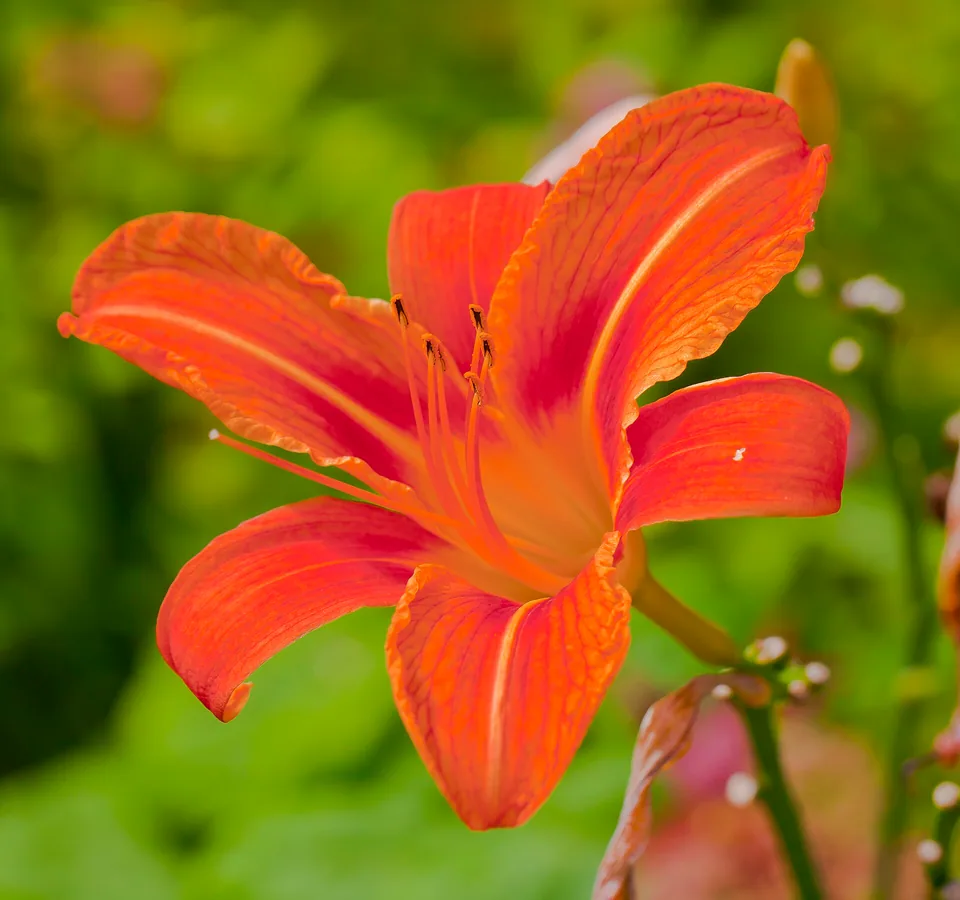


Cómo cultivar y cuidar Lirios de día
Hemerocallis fulva
Escrito por Emilio Marruso · última revisión
Tóxica para: Gatos · Por qué
De un vistazo
Este lirio de día es una vivaz que pide muy poco: sol pleno o semisombra, un suelo normal con buen drenaje y muy poco riego. Tolera incluso los suelos pobres y no tiene problemas importantes de plagas ni enfermedades. Además, sus capullos y flores son comestibles, con un sabor dulce y picante que da alegría a la cocina.
- Sol
Sol pleno o semisombra
Qué dicen las fuentes (1)
Luz: Pleno sol a semisombra
This daylily grows in full sun to partial shade in average, well-drained soil, but does tolerate poor soil as well.
— Hemerocallis fulva (Daylily, Ditch Lily, Orange Daylily, Tawny Daylily, Tiger Daylily) | North Carolina Extension Gardener Plant Toolbox [1] - Riego
Necesita muy poco riego
Qué dicen las fuentes (4)
Riego: Bajo mantenimiento con solo requerimientos moderados de agua; necesita muy poco riego
Según NC State Extension: It is low maintenance with only moderate water requirements and naturalizes easily.
— Hemerocallis fulva (Daylily, Ditch Lily, Orange Daylily, Tawny Daylily, Tiger Daylily) | North Carolina Extension Gardener Plant Toolbox [1] Según UVM Extension: Daylilies are tolerant of road salt, need very little watering or maintenance and can grow in poor soils.
— Daylilies to Celebrate Summer | University of Vermont… [4] It is low maintenance with only moderate water requirements and naturalizes easily.
— Hemerocallis fulva (Daylily, Ditch Lily, Orange Daylily, Tawny Daylily, Tiger Daylily) | North Carolina Extension Gardener Plant Toolbox [1] Daylilies are tolerant of road salt, need very little watering or maintenance and can grow in poor soils.
— Daylilies to Celebrate Summer | University of Vermont… [4] - Frío
Aguanta inviernos de hasta −40 °C (−40 °F)
Muy rústica · USDA 3a · RHS H7 · Z3
Qué dicen las fuentes (4)
Rusticidad, zona más fría: 3a [mínima invernal de −40 a −37,2 °C (de −40 a −35 °F)]
USDA Plant Hardiness Zone: 3a, 3b, 4a, 4b, 5a, 5b, 6a, 6b, 7a, 7b, 8a, 8b
— Hemerocallis fulva (Daylily, Ditch Lily, Orange Daylily, Tawny Daylily, Tiger Daylily) | North Carolina Extension Gardener Plant Toolbox [1] Rusticidad, zona más cálida:
Según NC State Extension (Hemerocallis fulva): USDA Plant Hardiness Zone: 3a, 3b, 4a, 4b, 5a, 5b, 6a, 6b, 7a, 7b, 8a, 8b
— Hemerocallis fulva (Daylily, Ditch Lily, Orange Daylily, Tawny Daylily, Tiger Daylily) | North Carolina Extension Gardener Plant Toolbox [1] Según NC State Extension (genus Hemerocallis): USDA Plant Hardiness Zone: 3a, 3b, 4a, 4b, 5a, 5b, 6a, 6b, 7a, 7b, 8a, 8b, 9a, 9b
— Hemerocallis (Day Lilies, Daylily, Day Lily) | North Carolina Extension Gardener Plant Toolbox [5] USDA Plant Hardiness Zone: 3a, 3b, 4a, 4b, 5a, 5b, 6a, 6b, 7a, 7b, 8a, 8b
— Hemerocallis fulva (Daylily, Ditch Lily, Orange Daylily, Tawny Daylily, Tiger Daylily) | North Carolina Extension Gardener Plant Toolbox [1] - Suelo
Suelo normal con buen drenaje; tolera también los suelos pobres
Qué dicen las fuentes (1)
Notas sobre el riego: Crece en suelo promedio y bien drenado; tolera suelos pobres
This daylily grows in full sun to partial shade in average, well-drained soil, but does tolerate poor soil as well.
— Hemerocallis fulva (Daylily, Ditch Lily, Orange Daylily, Tawny Daylily, Tiger Daylily) | North Carolina Extension Gardener Plant Toolbox [1] - Abonado
Abona poco a principios de primavera y otra vez a mitad de verano; nunca sobre tierra seca
Qué dicen las fuentes (4)
Cuándo: A principios de primavera, cuando comienza el nuevo crecimiento, y nuevamente a mediados del verano
Put down fertilizer in the early spring just as new growth commences, and again in midsummer.
— [6] Frecuencia: Dos veces al año (principios de primavera y mediados del verano); una alimentación ligera es suficiente
Put down fertilizer in the early spring just as new growth commences, and again in midsummer.
— [6] Daylilies usually grow adequately without fertilizer but grow best when lightly fertilized.
— [6] Evitar: Aplicación de fertilizante en suelo seco
and again in midsummer. Make sure that the soil is moist whenever applying fertilizer.
— [6] - Cosecha
Los capullos y las flores son comestibles, con un sabor dulce y picante
- Plagas
No tiene problemas importantes de plagas ni enfermedades
- Tamaño
De 61 a 76 cm de ancho
Qué dicen las fuentes (1)
Anchura adulta: 61-76 cm (2-2.5 pies)
Dimensions: Height: 3 ft. 0 in. - 6 ft. 0 in. Width: 2 ft. 0 in. - 2 ft. 6 in.
— Hemerocallis fulva (Daylily, Ditch Lily, Orange Daylily, Tawny Daylily, Tiger Daylily) | North Carolina Extension Gardener Plant Toolbox [1] - Multiplicación
Se multiplica dividiendo la mata
Qué dicen las fuentes (1)
Propagación: División.
The clump, which spreads rapidly by rhizomes, may be divided for propagation as needed.
— Hemerocallis fulva (Daylily, Ditch Lily, Orange Daylily, Tawny Daylily, Tiger Daylily) | North Carolina Extension Gardener Plant Toolbox [1] - Seguridad
Tóxica para los gatos; no es tóxica para los perros
Resumen
El lirio de día naranja es una perenne herbácea que se extiende rápidamente por rizomas y se usa en bordes perennes o en masas sobre áreas más grandes. [1] Crece a pleno sol o semisombra en suelo promedio y bien drenado, y tolera suelos pobres. [1] Se propaga dividiendo la mata, y se informa que es tóxico para los gatos. [1]
Citado en inglés, como en la fuente.
Esta ficha está incompleta: las fuentes consultadas aún no cubren todos los campos.
Aún no cubierto por nuestras fuentes: Poda
Cuidados
Riego
Riego
Bajo mantenimiento con solo requerimientos moderados de agua; necesita muy poco riego
Lo que dice cada fuente
Según NC State Extension: Bajo mantenimiento con solo requerimientos moderados de agua
Según UVM Extension: Necesita muy poco riego
Qué dicen las fuentes (4)
Según NC State Extension: It is low maintenance with only moderate water requirements and naturalizes easily.Según UVM Extension: Daylilies are tolerant of road salt, need very little watering or maintenance and can grow in poor soils.It is low maintenance with only moderate water requirements and naturalizes easily.Daylilies are tolerant of road salt, need very little watering or maintenance and can grow in poor soils.Notas sobre el riego
Crece en suelo promedio y bien drenado; tolera suelos pobres
Qué dicen las fuentes (1)
This daylily grows in full sun to partial shade in average, well-drained soil, but does tolerate poor soil as well.Luz
Pleno sol a semisombra
Qué dicen las fuentes (1)
This daylily grows in full sun to partial shade in average, well-drained soil, but does tolerate poor soil as well.Clima y frío
Rusticidad, zona más fría
3a [mínima invernal de −40 a −37,2 °C (de −40 a −35 °F)]
Qué dicen las fuentes (1)
USDA Plant Hardiness Zone:
3a, 3b, 4a, 4b, 5a, 5b, 6a, 6b, 7a, 7b, 8a, 8bRusticidad, zona más cálida
Las fuentes dan valores distintos según la región, la zona o las condiciones de cultivo.
Lo que dice cada fuente
Según NC State Extension (Hemerocallis fulva): 8b [mínima invernal de −9,4 a −6,7 °C (de 15 a 20 °F)]
Según NC State Extension (genus Hemerocallis): 9b [mínima invernal de −3,9 a −1,1 °C (de 25 a 30 °F)]
Qué dicen las fuentes (3)
Según NC State Extension (Hemerocallis fulva): USDA Plant Hardiness Zone:
3a, 3b, 4a, 4b, 5a, 5b, 6a, 6b, 7a, 7b, 8a, 8bSegún NC State Extension (genus Hemerocallis): USDA Plant Hardiness Zone:
3a, 3b, 4a, 4b, 5a, 5b, 6a, 6b, 7a, 7b, 8a, 8b, 9a, 9bUSDA Plant Hardiness Zone:
3a, 3b, 4a, 4b, 5a, 5b, 6a, 6b, 7a, 7b, 8a, 8bPropagación
División.
Qué dicen las fuentes (1)
The clump, which spreads rapidly by rhizomes, may be divided for propagation as needed.Cultivo
La planta
Ciclo de vida
perenne
Qué dicen las fuentes (1)
Orange daylily is a herbaceous perennial bulb in the daylily family (Asphodelaceae).Familia
Asphodelaceae
Qué dicen las fuentes (1)
Orange daylily is a herbaceous perennial bulb in the daylily family (Asphodelaceae).Altura adulta
Anchura adulta
61-76 cm (2-2.5 pies)
Qué dicen las fuentes (1)
Dimensions:
Height: 3 ft. 0 in. - 6 ft. 0 in.
Width: 2 ft. 0 in. - 2 ft. 6 in.Abonado
Cuándo
A principios de primavera, cuando comienza el nuevo crecimiento, y nuevamente a mediados del verano
Qué dicen las fuentes (1)
Put down fertilizer in the early spring just as new growth commences, and again in midsummer.Frecuencia
Dos veces al año (principios de primavera y mediados del verano); una alimentación ligera es suficiente
Abonos minerales
Fertilizante de liberación lenta con nitrógeno moderado y mayor contenido de fósforo y potasio
Qué dicen las fuentes (1)
They prefer moderate nitrogen and higher rates of phosphorous and potash. Slow-release fertilizers are best for daylilies.Evitar
Aplicación de fertilizante en suelo seco
Qué dicen las fuentes (1)
and again in midsummer. Make sure that the soil is moist whenever applying fertilizer.Remedios
Cada remedio indica qué dicen las fuentes oficiales; los remedios tradicionales sin fuente oficial aparecen marcados. Los perjudiciales están para que sepas evitarlos.
Cuidar la planta
pulgones
chorro fuerte de agua No verificado
Remedio tradicional, no verificado por una fuente oficial.
Cómo: Combátelos con una corriente fuerte de agua.
aceite de neem Funciona en parte
Despite these being biological pesticides, it is important to read the directions on the label and wear safety equipment.
— extension.illinois.edu [8] Cómo: Elimina tantos adultos como sea posible con un fuerte chorro de agua, luego trata la planta con aceite de neem.
Common pests include aphids, lily beetles, and spider mites. Regularly inspect your plants and use insecticidal soap or neem oil for effective control.
— treestopsecrets.com [7] Qué dicen las pruebas Neem oil is found in the seeds of the neem tree. The active component found in this biological pesticide reduces insect feeding, interferes with hormones -- making it hard to grow or lay eggs -- and acts as a repellent.
— extension.illinois.edu [8]
ácaros araña
trips
spray de jabón insecticida Funciona
Always spray in the evening to lessen the spray impact on pollinating insects.
— hgic.clemson.edu [9] Cómo: Para daños graves, se recomiendan rociados con jabón insecticida; rocía por la tarde.
For serious damage, insecticidal soap or spinosad sprays are recommended.
— hgic.clemson.edu [9] Qué dicen las pruebas For serious damage, insecticidal soap or spinosad sprays are recommended.
— hgic.clemson.edu [9]
babosas
recolección manual y cáscaras de huevo trituradas No verificado
Remedio tradicional, no verificado por una fuente oficial.
Cómo: Recógelos manualmente durante las tardes o usa barreras como cáscaras de huevo trituradas.
Elimina el mantillo y la hojarasca. Funciona
Cómo: Retira el mantillo y la hojarasca cerca de la base de los lirios de día para eliminar los escondites diurnos.
Remove mulch and leaf litter near the base of daylilies to eliminate daytime hiding places.
— hgic.clemson.edu [9] Qué dicen las pruebas Remove mulch and leaf litter near the base of daylilies to eliminate daytime hiding places.
— hgic.clemson.edu [9]
roya del lirio de día
eliminación del follaje infectado Funciona
Cómo: Retira y destruye el follaje infectado y asegura una buena circulación de aire; en otoño, retira el follaje muerto alrededor de la base y deshazte de los recortes.
Hemerocallis rust, a fungal disease marked by orange, yellow, or rusty spots on leaves, can be controlled by removing and destroying infected foliage, as well as ensuring good air circulation.
— thehomeyspace.com [10] Qué dicen las pruebas In the fall, remove dead foliage from around the base of daylily plants and dispose of the clippings.
— hgic.clemson.edu [9]
Cómo eliminarla
propagación invasiva
extracción manual y desenterrado de los tubérculos Funciona
These plants can easily grow back from sections of root; improper disposal will create a headache for someone else.
— gardeningknowhow.com [11] Cómo: Desentierra los tubérculos a mano y deséchalos en bolsas de plástico selladas, revisando cuidadosamente la tierra para eliminar todos los pequeños trozos de raíz o tubérculo.
Depending on the size of your daylily problem, you may be able to dig them out by hand and discard them in plastic bags. Make sure to carefully comb the soil of all the little bits of root or tubers and tightly seal the bags you're using for disposal.
— gardeningknowhow.com [11] Qué dicen las pruebas To control weeds without using manufactured herbicides, the best option is to pull, remove or interfere with weed growth. Regularly pulling, hoeing or mowing weeds and encouraging grass to grow and out-compete the weeds is an excellent solution.
— extension.usu.edu [12] sofocación con periódico y mantillo Funciona
Bear in mind that the mulch will have to stay there for a year to kill every part of the plant.
— epicgardening.com [13] Cómo: Siega los lirios de día, luego sofócalos con una capa gruesa de mantillo (4 a 6 pulgadas / 10-15 cm), con una capa de periódico bien regada debajo; el nuevo crecimiento debe combatirse durante la temporada.
Some gardeners have had good luck mowing down daylilies and then smothering them with thick layers of mulch . Apply 4 to 6 inches (10-15 cm.) over the daylily stand, but be prepared to fight with them through the season.
— gardeningknowhow.com [11] Qué dicen las pruebas A variety of household items, such as newspapers, can be used as weed barriers. Lay the material down to prevent sunlight from reaching the unwanted plants, and cover with mulch or other plant-resistant material.
— extension.usu.edu [12]
Venenosa para los animales
Según la fuente, citada textualmente. No es un consejo médico ni veterinario: si una persona o un animal pudo haber ingerido esta planta, contacta con un centro de toxicología o con un veterinario.
Insects, Diseases, and Other Plant Problems: No significant problems. The plant is reportedly toxic to cats.
[1]- Síntomas
These plants are toxic to cats, which may show signs of vomiting, inappetence, lethargy, kidney failure, and even death after eating.
[5]
#fast growing #butterfly friendly #HS302 #problem for cats #non-toxic for dogs #easy to grow
[1]La fuente señala el riesgo para este animal pero no explica por qué.
Calendario
Poda
No figura en las fuentes consultadas.
Meses tal como los dan las fuentes, en su mayoría de Estados Unidos (hemisferio norte). En el hemisferio sur se desplazan unos seis meses.
Comestibilidad
Según la fuente, citada textualmente. No comas una planta basándote solo en esta página: los errores de identificación pueden ser peligrosos.
Buds and flowers are edible and have been described as having a sweet-spicy or peppery flavor.
[1]
Valores orientativos
Valores de una fuente secundaria, no comprobados palabra por palabra como el resto de esta página. Úselos como punto de partida.
- Horas de sol
- 6-8 horasValor orientativo, adáptalo a tu clima · Fuente secundaria
- pH del suelo
- 6-7Valor orientativo, adáptalo a tu clima · Fuente secundaria
- Nivel de cuidado
- MedioValor orientativo, adáptalo a tu clima · Fuente secundaria
- Crecimiento
- BajoValor orientativo, adáptalo a tu clima · Fuente secundaria
- Poda
- Julio, mayoValor orientativo, adáptalo a tu clima · Fuente secundaria
Plantas similares
- Lirios de día Hemerocallis minor
- Lirios de día Hemerocallis citrina
- Azucena amarilla común Hemerocallis lilioasphodelus
- Bulbine frutescens Bulbine frutescens
- New Zealand Flax Phormium tenax
- Pearl Plant Tulista pumila
- Tritoma Kniphofia uvaria
- Aloe aristata Aloe aristata
Fuentes
Cada valor anterior se cita de estos documentos. Los enlaces llevan al editor original.
- Hemerocallis fulva (Daylily, Ditch Lily, Orange Daylily, Tawny Daylily, Tiger Daylily) | North Carolina Extension Gardener Plant Toolbox · plants.ces.ncsu.edu, consultado
- Tiger Daylily - Hemerocallis fulva | North Carolina Extension Gardener Plant Toolbox · plants.ces.ncsu.edu, consultado
- Ditch Lily - Hemerocallis fulva | North Carolina Extension Gardener Plant Toolbox · plants.ces.ncsu.edu, consultado
- Daylilies to Celebrate Summer | University of Vermont… · uvm.edu, consultado
- Hemerocallis (Day Lilies, Daylily, Day Lily) | North Carolina Extension Gardener Plant Toolbox · plants.ces.ncsu.edu, consultado
- hgic.clemson.edu · hgic.clemson.edu
- treestopsecrets.com · treestopsecrets.com
- extension.illinois.edu · extension.illinois.edu
- hgic.clemson.edu · hgic.clemson.edu
- thehomeyspace.com · thehomeyspace.com
- gardeningknowhow.com · gardeningknowhow.com
- extension.usu.edu · extension.usu.edu
- epicgardening.com · epicgardening.com
Escrito por Emilio Marruso · última revisión