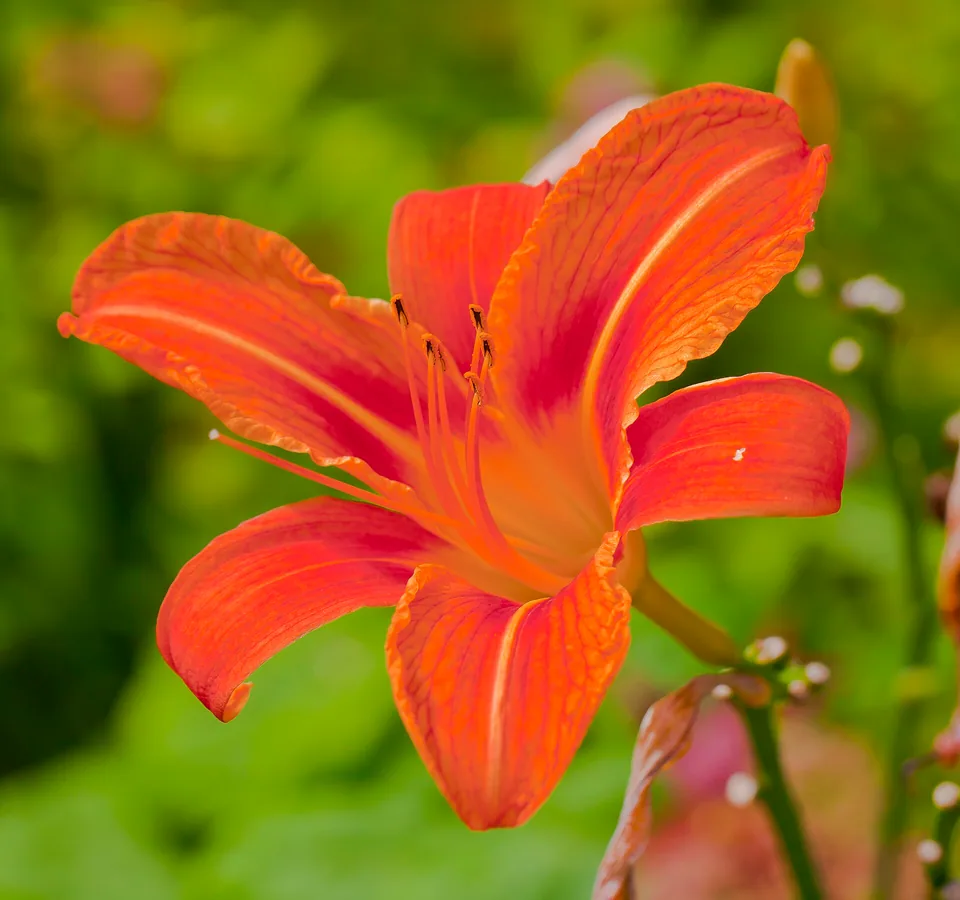


How to Grow and Care for Daylily
Hemerocallis fulva
Written by Emilio Marruso · last checked
Toxic to: Cats · Why
At a glance
This daylily is a carefree perennial that asks for very little: full sun to partial shade, average well-drained soil and only a little water. It even tolerates poor soil and has no significant pest or disease problems. As a bonus, its buds and flowers are edible, with a sweet-spicy, peppery flavor that brightens up the kitchen.
- Sun
Full sun to partial shade
What the sources say (1)
Light: Full sun to partial shade
This daylily grows in full sun to partial shade in average, well-drained soil, but does tolerate poor soil as well.
— Hemerocallis fulva (Daylily, Ditch Lily, Orange Daylily, Tawny Daylily, Tiger Daylily) | North Carolina Extension Gardener Plant Toolbox [1] - Water
Needs very little watering
What the sources say (4)
Watering: Low maintenance with only moderate water requirements; needs very little watering
According to NC State Extension: It is low maintenance with only moderate water requirements and naturalizes easily.
— Hemerocallis fulva (Daylily, Ditch Lily, Orange Daylily, Tawny Daylily, Tiger Daylily) | North Carolina Extension Gardener Plant Toolbox [1] According to UVM Extension: Daylilies are tolerant of road salt, need very little watering or maintenance and can grow in poor soils.
— Daylilies to Celebrate Summer | University of Vermont… [4] It is low maintenance with only moderate water requirements and naturalizes easily.
— Hemerocallis fulva (Daylily, Ditch Lily, Orange Daylily, Tawny Daylily, Tiger Daylily) | North Carolina Extension Gardener Plant Toolbox [1] Daylilies are tolerant of road salt, need very little watering or maintenance and can grow in poor soils.
— Daylilies to Celebrate Summer | University of Vermont… [4] - Cold
Survives winters down to −40 °F (−40 °C)
Very hardy · USDA 3a · RHS H7 · Z3
What the sources say (4)
Hardiness, coldest zone: 3a [winter low −40 to −37.2 °C (−40 to −35 °F)]
USDA Plant Hardiness Zone: 3a, 3b, 4a, 4b, 5a, 5b, 6a, 6b, 7a, 7b, 8a, 8b
— Hemerocallis fulva (Daylily, Ditch Lily, Orange Daylily, Tawny Daylily, Tiger Daylily) | North Carolina Extension Gardener Plant Toolbox [1] Hardiness, warmest zone:
According to NC State Extension (Hemerocallis fulva): USDA Plant Hardiness Zone: 3a, 3b, 4a, 4b, 5a, 5b, 6a, 6b, 7a, 7b, 8a, 8b
— Hemerocallis fulva (Daylily, Ditch Lily, Orange Daylily, Tawny Daylily, Tiger Daylily) | North Carolina Extension Gardener Plant Toolbox [1] According to NC State Extension (genus Hemerocallis): USDA Plant Hardiness Zone: 3a, 3b, 4a, 4b, 5a, 5b, 6a, 6b, 7a, 7b, 8a, 8b, 9a, 9b
— Hemerocallis (Day Lilies, Daylily, Day Lily) | North Carolina Extension Gardener Plant Toolbox [5] USDA Plant Hardiness Zone: 3a, 3b, 4a, 4b, 5a, 5b, 6a, 6b, 7a, 7b, 8a, 8b
— Hemerocallis fulva (Daylily, Ditch Lily, Orange Daylily, Tawny Daylily, Tiger Daylily) | North Carolina Extension Gardener Plant Toolbox [1] - Soil
Average, well-drained soil; it tolerates poor soil too
What the sources say (1)
Watering notes: Grows in average, well-drained soil; tolerates poor soil
This daylily grows in full sun to partial shade in average, well-drained soil, but does tolerate poor soil as well.
— Hemerocallis fulva (Daylily, Ditch Lily, Orange Daylily, Tawny Daylily, Tiger Daylily) | North Carolina Extension Gardener Plant Toolbox [1] - Feeding
Feed lightly in early spring and again in midsummer; never on dry soil
What the sources say (4)
When: Early spring as new growth begins, and again in midsummer
Put down fertilizer in the early spring just as new growth commences, and again in midsummer.
— [6] How often: Twice a year (early spring and midsummer); light feeding is enough
Put down fertilizer in the early spring just as new growth commences, and again in midsummer.
— [6] Daylilies usually grow adequately without fertilizer but grow best when lightly fertilized.
— [6] Avoid: Applying fertilizer to dry soil
and again in midsummer. Make sure that the soil is moist whenever applying fertilizer.
— [6] - Harvest
Buds and flowers are edible, with a sweet-spicy, peppery flavor
- Pests
No significant pest or disease problems
- Size
2 to 2.5 ft wide
What the sources say (1)
Mature width: 61-76 cm (2-2.5 ft)
Dimensions: Height: 3 ft. 0 in. - 6 ft. 0 in. Width: 2 ft. 0 in. - 2 ft. 6 in.
— Hemerocallis fulva (Daylily, Ditch Lily, Orange Daylily, Tawny Daylily, Tiger Daylily) | North Carolina Extension Gardener Plant Toolbox [1] - Propagation
Multiply it by dividing the clump
What the sources say (1)
Propagation: Division
The clump, which spreads rapidly by rhizomes, may be divided for propagation as needed.
— Hemerocallis fulva (Daylily, Ditch Lily, Orange Daylily, Tawny Daylily, Tiger Daylily) | North Carolina Extension Gardener Plant Toolbox [1] - Safety
Toxic to cats; not toxic to dogs
Overview
Orange daylily is a herbaceous perennial that spreads rapidly by rhizomes and is used in perennial borders or massed over larger areas. [1] It grows in full sun to partial shade in average, well-drained soil and tolerates poor soil. [1] It is propagated by dividing the clump, and is reportedly toxic to cats. [1]
This record is incomplete: the sources we read do not cover every field yet.
Not yet covered by our sources: Pruning
Daylily care
How to water Daylily
Watering
Low maintenance with only moderate water requirements; needs very little watering
What each source says
According to NC State Extension: Low maintenance with only moderate water requirements
According to UVM Extension: Needs very little watering
What the sources say (4)
According to NC State Extension: It is low maintenance with only moderate water requirements and naturalizes easily.According to UVM Extension: Daylilies are tolerant of road salt, need very little watering or maintenance and can grow in poor soils.It is low maintenance with only moderate water requirements and naturalizes easily.Daylilies are tolerant of road salt, need very little watering or maintenance and can grow in poor soils.Watering notes
Grows in average, well-drained soil; tolerates poor soil
What the sources say (1)
This daylily grows in full sun to partial shade in average, well-drained soil, but does tolerate poor soil as well.How much light Daylily needs
Full sun to partial shade
What the sources say (1)
This daylily grows in full sun to partial shade in average, well-drained soil, but does tolerate poor soil as well.How much cold Daylily can take
Hardiness, coldest zone
3a [winter low −40 to −37.2 °C (−40 to −35 °F)]
What the sources say (1)
USDA Plant Hardiness Zone:
3a, 3b, 4a, 4b, 5a, 5b, 6a, 6b, 7a, 7b, 8a, 8bHardiness, warmest zone
The sources give different values depending on region, zone or growing conditions.
What each source says
According to NC State Extension (Hemerocallis fulva): 8b [winter low −9.4 to −6.7 °C (15 to 20 °F)]
According to NC State Extension (genus Hemerocallis): 9b [winter low −3.9 to −1.1 °C (25 to 30 °F)]
What the sources say (3)
According to NC State Extension (Hemerocallis fulva): USDA Plant Hardiness Zone:
3a, 3b, 4a, 4b, 5a, 5b, 6a, 6b, 7a, 7b, 8a, 8bAccording to NC State Extension (genus Hemerocallis): USDA Plant Hardiness Zone:
3a, 3b, 4a, 4b, 5a, 5b, 6a, 6b, 7a, 7b, 8a, 8b, 9a, 9bUSDA Plant Hardiness Zone:
3a, 3b, 4a, 4b, 5a, 5b, 6a, 6b, 7a, 7b, 8a, 8bHow to propagate Daylily
Division
What the sources say (1)
The clump, which spreads rapidly by rhizomes, may be divided for propagation as needed.How to grow Daylily
The plant
Life cycle
perennial
What the sources say (1)
Orange daylily is a herbaceous perennial bulb in the daylily family (Asphodelaceae).Family
Asphodelaceae
What the sources say (1)
Orange daylily is a herbaceous perennial bulb in the daylily family (Asphodelaceae).Mature height
Mature width
61-76 cm (2-2.5 ft)
What the sources say (1)
Dimensions:
Height: 3 ft. 0 in. - 6 ft. 0 in.
Width: 2 ft. 0 in. - 2 ft. 6 in.Fertilizing
When
Early spring as new growth begins, and again in midsummer
What the sources say (1)
Put down fertilizer in the early spring just as new growth commences, and again in midsummer.How often
Twice a year (early spring and midsummer); light feeding is enough
Mineral fertilizers
Slow-release fertilizer with moderate nitrogen and higher phosphorus and potash
What the sources say (1)
They prefer moderate nitrogen and higher rates of phosphorous and potash. Slow-release fertilizers are best for daylilies.Avoid
Applying fertilizer to dry soil
What the sources say (1)
and again in midsummer. Make sure that the soil is moist whenever applying fertilizer.Remedies
Each remedy shows what official sources say about it; traditional remedies without an official source are marked as such. Harmful ones are listed so you know to avoid them.
Treating the plant
aphids
strong spray of water Not verified
Traditional remedy, not verified by an official source.
How: Combat them with a strong stream of water.
neem oil Partly works
Despite these being biological pesticides, it is important to read the directions on the label and wear safety equipment.
— extension.illinois.edu [8] How: Remove as many adults as possible with a strong spray of water, then treat the plant with neem oil.
Common pests include aphids, lily beetles, and spider mites. Regularly inspect your plants and use insecticidal soap or neem oil for effective control.
— treestopsecrets.com [7] What the evidence says Neem oil is found in the seeds of the neem tree. The active component found in this biological pesticide reduces insect feeding, interferes with hormones -- making it hard to grow or lay eggs -- and acts as a repellent.
— extension.illinois.edu [8]
spider mites
thrips
insecticidal soap spray Works
Always spray in the evening to lessen the spray impact on pollinating insects.
— hgic.clemson.edu [9] How: For serious damage, insecticidal soap sprays are recommended; spray in the evening.
For serious damage, insecticidal soap or spinosad sprays are recommended.
— hgic.clemson.edu [9] What the evidence says For serious damage, insecticidal soap or spinosad sprays are recommended.
— hgic.clemson.edu [9]
slugs
hand-picking and crushed eggshells Not verified
Traditional remedy, not verified by an official source.
How: Hand-pick them during the evenings or use barriers like crushed eggshells.
removing mulch and leaf litter Works
How: Remove mulch and leaf litter near the base of daylilies to eliminate daytime hiding places.
Remove mulch and leaf litter near the base of daylilies to eliminate daytime hiding places.
— hgic.clemson.edu [9] What the evidence says Remove mulch and leaf litter near the base of daylilies to eliminate daytime hiding places.
— hgic.clemson.edu [9]
daylily rust
removing infected foliage Works
How: Remove and destroy infected foliage and ensure good air circulation; in the fall, remove dead foliage from around the base and dispose of the clippings.
Hemerocallis rust, a fungal disease marked by orange, yellow, or rusty spots on leaves, can be controlled by removing and destroying infected foliage, as well as ensuring good air circulation.
— thehomeyspace.com [10] What the evidence says In the fall, remove dead foliage from around the base of daylily plants and dispose of the clippings.
— hgic.clemson.edu [9]
Getting rid of it
invasive spread
hand pulling and digging out tubers Works
These plants can easily grow back from sections of root; improper disposal will create a headache for someone else.
— gardeningknowhow.com [11] How: Dig them out by hand and discard them in sealed plastic bags, carefully combing the soil of all the little bits of root or tubers.
Depending on the size of your daylily problem, you may be able to dig them out by hand and discard them in plastic bags. Make sure to carefully comb the soil of all the little bits of root or tubers and tightly seal the bags you're using for disposal.
— gardeningknowhow.com [11] What the evidence says To control weeds without using manufactured herbicides, the best option is to pull, remove or interfere with weed growth. Regularly pulling, hoeing or mowing weeds and encouraging grass to grow and out-compete the weeds is an excellent solution.
— extension.usu.edu [12] newspaper and mulch smothering Works
Bear in mind that the mulch will have to stay there for a year to kill every part of the plant.
— epicgardening.com [13] How: Mow the daylilies down, then smother them with a thick layer of mulch (4 to 6 inches / 10-15 cm), with a layer of newspaper watered well underneath; new growth must be fought through the season.
Some gardeners have had good luck mowing down daylilies and then smothering them with thick layers of mulch . Apply 4 to 6 inches (10-15 cm.) over the daylily stand, but be prepared to fight with them through the season.
— gardeningknowhow.com [11] What the evidence says A variety of household items, such as newspapers, can be used as weed barriers. Lay the material down to prevent sunlight from reaching the unwanted plants, and cover with mulch or other plant-resistant material.
— extension.usu.edu [12]
Is Daylily toxic to pets?
Reported by the source, quoted verbatim. This is not medical or veterinary advice: if a person or an animal may have eaten this plant, contact a poison control centre or a veterinarian.
Insects, Diseases, and Other Plant Problems: No significant problems. The plant is reportedly toxic to cats.
[1]- Symptoms
These plants are toxic to cats, which may show signs of vomiting, inappetence, lethargy, kidney failure, and even death after eating.
[5]
#fast growing #butterfly friendly #HS302 #problem for cats #non-toxic for dogs #easy to grow
[1]The source flags the risk for this animal but does not explain why.
Calendar
Pruning
Not stated in the sources we read.
Months as given by the sources, which are mostly from the United States (northern hemisphere). In the southern hemisphere they shift by about six months.
Edibility
Reported by the source, quoted verbatim. Do not eat a plant on the basis of this page alone: identification mistakes can be dangerous.
Buds and flowers are edible and have been described as having a sweet-spicy or peppery flavor.
[1]
Indicative values
Values from a secondary source, not checked word for word like the rest of this page. Use them as a starting point.
- Hours of sun
- 6-8 hoursIndicative value, adapt it to your climate · Secondary source
- Soil pH
- 6-7Indicative value, adapt it to your climate · Secondary source
- Care level
- MediumIndicative value, adapt it to your climate · Secondary source
- Growth rate
- LowIndicative value, adapt it to your climate · Secondary source
- Pruning
- July, MayIndicative value, adapt it to your climate · Secondary source
Similar plants
- Daylily Hemerocallis minor
- Citron daylily Hemerocallis citrina
- Lemon day-lily Hemerocallis lilioasphodelus
- Bulbine frutescens Bulbine frutescens
- New Zealand Flax Phormium tenax
- Pearl Plant Tulista pumila
- Torch Lily Kniphofia uvaria
- Aloe aristata Aloe aristata
Sources
Every value above is quoted from these documents. Links lead to the original publisher.
- Hemerocallis fulva (Daylily, Ditch Lily, Orange Daylily, Tawny Daylily, Tiger Daylily) | North Carolina Extension Gardener Plant Toolbox · plants.ces.ncsu.edu, consulted
- Tiger Daylily - Hemerocallis fulva | North Carolina Extension Gardener Plant Toolbox · plants.ces.ncsu.edu, consulted
- Ditch Lily - Hemerocallis fulva | North Carolina Extension Gardener Plant Toolbox · plants.ces.ncsu.edu, consulted
- Daylilies to Celebrate Summer | University of Vermont… · uvm.edu, consulted
- Hemerocallis (Day Lilies, Daylily, Day Lily) | North Carolina Extension Gardener Plant Toolbox · plants.ces.ncsu.edu, consulted
- hgic.clemson.edu · hgic.clemson.edu
- treestopsecrets.com · treestopsecrets.com
- extension.illinois.edu · extension.illinois.edu
- hgic.clemson.edu · hgic.clemson.edu
- thehomeyspace.com · thehomeyspace.com
- gardeningknowhow.com · gardeningknowhow.com
- extension.usu.edu · extension.usu.edu
- epicgardening.com · epicgardening.com
Written by Emilio Marruso · last checked