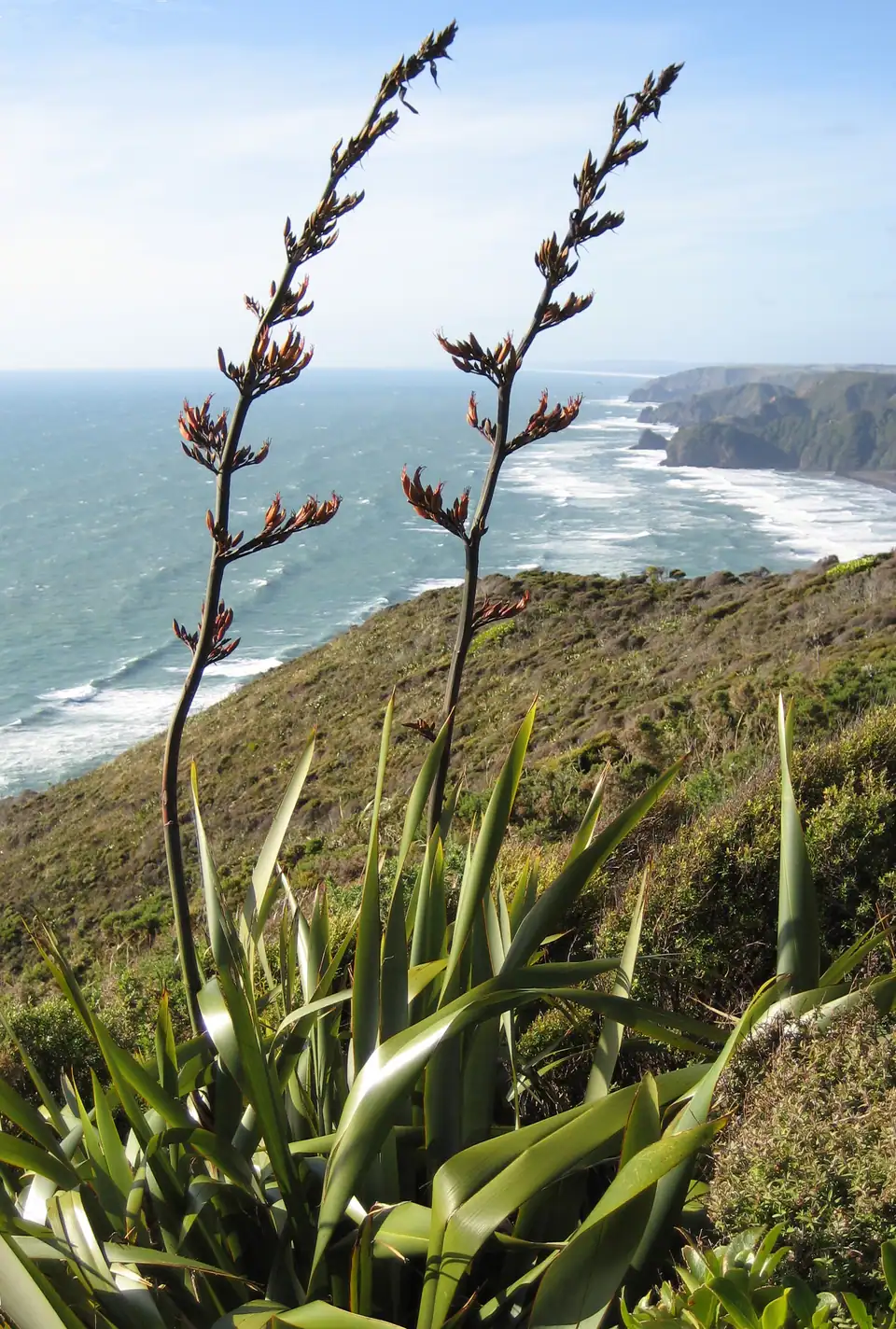


How to Grow and Care for New Zealand Flax
Phormium tenax
Written by Emilio Marruso · last checked
At a glance
New Zealand flax is an easygoing perennial that grows in full sun or partial shade and asks only for average, well-drained soil. It can stay 1 foot tall or rise to a bold 8 feet, and it grows happily in containers too. Just keep an eye out for snails and mealybugs, and enjoy a striking plant that comes back year after year.
- Sun
Full sun to partial shade
What the sources say (2)
Light: Full sun to partial shade
It grows in average, well-drained soil in full sun to partial shade.
— Phormium tenax (New Zealand Flax) | North Carolina Extension Gardener Plant Toolbox [1] Light: Full sun (6 or more hours of direct sunlight a day) Partial Shade (Direct sunlight only part of the day, 2-6 hours)
— Phormium tenax (New Zealand Flax) | North Carolina Extension Gardener Plant Toolbox [1] - Cold
Survives winters down to 20 °F (−6.7 °C)
Hardy in average winters · USDA 9a · RHS H4 · Z9
What the sources say (2)
Hardiness, coldest zone: 9a [winter low −6.7 to −3.9 °C (20 to 25 °F)]
USDA Plant Hardiness Zone: 9a, 9b, 10a, 10b, 11a, 11b
— Phormium tenax (New Zealand Flax) | North Carolina Extension Gardener Plant Toolbox [1] Hardiness, warmest zone: 11b [winter low 7.2 to 10 °C (45 to 50 °F)]
USDA Plant Hardiness Zone: 9a, 9b, 10a, 10b, 11a, 11b
— Phormium tenax (New Zealand Flax) | North Carolina Extension Gardener Plant Toolbox [1] - Soil
Average soil that drains well
What the sources say (1)
Watering notes: Grows in average, well-drained soil
It grows in average, well-drained soil in full sun to partial shade.
— Phormium tenax (New Zealand Flax) | North Carolina Extension Gardener Plant Toolbox [1] - Pests
Watch for mealybugs, snails and leaf spot
What the sources say (2)
Pests: mealybugs, snails
Insects, Diseases, and Other Plant Problems: mealybugs and snails. Leaf spot may damage the foliage.
— Phormium tenax (New Zealand Flax) | North Carolina Extension Gardener Plant Toolbox [1] Diseases: leaf spot
Insects, Diseases, and Other Plant Problems: mealybugs and snails. Leaf spot may damage the foliage.
— Phormium tenax (New Zealand Flax) | North Carolina Extension Gardener Plant Toolbox [1] - Size
1 to 8 ft tall and 1 to 5 ft wide
What the sources say (2)
Mature height: 30-244 cm (1 ft - 8 ft)
Dimensions: Height: 1 ft. 0 in. - 8 ft. 0 in. Width: 1 ft. 0 in. - 5 ft. 0 in.
— Phormium tenax (New Zealand Flax) | North Carolina Extension Gardener Plant Toolbox [1] Mature width: 30-152 cm (1 ft - 5 ft)
Dimensions: Height: 1 ft. 0 in. - 8 ft. 0 in. Width: 1 ft. 0 in. - 5 ft. 0 in.
— Phormium tenax (New Zealand Flax) | North Carolina Extension Gardener Plant Toolbox [1] - Containers
Grows in containers too
What the sources say (1)
In containers: Yes
It makes a good container plant, providing height and color contrast.
— Phormium tenax (New Zealand Flax) | North Carolina Extension Gardener Plant Toolbox [1]
Overview
New Zealand flax is an evergreen, clump-forming tender perennial grown for its foliage and flowers. [1] It grows in average, well-drained soil in full sun to partial shade and makes a good container plant. [1]
This record is incomplete: the sources we read do not cover every field yet.
Not yet covered by our sources: Watering, Pruning, Propagation
New Zealand Flax care
How to water New Zealand Flax
Watering
Not stated in the sources we read.
Watering notes
Grows in average, well-drained soil
What the sources say (1)
It grows in average, well-drained soil in full sun to partial shade.How much light New Zealand Flax needs
Full sun to partial shade
What the sources say (2)
It grows in average, well-drained soil in full sun to partial shade.Light:
Full sun (6 or more hours of direct sunlight a day)
Partial Shade (Direct sunlight only part of the day, 2-6 hours)How much cold New Zealand Flax can take
Hardiness, coldest zone
9a [winter low −6.7 to −3.9 °C (20 to 25 °F)]
What the sources say (1)
USDA Plant Hardiness Zone:
9a, 9b, 10a, 10b, 11a, 11bHardiness, warmest zone
11b [winter low 7.2 to 10 °C (45 to 50 °F)]
What the sources say (1)
USDA Plant Hardiness Zone:
9a, 9b, 10a, 10b, 11a, 11bWhere to grow New Zealand Flax
Yes
What the sources say (1)
It makes a good container plant, providing height and color contrast.How to propagate New Zealand Flax
Not stated in the sources we read.
How to grow New Zealand Flax
The plant
Life cycle
perennial
What the sources say (1)
It is an evergreen, clump-forming tender perennial that is grown for its attractive foliage, as well as its showy flowers.Family
Asphodelaceae
What the sources say (1)
New Zealand flax is native to New Zealand and is a member of the daylily family (Asphodelaceae).Mature height
30-244 cm (1 ft - 8 ft)
What the sources say (1)
Dimensions: Height: 1 ft. 0 in. - 8 ft. 0 in. Width: 1 ft. 0 in. - 5 ft. 0 in.Mature width
30-152 cm (1 ft - 5 ft)
What the sources say (1)
Dimensions: Height: 1 ft. 0 in. - 8 ft. 0 in. Width: 1 ft. 0 in. - 5 ft. 0 in.Pests and diseases
Pests
mealybugs, snails
What the sources say (1)
Insects, Diseases, and Other Plant Problems: mealybugs and snails. Leaf spot may damage the foliage.Diseases
leaf spot
What the sources say (1)
Insects, Diseases, and Other Plant Problems: mealybugs and snails. Leaf spot may damage the foliage.Fertilizing
When
The sources give different values depending on region, zone or growing conditions.
What each source says
in containers: Late spring to mid-summer
What the sources say (1)
in containers: Container-grown plants can benefit from feeding from late spring to mid-summer using an organic-based, balanced liquid fertiliser.How often
The sources give different values depending on region, zone or growing conditions.
What each source says
in the ground: No feeding needed
What the sources say (1)
in the ground: Plants in the ground shouldn't need feeding - Container-grown plants can benefit from feeding from late spring to mid-summerNatural fertilizers
The sources give different values depending on region, zone or growing conditions.
What each source says
in containers: Organic-based, balanced liquid fertilizer
What the sources say (1)
in containers: Container-grown plants can benefit from feeding from late spring to mid-summer using an organic-based, balanced liquid fertiliser.New Zealand Flax pests and problems
Mealybugs and snails
Symptom: Listed as insect and other plant problems
What the sources say (1)
Insects, Diseases, and Other Plant Problems: mealybugs and snails. Leaf spot may damage the foliage.
— Phormium tenax (New Zealand Flax) | North Carolina Extension Gardener Plant Toolbox [1]
Remedies
Each remedy shows what official sources say about it; traditional remedies without an official source are marked as such. Harmful ones are listed so you know to avoid them.
Getting rid of it
unwanted plants
uprooting, cutting and crushing Not verified
Traditional remedy, not verified by an official source.
How: Combination of uprooting, cutting and crushing, with follow-up operations.
Calendar
Pruning
Not stated in the sources we read.
Months as given by the sources, which are mostly from the United States (northern hemisphere). In the southern hemisphere they shift by about six months.
Indicative values
Values from a secondary source, not checked word for word like the rest of this page. Use them as a starting point.
- Watering
- AverageIndicative value, adapt it to your climate · Secondary source
- Drought tolerant
- yesIndicative value, adapt it to your climate · Secondary source
- Soil
- Well-drainedIndicative value, adapt it to your climate · Secondary source
- Soil pH
- 6-7.5Indicative value, adapt it to your climate · Secondary source
- Care level
- MediumIndicative value, adapt it to your climate · Secondary source
- Growth rate
- ModerateIndicative value, adapt it to your climate · Secondary source
- Pruning
- March, April, MayIndicative value, adapt it to your climate · Secondary source
- Propagation
- Seed PropagationIndicative value, adapt it to your climate · Secondary source
Similar plants
- Bulbine frutescens Bulbine frutescens
- Daylily Hemerocallis fulva
- Daylily Hemerocallis minor
- Pearl Plant Tulista pumila
- Torch Lily Kniphofia uvaria
- Aloe aristata Aloe aristata
- Aloe vera Aloe vera
- Asphodeline lutea Asphodeline lutea
Sources
Every value above is quoted from these documents. Links lead to the original publisher.
- Phormium tenax (New Zealand Flax) | North Carolina Extension Gardener Plant Toolbox · plants.ces.ncsu.edu, consulted
- rhs.org.uk · rhs.org.uk
Written by Emilio Marruso · last checked