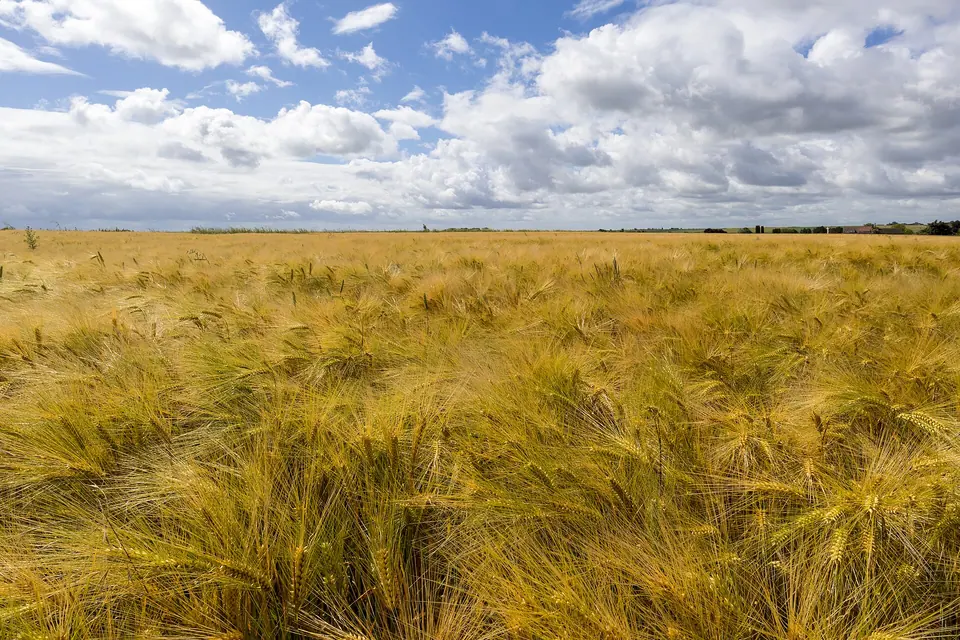


Cómo cultivar y cuidar Cebada
Hordeum vulgare
Escrito por Emilio Marruso · última revisión
De un vistazo
La cebada es un cereal fácil de cultivar a partir de semilla, y puedes sembrarla en otoño o lo antes posible en primavera. Dale sol pleno y crecerá de 30 cm a 1,2 m de alto, a menudo sin riegos extra. La cebada de invierno se cosecha a principios de julio y te da un grano versátil para comer, para pienso o para malta.
- Sol
Sol pleno: 6 horas o más al día
Qué dicen las fuentes (1)
Luz: Pleno sol (6 o más horas de luz solar directa al día)
Light: Full sun (6 or more hours of direct sunlight a day) Soil Texture: Clay
— Hordeum vulgare (Barley) | North Carolina Extension Gardener Plant Toolbox [1] - Riego
En climas lluviosos a menudo no necesita riego si la siembras en otoño o pronto en primavera
Qué dicen las fuentes (1)
Riego: No requiere riego si se planta en otoño al oeste de las Cascadas o si se planta lo suficientemente temprano en primavera para aprovechar al máximo la humedad disponible.
Barley is a hardy crop that does not require irrigation when fall-planted west of the Cascades or if planted early enough in the spring to make best use of available moisture.
— Growing malting barley in and around the Willamette Valley | OSU Extension Service [2] - Suelo
Suelo de neutro a alcalino, pH 6,0–8,0
Qué dicen las fuentes (2)
pH del suelo, mínimo: 6.0
Soil Texture: Clay High Organic Matter Loam (Silt) Sand Soil pH: Neutral (6.0-8.0) Soil Drainage: Good Drainage
— Hordeum vulgare (Barley) | North Carolina Extension Gardener Plant Toolbox [1] pH del suelo, máximo: 8.0
Soil Texture: Clay High Organic Matter Loam (Silt) Sand Soil pH: Neutral (6.0-8.0) Soil Drainage: Good Drainage
— Hordeum vulgare (Barley) | North Carolina Extension Gardener Plant Toolbox [1] - Abonado
Abona con nitrógeno en primavera, según un análisis de suelo; el abono de liberación lenta puede ir en otoño
Qué dicen las fuentes (6)
Cuándo: Aplicación de nitrógeno en primavera; el fertilizante de liberación lenta se puede aplicar en otoño
Cebada malteada de siembra de otoño: Assuming that the crop used 20 lbs N over the fall and winter, 100 lbs/a of N should be applied in the spring.
— Growing malting barley in and around the Willamette Valley | OSU Extension Service [2] Assuming that the crop used 20 lbs N over the fall and winter, 100 lbs/a of N should be applied in the spring.
— Growing malting barley in and around the Willamette Valley | OSU Extension Service [2] Consider applying slow-release fertilizers in fall if it is cost effective.
— Growing malting barley in and around the Willamette Valley | OSU Extension Service [2] Abonos minerales: Nitrógeno hasta 135 kg [297,6 lb] N/ha por temporada, según un análisis de suelo
Cebada malteada de siembra de otoño: Assuming that the crop used 20 lbs N over the fall and winter, 100 lbs/a of N should be applied in the spring.
— Growing malting barley in and around the Willamette Valley | OSU Extension Service [2] Cebada malteada de siembra de otoño: Consider applying slow-release fertilizers in fall if it is cost effective.
— Growing malting barley in and around the Willamette Valley | OSU Extension Service [2] recommendations call for a maximum of 120 lbs crop available N per acre per season based on soil tests.
— Growing malting barley in and around the Willamette Valley | OSU Extension Service [2] - Cosecha
La cebada de invierno se cosecha a principios de julio; el grano sirve para comer, para pienso y para malta
Qué dicen las fuentes (2)
Cosecha: Oregón occidental: cebada de invierno cosechada a principios de julio
Oregón occidental, cebada de invierno: In Western Oregon, winter barley is typically planted in mid-October and harvested in early July.
— Growing malting barley in and around the Willamette Valley | OSU Extension Service [2] In Western Oregon, winter barley is typically planted in mid-October and harvested in early July.
— Growing malting barley in and around the Willamette Valley | OSU Extension Service [2] - Plagas
Pulgones, royas, rincosporiosis y virus del enanismo amarillo; sembrar desde mediados de octubre ayuda contra el pulgón
Qué dicen las fuentes (6)
Plagas: nematodo agallador del sur, pulgón de la avena y el cerezo aviar, pulgón inglés de los cereales
Insects, Diseases, and Other Plant Problems: Barley is susceptible to southern root knot nematode.
— Hordeum vulgare (Barley) | North Carolina Extension Gardener Plant Toolbox [1] Our most common small grain aphid species are bird cherry oat aphid (Figure 2) and English grain aphid, although bird cherry oat aphid are associated with greater and more severe incidence of BYDV.
— Barley | University of Maryland Extension [3] Enfermedades: roya rayada, roya de la hoja, escaldado, virus del enanismo amarillo de la cebada (BYDV), carbón suelto, carbón cubierto, tizón de la espiga por Fusarium
The major diseases affecting barley in Western Oregon are stripe rust (incited by Puccinia striiformis f.sp. hordei ), scald (incited by Rhynchosporium commune ), and barley yellow dwarf virus, or BYDV, an aphid-transmitted luteovirus.
— Growing malting barley in and around the Willamette Valley | OSU Extension Service [2] In recent years, leaf rust (incited by Puccinia hordei ) has become more common.
— Growing malting barley in and around the Willamette Valley | OSU Extension Service [2] Loose and covered smuts (incited by Ustilago nuda and Ustilago hordei , respectively) are controlled by seed treatment in conventional production
— Growing malting barley in and around the Willamette Valley | OSU Extension Service [2] Fusarium head blight (FHB) is a severe fungal disease that affects small grains, wheat and barley.
— Barley | University of Maryland Extension [3] - Tamaño
De 30 cm a 1,2 m de alto y de 15 a 30 cm de ancho
Qué dicen las fuentes (2)
Altura adulta: 30-122 cm (1-4 pies)
Height: 1 ft. 0 in. - 4 ft. 0 in.
— Hordeum vulgare (Barley) | North Carolina Extension Gardener Plant Toolbox [1] Anchura adulta: 15-30 cm (6 pulgadas - 1 pie)
Width: 0 ft. 6 in. - 1 ft. 0 in.
— Hordeum vulgare (Barley) | North Carolina Extension Gardener Plant Toolbox [1] - Multiplicación
Se multiplica por semilla, sembrada a 2,5–5 cm de profundidad
Qué dicen las fuentes (2)
Propagación: Semilla
Life Cycle: Annual Recommended Propagation Strategy: Seed Dimensions: Height: 1 ft. 0 in. - 4 ft. 0 in.
— Hordeum vulgare (Barley) | North Carolina Extension Gardener Plant Toolbox [1] Profundidad de siembra: 2.5-5 cm (1-2 pulgadas)
Seeding depth: Drill 1-2” deep or broadcast and lightly till-in.
— Spring Barley – Crops and Soils [4] - Siembra
Cebada de invierno: de mediados de octubre a mediados de noviembre; de primavera: lo antes posible desde febrero
Qué dicen las fuentes (5)
Siembra: Oregón occidental: cebada de invierno de mediados de octubre a mediados de noviembre (ventana óptima de siembra); cebada de primavera lo más temprano posible, desde febrero en adelante.
Oregón occidental, cebada de invierno: The optimum planting window is mid-October to mid-November. Earlier plantings risk infection with barley yellow dwarf virus.
— Growing malting barley in and around the Willamette Valley | OSU Extension Service [2] Oregón occidental, cebada de primavera: Spring varieties should be seeded as early as possible, starting in February, in order to maximize crop growth and development while there is still a likelihood of rain.
— Growing malting barley in and around the Willamette Valley | OSU Extension Service [2] Valle de Willamette, variedades facultativas: Facultative varieties may be advantageous in the Willamette Valley, where they could give growers the option to plant the same variety anytime between October and April.
— Growing malting barley in and around the Willamette Valley | OSU Extension Service [2] The optimum planting window is mid-October to mid-November. Earlier plantings risk infection with barley yellow dwarf virus.
— Growing malting barley in and around the Willamette Valley | OSU Extension Service [2] Spring varieties should be seeded as early as possible, starting in February, in order to maximize crop growth and development while there is still a likelihood of rain.
— Growing malting barley in and around the Willamette Valley | OSU Extension Service [2]
Resumen
La cebada es un pasto anual que se cultiva como cultivo de cobertura, para forraje o para grano. [1] Crece mejor a pleno sol y se adapta a una variedad de tipos de suelo bien drenados. [1] La cebada de invierno se siembra en otoño y la cebada de primavera lo antes posible en primavera. [2]
Citado en inglés, como en la fuente.
Esta ficha está incompleta: las fuentes consultadas aún no cubren todos los campos.
Aún no cubierto por nuestras fuentes: Distancia de plantación
Cuidados
Riego
No requiere riego si se planta en otoño al oeste de las Cascadas o si se planta lo suficientemente temprano en primavera para aprovechar al máximo la humedad disponible.
Qué dicen las fuentes (1)
Barley is a hardy crop that does not require irrigation when fall-planted west of the Cascades or if planted early enough in the spring to make best use of available moisture.Luz
Pleno sol (6 o más horas de luz solar directa al día)
Qué dicen las fuentes (1)
Light:
Full sun (6 or more hours of direct sunlight a day)
Soil Texture:
ClaySuelo
pH del suelo, mínimo
6.0
Qué dicen las fuentes (1)
Soil Texture:
Clay
High Organic Matter
Loam (Silt)
Sand
Soil pH:
Neutral (6.0-8.0)
Soil Drainage:
Good DrainagepH del suelo, máximo
8.0
Qué dicen las fuentes (1)
Soil Texture:
Clay
High Organic Matter
Loam (Silt)
Sand
Soil pH:
Neutral (6.0-8.0)
Soil Drainage:
Good DrainageDónde cultivarla
No figura en las fuentes consultadas.
Propagación
Semilla
Qué dicen las fuentes (1)
Life Cycle:
Annual
Recommended Propagation Strategy:
Seed
Dimensions:
Height: 1 ft. 0 in. - 4 ft. 0 in.Cultivo
La planta
Ciclo de vida
anual
Qué dicen las fuentes (1)
Barley is an annual grass grown as a cover crop, for forage, or for grain.Familia
Poaceae
Qué dicen las fuentes (1)
The home gardener is apt to grow barley, which is a member of the grass family (Poaceae), as a fall-sown, winter cover crop.Altura adulta
30-122 cm (1-4 pies)
Qué dicen las fuentes (1)
Height: 1 ft. 0 in. - 4 ft. 0 in.Anchura adulta
15-30 cm (6 pulgadas - 1 pie)
Qué dicen las fuentes (1)
Width: 0 ft. 6 in. - 1 ft. 0 in.Siembra y crecimiento
Profundidad de siembra
2.5-5 cm (1-2 pulgadas)
Qué dicen las fuentes (1)
Seeding depth: Drill 1-2” deep or broadcast and lightly till-in.Plagas y enfermedades
Plagas
nematodo agallador del sur, pulgón de la avena y el cerezo aviar, pulgón inglés de los cereales
Qué dicen las fuentes (2)
Insects, Diseases, and Other Plant Problems: Barley is susceptible to southern root knot nematode.Our most common small grain aphid species are bird cherry oat aphid (Figure 2) and English grain aphid, although bird cherry oat aphid are associated with greater and more severe incidence of BYDV.Enfermedades
roya rayada, roya de la hoja, escaldado, virus del enanismo amarillo de la cebada (BYDV), carbón suelto, carbón cubierto, tizón de la espiga por Fusarium
Qué dicen las fuentes (4)
The major diseases affecting barley in Western Oregon are stripe rust (incited by Puccinia striiformis f.sp. hordei ), scald (incited by Rhynchosporium commune ), and barley yellow dwarf virus, or BYDV, an aphid-transmitted luteovirus.In recent years, leaf rust (incited by Puccinia hordei ) has become more common.Loose and covered smuts (incited by Ustilago nuda and Ustilago hordei , respectively) are controlled by seed treatment in conventional productionFusarium head blight (FHB) is a severe fungal disease that affects small grains, wheat and barley.Abonado
Cuándo
Aplicación de nitrógeno en primavera; el fertilizante de liberación lenta se puede aplicar en otoño
Lo que dice cada fuente
Cebada malteada de siembra de otoño: 112 kg [246,9 lb] N/ha en primavera
Qué dicen las fuentes (3)
Cebada malteada de siembra de otoño: Assuming that the crop used 20 lbs N over the fall and winter, 100 lbs/a of N should be applied in the spring.Assuming that the crop used 20 lbs N over the fall and winter, 100 lbs/a of N should be applied in the spring.Consider applying slow-release fertilizers in fall if it is cost effective.Abonos minerales
Nitrógeno hasta 135 kg [297,6 lb] N/ha por temporada, según un análisis de suelo
Lo que dice cada fuente
Cebada malteada de siembra de otoño: 112 kg [246,9 lb] N/ha en primavera
Cebada malteada de siembra de otoño: Fertilizante de liberación lenta en otoño
Qué dicen las fuentes (3)
Cebada malteada de siembra de otoño: Assuming that the crop used 20 lbs N over the fall and winter, 100 lbs/a of N should be applied in the spring.Cebada malteada de siembra de otoño: Consider applying slow-release fertilizers in fall if it is cost effective.recommendations call for a maximum of 120 lbs crop available N per acre per season based on soil tests.Signos de exceso
Mayor rendimiento de grano pero menos granos gruesos con altas tasas de nitrógeno
Qué dicen las fuentes (1)
Increasing nitrogen application did increase grain yield but decreased the percentage of plump seed, indicating that the medium level optimized performance for most varieties.Problemas
Virus del enanismo amarillo de la cebada (BYDV)
Síntoma: Las hojas se vuelven tonos de amarillo, rojo y púrpura, se reduce el vigor de la planta y las plantas jóvenes pueden morir.
Qué hacer: Retrasa la siembra de otoño hasta mediados de octubre cuando sea posible para ayudar a prevenir la actividad intensa de los pulgones.
Qué dicen las fuentes (2)
BYDV causes leaves to turn shades of yellow, red and purple, with older leaves being more affected. Overall, plant vigor is reduced and young plants can die.
— Growing malting barley in and around the Willamette Valley | OSU Extension Service [2] Delaying fall planting until mid-October, where possible, will help to prevent intensive aphid activity.
— Growing malting barley in and around the Willamette Valley | OSU Extension Service [2] Escaldadura
Síntoma: Las lesiones aparecen primero como manchas oscuras, pálidas o azuladas y se expanden, formando márgenes marrones oscuros.
Qué hacer: Las aplicaciones de fungicidas pueden ser efectivas para reducir los síntomas de escaldadura; se recomiendan aplicaciones a fines del invierno/principios de la primavera.
Qué dicen las fuentes (2)
Lesions first appear as dark, pale or bluish spots and expand, forming dark brown margins.
— Growing malting barley in and around the Willamette Valley | OSU Extension Service [2] Fungicide applications can be effective in reducing scald symptoms. Late winter/early spring applications are recommended.
— Growing malting barley in and around the Willamette Valley | OSU Extension Service [2] Nematodo agallador sureño
Síntoma: La cebada es susceptible al nematodo agallador sureño.
Qué dicen las fuentes (1)
Insects, Diseases, and Other Plant Problems: Barley is susceptible to southern root knot nematode.
— Hordeum vulgare (Barley) | North Carolina Extension Gardener Plant Toolbox [1]
Remedios
Cada remedio indica qué dicen las fuentes oficiales; los remedios tradicionales sin fuente oficial aparecen marcados. Los perjudiciales están para que sepas evitarlos.
Cuidar la planta
pulgones
fuerte chorro de agua Fuente oficial, sin prueba independiente
Cómo: Las plantas resistentes se pueden rociar con un chorro fuerte de agua para desprender los pulgones de las hojas.
Sturdy plants can be sprayed with a strong jet of water to knock aphids from leaves
— plantvillage.psu.edu [5] jabón insecticida Funciona
When “oils and soaps” are mentioned in UC IPM publications, we are referring to commercially available oils and soaps that are formulated specifically for use as pesticides- not household oils and soaps meant for cooking, cleaning, or other purposes.
— ucanr.edu [7] Cómo: Los jabones insecticidas están entre los métodos habituales de control; consulta la etiqueta del producto para conocer las pautas de uso antes de usarlos.
insecticidal soaps or oils such as neem or canola oil are usually the best method of control
— plantvillage.psu.edu [5] Qué dicen las pruebas For example, insecticidal soap is a safe, effective organic insecticide with minimal environmental impact.
— extension.psu.edu [6] aceite de neem Funciona en parte
Cómo: El aceite de neem o de canola suele ser el mejor método de control; consulta la etiqueta del producto para conocer las pautas de uso antes de aplicarlo.
insecticidal soaps or oils such as neem or canola oil are usually the best method of control
— plantvillage.psu.edu [5] Qué dicen las pruebas However, neem oil is not effective against every insect and disease, and often must be frequently reapplied to reach the desired outcome.
— extension.unh.edu [8]
Calendario
Siembra
Oregón occidental: cebada de invierno de mediados de octubre a mediados de noviembre (ventana óptima de siembra); cebada de primavera lo más temprano posible, desde febrero en adelante.
Lo que dice cada fuente
Oregón occidental, cebada de invierno: De mediados de octubre a mediados de noviembre
Oregón occidental, cebada de primavera: Lo más temprano posible, desde febrero en adelante
Valle de Willamette, variedades facultativas: En cualquier momento entre octubre y abril
Qué dicen las fuentes (5)
Oregón occidental, cebada de invierno: The optimum planting window is mid-October to mid-November. Earlier plantings risk infection with barley yellow dwarf virus.Oregón occidental, cebada de primavera: Spring varieties should be seeded as early as possible, starting in February, in order to maximize crop growth and development while there is still a likelihood of rain.Valle de Willamette, variedades facultativas: Facultative varieties may be advantageous in the Willamette Valley, where they could give growers the option to plant the same variety anytime between October and April.The optimum planting window is mid-October to mid-November. Earlier plantings risk infection with barley yellow dwarf virus.Spring varieties should be seeded as early as possible, starting in February, in order to maximize crop growth and development while there is still a likelihood of rain.Cosecha
Oregón occidental: cebada de invierno cosechada a principios de julio
Lo que dice cada fuente
Oregón occidental, cebada de invierno: Principios de julio
Qué dicen las fuentes (2)
Oregón occidental, cebada de invierno: In Western Oregon, winter barley is typically planted in mid-October and harvested in early July.In Western Oregon, winter barley is typically planted in mid-October and harvested in early July.Meses tal como los dan las fuentes, en su mayoría de Estados Unidos (hemisferio norte). En el hemisferio sur se desplazan unos seis meses.
Comestibilidad
Según la fuente, citada textualmente. No comas una planta basándote solo en esta página: los errores de identificación pueden ser peligrosos.
Barley is a versatile grain with multiple end uses, including feed, food, and malt (figure 4).
[2]
Plantas similares
- Cebadilla ratonera Hordeum murinum
- Maíz Zea mays
- Giant Cane Arundinaria gigantea
- Avena Avena sativa
- Centeno Secale cereale
- Sorgo Sorghum bicolor
- Trigo Triticum aestivum
- Teff Eragrostis tef
Fuentes
Cada valor anterior se cita de estos documentos. Los enlaces llevan al editor original.
- Hordeum vulgare (Barley) | North Carolina Extension Gardener Plant Toolbox · plants.ces.ncsu.edu, consultado
- Growing malting barley in and around the Willamette Valley | OSU Extension Service · extension.oregonstate.edu, consultado
- Barley | University of Maryland Extension · extension.umd.edu, consultado
- Spring Barley – Crops and Soils · cropsandsoils.extension.wisc.edu, consultado
- plantvillage.psu.edu · plantvillage.psu.edu
- extension.psu.edu · extension.psu.edu
- ucanr.edu · ucanr.edu
- extension.unh.edu · extension.unh.edu
Escrito por Emilio Marruso · última revisión