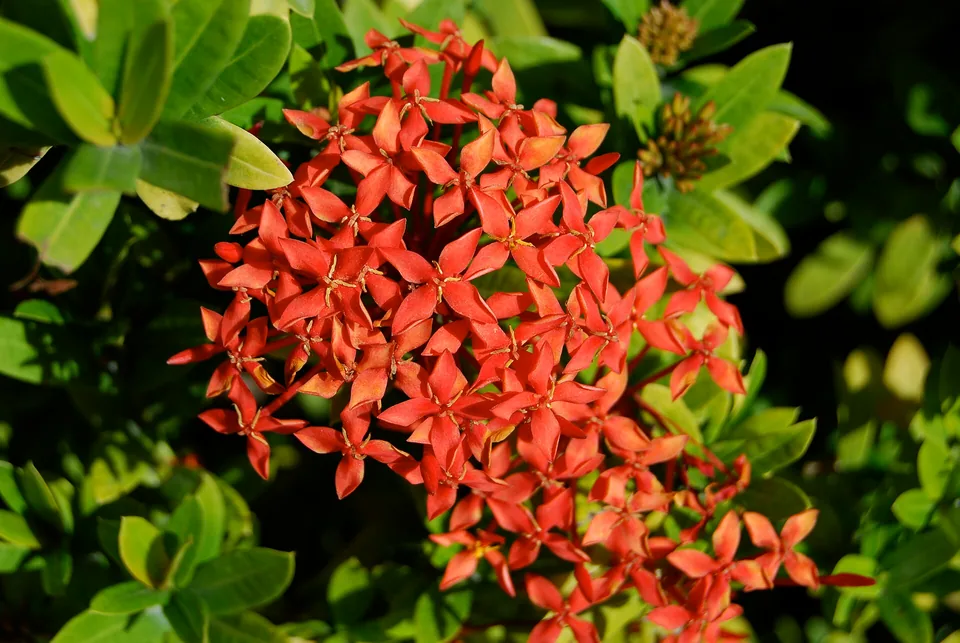


Cómo cultivar y cuidar Geranio de la jungla
Ixora coccinea
Escrito por Emilio Marruso · última revisión
No tóxica para gatos y perros, según las fuentes · Fuentes
De un vistazo
La ixora es un arbusto amante del sol que alcanza de 1,2 a 1,8 m de alto y también vive feliz en maceta. Dale un suelo ácido, húmedo y bien drenado, y abónala en mayo y en octubre: te regalará frutos desde finales de verano hasta finales de otoño. Los frutos maduros son comestibles y la planta no es tóxica para gatos, perros ni caballos.
- Sol
Sol pleno; tolera un poco de sombra por la tarde
Qué dicen las fuentes (1)
Luz: Pleno sol; tolera pequeñas cantidades de sombra por la tarde
The jungle geranium prefers full sun in moist, well-drained, organically rich soils with an acidic pH. It can tolerate small amounts of afternoon shade.
— Ixora coccinea (Burning Love, Flame Flower, Flame of the Woods, Jungle Flame, Jungle Geranium, Ratambala, Red Ixora) | North Carolina Extension Gardener Plant Toolbox [1] - Riego
Mantén la tierra húmeda pero bien drenada
Qué dicen las fuentes (1)
Riego: Suelos húmedos y bien drenados
The jungle geranium prefers full sun in moist, well-drained, organically rich soils with an acidic pH.
— Ixora coccinea (Burning Love, Flame Flower, Flame of the Woods, Jungle Flame, Jungle Geranium, Ratambala, Red Ixora) | North Carolina Extension Gardener Plant Toolbox [1] - Suelo
Suelo ácido, pH 6,0 o menos; en suelo calizo las hojas amarillean
Qué dicen las fuentes (1)
pH del suelo, máximo: 6.0
Light: Full sun (6 or more hours of direct sunlight a day) Soil Texture: Loam (Silt) Soil pH: Acid (<6.0)
— Ixora coccinea (Burning Love, Flame Flower, Flame of the Woods, Jungle Flame, Jungle Geranium, Ratambala, Red Ixora) | North Carolina Extension Gardener Plant Toolbox [1] - Abonado
Dos veces al año, en mayo y octubre, con abono de liberación lenta para plantas acidófilas
Qué dicen las fuentes (2)
Cuándo: Una vez establecida, en mayo y en octubre
Once ixora are established, use a slow-release granular fertilizers suitable for acid-loving plants such as azaleas as per label directions – perhaps once in May and once in October.
— Ixora – a staple in the landscape - UF/IFAS Extension Charlotte County [4] Abonos minerales: Fertilizante granular de liberación lenta para plantas que aman los suelos ácidos, siguiendo las instrucciones de la etiqueta
Once ixora are established, use a slow-release granular fertilizers suitable for acid-loving plants such as azaleas as per label directions – perhaps once in May and once in October.
— Ixora – a staple in the landscape - UF/IFAS Extension Charlotte County [4] - Cosecha
Da frutos de finales de verano a finales de otoño; los maduros son comestibles
Qué dicen las fuentes (1)
Cosecha: Los frutos aparecen generalmente desde finales del verano hasta finales del otoño
The fruits are round, fleshy, dark purple to black drupes, measuring less than 0.5 inches in diameter. They appear after flowering, usually late summer to late fall.
— Ixora coccinea (Burning Love, Flame Flower, Flame of the Woods, Jungle Flame, Jungle Geranium, Ratambala, Red Ixora) | North Carolina Extension Gardener Plant Toolbox [1] - Plagas
Pulgones, trips, cochinillas y cochinilla algodonosa; puede sufrir negrilla y podredumbre de raíz
Qué dicen las fuentes (2)
Plagas: pulgones, trips, escamas, gusanos de saco, nematodos, cochinillas
Aphids, thrips, scale, bagworms, nematodes, and mealybugs may be seen. Susceptible to sooty mold and mushroom root rot. Alkaline soils may cause chlorosis.
— Ixora coccinea (Burning Love, Flame Flower, Flame of the Woods, Jungle Flame, Jungle Geranium, Ratambala, Red Ixora) | North Carolina Extension Gardener Plant Toolbox [1] Enfermedades: moho fuliginoso, pudrición de raíz por hongos
Aphids, thrips, scale, bagworms, nematodes, and mealybugs may be seen. Susceptible to sooty mold and mushroom root rot. Alkaline soils may cause chlorosis.
— Ixora coccinea (Burning Love, Flame Flower, Flame of the Woods, Jungle Flame, Jungle Geranium, Ratambala, Red Ixora) | North Carolina Extension Gardener Plant Toolbox [1] - Tamaño
De 1,2 a 1,8 m de alto y de 0,9 a 1,5 m de ancho
Qué dicen las fuentes (3)
Altura adulta: 122-183 cm (4 a 6 pies)
tipos grandes sin podar: Some ixora types grow to 10-15 feet tall and 4-10 feet wide when unpruned, but they can handle shearing to maintain them as a smaller hedge.
— Ixora – Gardening Solutions [5] It grows 4 to 6 feet tall and 3 to 5 feet wide with a rounded, compact, multi-stemmed habit and has woody stems and leathery, dark green leaves.
— Ixora coccinea (Burning Love, Flame Flower, Flame of the Woods, Jungle Flame, Jungle Geranium, Ratambala, Red Ixora) | North Carolina Extension Gardener Plant Toolbox [1] Anchura adulta: 91-152 cm (3 a 5 pies)
It grows 4 to 6 feet tall and 3 to 5 feet wide with a rounded, compact, multi-stemmed habit and has woody stems and leathery, dark green leaves.
— Ixora coccinea (Burning Love, Flame Flower, Flame of the Woods, Jungle Flame, Jungle Geranium, Ratambala, Red Ixora) | North Carolina Extension Gardener Plant Toolbox [1] - Multiplicación
Se multiplica por esquejes de tallo
Qué dicen las fuentes (1)
Propagación: Esquejes de tallo
Pruning may be required and is best done in late winter. Propagated by stem cuttings.
— Ixora coccinea (Burning Love, Flame Flower, Flame of the Woods, Jungle Flame, Jungle Geranium, Ratambala, Red Ixora) | North Carolina Extension Gardener Plant Toolbox [1] - Maceta
Crece también en maceta
Qué dicen las fuentes (1)
En maceta: Sí
It may be grown in containers and brought indoors during the winter in colder climates
— Ixora coccinea (Burning Love, Flame Flower, Flame of the Woods, Jungle Flame, Jungle Geranium, Ratambala, Red Ixora) | North Carolina Extension Gardener Plant Toolbox [1] - Seguridad
No es tóxica para gatos, perros ni caballos
Resumen
La Ixora coccinea es un arbusto de hoja perenne de hoja ancha tropical que crece de 4 a 6 pies [1,2–1,8 m] de alto y de 3 a 5 pies [0,9–1,5 m] de ancho, con flores tubulares de color rojo brillante. [1] Prefiere pleno sol y suelo ácido, húmedo, bien drenado y rico en materia orgánica, y es intolerante a temperaturas por debajo de 50 grados Fahrenheit [10 °C]. [1] Puede cultivarse en contenedores y llevarse al interior durante el invierno. [1]
Citado en inglés, como en la fuente.
Cuidados
Las medidas entre corchetes son nuestra conversión al otro sistema de unidades; el texto citado no cambia.
Riego
Suelos húmedos y bien drenados
Qué dicen las fuentes (1)
The jungle geranium prefers full sun in moist, well-drained, organically rich soils with an acidic pH.Luz
Pleno sol; tolera pequeñas cantidades de sombra por la tarde
Qué dicen las fuentes (1)
The jungle geranium prefers full sun in moist, well-drained, organically rich soils with an acidic pH. It can tolerate small amounts of afternoon shade.Clima y frío
Rusticidad, zona más fría
Las fuentes dan valores distintos según la región, la zona o las condiciones de cultivo.
Lo que dice cada fuente
Según NC State Extension: 9a [mínima invernal de −6,7 a −3,9 °C (de 20 a 25 °F)]
Sur y centro de Florida: 9b [mínima invernal de −3,9 a −1,1 °C (de 25 a 30 °F)]
Qué dicen las fuentes (3)
Según NC State Extension: USDA Plant Hardiness Zone:
9a, 9b, 10a, 10b, 11a, 11bSur y centro de Florida: Ixora is adapted to South and Central Florida; zone 9B seems to be its northern-most limit, as frosts or freezes will injure it.USDA Plant Hardiness Zone:
9a, 9b, 10a, 10b, 11a, 11bRusticidad, zona más cálida
11b [mínima invernal de 7,2 a 10 °C (de 45 a 50 °F)]
Qué dicen las fuentes (1)
USDA Plant Hardiness Zone:
9a, 9b, 10a, 10b, 11a, 11bSuelo
6.0
Qué dicen las fuentes (1)
Light:
Full sun (6 or more hours of direct sunlight a day)
Soil Texture:
Loam (Silt)
Soil pH:
Acid (<6.0)Dónde cultivarla
En interior
En revisión: nuestro segundo control cuestionó este valor.
En maceta
Sí
Qué dicen las fuentes (1)
It may be grown in containers and brought indoors during the winter in colder climatesPropagación
Esquejes de tallo
Qué dicen las fuentes (1)
Pruning may be required and is best done in late winter. Propagated by stem cuttings.Cultivo
La planta
Ciclo de vida
perenne
Qué dicen las fuentes (1)
The leaves of this tropical perennial are bronze when young and shift to glistening dark green as the plant ages.Familia
Rubiaceae
Qué dicen las fuentes (1)
It is a member of the coffee family (Rubiaceae).Altura adulta
122-183 cm (4 a 6 pies)
Lo que dice cada fuente
tipos grandes sin podar:
Qué dicen las fuentes (2)
tipos grandes sin podar: Some ixora types grow to 10-15 feet tall and 4-10 feet wide when unpruned, but they can handle shearing to maintain them as a smaller hedge.It grows 4 to 6 feet tall and 3 to 5 feet wide with a rounded, compact, multi-stemmed habit and has woody stems and leathery, dark green leaves.Anchura adulta
91-152 cm (3 a 5 pies)
Qué dicen las fuentes (1)
It grows 4 to 6 feet tall and 3 to 5 feet wide with a rounded, compact, multi-stemmed habit and has woody stems and leathery, dark green leaves.Plagas y enfermedades
Plagas
pulgones, trips, escamas, gusanos de saco, nematodos, cochinillas
Qué dicen las fuentes (1)
Aphids, thrips, scale, bagworms, nematodes, and mealybugs may be seen. Susceptible to sooty mold and mushroom root rot. Alkaline soils may cause chlorosis.Enfermedades
moho fuliginoso, pudrición de raíz por hongos
Qué dicen las fuentes (1)
Aphids, thrips, scale, bagworms, nematodes, and mealybugs may be seen. Susceptible to sooty mold and mushroom root rot. Alkaline soils may cause chlorosis.Abonado
Cuándo
Una vez establecida, en mayo y en octubre
Qué dicen las fuentes (1)
Once ixora are established, use a slow-release granular fertilizers suitable for acid-loving plants such as azaleas as per label directions – perhaps once in May and once in October.Frecuencia
Dos veces al año una vez establecida, en mayo y en octubre
Qué dicen las fuentes (1)
Once ixora are established, use a slow-release granular fertilizers suitable for acid-loving plants such as azaleas as per label directions – perhaps once in May and once in October.Abonos minerales
Fertilizante granular de liberación lenta para plantas que aman los suelos ácidos, siguiendo las instrucciones de la etiqueta
Qué dicen las fuentes (1)
Once ixora are established, use a slow-release granular fertilizers suitable for acid-loving plants such as azaleas as per label directions – perhaps once in May and once in October.Microelementos
Hierro y manganeso; un rociado foliar de micronutrientes líquido durante el verano
Qué dicen las fuentes (2)
During the summer use a foliar spray of liquid supplemental micronutrients as per label directions that can be found at most garden centers.Symptoms of nutrient deficiencies such as yellowing leaves, smaller leaves and the death of buds may be the result of a lack of iron and manganese.Signos de carencia
Amarillamiento, hojas más pequeñas y muerte de los brotes, o crecimiento nuevo clorótico en suelos alcalinos (hierro y manganeso); manchas rojizas o púrpuras en las hojas más viejas (fósforo y potasio), especialmente en inviernos fríos
Qué dicen las fuentes (4)
Symptoms of nutrient deficiencies such as yellowing leaves, smaller leaves and the death of buds may be the result of a lack of iron and manganese.Reddish-purple spots may indicate phosphorus and potassium deficiencies – especially during cool winters.This native of Southern Asia is not well-suited to alkaline conditions, particularly areas next to sidewalks or foundations, and new growth will appear chlorotic from iron and manganese deficiencies.Purplish-red spots on older leaves indicate a combined potassium/phosphorus deficiency.Problemas
Plagas y enfermedades
Síntoma: Pueden observarse pulgones, trips, cochinillas, gusanos de saco, nematodos y cochinillas harinosas; susceptible al moho fuliginoso y a la pudrición de raíces por hongos.
Qué hacer: No se indica en la fuente.
Qué dicen las fuentes (1)
Aphids, thrips, scale, bagworms, nematodes, and mealybugs may be seen. Susceptible to sooty mold and mushroom root rot.
— Ixora coccinea (Burning Love, Flame Flower, Flame of the Woods, Jungle Flame, Jungle Geranium, Ratambala, Red Ixora) | North Carolina Extension Gardener Plant Toolbox [1] Clorosis en suelos alcalinos
Síntoma: Los suelos alcalinos pueden causar clorosis.
Qué hacer: Cultiva en suelo ácido.
Qué dicen las fuentes (2)
Alkaline soils may cause chlorosis. See this plant
— Ixora coccinea (Burning Love, Flame Flower, Flame of the Woods, Jungle Flame, Jungle Geranium, Ratambala, Red Ixora) | North Carolina Extension Gardener Plant Toolbox [1] The jungle geranium prefers full sun in moist, well-drained, organically rich soils with an acidic pH.
— Ixora coccinea (Burning Love, Flame Flower, Flame of the Woods, Jungle Flame, Jungle Geranium, Ratambala, Red Ixora) | North Carolina Extension Gardener Plant Toolbox [1] Problemas de plantas de interior
Síntoma: Cuando se pasa el invierno en interiores, puede volverse susceptible a cochinillas, trips y cochinillas harinosas.
Qué hacer: No se indica en la fuente.
Qué dicen las fuentes (1)
it may become susceptible to indoor plant problems such as scale, thrips, and mealybugs
— Ixora coccinea (Burning Love, Flame Flower, Flame of the Woods, Jungle Flame, Jungle Geranium, Ratambala, Red Ixora) | North Carolina Extension Gardener Plant Toolbox [1]
Remedios
Cada remedio indica qué dicen las fuentes oficiales; los remedios tradicionales sin fuente oficial aparecen marcados. Los perjudiciales están para que sepas evitarlos.
Cuidar la planta
pulgones
spray de jabón insecticida Funciona
Most dish soaps are not naturally occurring substances nor are they biodegradable. They can contain detergents and degreasers that are harmful to groundwater and aquatic and soil organisms.
— ucanr.edu [8] Cómo: intervención temprana con jabón insecticida
Regular inspection and early intervention with insecticidal soap or neem oil can effectively control these pests.
— bulbsociety.org [6] Qué dicen las pruebas For example, insecticidal soap is a safe, effective organic insecticide with minimal environmental impact.
— extension.psu.edu [7] spray de aceite de neem Funciona en parte
Cómo: intervención temprana con aceite de neem
Regular inspection and early intervention with insecticidal soap or neem oil can effectively control these pests.
— bulbsociety.org [6] Qué dicen las pruebas However, neem oil is not effective against every insect and disease, and often must be frequently reapplied to reach the desired outcome.
— extension.unh.edu [9]
Toxicidad
Según la fuente, citada textualmente. No es un consejo médico ni veterinario: si una persona o un animal pudo haber ingerido esta planta, contacta con un centro de toxicología o con un veterinario.
#non-toxic for cats #non-toxic for horses #non-toxic for dogs #full sun tolerant
[1]La fuente señala el riesgo para este animal pero no explica por qué.
Calendario
Cosecha
Los frutos aparecen generalmente desde finales del verano hasta finales del otoño
Qué dicen las fuentes (1)
The fruits are round, fleshy, dark purple to black drupes, measuring less than 0.5 inches in diameter. They appear after flowering, usually late summer to late fall.Poda
Las fuentes dan valores distintos según la región, la zona o las condiciones de cultivo.
Lo que dice cada fuente
Según NC State Extension: Finales del invierno
Según UF/IFAS Charlotte County Extension: A principios de la primavera, justo cuando comienza el nuevo crecimiento
Según UF/IFAS Gardening Solutions: En cualquier momento
Qué dicen las fuentes (4)
Según NC State Extension: Pruning may be required and is best done in late winter.Según UF/IFAS Charlotte County Extension: Also keep major pruning operations to early spring just as new growth begins.Según UF/IFAS Gardening Solutions: while ixora can be pruned anytime and will handle shearingPruning may be required and is best done in late winter.Meses tal como los dan las fuentes, en su mayoría de Estados Unidos (hemisferio norte). En el hemisferio sur se desplazan unos seis meses.
Comestibilidad
Según la fuente, citada textualmente. No comas una planta basándote solo en esta página: los errores de identificación pueden ser peligrosos.
Edible fruit Screening Edibility: The ripened fruits are edible.
[1]
Valores orientativos
Valores de una fuente secundaria, no comprobados palabra por palabra como el resto de esta página. Úselos como punto de partida.
- Nivel de cuidado
- MedioValor orientativo, adáptalo a tu clima · Fuente secundaria
- Crecimiento
- AltaValor orientativo, adáptalo a tu clima · Fuente secundaria
Plantas similares
- Azure Bluet Houstonia caerulea
- Aroma de laguna en Cuba Cephalanthus occidentalis
- Chinese Buttonbush Adina rubella
- Coralillo Hamelia patens
- Summer Bluet Houstonia purpurea
- Woodruff Cynanchica gussonei
- Cafeto arábico Coffea arabica
- Fever Tree Pinckneya pubens
Fuentes
Cada valor anterior se cita de estos documentos. Los enlaces llevan al editor original.
- Ixora coccinea (Burning Love, Flame Flower, Flame of the Woods, Jungle Flame, Jungle Geranium, Ratambala, Red Ixora) | North Carolina Extension Gardener Plant Toolbox · plants.ces.ncsu.edu, consultado
- Jungle Geranium - Ixora coccinea | North Carolina Extension Gardener Plant Toolbox · plants.ces.ncsu.edu, consultado
- Flame of the Woods - Ixora coccinea | North Carolina Extension Gardener Plant Toolbox · plants.ces.ncsu.edu, consultado
- Ixora – a staple in the landscape - UF/IFAS Extension Charlotte County · blogs.ifas.ufl.edu, consultado
- Ixora – Gardening Solutions · gardeningsolutions.ifas.ufl.edu, consultado
- bulbsociety.org · bulbsociety.org
- extension.psu.edu · extension.psu.edu
- ucanr.edu · ucanr.edu
- extension.unh.edu · extension.unh.edu
Escrito por Emilio Marruso · última revisión