

How to Grow and Care for Jungle Geranium
Ixora coccinea
Written by Emilio Marruso · last checked
Not toxic to cats and dogs, according to the sources · Sources
At a glance
Ixora is a sun-loving shrub that grows 4 to 6 feet tall and is happy in a container too. Give it moist, well-drained, acidic soil and a feeding in May and October, and it rewards you with fruit from late summer to late fall. The ripe fruits are edible, and the plant is safe for cats, dogs and horses.
- Sun
Full sun; a little afternoon shade is fine
What the sources say (1)
Light: Full sun; tolerates small amounts of afternoon shade
The jungle geranium prefers full sun in moist, well-drained, organically rich soils with an acidic pH. It can tolerate small amounts of afternoon shade.
— Ixora coccinea (Burning Love, Flame Flower, Flame of the Woods, Jungle Flame, Jungle Geranium, Ratambala, Red Ixora) | North Carolina Extension Gardener Plant Toolbox [1] - Water
Keep the soil moist but well drained
What the sources say (1)
Watering: Moist, well-drained soils
The jungle geranium prefers full sun in moist, well-drained, organically rich soils with an acidic pH.
— Ixora coccinea (Burning Love, Flame Flower, Flame of the Woods, Jungle Flame, Jungle Geranium, Ratambala, Red Ixora) | North Carolina Extension Gardener Plant Toolbox [1] - Soil
Acidic soil, pH 6.0 or lower; in alkaline soil the leaves turn yellow
What the sources say (1)
Soil pH, maximum: 6.0
Light: Full sun (6 or more hours of direct sunlight a day) Soil Texture: Loam (Silt) Soil pH: Acid (<6.0)
— Ixora coccinea (Burning Love, Flame Flower, Flame of the Woods, Jungle Flame, Jungle Geranium, Ratambala, Red Ixora) | North Carolina Extension Gardener Plant Toolbox [1] - Feeding
Twice a year, in May and October, with slow-release food for acid-loving plants
What the sources say (2)
When: Once established, in May and in October
Once ixora are established, use a slow-release granular fertilizers suitable for acid-loving plants such as azaleas as per label directions – perhaps once in May and once in October.
— Ixora – a staple in the landscape - UF/IFAS Extension Charlotte County [4] Mineral fertilizers: Slow-release granular fertilizer for acid-loving plants, following label directions
Once ixora are established, use a slow-release granular fertilizers suitable for acid-loving plants such as azaleas as per label directions – perhaps once in May and once in October.
— Ixora – a staple in the landscape - UF/IFAS Extension Charlotte County [4] - Harvest
Fruits appear from late summer to late fall; the ripe ones are edible
What the sources say (1)
Harvest: Fruits appear usually late summer to late fall
The fruits are round, fleshy, dark purple to black drupes, measuring less than 0.5 inches in diameter. They appear after flowering, usually late summer to late fall.
— Ixora coccinea (Burning Love, Flame Flower, Flame of the Woods, Jungle Flame, Jungle Geranium, Ratambala, Red Ixora) | North Carolina Extension Gardener Plant Toolbox [1] - Pests
Aphids, thrips, scale and mealybugs; can get sooty mold and root rot
What the sources say (2)
Pests: aphids, thrips, scale, bagworms, nematodes, mealybugs
Aphids, thrips, scale, bagworms, nematodes, and mealybugs may be seen. Susceptible to sooty mold and mushroom root rot. Alkaline soils may cause chlorosis.
— Ixora coccinea (Burning Love, Flame Flower, Flame of the Woods, Jungle Flame, Jungle Geranium, Ratambala, Red Ixora) | North Carolina Extension Gardener Plant Toolbox [1] Diseases: sooty mold, mushroom root rot
Aphids, thrips, scale, bagworms, nematodes, and mealybugs may be seen. Susceptible to sooty mold and mushroom root rot. Alkaline soils may cause chlorosis.
— Ixora coccinea (Burning Love, Flame Flower, Flame of the Woods, Jungle Flame, Jungle Geranium, Ratambala, Red Ixora) | North Carolina Extension Gardener Plant Toolbox [1] - Size
4 to 6 ft tall and 3 to 5 ft wide
What the sources say (3)
Mature height: 122-183 cm (4 to 6 feet)
large unpruned types: Some ixora types grow to 10-15 feet tall and 4-10 feet wide when unpruned, but they can handle shearing to maintain them as a smaller hedge.
— Ixora – Gardening Solutions [5] It grows 4 to 6 feet tall and 3 to 5 feet wide with a rounded, compact, multi-stemmed habit and has woody stems and leathery, dark green leaves.
— Ixora coccinea (Burning Love, Flame Flower, Flame of the Woods, Jungle Flame, Jungle Geranium, Ratambala, Red Ixora) | North Carolina Extension Gardener Plant Toolbox [1] Mature width: 91-152 cm (3 to 5 feet)
It grows 4 to 6 feet tall and 3 to 5 feet wide with a rounded, compact, multi-stemmed habit and has woody stems and leathery, dark green leaves.
— Ixora coccinea (Burning Love, Flame Flower, Flame of the Woods, Jungle Flame, Jungle Geranium, Ratambala, Red Ixora) | North Carolina Extension Gardener Plant Toolbox [1] - Propagation
Grow new plants from stem cuttings
What the sources say (1)
Propagation: Stem cuttings
Pruning may be required and is best done in late winter. Propagated by stem cuttings.
— Ixora coccinea (Burning Love, Flame Flower, Flame of the Woods, Jungle Flame, Jungle Geranium, Ratambala, Red Ixora) | North Carolina Extension Gardener Plant Toolbox [1] - Containers
Grows in containers too
What the sources say (1)
In containers: Yes
It may be grown in containers and brought indoors during the winter in colder climates
— Ixora coccinea (Burning Love, Flame Flower, Flame of the Woods, Jungle Flame, Jungle Geranium, Ratambala, Red Ixora) | North Carolina Extension Gardener Plant Toolbox [1] - Safety
Safe for cats, dogs and horses
Overview
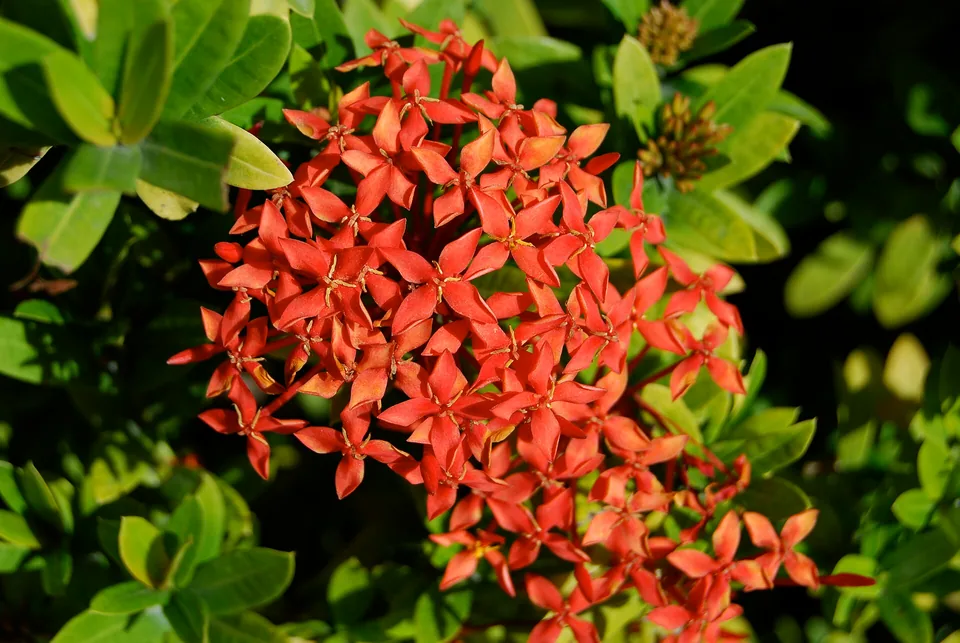
Ixora coccinea is a tropical broadleaf evergreen shrub that grows 4 to 6 feet [1.2–1.8 m] tall and 3 to 5 feet [0.9–1.5 m] wide, with bright red tubular flowers. [1] It prefers full sun and moist, well-drained, organically rich, acidic soil, and is intolerant of temperatures below 50 degrees Fahrenheit [10 °C]. [1] It may be grown in containers and brought indoors for the winter. [1]
Jungle Geranium care
Measurements in square brackets are our conversion into the other unit system; the quoted text is unchanged.
How to water Jungle Geranium
Moist, well-drained soils
What the sources say (1)
The jungle geranium prefers full sun in moist, well-drained, organically rich soils with an acidic pH.How much light Jungle Geranium needs
Full sun; tolerates small amounts of afternoon shade
What the sources say (1)
The jungle geranium prefers full sun in moist, well-drained, organically rich soils with an acidic pH. It can tolerate small amounts of afternoon shade.How much cold Jungle Geranium can take
Hardiness, coldest zone
The sources give different values depending on region, zone or growing conditions.
What each source says
According to NC State Extension: 9a [winter low −6.7 to −3.9 °C (20 to 25 °F)]
South and Central Florida: 9b [winter low −3.9 to −1.1 °C (25 to 30 °F)]
What the sources say (3)
According to NC State Extension: USDA Plant Hardiness Zone:
9a, 9b, 10a, 10b, 11a, 11bSouth and Central Florida: Ixora is adapted to South and Central Florida; zone 9B seems to be its northern-most limit, as frosts or freezes will injure it.USDA Plant Hardiness Zone:
9a, 9b, 10a, 10b, 11a, 11bHardiness, warmest zone
11b [winter low 7.2 to 10 °C (45 to 50 °F)]
What the sources say (1)
USDA Plant Hardiness Zone:
9a, 9b, 10a, 10b, 11a, 11bBest soil for Jungle Geranium
6.0
What the sources say (1)
Light:
Full sun (6 or more hours of direct sunlight a day)
Soil Texture:
Loam (Silt)
Soil pH:
Acid (<6.0)Where to grow Jungle Geranium
Indoors
Under review: our second check questioned this value.
In containers
Yes
What the sources say (1)
It may be grown in containers and brought indoors during the winter in colder climatesHow to propagate Jungle Geranium
Stem cuttings
What the sources say (1)
Pruning may be required and is best done in late winter. Propagated by stem cuttings.How to grow Jungle Geranium
The plant
Life cycle
perennial
What the sources say (1)
The leaves of this tropical perennial are bronze when young and shift to glistening dark green as the plant ages.Family
Rubiaceae
What the sources say (1)
It is a member of the coffee family (Rubiaceae).Mature height
122-183 cm (4 to 6 feet)
What each source says
large unpruned types:
What the sources say (2)
large unpruned types: Some ixora types grow to 10-15 feet tall and 4-10 feet wide when unpruned, but they can handle shearing to maintain them as a smaller hedge.It grows 4 to 6 feet tall and 3 to 5 feet wide with a rounded, compact, multi-stemmed habit and has woody stems and leathery, dark green leaves.Mature width
91-152 cm (3 to 5 feet)
What the sources say (1)
It grows 4 to 6 feet tall and 3 to 5 feet wide with a rounded, compact, multi-stemmed habit and has woody stems and leathery, dark green leaves.Pests and diseases
Pests
aphids, thrips, scale, bagworms, nematodes, mealybugs
What the sources say (1)
Aphids, thrips, scale, bagworms, nematodes, and mealybugs may be seen. Susceptible to sooty mold and mushroom root rot. Alkaline soils may cause chlorosis.Diseases
sooty mold, mushroom root rot
What the sources say (1)
Aphids, thrips, scale, bagworms, nematodes, and mealybugs may be seen. Susceptible to sooty mold and mushroom root rot. Alkaline soils may cause chlorosis.Fertilizing
When
Once established, in May and in October
What the sources say (1)
Once ixora are established, use a slow-release granular fertilizers suitable for acid-loving plants such as azaleas as per label directions – perhaps once in May and once in October.How often
Twice a year once established, in May and in October
What the sources say (1)
Once ixora are established, use a slow-release granular fertilizers suitable for acid-loving plants such as azaleas as per label directions – perhaps once in May and once in October.Mineral fertilizers
Slow-release granular fertilizer for acid-loving plants, following label directions
What the sources say (1)
Once ixora are established, use a slow-release granular fertilizers suitable for acid-loving plants such as azaleas as per label directions – perhaps once in May and once in October.Micronutrients
Iron and manganese; a liquid micronutrient foliar spray during the summer
What the sources say (2)
During the summer use a foliar spray of liquid supplemental micronutrients as per label directions that can be found at most garden centers.Symptoms of nutrient deficiencies such as yellowing leaves, smaller leaves and the death of buds may be the result of a lack of iron and manganese.Signs of deficiency
Yellowing, smaller leaves and bud death, or chlorotic new growth in alkaline soils (iron and manganese); reddish-purple spots on older leaves (phosphorus and potassium), especially in cool winters
What the sources say (4)
Symptoms of nutrient deficiencies such as yellowing leaves, smaller leaves and the death of buds may be the result of a lack of iron and manganese.Reddish-purple spots may indicate phosphorus and potassium deficiencies – especially during cool winters.This native of Southern Asia is not well-suited to alkaline conditions, particularly areas next to sidewalks or foundations, and new growth will appear chlorotic from iron and manganese deficiencies.Purplish-red spots on older leaves indicate a combined potassium/phosphorus deficiency.Jungle Geranium pests and problems
Pests and diseases
Symptom: Aphids, thrips, scale, bagworms, nematodes and mealybugs may be seen; susceptible to sooty mold and mushroom root rot.
What to do: Not stated in the source.
What the sources say (1)
Aphids, thrips, scale, bagworms, nematodes, and mealybugs may be seen. Susceptible to sooty mold and mushroom root rot.
— Ixora coccinea (Burning Love, Flame Flower, Flame of the Woods, Jungle Flame, Jungle Geranium, Ratambala, Red Ixora) | North Carolina Extension Gardener Plant Toolbox [1] Chlorosis in alkaline soils
Symptom: Alkaline soils may cause chlorosis.
What to do: Grow in acidic soil.
What the sources say (2)
Alkaline soils may cause chlorosis. See this plant
— Ixora coccinea (Burning Love, Flame Flower, Flame of the Woods, Jungle Flame, Jungle Geranium, Ratambala, Red Ixora) | North Carolina Extension Gardener Plant Toolbox [1] The jungle geranium prefers full sun in moist, well-drained, organically rich soils with an acidic pH.
— Ixora coccinea (Burning Love, Flame Flower, Flame of the Woods, Jungle Flame, Jungle Geranium, Ratambala, Red Ixora) | North Carolina Extension Gardener Plant Toolbox [1] Indoor plant problems
Symptom: When overwintered indoors it may become susceptible to scale, thrips, and mealybugs.
What to do: Not stated in the source.
What the sources say (1)
it may become susceptible to indoor plant problems such as scale, thrips, and mealybugs
— Ixora coccinea (Burning Love, Flame Flower, Flame of the Woods, Jungle Flame, Jungle Geranium, Ratambala, Red Ixora) | North Carolina Extension Gardener Plant Toolbox [1]
Remedies
Each remedy shows what official sources say about it; traditional remedies without an official source are marked as such. Harmful ones are listed so you know to avoid them.
Treating the plant
aphids
insecticidal soap spray Works
Most dish soaps are not naturally occurring substances nor are they biodegradable. They can contain detergents and degreasers that are harmful to groundwater and aquatic and soil organisms.
— ucanr.edu [8] How: early intervention with insecticidal soap
Regular inspection and early intervention with insecticidal soap or neem oil can effectively control these pests.
— bulbsociety.org [6] What the evidence says For example, insecticidal soap is a safe, effective organic insecticide with minimal environmental impact.
— extension.psu.edu [7] neem oil spray Partly works
How: early intervention with neem oil
Regular inspection and early intervention with insecticidal soap or neem oil can effectively control these pests.
— bulbsociety.org [6] What the evidence says However, neem oil is not effective against every insect and disease, and often must be frequently reapplied to reach the desired outcome.
— extension.unh.edu [9]
Is Jungle Geranium poisonous?
Reported by the source, quoted verbatim. This is not medical or veterinary advice: if a person or an animal may have eaten this plant, contact a poison control centre or a veterinarian.
#non-toxic for cats #non-toxic for horses #non-toxic for dogs #full sun tolerant
[1]The source flags the risk for this animal but does not explain why.
Calendar
Harvest
Fruits appear usually late summer to late fall
What the sources say (1)
The fruits are round, fleshy, dark purple to black drupes, measuring less than 0.5 inches in diameter. They appear after flowering, usually late summer to late fall.Pruning
The sources give different values depending on region, zone or growing conditions.
What each source says
According to NC State Extension: Late winter
According to UF/IFAS Charlotte County Extension: Early spring, just as new growth begins
According to UF/IFAS Gardening Solutions: Anytime
What the sources say (4)
According to NC State Extension: Pruning may be required and is best done in late winter.According to UF/IFAS Charlotte County Extension: Also keep major pruning operations to early spring just as new growth begins.According to UF/IFAS Gardening Solutions: while ixora can be pruned anytime and will handle shearingPruning may be required and is best done in late winter.Months as given by the sources, which are mostly from the United States (northern hemisphere). In the southern hemisphere they shift by about six months.
Edibility
Reported by the source, quoted verbatim. Do not eat a plant on the basis of this page alone: identification mistakes can be dangerous.
Edible fruit Screening Edibility: The ripened fruits are edible.
[1]
Indicative values
Values from a secondary source, not checked word for word like the rest of this page. Use them as a starting point.
- Care level
- MediumIndicative value, adapt it to your climate · Secondary source
- Growth rate
- HighIndicative value, adapt it to your climate · Secondary source
Similar plants
- Azure Bluet Houstonia caerulea
- Buttonbush Cephalanthus occidentalis
- Chinese Buttonbush Adina rubella
- Firebush Hamelia patens
- Summer Bluet Houstonia purpurea
- Woodruff Cynanchica gussonei
- Coffee Coffea arabica
- Fever Tree Pinckneya pubens
Sources
Every value above is quoted from these documents. Links lead to the original publisher.
- Ixora coccinea (Burning Love, Flame Flower, Flame of the Woods, Jungle Flame, Jungle Geranium, Ratambala, Red Ixora) | North Carolina Extension Gardener Plant Toolbox · plants.ces.ncsu.edu, consulted
- Jungle Geranium - Ixora coccinea | North Carolina Extension Gardener Plant Toolbox · plants.ces.ncsu.edu, consulted
- Flame of the Woods - Ixora coccinea | North Carolina Extension Gardener Plant Toolbox · plants.ces.ncsu.edu, consulted
- Ixora – a staple in the landscape - UF/IFAS Extension Charlotte County · blogs.ifas.ufl.edu, consulted
- Ixora – Gardening Solutions · gardeningsolutions.ifas.ufl.edu, consulted
- bulbsociety.org · bulbsociety.org
- extension.psu.edu · extension.psu.edu
- ucanr.edu · ucanr.edu
- extension.unh.edu · extension.unh.edu
Written by Emilio Marruso · last checked