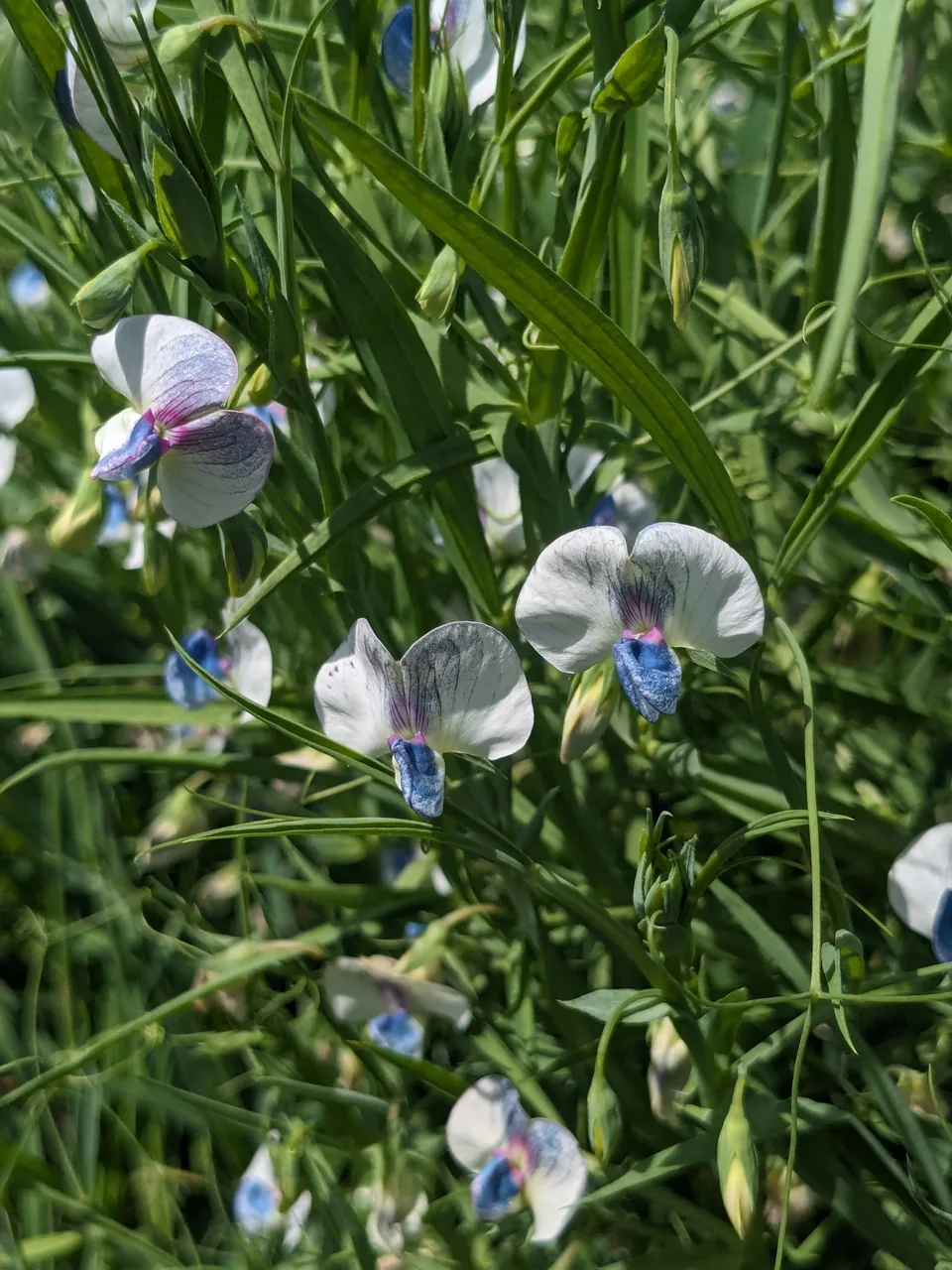
Cómo cultivar y cuidar Almorta
Lathyrus sativus
Escrito por Emilio Marruso · última revisión
Tóxica para: Caballos, Ganado, Personas · Por qué
De un vistazo
La almorta es una leguminosa anual amante del sol que te alimenta de varias formas: hierve las semillas como legumbre, come las semillas tiernas como guisantes o cocina las hojas como verdura. Las semillas maduran en 4–6 meses; cosecha cuando las hojas empiecen a amarillear, antes de que las vainas se abran. Remoja las semillas 24 horas antes de cocinarlas.
- Sol
Sol pleno
Qué dicen las fuentes (1)
Luz: Pleno sol
An easily grown plant, succeeding in any moderately good garden soil but preferring a position in full sun
— Chickling Pea (Lathyrus sativus) — Practical Plants [3] - Distancia
Siembra en surcos separados 3 cm
Qué dicen las fuentes (2)
Distancia de plantación: 3 (surcos de unos 3 cm de separación)
Seeds may be sown broadcast or in furrows about 3 cm apart in a well-prepared field.
— Grasspea [2] Distancia entre hileras: 3 cm [1,2 in]
Seeds may be sown broadcast or in furrows about 3 cm apart in a well-prepared field.
— Grasspea [2] - Plantación
Planta en verano, con plantones criados en cajonera fría
Qué dicen las fuentes (1)
Plantación: Verano (plántulas criadas en un marco frío)
prick the seedlings out into individual pots and plant them out in the summer.
— Chickling Pea (Lathyrus sativus) — Practical Plants [3] - Cosecha
Las semillas maduran en 4–6 meses; cosecha cuando las hojas amarilleen, antes de que las vainas se abran
Qué dicen las fuentes (3)
Cómo cosechar: Se cosechan en cuanto las hojas empiezan a ponerse amarillas y las vainas aún no están completamente maduras, porque las vainas maduras se abren y dispersan las semillas; se cosechan con hoz o se arrancan, se secan durante unos días en montones, luego se trillan y se aventan.
harvested as soon as the leaves begin to turn yellow and when pods are not fully ripe as fully ripe pods dehisce and scatter the seeds
— Grasspea [2] It is harvested with sickle or uprooted, left to dry for a few days in heaps and then threshed and winnowed.
— Grasspea [2] Días hasta la madurez: 4-6 meses (maduración de las semillas; punto de referencia no indicado)
Seeds of grasspea ripen in 4-6 months and are harvested as soon as the leaves begin to turn yellow and when pods are not fully ripe as fully ripe pods dehisce and scatter the seeds
— Grasspea [2] - Plagas
Pulgón, trips y nematodos de raíz; podredumbre gris, roya, oídio y mildiu
Qué dicen las fuentes (2)
Plagas: Heterodera goettingiana, Heterodera schachtii, Heterodera tyifolii (nematodos)
Nematodes attacking this plant include Heterodera goettingiana , H. schachtii and H. tyifolii . Rootknot nematodes are not usually serious
— Grasspea [2] Enfermedades: moho gris, roya, mildiu polvoriento, mildiu velloso
Major fungal diseases of grasspea are grey mold ( Botrytis sp.), rust ( Uromyces fabae ) powdery mildew ( Erysiphe polygoni ) and downy mildew ( Peronospora lathi-palustris )
— Grasspea [2] - Tamaño
Tallos de 60 cm a 9 m de largo
Qué dicen las fuentes (1)
Altura adulta: 60-900 cm (0.6-9.0 m, longitud del tallo)
stems are 0.6-9.0 m tall and the leaves are pinnately compound with usually two leaflets (linear-lanceolate 25-150 mm long, 3-9 mm broad)
— Grasspea [2] - Multiplicación
Por semilla, o por división en primavera, aunque puede no soportar bien el trasplante
- Seguridad
Remoja las semillas 24 horas antes de cocinarlas; como alimento principal durante meses causan parálisis
Resumen
El guisante de campo (Lathyrus sativus) es una legumbre anual cultivada como pulso y forraje y tolerante a suelos pobres. [3][2] Se propaga por semilla y fija el nitrógeno atmosférico mediante simbiosis con Rhizobium. [4] Comer las semillas como parte principal de la dieta durante meses puede causar latirismo, una enfermedad paralítica atribuida a la neurotoxina ODAP. [2]
Citado en inglés, como en la fuente.
Cuidados
Riego
Las fuentes dan valores distintos según la región, la zona o las condiciones de cultivo.
Lo que dice cada fuente
Según Purdue NewCROP: Tolerante a condiciones extremadamente secas
Según Practical Plants: Baja necesidad de agua; intolerante a la sequía
Según ECHO: Extremadamente tolerante a la sequía
Qué dicen las fuentes (3)
Según Purdue NewCROP: The crop is tolerant to extremely dry conditions in drought prone areas as in EthiopiaSegún Practical Plants: Water
low
Soil textures
sandy, loamy, clay
Soil pH
acid, neutral, alkaline
Tolerates Nutritionally Poor Soil
True
Drought
intolerantSegún ECHO: La almorta es extremadamente tolerante a la sequíaLuz
Pleno sol
Qué dicen las fuentes (1)
An easily grown plant, succeeding in any moderately good garden soil but preferring a position in full sunDónde cultivarla
3 (surcos de unos 3 cm de separación)
Qué dicen las fuentes (1)
Seeds may be sown broadcast or in furrows about 3 cm apart in a well-prepared field.Propagación
Cultivo
La planta
Ciclo de vida
anual (anual de invierno)
Qué dicen las fuentes (1)
Grasspea is a much-branched suberect, straggling or climbing herbaceous winter annual; stems are 0.6-9.0 m tall and the leaves are pinnately compound with usually two leaflets (linear-lanceolate 25-150 mm long, 3-9 mm broad)Familia
Leguminosae (Fabaceae)
Qué dicen las fuentes (1)
Species : Lathyrus sativus L.
Family : LeguminosaeAltura adulta
60-900 cm (0.6-9.0 m, longitud del tallo)
Qué dicen las fuentes (1)
stems are 0.6-9.0 m tall and the leaves are pinnately compound with usually two leaflets (linear-lanceolate 25-150 mm long, 3-9 mm broad)Siembra y crecimiento
Distancia entre hileras
3 cm [1,2 in]
Qué dicen las fuentes (1)
Seeds may be sown broadcast or in furrows about 3 cm apart in a well-prepared field.Días hasta la madurez
4-6 meses (maduración de las semillas; punto de referencia no indicado)
Qué dicen las fuentes (1)
Seeds of grasspea ripen in 4-6 months and are harvested as soon as the leaves begin to turn yellow and when pods are not fully ripe as fully ripe pods dehisce and scatter the seedsCosecha y conservación
Cómo cosechar
Se cosechan en cuanto las hojas empiezan a ponerse amarillas y las vainas aún no están completamente maduras, porque las vainas maduras se abren y dispersan las semillas; se cosechan con hoz o se arrancan, se secan durante unos días en montones, luego se trillan y se aventan.
Plagas y enfermedades
Plagas
Heterodera goettingiana, Heterodera schachtii, Heterodera tyifolii (nematodos)
Qué dicen las fuentes (1)
Nematodes attacking this plant include Heterodera goettingiana , H. schachtii and H. tyifolii . Rootknot nematodes are not usually seriousEnfermedades
moho gris, roya, mildiu polvoriento, mildiu velloso
Qué dicen las fuentes (1)
Major fungal diseases of grasspea are grey mold ( Botrytis sp.), rust ( Uromyces fabae ) powdery mildew ( Erysiphe polygoni ) and downy mildew ( Peronospora lathi-palustris )Abonado
Abonos minerales
Las fuentes dan valores distintos según la región, la zona o las condiciones de cultivo.
Lo que dice cada fuente
producción en campo: Rara vez se necesita, aparte de cal en suelos ácidos; el fósforo se aplica en la producción del sur de Asia
Qué dicen las fuentes (1)
producción en campo: Except for lime on acid soils, other nutrients are rarely needed. Phosphorus application is recommended in India, Pakistan, Nepal and Bangladesh,Problemas
Enfermedades fúngicas
Síntoma: Moho gris, roya, mildiu polvoriento y mildiu velloso
Qué hacer: No indicado por las fuentes
Qué dicen las fuentes (1)
Major fungal diseases of grasspea are grey mold ( Botrytis sp.), rust ( Uromyces fabae ) powdery mildew ( Erysiphe polygoni ) and downy mildew
— Grasspea [2] Pulgones y trips
Síntoma: Los insectos plaga incluyen pulgones y trips
Qué hacer: No indicado por las fuentes
Qué dicen las fuentes (1)
Insect pests of grass pea include aphids and thrips.
— Lathyrus sativus (PROTA) - Pl@ntUse [4]
Remedios
Las fuentes consultadas no dan remedios para esta planta.
Venenosa para los animales
Según la fuente, citada textualmente. No es un consejo médico ni veterinario: si una persona o un animal pudo haber ingerido esta planta, contacta con un centro de toxicología o con un veterinario.
Animales
Livestock that consume grasspea seeds (30-50% of the diet) for 3-6 months develop Neurolathyrism, a disease that leads to microgliosis in the anterior horns and lateral cords
[2]When fed alone, fresh young plants are reported to be harmful to horses; however, cattle, rabbits, and sheep can consume large amounts without ill effects
[2]La fuente señala el riesgo para este animal pero no explica por qué.
Personas
People and livestock consuming grasspea as the principal diet for months develop a paralytic disease known as "Lathyrism"
[2]- Partes venenosas
also the ODAP distribution in embryo was the greatest (400) followed by cotyledon
[2]- Principio tóxico
Beta-N-oxalyl-L-alpha-beta-diamino-propionic acid (ODAP) also referred as Beta-N-oxalylamino-L-alanine (BOAA) occurs in grasspea and is a neurotoxin which causes paralysis
[2]- Síntomas
Beta-N-oxalyl-L-alpha-beta-diamino-propionic acid (ODAP) also referred as Beta-N-oxalylamino-L-alanine (BOAA) occurs in grasspea and is a neurotoxin which causes paralysis
[2]- Gravedad
I am blamed for a condition known as lathyrism, which is a kind of irreversible paralysis of the legs
[6]
Occasional use is harmless. Seeds, if soaked in water for 24 hr before cooking, are not toxic
[2]The seed contains a toxic amino-acid which, in large quantities, can cause a very serious disease of the nervous system known as 'lathyrism'.
[3]- Principio tóxico
The seed contains a toxic amino-acid which, in large quantities, can cause a very serious disease of the nervous system known as 'lathyrism'.
[3]
Calendario
Siembra
Las fuentes dan valores distintos según la región, la zona o las condiciones de cultivo.
Lo que dice cada fuente
Según Practical Plants (cold frame): Principios de primavera
Según Practical Plants (in situ): Mediados de primavera
Etiopía: Septiembre-noviembre
India (sistemas basados en arroz): Distribuye sobre el arroz en pie unas 2 semanas antes de la cosecha del arroz
Qué dicen las fuentes (4)
Según Practical Plants (cold frame): Pre-soak the seed for 24 hours in warm water and then sow in early spring in a cold frameSegún Practical Plants (in situ): then it can also be sown in situ in mid springEtiopía: In Ethiopia grass pea is usually sown in September–November and harvested in January–April.India (sistemas basados en arroz): it is broadcast into a standing rice crop about 2 weeks before the rice harvest and left to grow on the residual moisturePlantación
Verano (plántulas criadas en un marco frío)
Qué dicen las fuentes (1)
prick the seedlings out into individual pots and plant them out in the summer.Cosecha
Las fuentes dan valores distintos según la región, la zona o las condiciones de cultivo.
Lo que dice cada fuente
Según Purdue NewCROP: Las semillas maduran en 4-6 meses
Según ECHO: 86 a 127 días
Etiopía: Enero-abril
Qué dicen las fuentes (4)
Según Purdue NewCROP: Seeds of grasspea ripen in 4-6 months and are harvested as soon as the leaves begin to turn yellowSegún ECHO: Después de 86 a 127 días, las flores azules, moradas, rosadas o rojas producen vainas oblongasEtiopía: In Ethiopia grass pea is usually sown in September–November and harvested in January–April.Harvesting of grass pea should be done when leaves turn yellow and pods turn grey, to avoid shattering.Meses tal como los dan las fuentes, en su mayoría de Estados Unidos (hemisferio norte). En el hemisferio sur se desplazan unos seis meses.
Comestibilidad
Según la fuente, citada textualmente. No comas una planta basándote solo en esta página: los errores de identificación pueden ser peligrosos.
The seeds are boiled and consumed as a pulse, can be used in dahl preparation and bread making.
[2]The immature seed can be eaten like green peas
[3]Leaves can be used as a pot-herb and can be consumed as a vegetable after boiling.
[2]cattle, rabbits, and sheep can consume large amounts without ill effects
[2]
Plantas similares
- Albejana Lathyrus latifolius
- Guija de hoja estrecha Lathyrus sylvestris
- Garden pea Lathyrus oleraceus
- Lathyrus pratensis Lathyrus pratensis
- Almorta de monte Lathyrus cicera
- Chorreque Lathyrus odoratus
- Tuberous pea Lathyrus tuberosus
- Spring pea Lathyrus vernus
Fuentes
Cada valor anterior se cita de estos documentos. Los enlaces llevan al editor original.
- Lathyrus sativus L. | Plants of the World Online | Kew Science · powo.science.kew.org, consultado
- Grasspea · hort.purdue.edu, consultado
- Chickling Pea (Lathyrus sativus) — Practical Plants · practicalplants.org, consultado
- Lathyrus sativus (PROTA) - Pl@ntUse · uses.plantnet-project.org, consultado
- Descripción · echocommunity.org, consultado
- Grasspea: A Story of Security - Crop Trust · croptrust.org, consultado
- Lathyrus sativus L. - Herbari Virtual del Mediterrani Occidental · herbarivirtual.uib.cat, consultado
Escrito por Emilio Marruso · última revisión