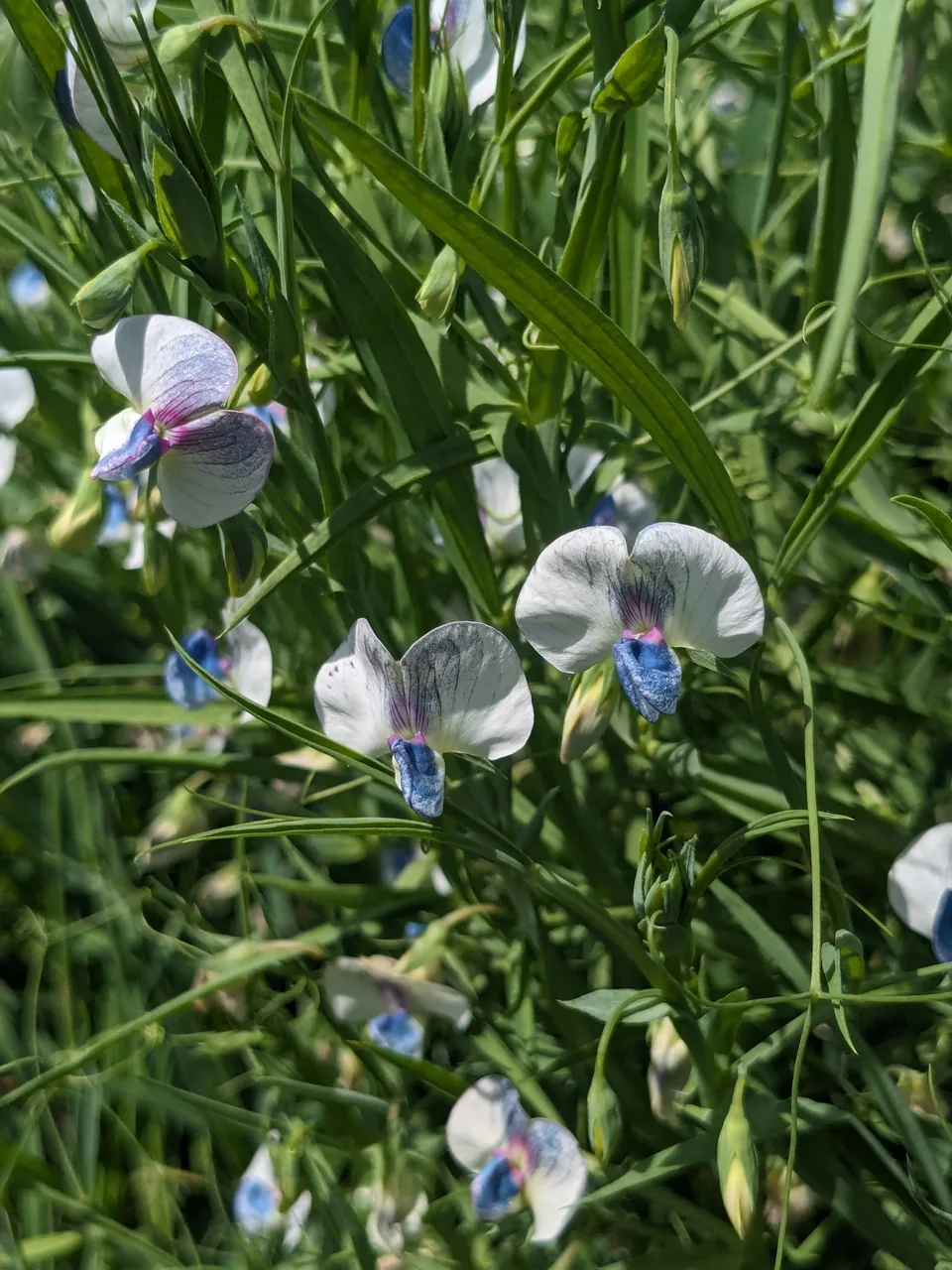
How to Grow and Care for Grass pea
Lathyrus sativus
Written by Emilio Marruso · last checked
Toxic to: Horses, Livestock, People · Why
At a glance
Grass pea is a sun-loving annual legume that feeds you in more ways than one: boil the seeds like lentils, eat the young seeds like green peas, or cook the leaves as greens. The seeds ripen in 4–6 months; harvest when the leaves start to turn yellow, before the pods burst open. Soak the seeds for 24 hours before cooking.
- Sun
Full sun
What the sources say (1)
Light: Full sun
An easily grown plant, succeeding in any moderately good garden soil but preferring a position in full sun
— Chickling Pea (Lathyrus sativus) — Practical Plants [3] - Spacing
Sow in furrows 1 inch apart
- Planting
Plant in summer, using seedlings raised in a cold frame
What the sources say (1)
Planting: Summer (seedlings raised in a cold frame)
prick the seedlings out into individual pots and plant them out in the summer.
— Chickling Pea (Lathyrus sativus) — Practical Plants [3] - Harvest
Seeds ripen in 4–6 months; pick when leaves start to yellow, before pods burst and scatter the seeds
What the sources say (3)
How to harvest: Harvested as soon as the leaves begin to turn yellow and while pods are not fully ripe, because fully ripe pods dehisce and scatter the seeds; harvested with a sickle or uprooted, dried for a few days in heaps, then threshed and winnowed.
harvested as soon as the leaves begin to turn yellow and when pods are not fully ripe as fully ripe pods dehisce and scatter the seeds
— Grasspea [2] It is harvested with sickle or uprooted, left to dry for a few days in heaps and then threshed and winnowed.
— Grasspea [2] Days to maturity: 4-6 months (seed ripening; reference point not stated)
Seeds of grasspea ripen in 4-6 months and are harvested as soon as the leaves begin to turn yellow and when pods are not fully ripe as fully ripe pods dehisce and scatter the seeds
— Grasspea [2] - Pests
Aphids, thrips and root nematodes; gray mold, rust, powdery mildew and downy mildew
What the sources say (2)
Pests: Heterodera goettingiana, Heterodera schachtii, Heterodera tyifolii (nematodes)
Nematodes attacking this plant include Heterodera goettingiana , H. schachtii and H. tyifolii . Rootknot nematodes are not usually serious
— Grasspea [2] Diseases: grey mold, rust, powdery mildew, downy mildew
Major fungal diseases of grasspea are grey mold ( Botrytis sp.), rust ( Uromyces fabae ) powdery mildew ( Erysiphe polygoni ) and downy mildew ( Peronospora lathi-palustris )
— Grasspea [2] - Size
Stems grow 2 to 30 ft long
What the sources say (1)
Mature height: 60-900 cm (0.6-9.0 m, stem length)
stems are 0.6-9.0 m tall and the leaves are pinnately compound with usually two leaflets (linear-lanceolate 25-150 mm long, 3-9 mm broad)
— Grasspea [2] - Propagation
From seed, or by division in spring, though it may not transplant well
- Safety
Soak seeds 24 hours before cooking; eaten as a main food for months, they cause paralysis
Overview
Grass pea (Lathyrus sativus) is an annual legume grown as a pulse and forage crop and tolerant of poor soils. [3][2] It is propagated by seed and fixes atmospheric nitrogen through symbiosis with Rhizobium. [4] Eating the seeds as the main part of the diet for months can cause lathyrism, a paralytic disease attributed to the neurotoxin ODAP. [2]
Grass pea care
How to water Grass pea
The sources give different values depending on region, zone or growing conditions.
What each source says
According to Purdue NewCROP: Tolerant to extremely dry conditions
According to Practical Plants: Low water need; drought intolerant
According to ECHO: Extremely drought tolerant
What the sources say (3)
According to Purdue NewCROP: The crop is tolerant to extremely dry conditions in drought prone areas as in EthiopiaAccording to Practical Plants: Water
low
Soil textures
sandy, loamy, clay
Soil pH
acid, neutral, alkaline
Tolerates Nutritionally Poor Soil
True
Drought
intolerantAccording to ECHO: La almorta es extremadamente tolerante a la sequíaHow much light Grass pea needs
Full sun
What the sources say (1)
An easily grown plant, succeeding in any moderately good garden soil but preferring a position in full sunWhere to grow Grass pea
3 (furrows about 3 cm apart)
What the sources say (1)
Seeds may be sown broadcast or in furrows about 3 cm apart in a well-prepared field.How to propagate Grass pea
How to grow Grass pea
The plant
Life cycle
annual (winter annual)
What the sources say (1)
Grasspea is a much-branched suberect, straggling or climbing herbaceous winter annual; stems are 0.6-9.0 m tall and the leaves are pinnately compound with usually two leaflets (linear-lanceolate 25-150 mm long, 3-9 mm broad)Family
Leguminosae (Fabaceae)
What the sources say (1)
Species : Lathyrus sativus L.
Family : LeguminosaeMature height
60-900 cm (0.6-9.0 m, stem length)
What the sources say (1)
stems are 0.6-9.0 m tall and the leaves are pinnately compound with usually two leaflets (linear-lanceolate 25-150 mm long, 3-9 mm broad)Sowing and growth
Row spacing
3 cm [1.2 in]
What the sources say (1)
Seeds may be sown broadcast or in furrows about 3 cm apart in a well-prepared field.Days to maturity
4-6 months (seed ripening; reference point not stated)
What the sources say (1)
Seeds of grasspea ripen in 4-6 months and are harvested as soon as the leaves begin to turn yellow and when pods are not fully ripe as fully ripe pods dehisce and scatter the seedsHarvest and storage
How to harvest
Harvested as soon as the leaves begin to turn yellow and while pods are not fully ripe, because fully ripe pods dehisce and scatter the seeds; harvested with a sickle or uprooted, dried for a few days in heaps, then threshed and winnowed.
Pests and diseases
Pests
Heterodera goettingiana, Heterodera schachtii, Heterodera tyifolii (nematodes)
What the sources say (1)
Nematodes attacking this plant include Heterodera goettingiana , H. schachtii and H. tyifolii . Rootknot nematodes are not usually seriousDiseases
grey mold, rust, powdery mildew, downy mildew
What the sources say (1)
Major fungal diseases of grasspea are grey mold ( Botrytis sp.), rust ( Uromyces fabae ) powdery mildew ( Erysiphe polygoni ) and downy mildew ( Peronospora lathi-palustris )Fertilizing
Mineral fertilizers
The sources give different values depending on region, zone or growing conditions.
What each source says
field production: Rarely needed apart from lime on acid soils; phosphorus is applied in South Asian production
What the sources say (1)
field production: Except for lime on acid soils, other nutrients are rarely needed. Phosphorus application is recommended in India, Pakistan, Nepal and Bangladesh,Grass pea pests and problems
Fungal diseases
Symptom: Grey mold, rust, powdery mildew and downy mildew
What to do: Not given by the sources
What the sources say (1)
Major fungal diseases of grasspea are grey mold ( Botrytis sp.), rust ( Uromyces fabae ) powdery mildew ( Erysiphe polygoni ) and downy mildew
— Grasspea [2] Aphids and thrips
Symptom: Insect pests include aphids and thrips
What to do: Not given by the sources
What the sources say (1)
Insect pests of grass pea include aphids and thrips.
— Lathyrus sativus (PROTA) - Pl@ntUse [4]
Remedies
The sources we checked give no remedies for this plant.
Is Grass pea toxic to pets?
Reported by the source, quoted verbatim. This is not medical or veterinary advice: if a person or an animal may have eaten this plant, contact a poison control centre or a veterinarian.
Animals
Livestock that consume grasspea seeds (30-50% of the diet) for 3-6 months develop Neurolathyrism, a disease that leads to microgliosis in the anterior horns and lateral cords
[2]When fed alone, fresh young plants are reported to be harmful to horses; however, cattle, rabbits, and sheep can consume large amounts without ill effects
[2]The source flags the risk for this animal but does not explain why.
People
People and livestock consuming grasspea as the principal diet for months develop a paralytic disease known as "Lathyrism"
[2]- Poisonous parts
also the ODAP distribution in embryo was the greatest (400) followed by cotyledon
[2]- Toxic principle
Beta-N-oxalyl-L-alpha-beta-diamino-propionic acid (ODAP) also referred as Beta-N-oxalylamino-L-alanine (BOAA) occurs in grasspea and is a neurotoxin which causes paralysis
[2]- Symptoms
Beta-N-oxalyl-L-alpha-beta-diamino-propionic acid (ODAP) also referred as Beta-N-oxalylamino-L-alanine (BOAA) occurs in grasspea and is a neurotoxin which causes paralysis
[2]- Severity
I am blamed for a condition known as lathyrism, which is a kind of irreversible paralysis of the legs
[6]
Occasional use is harmless. Seeds, if soaked in water for 24 hr before cooking, are not toxic
[2]The seed contains a toxic amino-acid which, in large quantities, can cause a very serious disease of the nervous system known as 'lathyrism'.
[3]- Toxic principle
The seed contains a toxic amino-acid which, in large quantities, can cause a very serious disease of the nervous system known as 'lathyrism'.
[3]
Calendar
Sowing
The sources give different values depending on region, zone or growing conditions.
What each source says
According to Practical Plants (cold frame): Early spring
According to Practical Plants (in situ): Mid spring
Ethiopia: September-November
India (rice-based systems): Broadcast into standing rice about 2 weeks before the rice harvest
What the sources say (4)
According to Practical Plants (cold frame): Pre-soak the seed for 24 hours in warm water and then sow in early spring in a cold frameAccording to Practical Plants (in situ): then it can also be sown in situ in mid springEthiopia: In Ethiopia grass pea is usually sown in September–November and harvested in January–April.India (rice-based systems): it is broadcast into a standing rice crop about 2 weeks before the rice harvest and left to grow on the residual moisturePlanting
Summer (seedlings raised in a cold frame)
What the sources say (1)
prick the seedlings out into individual pots and plant them out in the summer.Harvest
The sources give different values depending on region, zone or growing conditions.
What each source says
According to Purdue NewCROP: Seeds ripen in 4-6 months
According to ECHO: 86 to 127 days
Ethiopia: January-April
What the sources say (4)
According to Purdue NewCROP: Seeds of grasspea ripen in 4-6 months and are harvested as soon as the leaves begin to turn yellowAccording to ECHO: Después de 86 a 127 días, las flores azules, moradas, rosadas o rojas producen vainas oblongasEthiopia: In Ethiopia grass pea is usually sown in September–November and harvested in January–April.Harvesting of grass pea should be done when leaves turn yellow and pods turn grey, to avoid shattering.Months as given by the sources, which are mostly from the United States (northern hemisphere). In the southern hemisphere they shift by about six months.
Edibility
Reported by the source, quoted verbatim. Do not eat a plant on the basis of this page alone: identification mistakes can be dangerous.
The seeds are boiled and consumed as a pulse, can be used in dahl preparation and bread making.
[2]The immature seed can be eaten like green peas
[3]Leaves can be used as a pot-herb and can be consumed as a vegetable after boiling.
[2]cattle, rabbits, and sheep can consume large amounts without ill effects
[2]
Similar plants
- Everlasting Pea Lathyrus latifolius
- Flat Pea Lathyrus sylvestris
- Garden pea Lathyrus oleraceus
- Lathyrus pratensis Lathyrus pratensis
- Red pea Lathyrus cicera
- Sweet pea Lathyrus odoratus
- Tuberous pea Lathyrus tuberosus
- Spring pea Lathyrus vernus
Sources
Every value above is quoted from these documents. Links lead to the original publisher.
- Lathyrus sativus L. | Plants of the World Online | Kew Science · powo.science.kew.org, consulted
- Grasspea · hort.purdue.edu, consulted
- Chickling Pea (Lathyrus sativus) — Practical Plants · practicalplants.org, consulted
- Lathyrus sativus (PROTA) - Pl@ntUse · uses.plantnet-project.org, consulted
- Descripción · echocommunity.org, consulted
- Grasspea: A Story of Security - Crop Trust · croptrust.org, consulted
- Lathyrus sativus L. - Herbari Virtual del Mediterrani Occidental · herbarivirtual.uib.cat, consulted
Written by Emilio Marruso · last checked