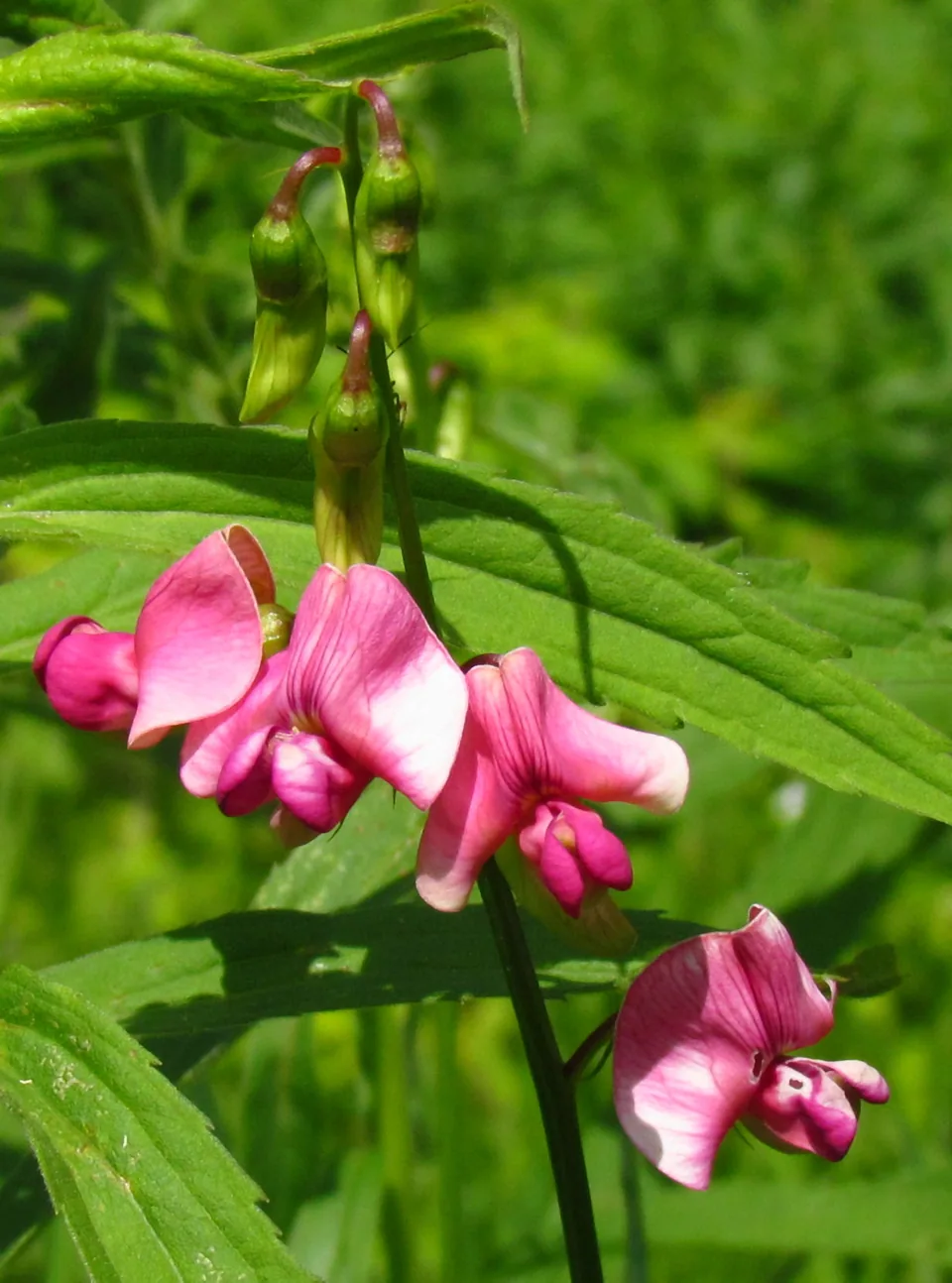

How to Grow and Care for Tuberous pea
Lathyrus tuberosus
Written by Emilio Marruso · last checked
At a glance
This climbing perennial hides a treat underground: small tubers you can eat raw or cooked. Baked, they are sweet and starchy, with a flavor somewhat like sweet potato. Give it partial shade in a warm spot, sow it in spring, and watch it climb up to 4 ft tall.
- Sun
Partial shade in a warm spot
What the sources say (2)
- Planting
Plant out seedlings grown in pots in summer
What the sources say (1)
Planting: Summer (seedlings raised in pots)
When they are large enough to handle, prick the seedlings out into individual pots and plant them out in the summer.
— Earthnut Pea (Lathyrus tuberosus) — Practical Plants [6] - Harvest
Eat the tubers raw or cooked; baked, they taste sweet, a bit like sweet potato
- Pests
Slugs can eat whole plants; pea weevil grubs feed on the seeds
What the sources say (1)
Pests: lesser pea weevil (Bruchus affinis) larvae, which feed on the seeds
are considered to be pests. L. tuberosus serves as a host for the larvae, which feed on the seeds of their host plant (12).
— Lathyrus tuberosus | CLIMBERS [3] - Watch out
It spreads: new stems pop up some distance from the parent plant
What the sources say (1)
Root system: Thin, branched rhizomes bearing small, thickened tubers
L. tuberosus is a climbing, perennial, herbaceous vine with small, thickened tubers along the thin, branched rhizomes.
— Lathyrus tuberosus | CLIMBERS [3] - Size
Climbs up to 4 ft tall
What the sources say (1)
Mature height: up to 120 cm (1.2 m), climbing
Plant Height: L. tuberosus can climb up to 1.2m in height (4). Subspecies/varieties recognized (5) : None found.
— Lathyrus tuberosus | CLIMBERS [3] - Propagation
From seed or by dividing the tubers
What the sources say (2)
Propagation: Seed; division of tubers
Pre-soak the seed for 24 hours in warm water and then sow in early spring in a cold frame [8] .
— Earthnut Pea (Lathyrus tuberosus) — Practical Plants [6] Division of the tubers when the plant is dormant in spring or autumn.
— Earthnut Pea (Lathyrus tuberosus) — Practical Plants [6] - Sowing
Sow in early spring in a cold frame, or in mid-spring right where it will grow
What the sources say (2)
Sowing: Early spring in a cold frame; mid spring in situ
Pre-soak the seed for 24 hours in warm water and then sow in early spring in a cold frame [8] .
— Earthnut Pea (Lathyrus tuberosus) — Practical Plants [6] If you have sufficient seed, then it can also be sown in situ in mid spring [8] .
— Earthnut Pea (Lathyrus tuberosus) — Practical Plants [6]
Overview
Earthnut pea is a climbing perennial legume with small edible tubers, native to Europe and western Asia. [3] It prefers warm, slightly alkaline, aerated soils and some shade, and can spread to become a weed in cereal fields. [3][7] The tubers are eaten raw or cooked, but yields are low. [5]
This record is incomplete: the sources we read do not cover every field yet.
Not yet covered by our sources: Watering, Harvest, Spacing
Tuberous pea care
How to water Tuberous pea
Not stated in the sources we read.
How much light Tuberous pea needs
Partial shade, warm position
Where to grow Tuberous pea
Not stated in the sources we read.
How to propagate Tuberous pea
Seed; division of tubers
What the sources say (2)
Pre-soak the seed for 24 hours in warm water and then sow in early spring in a cold frame [8] .Division of the tubers when the plant is dormant in spring or autumn.How to grow Tuberous pea
The plant
Life cycle
perennial
What the sources say (1)
L. tuberosus is a climbing, perennial, herbaceous vine with small, thickened tubers along the thin, branched rhizomes.Family
Fabaceae
What the sources say (1)
Family : Fabaceae, the Pea Family Common Names : Tuberous vetchling, earthnut pea, tuberous sweet peaMature height
up to 120 cm (1.2 m), climbing
What the sources say (1)
Plant Height: L. tuberosus can climb up to 1.2m in height (4). Subspecies/varieties recognized (5) : None found.Pests and diseases
Pests
lesser pea weevil (Bruchus affinis) larvae, which feed on the seeds
What the sources say (1)
are considered to be pests. L. tuberosus serves as a host for the larvae, which feed on the seeds of their host plant (12).Roots
Root system
Thin, branched rhizomes bearing small, thickened tubers
What the sources say (1)
L. tuberosus is a climbing, perennial, herbaceous vine with small, thickened tubers along the thin, branched rhizomes.Tuberous pea pests and problems
Slugs
Symptom: Plants eaten and destroyed
What the sources say (1)
Slugs are inordinately fond of this plant and will totally destroy it given a chance[K].
— Earthnut Pea (Lathyrus tuberosus) — Practical Plants [6] Spreading
Symptom: New stems emerge at some distance from the parent plant
What the sources say (1)
It tends to be slightly invasive [6] with new stems emerging at some distance from the parent plant [9] .
— Earthnut Pea (Lathyrus tuberosus) — Practical Plants [6]
Remedies
Each remedy shows what official sources say about it; traditional remedies without an official source are marked as such. Harmful ones are listed so you know to avoid them.
Getting rid of it
invasive spread
stubble cultivation and deep ploughing Not verified
Traditional remedy, not verified by an official source.
Ordinary cultivation only serves to spread it by breaking the rootstocks and scattering the tubers.
— chestofbooks.com [8] How: In grain crops, control measures are stubbling and deep plowing.
persistent cutting then fall ploughing Not verified
Traditional remedy, not verified by an official source.
Ordinary cultivation only serves to spread it by breaking the rootstocks and scattering the tubers.
— chestofbooks.com [8] How: Prevent seeding and check the rootstocks by close and persistent cutting throughout the growing season; then plow late in the fall and the next spring put the ground to a well-tilled hoed crop, permitting no leaf growth. A second season may be required.
Calendar
Sowing
Early spring in a cold frame; mid spring in situ
What the sources say (2)
Pre-soak the seed for 24 hours in warm water and then sow in early spring in a cold frame [8] .If you have sufficient seed, then it can also be sown in situ in mid spring [8] .Planting
Summer (seedlings raised in pots)
What the sources say (1)
When they are large enough to handle, prick the seedlings out into individual pots and plant them out in the summer.Harvest
Not stated in the sources we read.
Months as given by the sources, which are mostly from the United States (northern hemisphere). In the southern hemisphere they shift by about six months.
Edibility
Reported by the source, quoted verbatim. Do not eat a plant on the basis of this page alone: identification mistakes can be dangerous.
Root - cooked or raw [7] [10] [11] [12] [2] . Sweet and starchy, it is delicious when baked with a flavour that is somewhat like a sweet potato[183, K].
[6]No reported medicinal uses of Lathyrus tuberosus were found, but the root is edible and may be eaten raw or cooked
[3]The starch-rich root tubers can be eaten raw or cooked. They used to be cultivated for fattening pigs or as a nutritious food.
[5]
Similar plants
- Flat Pea Lathyrus sylvestris
- Garden pea Lathyrus oleraceus
- Sweet pea Lathyrus odoratus
- Everlasting Pea Lathyrus latifolius
- Lathyrus pratensis Lathyrus pratensis
- Grass pea Lathyrus sativus
- Red pea Lathyrus cicera
- Spring pea Lathyrus vernus
Sources
Every value above is quoted from these documents. Links lead to the original publisher.
- Lathyrus tuberosus L. · infoflora.ch, consulted
- Lathyrus tuberosus - Useful Temperate Plants · temperate.theferns.info, consulted
- Lathyrus tuberosus | CLIMBERS · climbers.lsa.umich.edu, consulted
- AgroAtlas - Weeds - Lathyrus tuberosus L. - Pea Tuber · agroatlas.ru, consulted
- · naturblick.museumfuernaturkunde.berlin, consulted
- Earthnut Pea (Lathyrus tuberosus) — Practical Plants · practicalplants.org, consulted
- Lathyrus tuberosus (tuber vetchling): Go Botany · gobotany.nativeplanttrust.org, consulted
- chestofbooks.com · chestofbooks.com
Written by Emilio Marruso · last checked