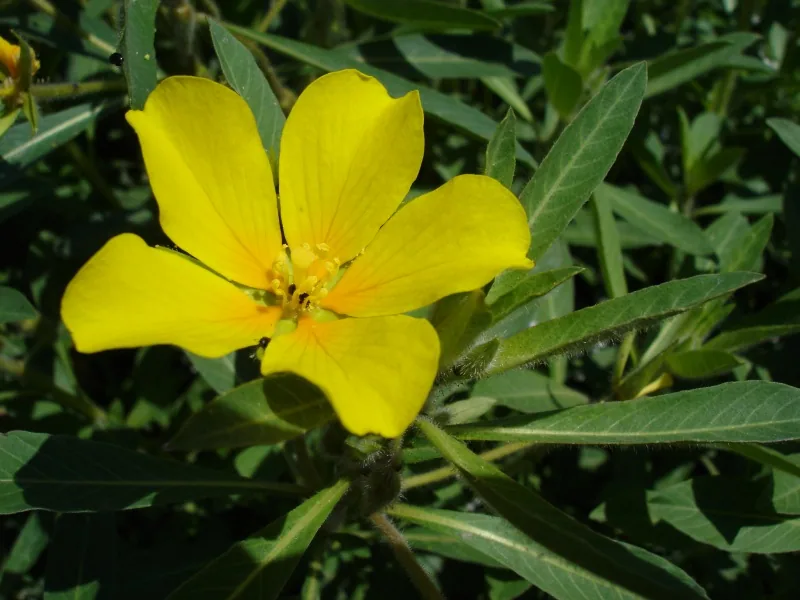


Cómo cultivar y cuidar Creeping Water Primrose
Ludwigia hexapetala
Escrito por Emilio Marruso · última revisión
De un vistazo
Esta planta perenne amante del sol alcanza hasta 91 cm de alto y se extiende con facilidad: echa raíces en los nudos de cualquier trozo de tallo y también nace de semilla. Un poco de abono líquido mantiene vivo el color de sus hojas. Pero su fuerza es también su problema: forma grandes alfombras que ahogan a las plantas autóctonas y atascan los cursos de agua, así que admírala, pero no la plantes.
- Sol
Sol pleno
Qué dicen las fuentes (1)
Luz: Pleno sol
Light: Full sun (6 or more hours of direct sunlight a day)
— Ludwigia hexapetala (Creeping Water Primrose, Large-Flower Primrose Willow, Primrose Willow, Six Petal Water Primrose, Uruguay Primrose Willow) | North Carolina Extension Gardener Plant Toolbox [1] - Abonado
El abono líquido estimula el crecimiento y el color de las hojas; hojas pálidas también indican poca luz
Qué dicen las fuentes (2)
Abonos minerales: Fertilizante líquido, para estimular el crecimiento y mejorar el color de las hojas
If allowed to float in the water, the stems are just below the water's surface. Liquid fertilizers help to encourage growth and enhance the leaf color.
— Ludwigia (Primrose-Willow, Water Primrose, Water-Primrose, Water-Purslane) | North Carolina Extension Gardener Plant Toolbox [2] Signos de carencia: Pérdida del color del follaje (también causada por luz insuficiente)
Inadequate light and nutrients can cause loss of foliage color.
— Ludwigia (Primrose-Willow, Water Primrose, Water-Primrose, Water-Purslane) | North Carolina Extension Gardener Plant Toolbox [2] - Atención
Invasora: forma grandes alfombras que ahogan a las plantas autóctonas y atascan el agua. No la plantes
- Tamaño
Hasta 91 cm de alto
Qué dicen las fuentes (1)
Altura adulta: 91.44 cm (3 pies)
This plant can form large mats that can grow 3 feet tall to shade out native plants and clog waterways.
— Ludwigia hexapetala (Creeping Water Primrose, Large-Flower Primrose Willow, Primrose Willow, Six Petal Water Primrose, Uruguay Primrose Willow) | North Carolina Extension Gardener Plant Toolbox [1] - Multiplicación
Los trozos de tallo echan raíces en los nudos; también se propaga por semilla
Qué dicen las fuentes (2)
Propagación: Fragmentación del tallo (enraizamiento en los nudos); semilla
The stems grow up to 10 feet long and freely root at the nodes allowing the plant to spread vegetatively also.
— Ludwigia hexapetala (Creeping Water Primrose, Large-Flower Primrose Willow, Primrose Willow, Six Petal Water Primrose, Uruguay Primrose Willow) | North Carolina Extension Gardener Plant Toolbox [1] Reproduction is primarily by fragmentation – also seeds
— Uruguayan waterprimrose - Plant Management in Florida Waters - An Integrated Approach - University of Florida, Institute of Food and Agricultural Sciences - UF/IFAS [4]
Resumen
La prímula de agua rastrera es una planta acuática invasora nativa de América Central y del Sur y está catalogada como maleza nociva de Clase B en Carolina del Norte. [1] Forma grandes mantos y se propaga vegetativamente porque los tallos enraízan libremente en los nudos. [1] El control se realiza mediante eliminación manual y mecánica, herbicidas o secuenciación integrada. [1]
Citado en inglés, como en la fuente.
Esta ficha está incompleta: las fuentes consultadas aún no cubren todos los campos.
Aún no cubierto por nuestras fuentes: Rusticidad, zona más fría, Rusticidad, zona más cálida
Cuidados
Luz
Pleno sol
Qué dicen las fuentes (1)
Light: Full sun (6 or more hours of direct sunlight a day)Clima y frío
Rusticidad, zona más fría
No figura en las fuentes consultadas.
Rusticidad, zona más cálida
No figura en las fuentes consultadas.
Propagación
Fragmentación del tallo (enraizamiento en los nudos); semilla
Qué dicen las fuentes (2)
The stems grow up to 10 feet long and freely root at the nodes allowing the plant to spread vegetatively also.Reproduction is primarily by fragmentation – also seedsCultivo
La planta
Ciclo de vida
perenne
Qué dicen las fuentes (1)
Life Cycle:
Perennial
Country Or Region Of Origin:
Central and South AmericaFamilia
Onagraceae
Qué dicen las fuentes (1)
Family:
Onagraceae
Life Cycle:
Perennial
Country Or Region Of Origin:
Central and South AmericaAltura adulta
91.44 cm (3 pies)
Qué dicen las fuentes (1)
This plant can form large mats that can grow 3 feet tall to shade out native plants and clog waterways.Abonado
Abonos minerales
Fertilizante líquido, para estimular el crecimiento y mejorar el color de las hojas
Qué dicen las fuentes (1)
If allowed to float in the water, the stems are just below the water's surface. Liquid fertilizers help to encourage growth and enhance the leaf color.Signos de carencia
Pérdida del color del follaje (también causada por luz insuficiente)
Qué dicen las fuentes (1)
Inadequate light and nutrients can cause loss of foliage color.Problemas
Formación de manto invasivo
Síntoma: Forma grandes mantos de hasta 3 pies de alto que dan sombra a las plantas nativas y obstruyen los cursos de agua
Qué hacer: Eliminación manual y mecánica, herbicidas y secuenciación integrada; no la plantes
Qué dicen las fuentes (2)
This plant can form large mats that can grow 3 feet tall to shade out native plants and clog waterways.
— Ludwigia hexapetala (Creeping Water Primrose, Large-Flower Primrose Willow, Primrose Willow, Six Petal Water Primrose, Uruguay Primrose Willow) | North Carolina Extension Gardener Plant Toolbox [1] Control of this plant is by manual and mechanical removal, herbicides and Integrated Sequencing
— Ludwigia hexapetala (Creeping Water Primrose, Large-Flower Primrose Willow, Primrose Willow, Six Petal Water Primrose, Uruguay Primrose Willow) | North Carolina Extension Gardener Plant Toolbox [1]
Remedios
Cada remedio indica qué dicen las fuentes oficiales; los remedios tradicionales sin fuente oficial aparecen marcados. Los perjudiciales están para que sepas evitarlos.
Cómo eliminarla
propagación invasiva
Corta y desentierra las raíces. Fuente oficial, sin prueba independiente
It is easy to leave roots still in the soil or to break off a piece of stem. Both roots and stems can make new plants.
— portland.gov [6] Mechanical: Harvest mature mats – fragments likely start new infestation.
— Uruguayan waterprimrose - Plant Management in Florida Waters - An Integrated Approach - University of Florida, Institute of Food and Agricultural Sciences - UF/IFAS [4] Never place plants or seeds in your compost or yard debris.
— portland.gov [6] Cómo: La primavera acuática se puede cortar y las raíces se pueden desenterrar.
Water Primrose can be cut, and the roots can be dug up. However, physical control is difficult because it can re-establish from seeds or remaining roots.
— aquaplant.tamu.edu [5]
Plantas similares
- Marsh Purslane Ludwigia palustris
- Mosaic Plant Ludwigia sedoides
- Seedbox Ludwigia alternifolia
- Fireweed Epilobium angustifolium
- Fringed Willowherb Epilobium ciliatum
- Hierba de San Antonio Epilobium hirsutum
- Showy Evening Primrose Oenothera speciosa
- Chilco Fuchsia magellanica
Fuentes
Cada valor anterior se cita de estos documentos. Los enlaces llevan al editor original.
- Ludwigia hexapetala (Creeping Water Primrose, Large-Flower Primrose Willow, Primrose Willow, Six Petal Water Primrose, Uruguay Primrose Willow) | North Carolina Extension Gardener Plant Toolbox · plants.ces.ncsu.edu, consultado
- Ludwigia (Primrose-Willow, Water Primrose, Water-Primrose, Water-Purslane) | North Carolina Extension Gardener Plant Toolbox · plants.ces.ncsu.edu, consultado
- | Center for Aquatic and Invasive Plants | University of Florida, IFAS · plant-directory.ifas.ufl.edu, consultado
- Uruguayan waterprimrose - Plant Management in Florida Waters - An Integrated Approach - University of Florida, Institute of Food and Agricultural Sciences - UF/IFAS · plants.ifas.ufl.edu, consultado
- aquaplant.tamu.edu · aquaplant.tamu.edu
- portland.gov · portland.gov
Escrito por Emilio Marruso · última revisión