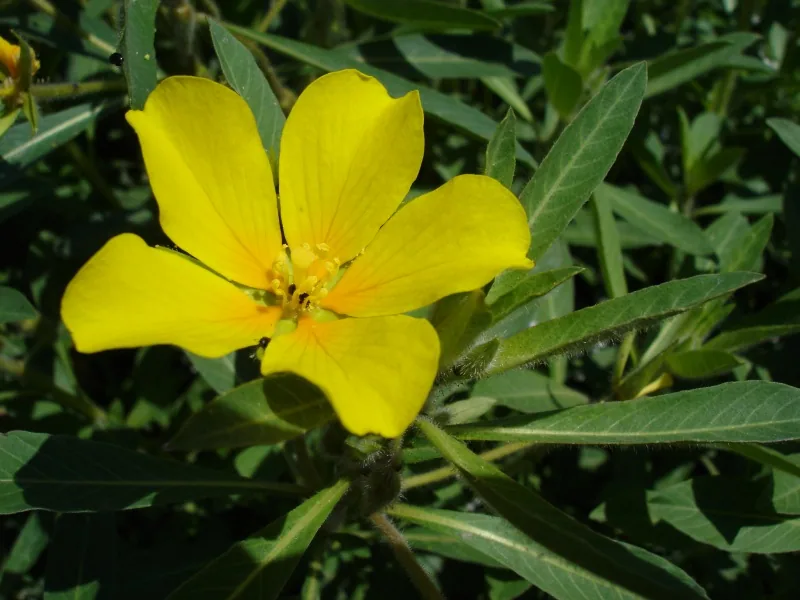


How to Grow and Care for Creeping Water Primrose
Ludwigia hexapetala
Written by Emilio Marruso · last checked
At a glance
This sun-loving perennial grows up to 3 feet tall and spreads with ease, rooting from bits of stem at the nodes or growing from seed. A little liquid fertilizer keeps its leaves richly colored. But its strength is also its problem: it forms large mats that shade out native plants and clog waterways, so admire it, but do not plant it.
- Sun
Full sun
What the sources say (1)
Light: Full sun
Light: Full sun (6 or more hours of direct sunlight a day)
— Ludwigia hexapetala (Creeping Water Primrose, Large-Flower Primrose Willow, Primrose Willow, Six Petal Water Primrose, Uruguay Primrose Willow) | North Carolina Extension Gardener Plant Toolbox [1] - Feeding
Liquid fertilizer boosts growth and leaf color; pale leaves can also mean too little light
What the sources say (2)
Mineral fertilizers: Liquid fertilizer, to encourage growth and enhance leaf color
If allowed to float in the water, the stems are just below the water's surface. Liquid fertilizers help to encourage growth and enhance the leaf color.
— Ludwigia (Primrose-Willow, Water Primrose, Water-Primrose, Water-Purslane) | North Carolina Extension Gardener Plant Toolbox [2] Signs of deficiency: Loss of foliage color (also caused by inadequate light)
Inadequate light and nutrients can cause loss of foliage color.
— Ludwigia (Primrose-Willow, Water Primrose, Water-Primrose, Water-Purslane) | North Carolina Extension Gardener Plant Toolbox [2] - Watch out
Invasive: forms big mats that crowd out native plants and clog waterways. Do not plant it
- Size
Up to 3 ft tall
What the sources say (1)
Mature height: 91.44 cm (3 feet)
This plant can form large mats that can grow 3 feet tall to shade out native plants and clog waterways.
— Ludwigia hexapetala (Creeping Water Primrose, Large-Flower Primrose Willow, Primrose Willow, Six Petal Water Primrose, Uruguay Primrose Willow) | North Carolina Extension Gardener Plant Toolbox [1] - Propagation
Bits of stem root at the nodes; it also spreads by seed
What the sources say (2)
Propagation: Stem fragmentation (rooting at the nodes); seed
The stems grow up to 10 feet long and freely root at the nodes allowing the plant to spread vegetatively also.
— Ludwigia hexapetala (Creeping Water Primrose, Large-Flower Primrose Willow, Primrose Willow, Six Petal Water Primrose, Uruguay Primrose Willow) | North Carolina Extension Gardener Plant Toolbox [1] Reproduction is primarily by fragmentation – also seeds
— Uruguayan waterprimrose - Plant Management in Florida Waters - An Integrated Approach - University of Florida, Institute of Food and Agricultural Sciences - UF/IFAS [4]
Overview
Creeping water primrose is an invasive aquatic plant native to Central and South America and listed as a Class B state noxious weed in North Carolina. [1] It forms large mats and spreads vegetatively because the stems root freely at the nodes. [1] Control is by manual and mechanical removal, herbicides, or integrated sequencing. [1]
This record is incomplete: the sources we read do not cover every field yet.
Not yet covered by our sources: Hardiness, coldest zone, Hardiness, warmest zone
Creeping Water Primrose care
How much light Creeping Water Primrose needs
Full sun
What the sources say (1)
Light: Full sun (6 or more hours of direct sunlight a day)How much cold Creeping Water Primrose can take
Hardiness, coldest zone
Not stated in the sources we read.
Hardiness, warmest zone
Not stated in the sources we read.
How to propagate Creeping Water Primrose
Stem fragmentation (rooting at the nodes); seed
What the sources say (2)
The stems grow up to 10 feet long and freely root at the nodes allowing the plant to spread vegetatively also.Reproduction is primarily by fragmentation – also seedsHow to grow Creeping Water Primrose
The plant
Life cycle
perennial
What the sources say (1)
Life Cycle:
Perennial
Country Or Region Of Origin:
Central and South AmericaFamily
Onagraceae
What the sources say (1)
Family:
Onagraceae
Life Cycle:
Perennial
Country Or Region Of Origin:
Central and South AmericaMature height
91.44 cm (3 feet)
What the sources say (1)
This plant can form large mats that can grow 3 feet tall to shade out native plants and clog waterways.Fertilizing
Mineral fertilizers
Liquid fertilizer, to encourage growth and enhance leaf color
What the sources say (1)
If allowed to float in the water, the stems are just below the water's surface. Liquid fertilizers help to encourage growth and enhance the leaf color.Signs of deficiency
Loss of foliage color (also caused by inadequate light)
What the sources say (1)
Inadequate light and nutrients can cause loss of foliage color.Creeping Water Primrose pests and problems
Invasive mat formation
Symptom: Forms large mats up to 3 feet tall that shade out native plants and clog waterways
What to do: Manual and mechanical removal, herbicides and Integrated Sequencing; do not plant
What the sources say (2)
This plant can form large mats that can grow 3 feet tall to shade out native plants and clog waterways.
— Ludwigia hexapetala (Creeping Water Primrose, Large-Flower Primrose Willow, Primrose Willow, Six Petal Water Primrose, Uruguay Primrose Willow) | North Carolina Extension Gardener Plant Toolbox [1] Control of this plant is by manual and mechanical removal, herbicides and Integrated Sequencing
— Ludwigia hexapetala (Creeping Water Primrose, Large-Flower Primrose Willow, Primrose Willow, Six Petal Water Primrose, Uruguay Primrose Willow) | North Carolina Extension Gardener Plant Toolbox [1]
Remedies
Each remedy shows what official sources say about it; traditional remedies without an official source are marked as such. Harmful ones are listed so you know to avoid them.
Getting rid of it
invasive spread
cutting and digging up roots Official source, not independently tested
It is easy to leave roots still in the soil or to break off a piece of stem. Both roots and stems can make new plants.
— portland.gov [6] Mechanical: Harvest mature mats – fragments likely start new infestation.
— Uruguayan waterprimrose - Plant Management in Florida Waters - An Integrated Approach - University of Florida, Institute of Food and Agricultural Sciences - UF/IFAS [4] Never place plants or seeds in your compost or yard debris.
— portland.gov [6] How: Water primrose can be cut, and the roots can be dug up.
Water Primrose can be cut, and the roots can be dug up. However, physical control is difficult because it can re-establish from seeds or remaining roots.
— aquaplant.tamu.edu [5]
Similar plants
- Marsh Purslane Ludwigia palustris
- Mosaic Plant Ludwigia sedoides
- Seedbox Ludwigia alternifolia
- Fireweed Epilobium angustifolium
- Fringed Willowherb Epilobium ciliatum
- Hairy Willowherb Epilobium hirsutum
- Showy Evening Primrose Oenothera speciosa
- Hardy Fushia Fuchsia magellanica
Sources
Every value above is quoted from these documents. Links lead to the original publisher.
- Ludwigia hexapetala (Creeping Water Primrose, Large-Flower Primrose Willow, Primrose Willow, Six Petal Water Primrose, Uruguay Primrose Willow) | North Carolina Extension Gardener Plant Toolbox · plants.ces.ncsu.edu, consulted
- Ludwigia (Primrose-Willow, Water Primrose, Water-Primrose, Water-Purslane) | North Carolina Extension Gardener Plant Toolbox · plants.ces.ncsu.edu, consulted
- | Center for Aquatic and Invasive Plants | University of Florida, IFAS · plant-directory.ifas.ufl.edu, consulted
- Uruguayan waterprimrose - Plant Management in Florida Waters - An Integrated Approach - University of Florida, Institute of Food and Agricultural Sciences - UF/IFAS · plants.ifas.ufl.edu, consulted
- aquaplant.tamu.edu · aquaplant.tamu.edu
- portland.gov · portland.gov
Written by Emilio Marruso · last checked