
Cómo cultivar y cuidar Pino blanco
Pinus strobus
Escrito por Emilio Marruso · última revisión
De un vistazo
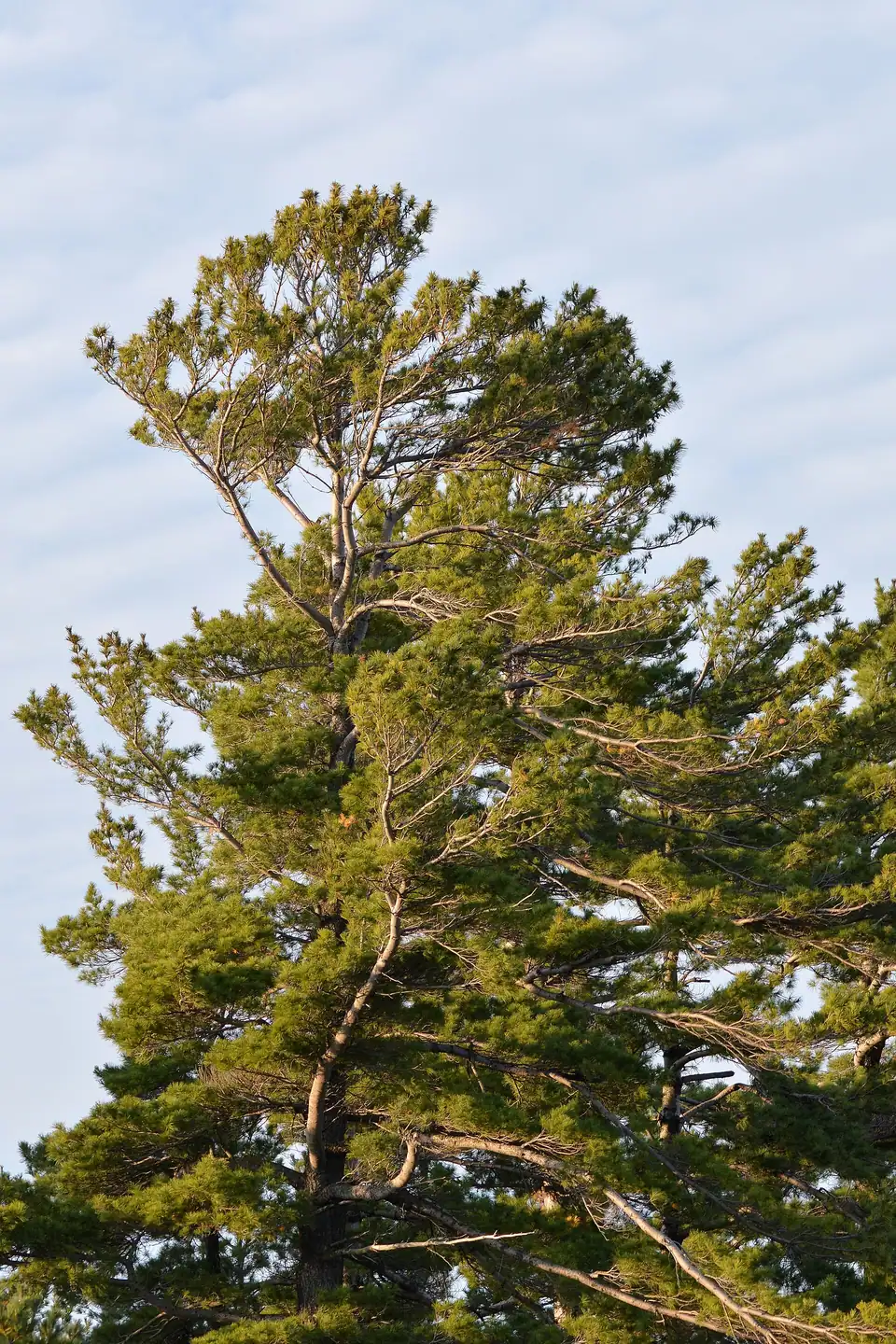
El pino blanco se convierte en un árbol majestuoso, de 15–24 m de alto y 6–12 m de ancho. Dale sol pleno o semisombra y un suelo húmedo, ácido y con buen drenaje, y crecerá a gusto. Mantenlo lejos de la sal, el aire contaminado y la tierra compactada, y no te pases con el abono mientras es joven.
- Sol
Sol pleno o semisombra
Qué dicen las fuentes (4)
Luz: Pleno sol a semisombra
Según NC State Extension: Light: Full sun (6 or more hours of direct sunlight a day) Partial Shade (Direct sunlight only part of the day, 2-6 hours)
— Pinus strobus (Eastern White Pine, North American White Pine, Northern White Pine, Soft Pine, White Pine) | North Carolina Extension Gardener Plant Toolbox [1] Según University of Illinois Extension: Full sun; fertile, moist, but well-drained soils; prefers acid soil.
— Eastern White Pine (Pinus strobus)-Hort Answers - University of Illinois Extension [2] Full sun (6 or more hours of direct sunlight a day) Partial Shade (Direct sunlight only part of the day, 2-6 hours)
— Pinus strobus (Eastern White Pine, North American White Pine, Northern White Pine, Soft Pine, White Pine) | North Carolina Extension Gardener Plant Toolbox [1] Full sun; fertile, moist, but well-drained soils; prefers acid soil.
— Eastern White Pine (Pinus strobus)-Hort Answers - University of Illinois Extension [2] - Riego
Le gusta el suelo húmedo y con buen drenaje; sufre si la tierra está encharcada
Qué dicen las fuentes (2)
Notas sobre el riego: Prefiere suelos húmedos y bien drenados; tiende a sufrir cuando se ubica en suelos húmedos
Full sun; fertile, moist, but well-drained soils; prefers acid soil.
— Eastern White Pine (Pinus strobus)-Hort Answers - University of Illinois Extension [2] Tends to suffer when sited in wet soils. Intolerant of salt and air pollution; sensitive to soil compaction.
— Eastern White Pine (Pinus strobus)-Hort Answers - University of Illinois Extension [2] - Frío
Aguanta inviernos de hasta −40 °C (−40 °F)
Muy rústica · USDA 3a · RHS H7 · Z3
Qué dicen las fuentes (3)
Rusticidad, zona más fría: 3a [mínima invernal de −40 a −37,2 °C (de −40 a −35 °F)]
3a, 3b, 4a, 4b, 5a, 5b, 6a, 6b, 7a, 7b, 8a, 8b
— Pinus strobus (Eastern White Pine, North American White Pine, Northern White Pine, Soft Pine, White Pine) | North Carolina Extension Gardener Plant Toolbox [1] Rusticidad, zona más cálida: 8b [mínima invernal de −9,4 a −6,7 °C (de 15 a 20 °F)]
Según University of Illinois Extension: USDA Hardiness Zone 3 - 8
— Eastern White Pine (Pinus strobus)-Hort Answers - University of Illinois Extension [2] 3a, 3b, 4a, 4b, 5a, 5b, 6a, 6b, 7a, 7b, 8a, 8b
— Pinus strobus (Eastern White Pine, North American White Pine, Northern White Pine, Soft Pine, White Pine) | North Carolina Extension Gardener Plant Toolbox [1] - Suelo
Suelo con pH no superior a 6,0; en suelos de pH alto las acículas amarillean
Qué dicen las fuentes (2)
pH del suelo, máximo: 6.0
Loam (Silt) Sand Soil pH: Acid (<6.0) Soil Drainage: Good Drainage
— Pinus strobus (Eastern White Pine, North American White Pine, Northern White Pine, Soft Pine, White Pine) | North Carolina Extension Gardener Plant Toolbox [1] Signos de carencia: Amarillamiento de las agujas (clorosis férrica) en suelos de pH alto
It is not a good plant for city conditions or along roads. Iron chlorosis (yellowing of the needles) may develop in high pH soils.
— [5] - Abonado
No uses abono de liberación rápida en árboles recién plantados: las raíces jóvenes son delicadas
Qué dicen las fuentes (1)
Evitar: Fertilizante de liberación rápida en árboles recién plantados: las raíces jóvenes son sensibles al exceso de fertilización
When fertilizing newly planted trees, use slow-release fertilizers. Care should be taken if quick-release fertilizers are used since the roots of young trees are sensitive to overfertilizing.
— [5] - Plagas
Gorgojo del pino blanco, escarabajos de la corteza y pulgones; la roya vesicular suele ser mortal
Qué dicen las fuentes (4)
Plagas: gorgojo del pino blanco, escarabajos de la corteza, barrenador del brote del pino blanco, larvas de la polilla de Zimmerman, mosca sierra del pino, cochinillas, pulgones, arañitas rojas
Insect problems include white pine weevil, bark beetles, white pine shoot borer, Zimmerman moth larvae, pine sawfly, scale, and aphids. Spider mites are occasional visitors in some areas.
— Pinus strobus (Eastern White Pine, North American White Pine, Northern White Pine, Soft Pine, White Pine) | North Carolina Extension Gardener Plant Toolbox [1] Enfermedades: tizones, cancros, royas, roya de la corteza del pino blanco, enfermedad de las agujas del pino blanco, cancro de Caliciopsis
It is susceptible to blights, canker, and rusts, especially white pine blister rust, which is usually fatal.
— Pinus strobus (Eastern White Pine, North American White Pine, Northern White Pine, Soft Pine, White Pine) | North Carolina Extension Gardener Plant Toolbox [1] First and most importantly, white pine needle disease (WPND) is primarily responsible for the symptoms that many trees exhibit and is caused by several fungal pathogens.
— Dieback of Eastern White Pine (Pinus strobus): Pathogens, Pests and a Changing Climate | Extension [3] Branch and trunk cankering, caused by Caliciopsis canker, is also as an important component of the decline complex
— Dieback of Eastern White Pine (Pinus strobus): Pathogens, Pests and a Changing Climate | Extension [3] - Atención
No tolera la sal, la contaminación ni el suelo compactado
- Tamaño
De 15–24 m de alto y 6–12 m de ancho
Qué dicen las fuentes (3)
Altura adulta: 1524-2438 cm (50-80 pies)
It may grow 50 to 80 feet tall and 20 to 40 feet wide.
— Pinus strobus (Eastern White Pine, North American White Pine, Northern White Pine, Soft Pine, White Pine) | North Carolina Extension Gardener Plant Toolbox [1] Mature Height 50-80 Feet
— Eastern White Pine (Pinus strobus)-Hort Answers - University of Illinois Extension [2] Anchura adulta: 610-1219 cm (20-40 pies)
It may grow 50 to 80 feet tall and 20 to 40 feet wide.
— Pinus strobus (Eastern White Pine, North American White Pine, Northern White Pine, Soft Pine, White Pine) | North Carolina Extension Gardener Plant Toolbox [1] - Multiplicación
Se multiplica por semilla
Qué dicen las fuentes (1)
Propagación: Semilla
Used for tar, furniture, christmas tree and bark used as astringent and expectorant or antiseptic. Life Cycle: Woody Recommended Propagation Strategy: Seed
— Pinus strobus (Eastern White Pine, North American White Pine, Northern White Pine, Soft Pine, White Pine) | North Carolina Extension Gardener Plant Toolbox [1]
Resumen
El pino blanco oriental es un árbol conífero de hoja perenne de la familia Pinaceae que puede crecer de 50 a 80 pies [15,2–24,4 m] de alto y de 20 a 40 pies [6,1–12,2 m] de ancho. [1] Prefiere pleno sol y suelos húmedos, bien drenados y fértiles, y es intolerante a las sales y a los suelos alcalinos. [1] Es susceptible a tizones, cancros y royas, especialmente a la roya vesicular del pino blanco, que suele ser mortal. [1]
Citado en inglés, como en la fuente.
Esta ficha está incompleta: las fuentes consultadas aún no cubren todos los campos.
Aún no cubierto por nuestras fuentes: Riego, Poda
Cuidados
Las medidas entre corchetes son nuestra conversión al otro sistema de unidades; el texto citado no cambia.
Riego
Riego
No figura en las fuentes consultadas.
Notas sobre el riego
Prefiere suelos húmedos y bien drenados; tiende a sufrir cuando se ubica en suelos húmedos
Qué dicen las fuentes (2)
Full sun; fertile, moist, but well-drained soils; prefers acid soil.Tends to suffer when sited in wet soils. Intolerant of salt and air pollution; sensitive to soil compaction.Luz
Pleno sol a semisombra
Lo que dice cada fuente
Según NC State Extension: Pleno sol a semisombra
Según University of Illinois Extension: Pleno sol
Qué dicen las fuentes (4)
Según NC State Extension: Light:
Full sun (6 or more hours of direct sunlight a day)
Partial Shade (Direct sunlight only part of the day, 2-6 hours)Según University of Illinois Extension: Full sun; fertile, moist, but well-drained soils; prefers acid soil.Full sun (6 or more hours of direct sunlight a day)
Partial Shade (Direct sunlight only part of the day, 2-6 hours)Full sun; fertile, moist, but well-drained soils; prefers acid soil.Clima y frío
Rusticidad, zona más fría
3a [mínima invernal de −40 a −37,2 °C (de −40 a −35 °F)]
Qué dicen las fuentes (1)
3a, 3b, 4a, 4b, 5a, 5b, 6a, 6b, 7a, 7b, 8a, 8bRusticidad, zona más cálida
8b [mínima invernal de −9,4 a −6,7 °C (de 15 a 20 °F)]
Lo que dice cada fuente
Según University of Illinois Extension: 8 [mínima invernal de −12,2 a −6,7 °C (de 10 a 20 °F)]
Qué dicen las fuentes (2)
Según University of Illinois Extension: USDA Hardiness Zone
3 - 83a, 3b, 4a, 4b, 5a, 5b, 6a, 6b, 7a, 7b, 8a, 8bSuelo
6.0
Qué dicen las fuentes (1)
Loam (Silt)
Sand
Soil pH:
Acid (<6.0)
Soil Drainage:
Good DrainagePropagación
Semilla
Qué dicen las fuentes (1)
Used for tar, furniture, christmas tree and bark used as astringent and expectorant or antiseptic.
Life Cycle:
Woody
Recommended Propagation Strategy:
SeedCultivo
La planta
Ciclo de vida
leñoso
Qué dicen las fuentes (1)
Life Cycle:
WoodyFamilia
Pinaceae
Qué dicen las fuentes (1)
Eastern white pine is an evergreen conifer tree in the Pinaceae (pine) family.Altura adulta
1524-2438 cm (50-80 pies)
Qué dicen las fuentes (2)
It may grow 50 to 80 feet tall and 20 to 40 feet wide.Mature Height
50-80 FeetAnchura adulta
610-1219 cm (20-40 pies)
Qué dicen las fuentes (1)
It may grow 50 to 80 feet tall and 20 to 40 feet wide.Plagas y enfermedades
Plagas
gorgojo del pino blanco, escarabajos de la corteza, barrenador del brote del pino blanco, larvas de la polilla de Zimmerman, mosca sierra del pino, cochinillas, pulgones, arañitas rojas
Qué dicen las fuentes (1)
Insect problems include white pine weevil, bark beetles, white pine shoot borer, Zimmerman moth larvae, pine sawfly, scale, and aphids. Spider mites are occasional visitors in some areas.Enfermedades
tizones, cancros, royas, roya de la corteza del pino blanco, enfermedad de las agujas del pino blanco, cancro de Caliciopsis
Qué dicen las fuentes (3)
It is susceptible to blights, canker, and rusts, especially white pine blister rust, which is usually fatal.First and most importantly, white pine needle disease (WPND) is primarily responsible for the symptoms that many trees exhibit and is caused by several fungal pathogens.Branch and trunk cankering, caused by Caliciopsis canker, is also as an important component of the decline complexAbonado
Abonos minerales
Las fuentes dan valores distintos según la región, la zona o las condiciones de cultivo.
Lo que dice cada fuente
árboles recién plantados: Fertilizante de liberación lenta
segundo año en adelante, en camas: 10-10-10, 97.6–195 g/m² de área de cama
árboles grandes en áreas abiertas: 10-10-10, 908 g por 2.54 cm [1 in] de diámetro del tronco
Qué dicen las fuentes (3)
árboles recién plantados: When fertilizing newly planted trees, use slow-release fertilizers. Care should be taken if quick-release fertilizers are used since the roots of young trees are sensitive to overfertilizing.segundo año en adelante, en camas: During the second and subsequent years, 2 to 4 pounds of 10-10-10 fertilizer should be applied for every 100 square feet of bed area.árboles grandes en áreas abiertas: For larger trees in open areas, about 2 pounds of 10-10-10 fertilizer can be applied for each inch of trunk diameter of the tree.Microelementos
Hierro: la clorosis férrica puede desarrollarse en suelos de pH alto
Qué dicen las fuentes (1)
It is not a good plant for city conditions or along roads. Iron chlorosis (yellowing of the needles) may develop in high pH soils.Evitar
Fertilizante de liberación rápida en árboles recién plantados: las raíces jóvenes son sensibles al exceso de fertilización
Qué dicen las fuentes (1)
When fertilizing newly planted trees, use slow-release fertilizers. Care should be taken if quick-release fertilizers are used since the roots of young trees are sensitive to overfertilizing.Signos de carencia
Amarillamiento de las agujas (clorosis férrica) en suelos de pH alto
Qué dicen las fuentes (1)
It is not a good plant for city conditions or along roads. Iron chlorosis (yellowing of the needles) may develop in high pH soils.Problemas
Roya vesicular del pino blanco y otras enfermedades
Síntoma: Tizones, cancros y royas; la roya vesicular del pino blanco suele ser mortal.
Qué hacer: No se indica en las fuentes.
Qué dicen las fuentes (1)
It is susceptible to blights, canker, and rusts, especially white pine blister rust, which is usually fatal.
— Pinus strobus (Eastern White Pine, North American White Pine, Northern White Pine, Soft Pine, White Pine) | North Carolina Extension Gardener Plant Toolbox [1] Insectos plaga
Síntoma: Gorgojo del pino blanco, escarabajos de la corteza, barrenador del brote del pino blanco, larvas de la polilla de Zimmerman, mosca sierra del pino, cochinillas y pulgones.
Qué hacer: No se indica en las fuentes.
Qué dicen las fuentes (1)
Insect problems include white pine weevil, bark beetles, white pine shoot borer, Zimmerman moth larvae, pine sawfly, scale, and aphids.
— Pinus strobus (Eastern White Pine, North American White Pine, Northern White Pine, Soft Pine, White Pine) | North Carolina Extension Gardener Plant Toolbox [1] Suelos húmedos, sal, contaminación del aire y compactación
Síntoma: Tiende a sufrir en suelos húmedos; es intolerante a la sal y a la contaminación del aire; sensible a la compactación del suelo.
Qué hacer: Ubica en suelo húmedo y bien drenado.
Qué dicen las fuentes (1)
Tends to suffer when sited in wet soils. Intolerant of salt and air pollution; sensitive to soil compaction.
— Eastern White Pine (Pinus strobus)-Hort Answers - University of Illinois Extension [2] Muerte regresiva
Síntoma: Amarillamiento/pardeamiento de las agujas, caída prematura de las agujas, copas ralas, muerte regresiva de ramas y muerte.
Qué hacer: Existen opciones de manejo para ayudar a mejorar la salud y el vigor de los pinos blancos estresados.
Qué dicen las fuentes (2)
white pines in the region have exhibited symptoms of decline, which include: yellowing/browning needles, premature needle shedding, thinning canopies, undersized shoots and needles, resinosis, branch dieback and death.
— Dieback of Eastern White Pine (Pinus strobus): Pathogens, Pests and a Changing Climate | Extension [3] management options do exist to help improve the health and vigor of stressed white pines.
— Dieback of Eastern White Pine (Pinus strobus): Pathogens, Pests and a Changing Climate | Extension [3]
Remedios
Las fuentes consultadas no dan remedios para esta planta.
Calendario
Poda
No figura en las fuentes consultadas.
Meses tal como los dan las fuentes, en su mayoría de Estados Unidos (hemisferio norte). En el hemisferio sur se desplazan unos seis meses.
Valores orientativos
Valores de una fuente secundaria, no comprobados palabra por palabra como el resto de esta página. Úselos como punto de partida.
- Horas de sol
- 6-8 horasValor orientativo, adáptalo a tu clima · Fuente secundaria
- Riego
- PromedioValor orientativo, adáptalo a tu clima · Fuente secundaria
- Resiste la sequía
- SíValor orientativo, adáptalo a tu clima · Fuente secundaria
- Suelo
- Arenoso, Franco, RocosoValor orientativo, adáptalo a tu clima · Fuente secundaria
- Nivel de cuidado
- MedioValor orientativo, adáptalo a tu clima · Fuente secundaria
- Crecimiento
- AltaValor orientativo, adáptalo a tu clima · Fuente secundaria
- Poda
- Febrero, marzo, abrilValor orientativo, adáptalo a tu clima · Fuente secundaria
Plantas similares
- Pino carrasco Pinus halepensis
- Armand Pine Pinus armandi
- Pino salgareño Pinus nigra
- Pino de Colorado Pinus aristata
- Chinese Pine Pinus yunnanensis
- Pino azul del Himalaya Pinus wallichiana
- Pino de Banks Pinus banksiana
- Pino negro japonés Pinus thunbergii
Fuentes
Cada valor anterior se cita de estos documentos. Los enlaces llevan al editor original.
- Pinus strobus (Eastern White Pine, North American White Pine, Northern White Pine, Soft Pine, White Pine) | North Carolina Extension Gardener Plant Toolbox · plants.ces.ncsu.edu, consultado
- Eastern White Pine (Pinus strobus)-Hort Answers - University of Illinois Extension · web.extension.illinois.edu, consultado
- Dieback of Eastern White Pine (Pinus strobus): Pathogens, Pests and a Changing Climate | Extension · extension.unh.edu, consultado
- Eastern White Pine Fact Sheet - Signs of the Seasons: A New England Phenology Program - University of Maine Cooperative Extension · extension.umaine.edu, consultado
- hgic.clemson.edu · hgic.clemson.edu
Escrito por Emilio Marruso · última revisión