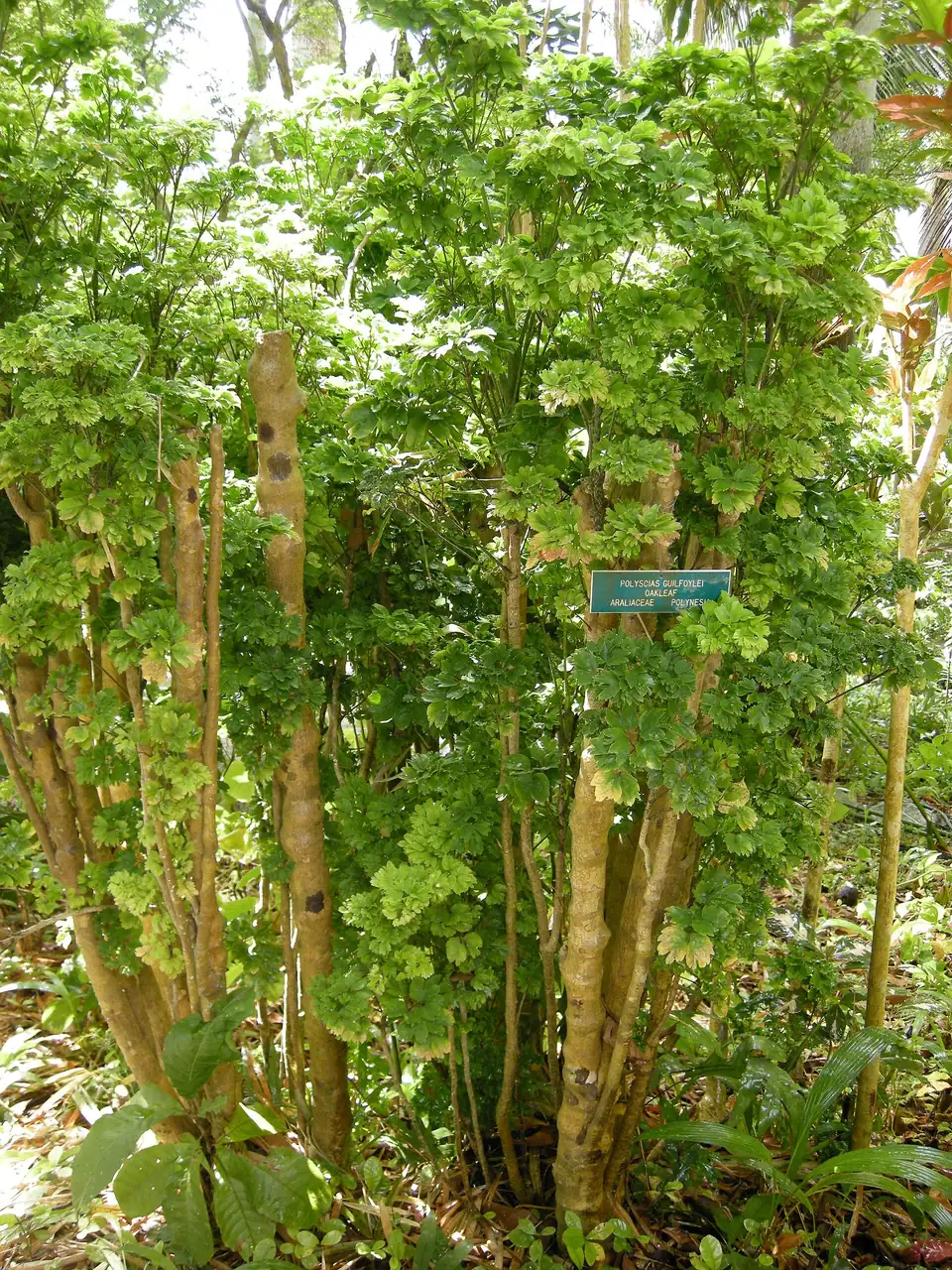


Cómo cultivar y cuidar Geranium Aralia
Polyscias guilfoylei
Escrito por Emilio Marruso · última revisión
Tóxica para: Gatos, Perros, Caballos, Personas · Por qué
De un vistazo
Esta aralia es una planta perenne que vive feliz en interior y en maceta, así que puedes disfrutarla en casa. Dale luz brillante indirecta o un poco de sol de mañana, y deja que la tierra se seque en parte antes de cada riego profundo. Además, es fácil de compartir: las plantas nuevas salen de esquejes de tallo.
- Sol
Luz brillante indirecta; el sol de la mañana le va bien
Qué dicen las fuentes (1)
Luz: Luz indirecta brillante; tolera sol de la mañana
Grow in moist well-drained loamy acidic potting soil and place in bright indirect lighting. They can tolerate the morning sun.
— Polyscias guilfoylei (Coffee Tree, Geranium Aralia, Geranium-Leaf Aralia, Wild Coffee) | North Carolina Extension Gardener Plant Toolbox [1] - Riego
Deja que la tierra se seque en parte y riega a fondo; el exceso de agua pudre las raíces
Qué dicen las fuentes (3)
Riego: Deja que el suelo se seque parcialmente entre riegos, luego riega profundamente y con abundancia.
Allow the soil to partially dry between waterings, then water deeply and thoroughly.
— Polyscias guilfoylei (Coffee Tree, Geranium Aralia, Geranium-Leaf Aralia, Wild Coffee) | North Carolina Extension Gardener Plant Toolbox [1] Notas sobre el riego: La pudrición de raíces puede ocurrir por exceso de riego; cultiva en tierra para macetas húmeda y bien drenada
Insects, Diseases, and Other Plant Problems: Root rot can occur from overwatering.
— Polyscias guilfoylei (Coffee Tree, Geranium Aralia, Geranium-Leaf Aralia, Wild Coffee) | North Carolina Extension Gardener Plant Toolbox [1] Grow in moist well-drained loamy acidic potting soil and place in bright indirect lighting. They can tolerate the morning sun.
— Polyscias guilfoylei (Coffee Tree, Geranium Aralia, Geranium-Leaf Aralia, Wild Coffee) | North Carolina Extension Gardener Plant Toolbox [1] - Frío
Aguanta inviernos de hasta 4,4 °C (40 °F)
Delicada: necesita invernadero sin heladas · USDA 11a · RHS H2 · Z11
Qué dicen las fuentes (2)
Rusticidad, zona más fría: 11a [mínima invernal de 4,4 a 7,2 °C (de 40 a 45 °F)]
USDA Plant Hardiness Zone: 11a, 11b, 12a, 12b
— Polyscias guilfoylei (Coffee Tree, Geranium Aralia, Geranium-Leaf Aralia, Wild Coffee) | North Carolina Extension Gardener Plant Toolbox [1] Rusticidad, zona más cálida: 12b [mínima invernal de 12,8 a 15,6 °C (de 55 a 60 °F)]
USDA Plant Hardiness Zone: 11a, 11b, 12a, 12b
— Polyscias guilfoylei (Coffee Tree, Geranium Aralia, Geranium-Leaf Aralia, Wild Coffee) | North Carolina Extension Gardener Plant Toolbox [1] - Suelo
Sustrato húmedo y con buen drenaje, pH hasta 6,0
Qué dicen las fuentes (3)
Notas sobre el riego: La pudrición de raíces puede ocurrir por exceso de riego; cultiva en tierra para macetas húmeda y bien drenada
Insects, Diseases, and Other Plant Problems: Root rot can occur from overwatering.
— Polyscias guilfoylei (Coffee Tree, Geranium Aralia, Geranium-Leaf Aralia, Wild Coffee) | North Carolina Extension Gardener Plant Toolbox [1] Grow in moist well-drained loamy acidic potting soil and place in bright indirect lighting. They can tolerate the morning sun.
— Polyscias guilfoylei (Coffee Tree, Geranium Aralia, Geranium-Leaf Aralia, Wild Coffee) | North Carolina Extension Gardener Plant Toolbox [1] pH del suelo, máximo: 6.0
Soil pH: Acid (<6.0) Soil Drainage: Good Drainage
— Polyscias guilfoylei (Coffee Tree, Geranium Aralia, Geranium-Leaf Aralia, Wild Coffee) | North Carolina Extension Gardener Plant Toolbox [1] - Plagas
Podredumbre de raíz por exceso de riego: deja secar la tierra en parte entre riegos
Qué dicen las fuentes (1)
Enfermedades: pudrición de la raíz
Insects, Diseases, and Other Plant Problems: Root rot can occur from overwatering.
— Polyscias guilfoylei (Coffee Tree, Geranium Aralia, Geranium-Leaf Aralia, Wild Coffee) | North Carolina Extension Gardener Plant Toolbox [1] - Multiplicación
Consigue plantas nuevas con esquejes de tallo
Qué dicen las fuentes (1)
Propagación: Esquejes de tallo
Life Cycle: Perennial Woody Recommended Propagation Strategy: Stem Cutting
— Polyscias guilfoylei (Coffee Tree, Geranium Aralia, Geranium-Leaf Aralia, Wild Coffee) | North Carolina Extension Gardener Plant Toolbox [1] - Maceta
Crece bien en maceta y en interior
Qué dicen las fuentes (2)
En interior: Sí
Geranium Aralia is a tropical shrub native to Southeast Asia and is commonly used as a houseplant.
— Polyscias guilfoylei (Coffee Tree, Geranium Aralia, Geranium-Leaf Aralia, Wild Coffee) | North Carolina Extension Gardener Plant Toolbox [1] En maceta: Sí
#problem for cats #houseplant #problem for dogs #slow growing #evergreen #problem for horses #tropical feel #container plant
— Polyscias guilfoylei (Coffee Tree, Geranium Aralia, Geranium-Leaf Aralia, Wild Coffee) | North Carolina Extension Gardener Plant Toolbox [1] - Seguridad
Es tóxica para personas, gatos, perros y caballos: mantenla lejos de niños y mascotas
Resumen
La aralia de geranio es un arbusto tropical de crecimiento lento que se usa comúnmente como planta de interior. [1] Prefiere luz indirecta brillante y suelo que se seque parcialmente entre riegos profundos. [1] La planta está catalogada como venenosa con características de toxicidad de baja gravedad. [1]
Citado en inglés, como en la fuente.
Cuidados
Riego
Riego
Deja que el suelo se seque parcialmente entre riegos, luego riega profundamente y con abundancia.
Qué dicen las fuentes (1)
Allow the soil to partially dry between waterings, then water deeply and thoroughly.Notas sobre el riego
La pudrición de raíces puede ocurrir por exceso de riego; cultiva en tierra para macetas húmeda y bien drenada
Qué dicen las fuentes (2)
Insects, Diseases, and Other Plant Problems: Root rot can occur from overwatering.Grow in moist well-drained loamy acidic potting soil and place in bright indirect lighting. They can tolerate the morning sun.Luz
Luz indirecta brillante; tolera sol de la mañana
Qué dicen las fuentes (1)
Grow in moist well-drained loamy acidic potting soil and place in bright indirect lighting. They can tolerate the morning sun.Clima y frío
Rusticidad, zona más fría
11a [mínima invernal de 4,4 a 7,2 °C (de 40 a 45 °F)]
Qué dicen las fuentes (1)
USDA Plant Hardiness Zone:
11a, 11b, 12a, 12bRusticidad, zona más cálida
12b [mínima invernal de 12,8 a 15,6 °C (de 55 a 60 °F)]
Qué dicen las fuentes (1)
USDA Plant Hardiness Zone:
11a, 11b, 12a, 12bSuelo
6.0
Qué dicen las fuentes (1)
Soil pH:
Acid (<6.0)
Soil Drainage:
Good DrainageDónde cultivarla
En interior
Sí
Qué dicen las fuentes (1)
Geranium Aralia is a tropical shrub native to Southeast Asia and is commonly used as a houseplant.En maceta
Sí
Qué dicen las fuentes (1)
#problem for cats #houseplant #problem for dogs #slow growing #evergreen #problem for horses #tropical feel #container plantPropagación
Esquejes de tallo
Qué dicen las fuentes (1)
Life Cycle:
Perennial
Woody
Recommended Propagation Strategy:
Stem CuttingCultivo
La planta
Ciclo de vida
perenne
Qué dicen las fuentes (1)
Family:
Araliaceae
Life Cycle:
Perennial
Woody
Recommended Propagation Strategy:Familia
Araliáceas
Qué dicen las fuentes (1)
Family:
Araliaceae
Life Cycle:
Perennial
Woody
Recommended Propagation Strategy:Plagas y enfermedades
Enfermedades
pudrición de la raíz
Qué dicen las fuentes (1)
Insects, Diseases, and Other Plant Problems: Root rot can occur from overwatering.Problemas
Podredumbre de la raíz
Síntoma: Pudrición de raíces por exceso de riego
Qué hacer: Permite que el suelo se seque parcialmente entre riegos
Qué dicen las fuentes (2)
Insects, Diseases, and Other Plant Problems: Root rot can occur from overwatering.
— Polyscias guilfoylei (Coffee Tree, Geranium Aralia, Geranium-Leaf Aralia, Wild Coffee) | North Carolina Extension Gardener Plant Toolbox [1] Allow the soil to partially dry between waterings, then water deeply and thoroughly.
— Polyscias guilfoylei (Coffee Tree, Geranium Aralia, Geranium-Leaf Aralia, Wild Coffee) | North Carolina Extension Gardener Plant Toolbox [1]
Remedios
Cada remedio indica qué dicen las fuentes oficiales; los remedios tradicionales sin fuente oficial aparecen marcados. Los perjudiciales están para que sepas evitarlos.
Primeros auxilios
Primeros auxilios: no sustituyen al médico
irritación de la piel por la savia
Lava con agua corriente y jabón. Fuente oficial, sin prueba independiente
Observe the area for such signs of infection as red streaks around the area, swelling, pus, or a lot of discharge. If this happens, see your health care provider.
— poison.org [4] Swallowed a possibly poisonous plant? Use the web POISON CONTROL online tool to get help, or call your poison center at 1-800-222-1222
— poison.org [4] Cómo: Lava bien la zona con abundante agua corriente y jabón.
Wash the area thoroughly with plenty of running water and soap.
— poison.org [4]
savia en la piel
Lava rápidamente con abundante agua corriente Fuente oficial, sin prueba independiente
Observe the area for such signs of infection as red streaks around the area, swelling, pus, or a lot of discharge. If this happens, see your health care provider.
— poison.org [4] Cómo: Si sabes que tienes material vegetal, jugos o savia en la piel, lávate rápidamente con abundante agua corriente.
If you know you have plant material, juices, or sap on your skin, wash quickly with plenty of running water.
— poison.org [4]
Cuidar la planta
ácaros araña
Lavado con agua jabonosa y cepillo suave Funciona
Certain chemicals, including oils and insecticidal soaps, may cause plant injury if used at the wrong stage of plant development or when temperatures are too high.
— extension.missouri.edu [5] Cómo: Lava las plantas con agua jabonosa (2 cucharaditas de detergente suave por galón de agua) y un cepillo suave, asegurándote de lavar el envés de las hojas.
Wash plants with soapy water (2 teaspoons mild detergent per gallon of water) and a soft brush, making sure to wash the undersides of leaves.
— extension.missouri.edu [5] Qué dicen las pruebas Wash plants with soapy water (2 teaspoons mild detergent per gallon of water) and a soft brush, making sure to wash the undersides of leaves.
— extension.missouri.edu [5] chorro de agua fuerte Funciona
Cómo: Rocía las plantas resistentes con un chorro de agua fuerte para desalojar los ácaros y destruir sus telarañas.
Hosing tough plants with a forceful spray of water knocks off mites and destroys their webs.
— extension.missouri.edu [5] Qué dicen las pruebas Hosing tough plants with a forceful spray of water knocks off mites and destroys their webs.
— extension.missouri.edu [5]
pulgones
Lavado con agua jabonosa y cepillo suave Funciona
Certain chemicals, including oils and insecticidal soaps, may cause plant injury if used at the wrong stage of plant development or when temperatures are too high.
— extension.missouri.edu [5] Cómo: Lava las plantas con agua jabonosa (2 cucharaditas de detergente suave por galón de agua) y un cepillo suave, asegurándote de lavar el envés de las hojas.
Wash plants with soapy water (2 teaspoons mild detergent per gallon of water) and a soft brush, making sure to wash the undersides of leaves.
— extension.missouri.edu [5] Qué dicen las pruebas Wash plants with soapy water (2 teaspoons mild detergent per gallon of water) and a soft brush, making sure to wash the undersides of leaves.
— extension.missouri.edu [5] Aplasta con los dedos Funciona
Cómo: Controla poblaciones pequeñas de pulgones aplastando los insectos de cuerpo blando con los dedos.
Control small populations of aphids by squashing the soft-bodied insects with your fingers.
— extension.missouri.edu [5] Qué dicen las pruebas Control small populations of aphids by squashing the soft-bodied insects with your fingers.
— extension.missouri.edu [5]
cochinilla
Lavado con agua jabonosa y cepillo suave Funciona
Certain chemicals, including oils and insecticidal soaps, may cause plant injury if used at the wrong stage of plant development or when temperatures are too high.
— extension.missouri.edu [5] Cómo: Lava las plantas con agua jabonosa (2 cucharaditas de detergente suave por galón de agua) y un cepillo suave, asegurándote de lavar el envés de las hojas.
Wash plants with soapy water (2 teaspoons mild detergent per gallon of water) and a soft brush, making sure to wash the undersides of leaves.
— extension.missouri.edu [5] Qué dicen las pruebas Wash plants with soapy water (2 teaspoons mild detergent per gallon of water) and a soft brush, making sure to wash the undersides of leaves.
— extension.missouri.edu [5] Frota a mano o con un hisopo empapado en alcohol. Funciona en parte
Cómo: Las cochinillas pueden frotarse de las plantas con la mano usando guantes de jardín, un cepillo de dientes o un hisopo de algodón seco o empapado en alcohol. Sin embargo, este tratamiento puede no ser suficiente cuando hay grandes cantidades de cochinillas.
Scales can be rubbed off plants by hand using garden gloves, a toothbrush or a dry or alcohol-dipped cotton swab. However, this treatment may not be adequate when scale are present in large numbers.
— extension.missouri.edu [5] Qué dicen las pruebas Scales can be rubbed off plants by hand using garden gloves, a toothbrush or a dry or alcohol-dipped cotton swab. However, this treatment may not be adequate when scale are present in large numbers.
— extension.missouri.edu [5]
cochinillas harinosas
Aplicación de alcohol con un hisopo de algodón Funciona en parte
Cómo: Unas pocas cochinillas harinosas encontradas en una planta pueden eliminarse tocando los insectos visibles con alcohol en un hisopo de algodón
A few mealybugs found on a plant can be killed by dabbing the visible insects with alcohol on a cotton swab
— extension.missouri.edu [5] Qué dicen las pruebas (alcohol dissolves the wax around the insect and its egg masses and kills them). This strategy is not adequate when mealybugs are present in large numbers.
— extension.missouri.edu [5]
Venenosa para los animales
Según la fuente, citada textualmente. No es un consejo médico ni veterinario: si una persona o un animal pudo haber ingerido esta planta, contacta con un centro de toxicología o con un veterinario.
Problems: Poisonous to Humans Problem for Cats Problem for Children Problem for Dogs Problem for Horses
[1]- Partes venenosas
Poison Part: Flowers Fruits Leaves Roots Sap/Juice Stems
[1]- Principio tóxico
Poison Toxic Principle: Saponin Causes Contact Dermatitis: Yes
[1]- Síntomas
If ingested, mouth irritation, nausea, vomiting, and gastrointestinal issues. Skin irritation with contact.
[1]- Síntomas
In dogs and cats, anorexia and depression can also occur. Poison Toxic Principle:
[1]- Gravedad
Poison Severity: Low Poison Symptoms: If ingested, mouth irritation, nausea, vomiting, and gastrointestinal issues.
[1]
Plantas similares
- Balfour Aralia Polyscias balfouriana
- Ming Aralia Polyscias fruticosa
- Devil's Walking Stick Aralia spinosa
- Dwarf Umbrella Tree Heptapleurum arboricola
- Hiedra común Hedera helix
- False Aralia Plerandra elegantissima
- Aralia Fatsia japonica
- Umbrella Tree Heptapleurum actinophyllum
Fuentes
Cada valor anterior se cita de estos documentos. Los enlaces llevan al editor original.
- Polyscias guilfoylei (Coffee Tree, Geranium Aralia, Geranium-Leaf Aralia, Wild Coffee) | North Carolina Extension Gardener Plant Toolbox · plants.ces.ncsu.edu, consultado
- Ming aralia - Polyscias | North Carolina Extension Gardener Plant Toolbox · plants.ces.ncsu.edu, consultado
- Polyscias (Aralia, Ming aralia) | North Carolina Extension Gardener Plant Toolbox · plants.ces.ncsu.edu, consultado
- poison.org · poison.org
- extension.missouri.edu · extension.missouri.edu
Escrito por Emilio Marruso · última revisión