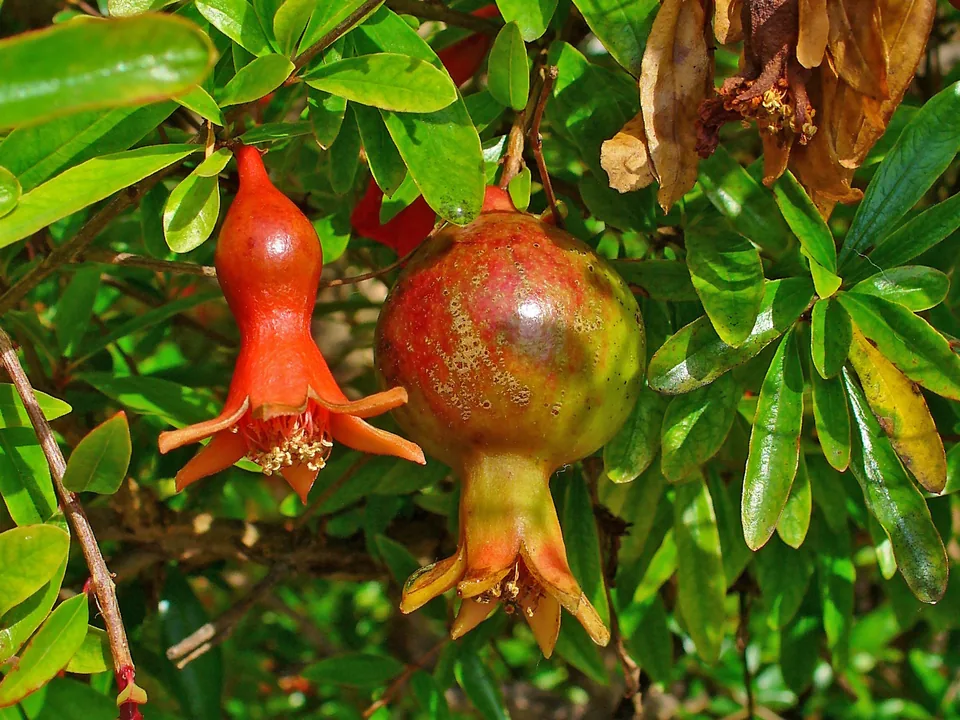


Cómo cultivar y cuidar Granado
Punica granatum
Escrito por Emilio Marruso · última revisión
De un vistazo
Los granados son resistentes y generosos: una vez establecidos aguantan la sequía, pero un riego profundo cada 7 a 10 días da la mejor fruta. Un solo ejemplar autofértil ya da fruto, y con una segunda planta la cosecha aumenta. Ponlo a pleno sol o en semisombra y, a los 3 años, producirá bien granadas de zumo dulce y ácido a principios de otoño.
- Sol
Sol pleno o semisombra
Qué dicen las fuentes (2)
Luz: Pleno sol a semisombra
Pomegranate grows in partial shade to full sun. It tolerates all types of soil as long as there is good drainage and moisture.
— Punica granatum (Pomegranate) | North Carolina Extension Gardener Plant Toolbox [1] Light: Full sun for best flowering and fruiting; partial shade reduces fruit set.
— Pomegranate (Punica granatum): How to Grow, Care for, and Enjoy in South Carolina | Home & Garden Information Center [3] - Riego
Riego profundo cada 7–10 días; el acolchado ayuda; el riego regular evita que el fruto se raje
Qué dicen las fuentes (5)
Riego: Tolerante a la sequía una vez establecido; para fruta de calidad, riega regularmente con un riego profundo y completo cada 7 a 10 días; mantén la humedad del suelo uniforme
Once established, plants are drought tolerant. - Maintain even soil moisture to reduce fruit drop and splitting.
— Pomegranate (Punica granatum): How to Grow, Care for, and Enjoy in South Carolina | Home & Garden Information Center [3] A deep thorough watering every 7 to 10 days is suggested.
— Pomegranate, Fruit of the Desert | USU [4] Notas sobre el riego: Aplica una capa de mantillo orgánico de 2 a 3 pulgadas [5,1–7,6 cm] para conservar la humedad; el riego regular previene el agrietamiento de la fruta, y las lluvias de fines de verano y principios de otoño fomentan el agrietamiento.
Mulch: Apply a 2- to 3-inch organic layer to conserve moisture and suppress weeds
— Pomegranate (Punica granatum): How to Grow, Care for, and Enjoy in South Carolina | Home & Garden Information Center [3] The best way to prevent cracking is to provide regular irrigation.
— Pomegranate, Fruit of the Desert | USU [4] Late summer and early fall rains will encourage cracking.
— Pomegranate, Fruit of the Desert | USU [4] - Suelo
pH del suelo de al menos 5,5
Qué dicen las fuentes (1)
pH del suelo, mínimo: 5.5
Soil: Adaptable to most SC soils (pH 5.5 – 7.0); requires good drainage.
— Pomegranate (Punica granatum): How to Grow, Care for, and Enjoy in South Carolina | Home & Garden Information Center [3] - Distancia
3–3,7 m entre plantas, 4,3–4,9 m entre hileras
Qué dicen las fuentes (3)
Distancia de plantación: 304.8-365.8 cm (10-12 pies) entre plantas, filas a 426.7-487.7 cm (14-16 pies) de distancia (cultivo en casa)
A suggested spacing for home growing is 10 to 12 feet between plants with 14 to 16 feet between rows.
— Pomegranate, Fruit of the Desert | USU [4] Distancia entre hileras: 427-488 cm (14 a 16 pies) entre hileras, para cultivo doméstico
: Commercial plantings should be on the order of 12 to 14 feet in the row with 18 to 20 feet between rows.
— Pomegranate, Fruit of the Desert | USU [4] A suggested spacing for home growing is 10 to 12 feet between plants with 14 to 16 feet between rows.
— Pomegranate, Fruit of the Desert | USU [4] - Abonado
Abona dos veces al año: en marzo y julio
Qué dicen las fuentes (3)
Cuándo: Principios de primavera (marzo) y mediados de verano (julio)
Maintain even soil moisture to reduce fruit drop and splitting. - Fertilize in March and July with 1 lb. (one pound) 10-10-10 per 3 ft. of plant height
— Pomegranate (Punica granatum): How to Grow, Care for, and Enjoy in South Carolina | Home & Garden Information Center [3] Frecuencia: Dos veces al año, en marzo y julio
Maintain even soil moisture to reduce fruit drop and splitting. - Fertilize in March and July with 1 lb. (one pound) 10-10-10 per 3 ft. of plant height
— Pomegranate (Punica granatum): How to Grow, Care for, and Enjoy in South Carolina | Home & Garden Information Center [3] Annual applications of nitrogen are suggested to help maintain vigor. Young plants will benefit from 6 to 8 ounces of ammonium sulfate per tree, annually, for the first 3 to 4 years.
— Pomegranate, Fruit of the Desert | USU [4] - Poda
Poda ligera a finales de invierno o principios de primavera; evita la poda severa
Qué dicen las fuentes (6)
Poda: A fines del invierno o principios de la primavera, antes de que comience el nuevo crecimiento primaveral
The best time to prune is late winter or early spring since it blooms on new growth.
— Pomegranates | Home & Garden Information Center [5] When to Prune: Before new spring growth begins.
— Pomegranate (Punica granatum): How to Grow, Care for, and Enjoy in South Carolina | Home & Garden Information Center [3] Cuándo podar: A fines del invierno o a principios de la primavera, antes de que comience el nuevo crecimiento; una poda anual ligera renueva la madera frutal.
The best time to prune is late winter or early spring since it blooms on new growth.
— Pomegranates | Home & Garden Information Center [5] Light annual pruning is recommended to renew fruit wood. Severe pruning will reduce yields.
— Pomegranate, Fruit of the Desert | USU [4] Poda drástica: Evita la poda severa: reduce los rendimientos.
Light annual pruning is recommended to renew fruit wood. Severe pruning will reduce yields.
— Pomegranate, Fruit of the Desert | USU [4] Be sure not to prune too heavily as this will reduce the fruiting for the season.
— Pomegranates | Home & Garden Information Center [5] - Cosecha
Recolecta a principios de otoño (agosto–octubre), mejor un poco pronto que pasada
Qué dicen las fuentes (3)
Cosecha: A principios del otoño (agosto-octubre)
depending on the cultivar, and resembles a Christmas ornament. Fruit typically ripens in early fall (August-October).
— Pomegranate (Punica granatum): How to Grow, Care for, and Enjoy in South Carolina | Home & Garden Information Center [3] Cómo cosechar: Cosecha a mano en su punto máximo de madurez, un poco antes en lugar de demasiado maduro, para evitar que se parta; recoge frutos pesados para su tamaño sin grietas ni hendiduras.
Select a fruit that is heavy for the size and does not have cracks or splits. Pomegranates are hand-harvested at peak ripeness.
— Punica granatum (Pomegranate) | North Carolina Extension Gardener Plant Toolbox [1] Harvest before overripe (even a little early) to avoid splitting.
— Pomegranate, Fruit of the Desert | USU [4] - Polinización
Autofértil; una segunda planta aumenta la cantidad de fruto
Qué dicen las fuentes (3)
Cuajado: Autofértil: produce fruto con su propio polen
Pomegranates are selfpollinating, but bees and other insects such as beetles do visit the flowers
— Pomegranate, Fruit of the Desert | USU [4] Qué necesita: No es necesaria una segunda planta, pero la polinización cruzada entre dos o más plantas aumenta la producción de frutos.
It is recommended, but not necessary, to have at least two or more plants for cross-pollination.
— Pomegranates | Home & Garden Information Center [5] Plant two or more pomegranate plants, as cross-pollination increases fruit set.
— [6] - Plagas
Vigila orugas, moscas blancas, cochinillas, trips; mancha de la hoja y podredumbre de raíz
Qué dicen las fuentes (5)
Plagas: orugas, moscas blancas, cochinillas harinosas, cochinillas, trips, chinche de patas de hoja
: The Leaf-footed plant bug has been found in home grown fruit in Nevada (Crites, Robison, Mills, 2004) and Utah.
— Pomegranate, Fruit of the Desert | USU [4] Caterpillars, whiteflies, mealybugs and scale may be present.
— Punica granatum (Pomegranate) | North Carolina Extension Gardener Plant Toolbox [1] Insects such as whiteflies, thrips, mealybugs and scale have been identified but none are considered serious.
— Pomegranate, Fruit of the Desert | USU [4] Enfermedades: mancha foliar, mancha de fruto, pudrición de raíces
Leaf spot, fruit blotch and root rot may occur.
— Punica granatum (Pomegranate) | North Carolina Extension Gardener Plant Toolbox [1] Leaf and fruit spots are common in SC due to our high humidity, but don’t require treatment.
— Pomegranate (Punica granatum): How to Grow, Care for, and Enjoy in South Carolina | Home & Garden Information Center [3] - Multiplicación
Los esquejes enraízan fácil; la semilla no da plantas iguales a la madre
Qué dicen las fuentes (5)
Propagación: Esquejes de madera dura y blanda; semilla (no sale fiel a la variedad)
Pomegranates may be propagated from seed, but will not come true to variety. Both hardwood and softwood cuttings root easily, but softwood cuttings require mist to prevent desiccation.
— Pomegranate (Punica granatum): How to Grow, Care for, and Enjoy in South Carolina | Home & Garden Information Center [3] Esquejes: Esquejes de un año de 25.4-30.5 cm [10–12 in] de largo y 0.6-1.3 cm [0,2–0,5 in] de grosor, tomados a fines del invierno; retira las hojas y trata el corte con hormona de enraizamiento. A principios de la primavera, los esquejes pueden salir al exterior una vez que el suelo haya comenzado a calentarse. Los esquejes enraízan con facilidad.
Vegetative propagation is easily done by using one year old cuttings about 10 to 12 inches long and ¼ to ½ inch in diameter taken in late winter.
— Pomegranate, Fruit of the Desert | USU [4] Remove leaves and treat cut area with rooting hormone.
— Pomegranate, Fruit of the Desert | USU [4] Or, in early spring, cuttings may be placed outside if soil has begun to warm.
— Pomegranate, Fruit of the Desert | USU [4] Pomegranate cuttings root easily, making propagation simple for home gardeners.
— Pomegranate (Punica granatum): How to Grow, Care for, and Enjoy in South Carolina | Home & Garden Information Center [3] - Maceta
Crece en maceta
Qué dicen las fuentes (2)
En maceta: Sí
The compact forms perform quite well in large containers.
— Pomegranate (Punica granatum): How to Grow, Care for, and Enjoy in South Carolina | Home & Garden Information Center [3] Plants grown in North Carolina may need to be planted in a protected area or in a container that can be brought indoors for the winter.
— Punica granatum (Pomegranate) | North Carolina Extension Gardener Plant Toolbox [1]
Resumen
El granado es un arbusto caducifolio o árbol pequeño cultivado por su fruta comestible y sus flores ornamentales. [1][3] Crece a pleno sol o semisombra en suelo bien drenado y tolera la sequía una vez establecido. [1][3] Se propaga por esquejes de madera dura o blanda y se poda a fines del invierno o principios de la primavera. [3][5]
Citado en inglés, como en la fuente.
Esta ficha está incompleta: las fuentes consultadas aún no cubren todos los campos.
Aún no cubierto por nuestras fuentes: Plantación
Cuidados
Las medidas entre corchetes son nuestra conversión al otro sistema de unidades; el texto citado no cambia.
Riego
Riego
Tolerante a la sequía una vez establecido; para fruta de calidad, riega regularmente con un riego profundo y completo cada 7 a 10 días; mantén la humedad del suelo uniforme
Qué dicen las fuentes (2)
Once established, plants are drought tolerant.
- Maintain even soil moisture to reduce fruit drop and splitting.A deep thorough watering every 7 to 10 days is suggested.Notas sobre el riego
Aplica una capa de mantillo orgánico de 2 a 3 pulgadas [5,1–7,6 cm] para conservar la humedad; el riego regular previene el agrietamiento de la fruta, y las lluvias de fines de verano y principios de otoño fomentan el agrietamiento.
Qué dicen las fuentes (3)
Mulch: Apply a 2- to 3-inch organic layer to conserve moisture and suppress weedsThe best way to prevent cracking is to provide regular irrigation.Late summer and early fall rains will encourage cracking.Luz
Pleno sol a semisombra
Qué dicen las fuentes (2)
Pomegranate grows in partial shade to full sun. It tolerates all types of soil as long as there is good drainage and moisture.Light: Full sun for best flowering and fruiting; partial shade reduces fruit set.Clima y frío
Rusticidad, zona más fría
Las fuentes dan valores distintos según la región, la zona o las condiciones de cultivo.
Lo que dice cada fuente
Según NC State Extension: 8a [mínima invernal de −12,2 a −9,4 °C (de 10 a 15 °F)]
Según Clemson Cooperative Extension HGIC: 8 [mínima invernal de −12,2 a −6,7 °C (de 10 a 20 °F)] (7b [mínima invernal de −15 a −12,2 °C (de 5 a 10 °F)] con protección)
Según Utah State University Extension: 8 [mínima invernal de −12,2 a −6,7 °C (de 10 a 20 °F)]
Qué dicen las fuentes (4)
Según NC State Extension: USDA Plant Hardiness Zone:
8a, 8b, 9a, 9b, 10a, 10bSegún Clemson Cooperative Extension HGIC: USDA Zones: 8 – 10 (Zone 7b with protection)Según Utah State University Extension: Pomegranates are suited to USDA Zones 8-11. Plants will harden off when exposed to cold graduallyUSDA Plant Hardiness Zone:
8a, 8b, 9a, 9b, 10a, 10bRusticidad, zona más cálida
Las fuentes dan valores distintos según la región, la zona o las condiciones de cultivo.
Lo que dice cada fuente
Según NC State Extension: 10b [mínima invernal de 1,7 a 4,4 °C (de 35 a 40 °F)]
Según Clemson Cooperative Extension HGIC: 10 [mínima invernal de −1,1 a 4,4 °C (de 30 a 40 °F)]
Según Utah State University Extension: 11 [mínima invernal de 4,4 a 10 °C (de 40 a 50 °F)]
Qué dicen las fuentes (4)
Según NC State Extension: USDA Plant Hardiness Zone:
8a, 8b, 9a, 9b, 10a, 10bSegún Clemson Cooperative Extension HGIC: USDA Zones: 8 – 10 (Zone 7b with protection)Según Utah State University Extension: Pomegranates are suited to USDA Zones 8-11. Plants will harden off when exposed to cold graduallyUSDA Plant Hardiness Zone:
8a, 8b, 9a, 9b, 10a, 10bSuelo
pH del suelo, mínimo
5.5
Qué dicen las fuentes (1)
Soil: Adaptable to most SC soils (pH 5.5 – 7.0); requires good drainage.pH del suelo, máximo
Las fuentes dan valores distintos según la región, la zona o las condiciones de cultivo.
Lo que dice cada fuente
Según Clemson Cooperative Extension HGIC: 7.0
Según Utah State University Extension: Tolera condiciones alcalinas
Qué dicen las fuentes (3)
Según Clemson Cooperative Extension HGIC: Soil: Adaptable to most SC soils (pH 5.5 – 7.0); requires good drainage.Según Utah State University Extension: Plants thrive in well drained loamy soil, but don’t require a specific soil type and do quite well in alkaline conditions.Soil: Adaptable to most SC soils (pH 5.5 – 7.0); requires good drainage.Dónde cultivarla
En maceta
Sí
Qué dicen las fuentes (2)
The compact forms perform quite well in large containers.Plants grown in North Carolina may need to be planted in a protected area or in a container that can be brought indoors for the winter.Distancia de plantación
304.8-365.8 cm (10-12 pies) entre plantas, filas a 426.7-487.7 cm (14-16 pies) de distancia (cultivo en casa)
Qué dicen las fuentes (1)
A suggested spacing for home growing is 10 to 12 feet between plants with 14 to 16 feet between rows.Propagación
Esquejes de madera dura y blanda; semilla (no sale fiel a la variedad)
Qué dicen las fuentes (1)
Pomegranates may be propagated from seed, but will not come true to variety. Both hardwood and softwood cuttings root easily, but softwood cuttings require mist to prevent desiccation.Cultivo
La planta
Ciclo de vida
perenne
Qué dicen las fuentes (1)
Pomegranate is a woody, deciduous, perennial shrub or tree with edible fruit in the henna family (Lythraceae).Familia
Lythraceae (familia de la alheña)
Qué dicen las fuentes (1)
Pomegranate is a woody, deciduous, perennial shrub or tree with edible fruit in the henna family (Lythraceae).Altura adulta
Las fuentes no coinciden:
The shrub is drought tolerant and will grow to be 10 to 12 feet tall and 8 to 10 feet wide.
[1]This deciduous (rarely evergreen) shrub or small tree typically grows from 12 to 20 feet tall and nearly the same in spread.
[3]Pomegranates grow naturally as a bushy shrub, but may be trained as a small tree growing 12 to15 feet high
[4]
Siembra y crecimiento
Distancia entre hileras
427-488 cm (14 a 16 pies) entre hileras, para cultivo doméstico
Lo que dice cada fuente
:
Qué dicen las fuentes (2)
: Commercial plantings should be on the order of 12 to 14 feet in the row with 18 to 20 feet between rows.A suggested spacing for home growing is 10 to 12 feet between plants with 14 to 16 feet between rows.Días hasta la madurez
3 años después de la siembra para dar frutos bien (puede florecer esporádicamente y dar uno o dos frutos en el primer año)
Qué dicen las fuentes (1)
They will flower sporadically the first year after planting into the landscape and may bear one to two fruits. More commonly, they will begin to bear well three years after planting.Cosecha y conservación
Cómo cosechar
Cosecha a mano en su punto máximo de madurez, un poco antes en lugar de demasiado maduro, para evitar que se parta; recoge frutos pesados para su tamaño sin grietas ni hendiduras.
Qué dicen las fuentes (2)
Select a fruit that is heavy for the size and does not have cracks or splits. Pomegranates are hand-harvested at peak ripeness.Harvest before overripe (even a little early) to avoid splitting.Conservación
Fruto entero: temperatura ambiente durante unos días, o refrigerado en bolsas de plástico hasta 3 meses; a 32-41 °F (0-5 °C) con 80% de humedad los frutos pueden almacenarse 6-7 meses. Los arilos pueden refrigerarse o congelarse.
Qué dicen las fuentes (2)
Store whole fruit at room temperature for a few days or place in the refrigerator in plastic bags for up to 3 months.Fruits may store for 6-7 months. Highest quality will be realized if fruits are stored between 32 and 41 degrees F.Plagas y enfermedades
Plagas
orugas, moscas blancas, cochinillas harinosas, cochinillas, trips, chinche de patas de hoja
Lo que dice cada fuente
:
Qué dicen las fuentes (3)
: The Leaf-footed plant bug has been found in home grown fruit in Nevada (Crites, Robison, Mills, 2004) and Utah.Caterpillars, whiteflies, mealybugs and scale may be present.Insects such as whiteflies, thrips, mealybugs and scale have been identified but none are considered serious.Enfermedades
mancha foliar, mancha de fruto, pudrición de raíces
Qué dicen las fuentes (2)
Leaf spot, fruit blotch and root rot may occur.Leaf and fruit spots are common in SC due to our high humidity, but don’t require treatment.Abonado
Cuándo
Principios de primavera (marzo) y mediados de verano (julio)
Qué dicen las fuentes (1)
Maintain even soil moisture to reduce fruit drop and splitting. - Fertilize in March and July with 1 lb. (one pound) 10-10-10 per 3 ft. of plant heightFrecuencia
Dos veces al año, en marzo y julio
Qué dicen las fuentes (2)
Maintain even soil moisture to reduce fruit drop and splitting. - Fertilize in March and July with 1 lb. (one pound) 10-10-10 per 3 ft. of plant heightAnnual applications of nitrogen are suggested to help maintain vigor. Young plants will benefit from 6 to 8 ounces of ammonium sulfate per tree, annually, for the first 3 to 4 years.Abonos minerales
Las fuentes no coinciden:
Maintain even soil moisture to reduce fruit drop and splitting. - Fertilize in March and July with 1 lb. (one pound) 10-10-10 per 3 ft. of plant height
[3]Pomegranates do not seem to benefit from the addition of phosphorus or potassium. If zinc or iron deficiency symptoms appear it is best to apply chelated forms of each as needed.
[4]
Lo que dice cada fuente
Carolina del Sur: 10-10-10, 454 g per 91.4 cm [36 in] of plant height, in March and July
young trees (first 3 to 4 years): Ammonium sulfate, 169.8–226.4 g per tree per year
árboles establecidos: Ammonium sulfate, 84.9–113.2 g per tree per year
Qué dicen las fuentes (3)
Carolina del Sur: Maintain even soil moisture to reduce fruit drop and splitting. - Fertilize in March and July with 1 lb. (one pound) 10-10-10 per 3 ft. of plant heightyoung trees (first 3 to 4 years): Annual applications of nitrogen are suggested to help maintain vigor. Young plants will benefit from 6 to 8 ounces of ammonium sulfate per tree, annually, for the first 3 to 4 years.árboles establecidos: Young plants will benefit from 6 to 8 ounces of ammonium sulfate per tree, annually, for the first 3 to 4 years. After that, 3 to 4 ounces is usually sufficient to maintain new growth each year.Microelementos
Zinc y hierro en forma quelatada, solo cuando aparezcan síntomas de deficiencia
Qué dicen las fuentes (1)
If zinc or iron deficiency symptoms appear it is best to apply chelated forms of each as needed.Distancias
Entre plantas
3.05-3.66 m [10–12 ft] entre plantas en el huerto familiar.
Lo que dice cada fuente
plantaciones comerciales: 3.66-4.27 m [12–14 ft] en la hilera
Qué dicen las fuentes (2)
plantaciones comerciales: Commercial plantings should be on the order of 12 to 14 feet in the row with 18 to 20 feet between rows.A suggested spacing for home growing is 10 to 12 feet between plants with 14 to 16 feet between rows.Entre hileras
4.27-4.88 m [14–16 ft] entre hileras en el huerto familiar.
Lo que dice cada fuente
plantaciones comerciales: 5.49-6.1 m [18–20 ft] entre hileras
Qué dicen las fuentes (2)
plantaciones comerciales: Commercial plantings should be on the order of 12 to 14 feet in the row with 18 to 20 feet between rows.A suggested spacing for home growing is 10 to 12 feet between plants with 14 to 16 feet between rows.Propagación
Esquejes
Esquejes de un año de 25.4-30.5 cm [10–12 in] de largo y 0.6-1.3 cm [0,2–0,5 in] de grosor, tomados a fines del invierno; retira las hojas y trata el corte con hormona de enraizamiento. A principios de la primavera, los esquejes pueden salir al exterior una vez que el suelo haya comenzado a calentarse. Los esquejes enraízan con facilidad.
Qué dicen las fuentes (4)
Vegetative propagation is easily done by using one year old cuttings about 10 to 12 inches long and ¼ to ½ inch in diameter taken in late winter.Remove leaves and treat cut area with rooting hormone.Or, in early spring, cuttings may be placed outside if soil has begun to warm.Pomegranate cuttings root easily, making propagation simple for home gardeners.Tras la cosecha
Conservación
Los frutos se conservan de 6 a 7 meses; la mejor calidad se logra a 0-5 °C [32–41 °F], y una humedad relativa del 80% reduce la contracción y el deterioro. En casa: unos días a temperatura ambiente, o hasta 3 meses en bolsas de plástico en el refrigerador.
Qué dicen las fuentes (3)
Fruits may store for 6-7 months. Highest quality will be realized if fruits are stored between 32 and 41 degrees F.Shrinking and spoilage are reduced if humidity can be maintained around 80%.Store whole fruit at room temperature for a few days or place in the refrigerator in plastic bags for up to 3 months.Calor y sequía
Sequía
Muy tolerante a la sequía una vez establecida, con buena tolerancia a la sal; absorbe agua rápidamente cuando esta está disponible después de un período seco.
Qué dicen las fuentes (3)
Once established, the plants are very tolerant of drought.The Pomegranate has surprisingly good drought and salt tolerance and should be considered fruit along the coast.Pomegranates will take up water rapidly when available, especially after periods of drought.Polinización
Cuajado
Autofértil: produce fruto con su propio polen
Qué dicen las fuentes (1)
Pomegranates are selfpollinating, but bees and other insects such as beetles do visit the flowersQué necesita
No es necesaria una segunda planta, pero la polinización cruzada entre dos o más plantas aumenta la producción de frutos.
Polinizadores
colibrí
Qué dicen las fuentes (1)
The bright red flowers not only turn into wonderful fruit but are highly attractive to a variety of pollinators, including the hummingbird.Poda
Madera que florece
Cuándo podar
A fines del invierno o a principios de la primavera, antes de que comience el nuevo crecimiento; una poda anual ligera renueva la madera frutal.
Poda drástica
Evita la poda severa: reduce los rendimientos.
Despunte
En el cultivo en arbusto, despunta los brotes durante los primeros 2-3 años para estimular más brotes nuevos, luego deja las puntas sin podar para favorecer la fructificación.
Qué dicen las fuentes (1)
For bush culture, prune tips of shoots the first 2 to 3 years to encourage more new shoots to form. Leave tips unpruned from then on to promote fruiting.Frío invernal
Horas de frío
50–300 horas entre 0 y 7.2 °C [32–45 °F]
Lo que dice cada fuente
especie «Granado»: 50–300 horas
especie «Granado»: 100–200 horas
Qué dicen las fuentes (6)
especie «Granado»: Pomegranate Chill hours: 50 to 300 Pomegranates are adapted to climates with cool winters and hot summers.especie «Granado»: Pecan 300–500 Persimmon 200–400 Plum 400–700 Pomegranate 100–200 Strawberry 200–400Pomegranate Chill hours: 50 to 300 Pomegranates are adapted to climates with cool winters and hot summers.Pecan 300–500 Persimmon 200–400 Plum 400–700 Pomegranate 100–200 Strawberry 200–400Chill hours are accumulated from November through February when temperatures are between 32° and 45°F.Different models exist to estimate chilling. One model defines a chill hour as each hour below 45°F starting on October 1.Problemas
Agrietamiento de la fruta.
Síntoma: La cáscara se agrieta, exponiendo los arilos a esporas de hongos e insectos.
Qué hacer: Proporciona riego regular; las lluvias de fines de verano y principios de otoño fomentan el agrietamiento.
Falla en el cuaje de la fruta
Síntoma: Las plantas florecen pero no cuajan fruta.
Qué hacer: Asegura sol adecuado y planta dos o más plantas para la polinización cruzada.
Qué dicen las fuentes (2)
Plant two or more pomegranate plants, as cross-pollination increases fruit set.
— Pomegranate (Punica granatum): How to Grow, Care for, and Enjoy in South Carolina | Home & Garden Information Center [3] The most common reasons pomegranates do not set fruit include:
— Pomegranate (Punica granatum): How to Grow, Care for, and Enjoy in South Carolina | Home & Garden Information Center [3] Mancha foliar, mancha de la fruta y pudrición de la raíz
Síntoma: Manchas en hojas y frutos, pudrición de la raíz; en el sureste los granados no producen fruta de manera confiable.
Qué hacer: Las manchas en hojas y frutos causadas por alta humedad no requieren tratamiento.
Qué dicen las fuentes (2)
Leaf spot, fruit blotch and root rot may occur.
— Punica granatum (Pomegranate) | North Carolina Extension Gardener Plant Toolbox [1] Leaf and fruit spots are common in SC due to our high humidity, but don’t require treatment.
— Pomegranate (Punica granatum): How to Grow, Care for, and Enjoy in South Carolina | Home & Garden Information Center [3]
Remedios
Cada remedio indica qué dicen las fuentes oficiales; los remedios tradicionales sin fuente oficial aparecen marcados. Los perjudiciales están para que sepas evitarlos.
Cuidar la planta
herbívoros
spray de capsaicina No verificado
Remedio tradicional, no verificado por una fuente oficial.
The pepper spray can be very potent if it gets on your skin or in your eyes.
— extension.psu.edu [9] Cómo: Rocía capsaicina sobre los frutos en formación; vuelve a aplicar después de lluvias intensas.
bolsas de malla o barrera de papel No verificado
Remedio tradicional, no verificado por una fuente oficial.
Cómo: Envuelve cada fruto individualmente.
ácaros planos de los cítricos
aceite de neem No verificado
Remedio tradicional, no verificado por una fuente oficial.
Cómo: Aplica aceite de neem en los meses de reposo; la fuente añade una aplicación de azufre entre primavera y verano, con al menos dos meses de diferencia.
chinches paticojas
Recoge a mano en agua jabonosa No verificado
Remedio tradicional, no verificado por una fuente oficial.
Cómo: Usa guantes de jardinería, reúne los insectos y tíralos en un cubo con agua jabonosa, siempre que estén al alcance.
aceite de neem Funciona
Be sure to apply it prior to the onset of temperatures over 90°F to avoid smothering the tree.
— gardenerspath.com [10] Cómo: Rocía la planta según las instrucciones del paquete cuando los insectos estén en la etapa de ninfa.
One or more applications of neem oil can also be sprayed on the plant, according to package instructions, when the insects are in the nymph stage.
— gardenerspath.com [10] Qué dicen las pruebas Neem oil is found in the seeds of the neem tree. The active component found in this biological pesticide reduces insect feeding, interferes with hormones -- making it hard to grow or lay eggs -- and acts as a repellent.
— extension.illinois.edu [11]
orugas enrolladoras de hojas
aceite de neem Funciona
Cómo: Rocía el árbol según las indicaciones del paquete a fines del invierno o principios de la primavera, y nuevamente a fines de la primavera o principios del verano, mientras los frutos aún sean pequeños.
A generous application of neem oil can be sprayed on the tree according to package directions in late winter or early spring, and again in late spring or early summer, while fruits are still small and developing.
— gardenerspath.com [10] Qué dicen las pruebas Neem oil is found in the seeds of the neem tree. The active component found in this biological pesticide reduces insect feeding, interferes with hormones -- making it hard to grow or lay eggs -- and acts as a repellent.
— extension.illinois.edu [11]
pulgones
chorro de agua fuerte Fuente oficial, sin prueba independiente
Cómo: Rocía un chorro de agua fuerte para desprender los pulgones.
Spraying strong jet of water to dislodge the aphid.
— plantvillage.psu.edu [12]
cochinillas harinosas
solución de jabón Fuente oficial, sin prueba independiente
spraying home remedies that contain dish detergent on plants on a sunny day can injure the plant, essentially burning it.
— extension.psu.edu [9] Cómo: Rocía una solución de jabón.
Spraying soap solution reduces mealy bug population.
— plantvillage.psu.edu [12]
barrenador de la fruta
Quema la fruta dañada Fuente oficial, sin prueba independiente
Cómo: Retira la fruta dañada y quémala.
Remove the damaged fruit and burn them.
— plantvillage.psu.edu [12]
mancha de fruta por cercospora
poda de material infectado No verificado
Remedio tradicional, no verificado por una fuente oficial.
Cómo: Poda el material vegetal infectado y deséchalo quemándolo o en una bolsa de basura bien sellada, lejos de otras plantas.
fruta sin azúcar
sal de Epsom Perjudicial
Cómo: Aplica sal de Epsom en otoño, 1 cucharada por pie cuadrado de árbol.
an application of epsom salt helps produce sweeter fruit. Add 1 Tablespoon per square foot of tree.
— gardenista.com [13] Qué dicen las pruebas Epsom salts (magnesium sulfate) should only be used if a soil test shows a magnesium deficiency. In most gardens, they can harm plants rather than help them.
— extension.oregonstate.edu [14]
Calendario
No figura en las fuentes consultadas.
A principios del otoño (agosto-octubre)
Qué dicen las fuentes (1)
depending on the cultivar, and resembles a Christmas ornament. Fruit typically ripens in early fall (August-October).A fines del invierno o principios de la primavera, antes de que comience el nuevo crecimiento primaveral
Qué dicen las fuentes (2)
The best time to prune is late winter or early spring since it blooms on new growth.When to Prune: Before new spring growth begins.Meses tal como los dan las fuentes, en su mayoría de Estados Unidos (hemisferio norte). En el hemisferio sur se desplazan unos seis meses.
Comestibilidad
Según la fuente, citada textualmente. No comas una planta basándote solo en esta página: los errores de identificación pueden ser peligrosos.
Valores orientativos
Valores de una fuente secundaria, no comprobados palabra por palabra como el resto de esta página. Úselos como punto de partida.
- Horas de sol
- 8-10 horasValor orientativo, adáptalo a tu clima · Fuente secundaria
- Crecimiento
- BajoValor orientativo, adáptalo a tu clima · Fuente secundaria
Plantas similares
- Abeto de Vancuver Abies grandis
- Abraham Trachystemon orientalis
- Bananero de Etiopía Ensete ventricosum
- Acacia longifolia Acacia longifolia
- Acanthus hungaricus Acanthus hungaricus
- Achlys triphylla Achlys triphylla
- Palma de aguja Yucca flaccida
- Adriatic lizard orchid Himantoglossum adriaticum
Fuentes
Cada valor anterior se cita de estos documentos. Los enlaces llevan al editor original.
- Punica granatum (Pomegranate) | North Carolina Extension Gardener Plant Toolbox · plants.ces.ncsu.edu, consultado
- Pomegranate - Punica granatum | North Carolina Extension Gardener Plant Toolbox · plants.ces.ncsu.edu, consultado
- Pomegranate (Punica granatum): How to Grow, Care for, and Enjoy in South Carolina | Home & Garden Information Center · hgic.clemson.edu, consultado
- Pomegranate, Fruit of the Desert | USU · extension.usu.edu, consultado
- Pomegranates | Home & Garden Information Center · hgic.clemson.edu, consultado
- hgic.clemson.edu · hgic.clemson.edu
- escholarship.org · escholarship.org
- extension.msstate.edu · extension.msstate.edu
- extension.psu.edu · extension.psu.edu
- gardenerspath.com · gardenerspath.com
- extension.illinois.edu · extension.illinois.edu
- plantvillage.psu.edu · plantvillage.psu.edu
- gardenista.com · gardenista.com
- extension.oregonstate.edu · extension.oregonstate.edu
Escrito por Emilio Marruso · última revisión