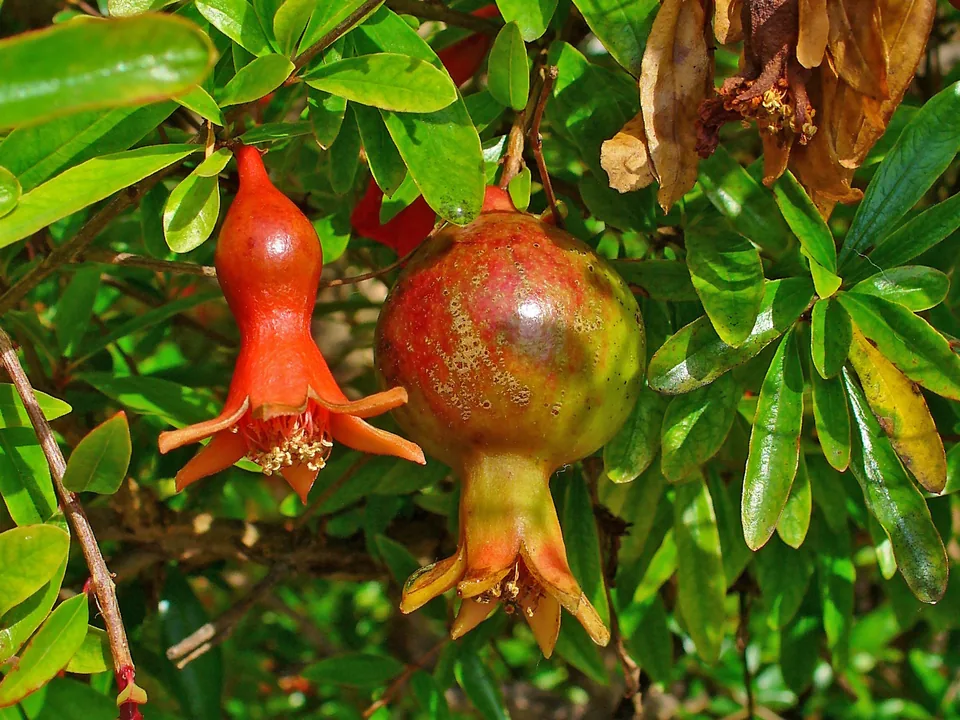


How to Grow and Care for Pomegranate
Punica granatum
Written by Emilio Marruso · last checked
At a glance
Pomegranates are tough and rewarding: once established they shrug off drought, yet a deep watering every 7 to 10 days gives the best fruit. A single self-fertile plant will set fruit, and hummingbirds visit the flowers. Plant it in full sun to partial shade, and in 3 years it bears well, with sweet-tart, juicy fruit in early fall.
- Sun
Full sun to partial shade
What the sources say (2)
Light: Full sun to partial shade
Pomegranate grows in partial shade to full sun. It tolerates all types of soil as long as there is good drainage and moisture.
— Punica granatum (Pomegranate) | North Carolina Extension Gardener Plant Toolbox [1] Light: Full sun for best flowering and fruiting; partial shade reduces fruit set.
— Pomegranate (Punica granatum): How to Grow, Care for, and Enjoy in South Carolina | Home & Garden Information Center [3] - Water
Deep watering every 7–10 days; mulch helps; regular water keeps fruit from cracking
What the sources say (5)
Watering: Drought tolerant once established; for quality fruit, regular irrigation with a deep thorough watering every 7 to 10 days; maintain even soil moisture
Once established, plants are drought tolerant. - Maintain even soil moisture to reduce fruit drop and splitting.
— Pomegranate (Punica granatum): How to Grow, Care for, and Enjoy in South Carolina | Home & Garden Information Center [3] A deep thorough watering every 7 to 10 days is suggested.
— Pomegranate, Fruit of the Desert | USU [4] Watering notes: Apply a 2- to 3-inch [5.1–7.6 cm] organic mulch layer to conserve moisture; regular irrigation prevents fruit cracking, and late summer and early fall rains encourage cracking
Mulch: Apply a 2- to 3-inch organic layer to conserve moisture and suppress weeds
— Pomegranate (Punica granatum): How to Grow, Care for, and Enjoy in South Carolina | Home & Garden Information Center [3] The best way to prevent cracking is to provide regular irrigation.
— Pomegranate, Fruit of the Desert | USU [4] Late summer and early fall rains will encourage cracking.
— Pomegranate, Fruit of the Desert | USU [4] - Soil
Soil pH at least 5.5
What the sources say (1)
Soil pH, minimum: 5.5
Soil: Adaptable to most SC soils (pH 5.5 – 7.0); requires good drainage.
— Pomegranate (Punica granatum): How to Grow, Care for, and Enjoy in South Carolina | Home & Garden Information Center [3] - Spacing
10–12 ft between plants, 14–16 ft between rows
What the sources say (3)
Spacing: 304.8-365.8 cm (10-12 ft) between plants, rows 426.7-487.7 cm (14-16 ft) apart (home growing)
A suggested spacing for home growing is 10 to 12 feet between plants with 14 to 16 feet between rows.
— Pomegranate, Fruit of the Desert | USU [4] Row spacing: 427-488 cm (14 to 16 ft) between rows, for home growing
: Commercial plantings should be on the order of 12 to 14 feet in the row with 18 to 20 feet between rows.
— Pomegranate, Fruit of the Desert | USU [4] A suggested spacing for home growing is 10 to 12 feet between plants with 14 to 16 feet between rows.
— Pomegranate, Fruit of the Desert | USU [4] - Feeding
Feed twice a year: in March and July
What the sources say (3)
When: Early spring (March) and midsummer (July)
Maintain even soil moisture to reduce fruit drop and splitting. - Fertilize in March and July with 1 lb. (one pound) 10-10-10 per 3 ft. of plant height
— Pomegranate (Punica granatum): How to Grow, Care for, and Enjoy in South Carolina | Home & Garden Information Center [3] How often: Twice a year, in March and July
Maintain even soil moisture to reduce fruit drop and splitting. - Fertilize in March and July with 1 lb. (one pound) 10-10-10 per 3 ft. of plant height
— Pomegranate (Punica granatum): How to Grow, Care for, and Enjoy in South Carolina | Home & Garden Information Center [3] Annual applications of nitrogen are suggested to help maintain vigor. Young plants will benefit from 6 to 8 ounces of ammonium sulfate per tree, annually, for the first 3 to 4 years.
— Pomegranate, Fruit of the Desert | USU [4] - Pruning
Prune lightly in late winter or early spring; avoid severe pruning
What the sources say (6)
Pruning: Late winter or early spring, before new spring growth begins
The best time to prune is late winter or early spring since it blooms on new growth.
— Pomegranates | Home & Garden Information Center [5] When to Prune: Before new spring growth begins.
— Pomegranate (Punica granatum): How to Grow, Care for, and Enjoy in South Carolina | Home & Garden Information Center [3] When to prune: In late winter or early spring, before new growth begins; light annual pruning renews the fruiting wood.
The best time to prune is late winter or early spring since it blooms on new growth.
— Pomegranates | Home & Garden Information Center [5] Light annual pruning is recommended to renew fruit wood. Severe pruning will reduce yields.
— Pomegranate, Fruit of the Desert | USU [4] Hard pruning: Avoid severe pruning: it reduces yields.
Light annual pruning is recommended to renew fruit wood. Severe pruning will reduce yields.
— Pomegranate, Fruit of the Desert | USU [4] Be sure not to prune too heavily as this will reduce the fruiting for the season.
— Pomegranates | Home & Garden Information Center [5] - Harvest
Harvest in early fall (August–October), a bit early rather than overripe
What the sources say (3)
Harvest: Early fall (August-October)
depending on the cultivar, and resembles a Christmas ornament. Fruit typically ripens in early fall (August-October).
— Pomegranate (Punica granatum): How to Grow, Care for, and Enjoy in South Carolina | Home & Garden Information Center [3] How to harvest: Hand-harvest at peak ripeness, a little early rather than overripe, to avoid splitting; pick fruit heavy for its size without cracks or splits.
Select a fruit that is heavy for the size and does not have cracks or splits. Pomegranates are hand-harvested at peak ripeness.
— Punica granatum (Pomegranate) | North Carolina Extension Gardener Plant Toolbox [1] Harvest before overripe (even a little early) to avoid splitting.
— Pomegranate, Fruit of the Desert | USU [4] - Pollination
Self-fertile; a second plant increases fruit set
What the sources say (3)
Fruit set: Self-fertile: sets fruit with its own pollen
Pomegranates are selfpollinating, but bees and other insects such as beetles do visit the flowers
— Pomegranate, Fruit of the Desert | USU [4] What it needs: A second plant is not necessary, but cross-pollination between two or more plants increases fruit set.
It is recommended, but not necessary, to have at least two or more plants for cross-pollination.
— Pomegranates | Home & Garden Information Center [5] Plant two or more pomegranate plants, as cross-pollination increases fruit set.
— [6] - Pests
Watch for caterpillars, whiteflies, mealybugs, scale, thrips; leaf spot and root rot
What the sources say (5)
Pests: caterpillars, whiteflies, mealybugs, scale, thrips, leaf-footed plant bug
: The Leaf-footed plant bug has been found in home grown fruit in Nevada (Crites, Robison, Mills, 2004) and Utah.
— Pomegranate, Fruit of the Desert | USU [4] Caterpillars, whiteflies, mealybugs and scale may be present.
— Punica granatum (Pomegranate) | North Carolina Extension Gardener Plant Toolbox [1] Insects such as whiteflies, thrips, mealybugs and scale have been identified but none are considered serious.
— Pomegranate, Fruit of the Desert | USU [4] Diseases: leaf spot, fruit blotch, root rot
Leaf spot, fruit blotch and root rot may occur.
— Punica granatum (Pomegranate) | North Carolina Extension Gardener Plant Toolbox [1] Leaf and fruit spots are common in SC due to our high humidity, but don’t require treatment.
— Pomegranate (Punica granatum): How to Grow, Care for, and Enjoy in South Carolina | Home & Garden Information Center [3] - Propagation
Cuttings root easily; seed does not come true
What the sources say (5)
Propagation: Hardwood and softwood cuttings; seed (does not come true to variety)
Pomegranates may be propagated from seed, but will not come true to variety. Both hardwood and softwood cuttings root easily, but softwood cuttings require mist to prevent desiccation.
— Pomegranate (Punica granatum): How to Grow, Care for, and Enjoy in South Carolina | Home & Garden Information Center [3] Cuttings: One-year-old cuttings 25.4-30.5 cm [10–12 in] long and 0.6-1.3 cm [0.2–0.5 in] thick, taken in late winter; remove the leaves and treat the cut with rooting hormone. In early spring cuttings can go outdoors once the soil has begun to warm. Cuttings root easily.
Vegetative propagation is easily done by using one year old cuttings about 10 to 12 inches long and ¼ to ½ inch in diameter taken in late winter.
— Pomegranate, Fruit of the Desert | USU [4] Remove leaves and treat cut area with rooting hormone.
— Pomegranate, Fruit of the Desert | USU [4] Or, in early spring, cuttings may be placed outside if soil has begun to warm.
— Pomegranate, Fruit of the Desert | USU [4] Pomegranate cuttings root easily, making propagation simple for home gardeners.
— Pomegranate (Punica granatum): How to Grow, Care for, and Enjoy in South Carolina | Home & Garden Information Center [3] - Containers
Grows in containers
What the sources say (2)
In containers: Yes
The compact forms perform quite well in large containers.
— Pomegranate (Punica granatum): How to Grow, Care for, and Enjoy in South Carolina | Home & Garden Information Center [3] Plants grown in North Carolina may need to be planted in a protected area or in a container that can be brought indoors for the winter.
— Punica granatum (Pomegranate) | North Carolina Extension Gardener Plant Toolbox [1]
Overview
Pomegranate is a deciduous shrub or small tree grown for its edible fruit and ornamental flowers. [1][3] It grows in full sun to partial shade in well-drained soil and is drought tolerant once established. [1][3] It is propagated by hardwood or softwood cuttings and pruned in late winter or early spring. [3][5]
This record is incomplete: the sources we read do not cover every field yet.
Not yet covered by our sources: Planting
Pomegranate care
Measurements in square brackets are our conversion into the other unit system; the quoted text is unchanged.
How to water Pomegranate
Watering
Drought tolerant once established; for quality fruit, regular irrigation with a deep thorough watering every 7 to 10 days; maintain even soil moisture
What the sources say (2)
Once established, plants are drought tolerant.
- Maintain even soil moisture to reduce fruit drop and splitting.A deep thorough watering every 7 to 10 days is suggested.Watering notes
Apply a 2- to 3-inch [5.1–7.6 cm] organic mulch layer to conserve moisture; regular irrigation prevents fruit cracking, and late summer and early fall rains encourage cracking
What the sources say (3)
Mulch: Apply a 2- to 3-inch organic layer to conserve moisture and suppress weedsThe best way to prevent cracking is to provide regular irrigation.Late summer and early fall rains will encourage cracking.How much light Pomegranate needs
Full sun to partial shade
What the sources say (2)
Pomegranate grows in partial shade to full sun. It tolerates all types of soil as long as there is good drainage and moisture.Light: Full sun for best flowering and fruiting; partial shade reduces fruit set.How much cold Pomegranate can take
Hardiness, coldest zone
The sources give different values depending on region, zone or growing conditions.
What each source says
According to NC State Extension: 8a [winter low −12.2 to −9.4 °C (10 to 15 °F)]
According to Clemson Cooperative Extension HGIC: 8 [winter low −12.2 to −6.7 °C (10 to 20 °F)] (7b [winter low −15 to −12.2 °C (5 to 10 °F)] with protection)
According to Utah State University Extension: 8 [winter low −12.2 to −6.7 °C (10 to 20 °F)]
What the sources say (4)
According to NC State Extension: USDA Plant Hardiness Zone:
8a, 8b, 9a, 9b, 10a, 10bAccording to Clemson Cooperative Extension HGIC: USDA Zones: 8 – 10 (Zone 7b with protection)According to Utah State University Extension: Pomegranates are suited to USDA Zones 8-11. Plants will harden off when exposed to cold graduallyUSDA Plant Hardiness Zone:
8a, 8b, 9a, 9b, 10a, 10bHardiness, warmest zone
The sources give different values depending on region, zone or growing conditions.
What each source says
According to NC State Extension: 10b [winter low 1.7 to 4.4 °C (35 to 40 °F)]
According to Clemson Cooperative Extension HGIC: 10 [winter low −1.1 to 4.4 °C (30 to 40 °F)]
According to Utah State University Extension: 11 [winter low 4.4 to 10 °C (40 to 50 °F)]
What the sources say (4)
According to NC State Extension: USDA Plant Hardiness Zone:
8a, 8b, 9a, 9b, 10a, 10bAccording to Clemson Cooperative Extension HGIC: USDA Zones: 8 – 10 (Zone 7b with protection)According to Utah State University Extension: Pomegranates are suited to USDA Zones 8-11. Plants will harden off when exposed to cold graduallyUSDA Plant Hardiness Zone:
8a, 8b, 9a, 9b, 10a, 10bBest soil for Pomegranate
Soil pH, minimum
5.5
What the sources say (1)
Soil: Adaptable to most SC soils (pH 5.5 – 7.0); requires good drainage.Soil pH, maximum
The sources give different values depending on region, zone or growing conditions.
What each source says
According to Clemson Cooperative Extension HGIC: 7.0
According to Utah State University Extension: Tolerates alkaline conditions
What the sources say (3)
According to Clemson Cooperative Extension HGIC: Soil: Adaptable to most SC soils (pH 5.5 – 7.0); requires good drainage.According to Utah State University Extension: Plants thrive in well drained loamy soil, but don’t require a specific soil type and do quite well in alkaline conditions.Soil: Adaptable to most SC soils (pH 5.5 – 7.0); requires good drainage.Where to grow Pomegranate
In containers
Yes
What the sources say (2)
The compact forms perform quite well in large containers.Plants grown in North Carolina may need to be planted in a protected area or in a container that can be brought indoors for the winter.Spacing
304.8-365.8 cm (10-12 ft) between plants, rows 426.7-487.7 cm (14-16 ft) apart (home growing)
What the sources say (1)
A suggested spacing for home growing is 10 to 12 feet between plants with 14 to 16 feet between rows.How to propagate Pomegranate
Hardwood and softwood cuttings; seed (does not come true to variety)
What the sources say (1)
Pomegranates may be propagated from seed, but will not come true to variety. Both hardwood and softwood cuttings root easily, but softwood cuttings require mist to prevent desiccation.How to grow Pomegranate
The plant
Life cycle
perennial
What the sources say (1)
Pomegranate is a woody, deciduous, perennial shrub or tree with edible fruit in the henna family (Lythraceae).Family
Lythraceae (henna family)
What the sources say (1)
Pomegranate is a woody, deciduous, perennial shrub or tree with edible fruit in the henna family (Lythraceae).Mature height
The sources disagree:
The shrub is drought tolerant and will grow to be 10 to 12 feet tall and 8 to 10 feet wide.
[1]This deciduous (rarely evergreen) shrub or small tree typically grows from 12 to 20 feet tall and nearly the same in spread.
[3]Pomegranates grow naturally as a bushy shrub, but may be trained as a small tree growing 12 to15 feet high
[4]
Sowing and growth
Row spacing
427-488 cm (14 to 16 ft) between rows, for home growing
What each source says
:
What the sources say (2)
: Commercial plantings should be on the order of 12 to 14 feet in the row with 18 to 20 feet between rows.A suggested spacing for home growing is 10 to 12 feet between plants with 14 to 16 feet between rows.Days to maturity
3 years after planting to bear well (may flower sporadically and bear one to two fruits in the first year)
What the sources say (1)
They will flower sporadically the first year after planting into the landscape and may bear one to two fruits. More commonly, they will begin to bear well three years after planting.Harvest and storage
How to harvest
Hand-harvest at peak ripeness, a little early rather than overripe, to avoid splitting; pick fruit heavy for its size without cracks or splits.
What the sources say (2)
Select a fruit that is heavy for the size and does not have cracks or splits. Pomegranates are hand-harvested at peak ripeness.Harvest before overripe (even a little early) to avoid splitting.Storage
Whole fruit: room temperature for a few days, or refrigerated in plastic bags up to 3 months; at 32-41 °F (0-5 °C) with 80% humidity fruits may store 6-7 months. Arils can be refrigerated or frozen.
What the sources say (2)
Store whole fruit at room temperature for a few days or place in the refrigerator in plastic bags for up to 3 months.Fruits may store for 6-7 months. Highest quality will be realized if fruits are stored between 32 and 41 degrees F.Pests and diseases
Pests
caterpillars, whiteflies, mealybugs, scale, thrips, leaf-footed plant bug
What each source says
:
What the sources say (3)
: The Leaf-footed plant bug has been found in home grown fruit in Nevada (Crites, Robison, Mills, 2004) and Utah.Caterpillars, whiteflies, mealybugs and scale may be present.Insects such as whiteflies, thrips, mealybugs and scale have been identified but none are considered serious.Diseases
leaf spot, fruit blotch, root rot
What the sources say (2)
Leaf spot, fruit blotch and root rot may occur.Leaf and fruit spots are common in SC due to our high humidity, but don’t require treatment.Fertilizing
When
Early spring (March) and midsummer (July)
What the sources say (1)
Maintain even soil moisture to reduce fruit drop and splitting. - Fertilize in March and July with 1 lb. (one pound) 10-10-10 per 3 ft. of plant heightHow often
Twice a year, in March and July
What the sources say (2)
Maintain even soil moisture to reduce fruit drop and splitting. - Fertilize in March and July with 1 lb. (one pound) 10-10-10 per 3 ft. of plant heightAnnual applications of nitrogen are suggested to help maintain vigor. Young plants will benefit from 6 to 8 ounces of ammonium sulfate per tree, annually, for the first 3 to 4 years.Mineral fertilizers
The sources disagree:
Maintain even soil moisture to reduce fruit drop and splitting. - Fertilize in March and July with 1 lb. (one pound) 10-10-10 per 3 ft. of plant height
[3]Pomegranates do not seem to benefit from the addition of phosphorus or potassium. If zinc or iron deficiency symptoms appear it is best to apply chelated forms of each as needed.
[4]
What each source says
South Carolina: 10-10-10, 454 g per 91.4 cm [36 in] of plant height, in March and July
young trees (first 3 to 4 years): Ammonium sulfate, 169.8–226.4 g per tree per year
established trees: Ammonium sulfate, 84.9–113.2 g per tree per year
What the sources say (3)
South Carolina: Maintain even soil moisture to reduce fruit drop and splitting. - Fertilize in March and July with 1 lb. (one pound) 10-10-10 per 3 ft. of plant heightyoung trees (first 3 to 4 years): Annual applications of nitrogen are suggested to help maintain vigor. Young plants will benefit from 6 to 8 ounces of ammonium sulfate per tree, annually, for the first 3 to 4 years.established trees: Young plants will benefit from 6 to 8 ounces of ammonium sulfate per tree, annually, for the first 3 to 4 years. After that, 3 to 4 ounces is usually sufficient to maintain new growth each year.Micronutrients
Zinc and iron in chelated form, only when deficiency symptoms appear
What the sources say (1)
If zinc or iron deficiency symptoms appear it is best to apply chelated forms of each as needed.Spacing
Between plants
3.05-3.66 m [10–12 ft] between plants in the home garden.
What each source says
commercial plantings: 3.66-4.27 m [12–14 ft] in the row
What the sources say (2)
commercial plantings: Commercial plantings should be on the order of 12 to 14 feet in the row with 18 to 20 feet between rows.A suggested spacing for home growing is 10 to 12 feet between plants with 14 to 16 feet between rows.Between rows
4.27-4.88 m [14–16 ft] between rows in the home garden.
What each source says
commercial plantings: 5.49-6.1 m [18–20 ft] between rows
What the sources say (2)
commercial plantings: Commercial plantings should be on the order of 12 to 14 feet in the row with 18 to 20 feet between rows.A suggested spacing for home growing is 10 to 12 feet between plants with 14 to 16 feet between rows.Propagation
Cuttings
One-year-old cuttings 25.4-30.5 cm [10–12 in] long and 0.6-1.3 cm [0.2–0.5 in] thick, taken in late winter; remove the leaves and treat the cut with rooting hormone. In early spring cuttings can go outdoors once the soil has begun to warm. Cuttings root easily.
What the sources say (4)
Vegetative propagation is easily done by using one year old cuttings about 10 to 12 inches long and ¼ to ½ inch in diameter taken in late winter.Remove leaves and treat cut area with rooting hormone.Or, in early spring, cuttings may be placed outside if soil has begun to warm.Pomegranate cuttings root easily, making propagation simple for home gardeners.After harvest
Storage
Fruits keep 6-7 months; best quality at 0-5 °C [32–41 °F], and 80% relative humidity reduces shrinking and spoilage. At home: a few days at room temperature, or up to 3 months in plastic bags in the refrigerator.
What the sources say (3)
Fruits may store for 6-7 months. Highest quality will be realized if fruits are stored between 32 and 41 degrees F.Shrinking and spoilage are reduced if humidity can be maintained around 80%.Store whole fruit at room temperature for a few days or place in the refrigerator in plastic bags for up to 3 months.Heat and drought
Drought
Very tolerant of drought once established, with good salt tolerance; takes up water rapidly when it becomes available after drought.
What the sources say (3)
Once established, the plants are very tolerant of drought.The Pomegranate has surprisingly good drought and salt tolerance and should be considered fruit along the coast.Pomegranates will take up water rapidly when available, especially after periods of drought.Pollination
Fruit set
Self-fertile: sets fruit with its own pollen
What the sources say (1)
Pomegranates are selfpollinating, but bees and other insects such as beetles do visit the flowersWhat it needs
A second plant is not necessary, but cross-pollination between two or more plants increases fruit set.
Pollinators
hummingbird
What the sources say (1)
The bright red flowers not only turn into wonderful fruit but are highly attractive to a variety of pollinators, including the hummingbird.Pruning
Flowering wood
When to prune
In late winter or early spring, before new growth begins; light annual pruning renews the fruiting wood.
Hard pruning
Avoid severe pruning: it reduces yields.
Pinching
In bush culture, tip the shoots during the first 2-3 years to encourage more new shoots, then leave the tips unpruned to promote fruiting.
What the sources say (1)
For bush culture, prune tips of shoots the first 2 to 3 years to encourage more new shoots to form. Leave tips unpruned from then on to promote fruiting.Winter chill
Chill hours
50–300 hours between 0 and 7.2 °C [32–45 °F]
What each source says
specie «Pomegranate»: 50–300 hours
specie «Pomegranate»: 100–200 hours
What the sources say (6)
specie «Pomegranate»: Pomegranate Chill hours: 50 to 300 Pomegranates are adapted to climates with cool winters and hot summers.specie «Pomegranate»: Pecan 300–500 Persimmon 200–400 Plum 400–700 Pomegranate 100–200 Strawberry 200–400Pomegranate Chill hours: 50 to 300 Pomegranates are adapted to climates with cool winters and hot summers.Pecan 300–500 Persimmon 200–400 Plum 400–700 Pomegranate 100–200 Strawberry 200–400Chill hours are accumulated from November through February when temperatures are between 32° and 45°F.Different models exist to estimate chilling. One model defines a chill hour as each hour below 45°F starting on October 1.Pomegranate pests and problems
Fruit cracking
Symptom: Rind splits, exposing the arils to fungal spores and insects.
What to do: Provide regular irrigation; late summer and early fall rains encourage cracking.
Failure to set fruit
Symptom: Plants flower but do not set fruit.
What to do: Ensure adequate sun and plant two or more plants for cross-pollination.
What the sources say (2)
Plant two or more pomegranate plants, as cross-pollination increases fruit set.
— Pomegranate (Punica granatum): How to Grow, Care for, and Enjoy in South Carolina | Home & Garden Information Center [3] The most common reasons pomegranates do not set fruit include:
— Pomegranate (Punica granatum): How to Grow, Care for, and Enjoy in South Carolina | Home & Garden Information Center [3] Leaf spot, fruit blotch and root rot
Symptom: Leaf and fruit spots, root rot; in the Southeast pomegranates do not fruit reliably.
What to do: Leaf and fruit spots caused by high humidity do not require treatment.
What the sources say (2)
Leaf spot, fruit blotch and root rot may occur.
— Punica granatum (Pomegranate) | North Carolina Extension Gardener Plant Toolbox [1] Leaf and fruit spots are common in SC due to our high humidity, but don’t require treatment.
— Pomegranate (Punica granatum): How to Grow, Care for, and Enjoy in South Carolina | Home & Garden Information Center [3]
Remedies
Each remedy shows what official sources say about it; traditional remedies without an official source are marked as such. Harmful ones are listed so you know to avoid them.
Treating the plant
herbivores
capsaicin spray Not verified
Traditional remedy, not verified by an official source.
The pepper spray can be very potent if it gets on your skin or in your eyes.
— extension.psu.edu [9] How: Spray capsaicin on forming fruits; reapply after heavy rain.
mesh or paper barrier bags Not verified
Traditional remedy, not verified by an official source.
How: Wrap each fruit individually.
citrus flat mites
neem oil Not verified
Traditional remedy, not verified by an official source.
How: Apply neem oil in the dormant months; the source adds a sulfur application between spring and summer, at least two months apart.
leaf-footed bugs
hand-picking into soapy water Not verified
Traditional remedy, not verified by an official source.
How: Wear garden gloves, gather the bugs and toss them into a bucket of soapy water, provided they are within reach.
neem oil Works
Be sure to apply it prior to the onset of temperatures over 90°F to avoid smothering the tree.
— gardenerspath.com [10] How: Spray on the plant according to package instructions when the insects are in the nymph stage.
One or more applications of neem oil can also be sprayed on the plant, according to package instructions, when the insects are in the nymph stage.
— gardenerspath.com [10] What the evidence says Neem oil is found in the seeds of the neem tree. The active component found in this biological pesticide reduces insect feeding, interferes with hormones -- making it hard to grow or lay eggs -- and acts as a repellent.
— extension.illinois.edu [11]
leafroller caterpillars
neem oil Works
How: Spray on the tree according to package directions in late winter or early spring, and again in late spring or early summer, while fruits are still small.
A generous application of neem oil can be sprayed on the tree according to package directions in late winter or early spring, and again in late spring or early summer, while fruits are still small and developing.
— gardenerspath.com [10] What the evidence says Neem oil is found in the seeds of the neem tree. The active component found in this biological pesticide reduces insect feeding, interferes with hormones -- making it hard to grow or lay eggs -- and acts as a repellent.
— extension.illinois.edu [11]
aphids
strong water jet Official source, not independently tested
How: Spray a strong jet of water to dislodge the aphids.
Spraying strong jet of water to dislodge the aphid.
— plantvillage.psu.edu [12]
mealybugs
soap solution Official source, not independently tested
spraying home remedies that contain dish detergent on plants on a sunny day can injure the plant, essentially burning it.
— extension.psu.edu [9] How: Spray a soap solution.
Spraying soap solution reduces mealy bug population.
— plantvillage.psu.edu [12]
fruit borer
burning damaged fruit Official source, not independently tested
How: Remove the damaged fruit and burn it.
Remove the damaged fruit and burn them.
— plantvillage.psu.edu [12]
cercospora fruit spot
pruning infected material Not verified
Traditional remedy, not verified by an official source.
How: Prune away infected plant material and discard it by burning or in a well-sealed trash bag away from other plants.
unsweet fruit
epsom salt Harmful
How: Application of epsom salt in the fall, 1 tablespoon per square foot of tree.
an application of epsom salt helps produce sweeter fruit. Add 1 Tablespoon per square foot of tree.
— gardenista.com [13] What the evidence says Epsom salts (magnesium sulfate) should only be used if a soil test shows a magnesium deficiency. In most gardens, they can harm plants rather than help them.
— extension.oregonstate.edu [14]
Calendar
Not stated in the sources we read.
Early fall (August-October)
What the sources say (1)
depending on the cultivar, and resembles a Christmas ornament. Fruit typically ripens in early fall (August-October).Late winter or early spring, before new spring growth begins
What the sources say (2)
The best time to prune is late winter or early spring since it blooms on new growth.When to Prune: Before new spring growth begins.Months as given by the sources, which are mostly from the United States (northern hemisphere). In the southern hemisphere they shift by about six months.
Edibility
Reported by the source, quoted verbatim. Do not eat a plant on the basis of this page alone: identification mistakes can be dangerous.
Indicative values
Values from a secondary source, not checked word for word like the rest of this page. Use them as a starting point.
- Hours of sun
- 8-10 hoursIndicative value, adapt it to your climate · Secondary source
- Growth rate
- LowIndicative value, adapt it to your climate · Secondary source
Similar plants
- Abies grandis Abies grandis
- Abraham Trachystemon orientalis
- Abyssinian banana Ensete ventricosum
- Acacia longifolia Acacia longifolia
- Acanthus hungaricus Acanthus hungaricus
- Achlys triphylla Achlys triphylla
- Adam's Needle Yucca flaccida
- Adriatic lizard orchid Himantoglossum adriaticum
Sources
Every value above is quoted from these documents. Links lead to the original publisher.
- Punica granatum (Pomegranate) | North Carolina Extension Gardener Plant Toolbox · plants.ces.ncsu.edu, consulted
- Pomegranate - Punica granatum | North Carolina Extension Gardener Plant Toolbox · plants.ces.ncsu.edu, consulted
- Pomegranate (Punica granatum): How to Grow, Care for, and Enjoy in South Carolina | Home & Garden Information Center · hgic.clemson.edu, consulted
- Pomegranate, Fruit of the Desert | USU · extension.usu.edu, consulted
- Pomegranates | Home & Garden Information Center · hgic.clemson.edu, consulted
- hgic.clemson.edu · hgic.clemson.edu
- escholarship.org · escholarship.org
- extension.msstate.edu · extension.msstate.edu
- extension.psu.edu · extension.psu.edu
- gardenerspath.com · gardenerspath.com
- extension.illinois.edu · extension.illinois.edu
- plantvillage.psu.edu · plantvillage.psu.edu
- gardenista.com · gardenista.com
- extension.oregonstate.edu · extension.oregonstate.edu
Written by Emilio Marruso · last checked