
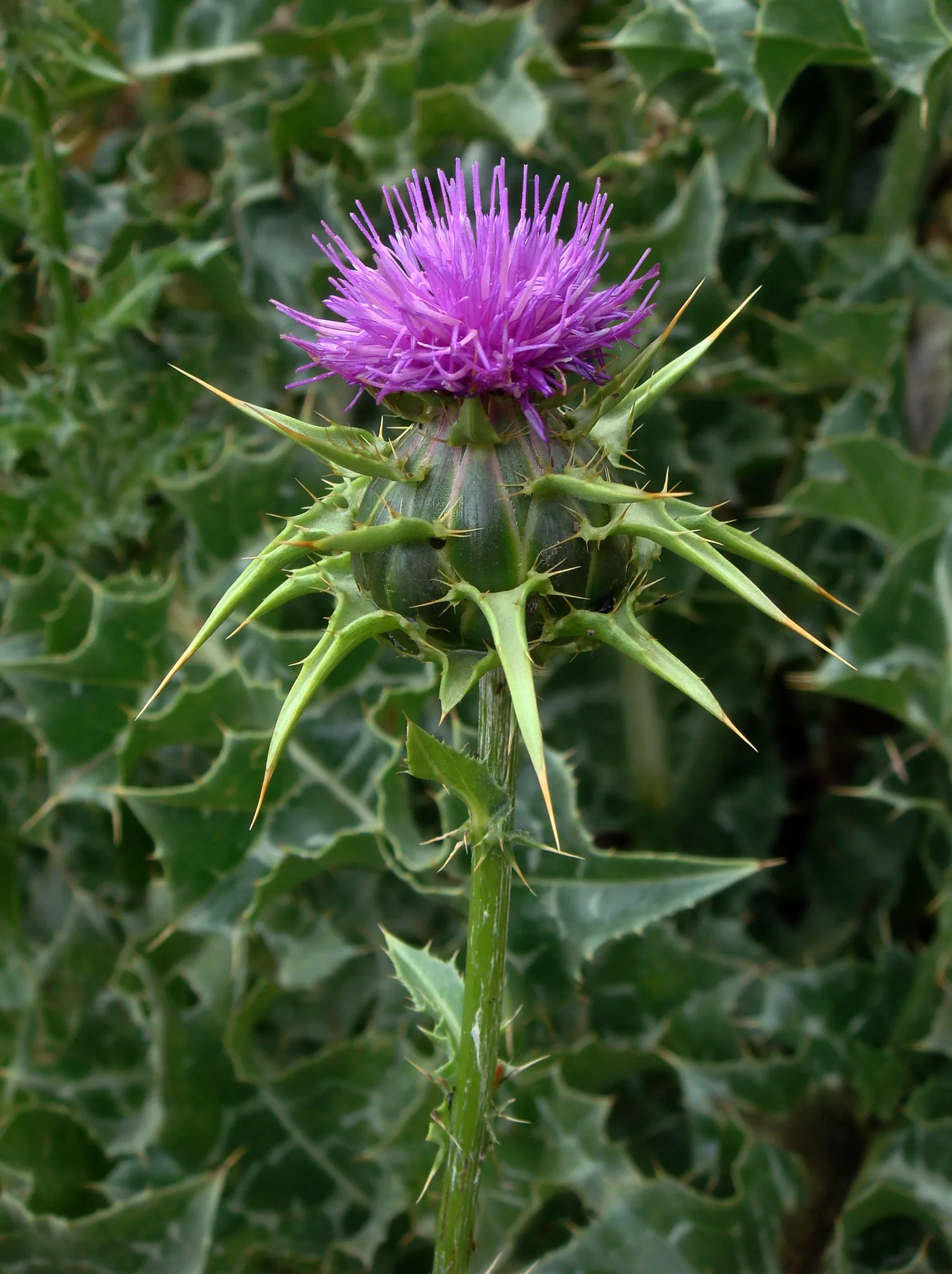

Cómo cultivar y cuidar Cardo mariano
Silybum marianum
Escrito por Emilio Marruso · última revisión
Tóxica para: Ganado · Por qué
De un vistazo
El cardo mariano es una planta agradecida que tolera suelos secos y húmedos y crece fácilmente de semilla sembrada a principios de primavera. Alcanza de 61 cm a 1,8 m de alto, y gran parte es comestible: las raíces hervidas recuerdan al salsifí, las cabezas florales sin abrir se cocinan como alcachofas y las hojas tiernas, sin espinas, van crudas en ensalada.
- Riego
Fácil de regar: tolera suelos tanto secos como húmedos
Qué dicen las fuentes (1)
Notas sobre el riego: Tolera tanto suelos secos como húmedos
They readily tolerate dry ands wet soils, so just let them be.
— Silybum Plant Growing & Care Guide for Gardeners [8] - Frío
Aguanta inviernos de hasta −28,9 °C (−20 °F)
Muy rústica · USDA 5 · RHS H7 · Z5
Qué dicen las fuentes (2)
Rusticidad, zona más fría: 5 [mínima invernal de −28,9 a −23,3 °C (de −20 a −10 °F)]
Milk thistle ( Silybum marianum , USDA zones 5-10) is a biennial flowering plant with medicinal properties.
— How To Grow Milk Thistle [6] Rusticidad, zona más cálida: 10 [mínima invernal de −1,1 a 4,4 °C (de 30 a 40 °F)]
Milk thistle ( Silybum marianum , USDA zones 5-10) is a biennial flowering plant with medicinal properties.
— How To Grow Milk Thistle [6] - Distancia
61–91 cm entre plantas
Qué dicen las fuentes (1)
Distancia de plantación: 61-91 cm (2-3 pies)
Once sprouted, thin plants to about 2 to 3 feet apart.
— How To Grow Milk Thistle [6] - Plantación
Planta tras la última helada de primavera si es anual, o a finales de verano si es bienal
Qué dicen las fuentes (1)
Plantación: Finales del verano para las bienales; después de la última helada de la primavera para las anuales
Transplant biennials in late summer, and annuals following the last frost of spring.
— Silybum Plant Growing & Care Guide for Gardeners [8] - Cosecha
Cabezas de semillas a finales de verano u otoño; hojas tiernas, tallos pelados y raíces hervidas son comestibles
Qué dicen las fuentes (1)
Cosecha: Finales del verano o el otoño (cabezas de semillas)
To harvest the seeds, remove the flowers once they start to turn brown. This will probably happen in the late summer or autumn.
— How To Grow Milk Thistle [6] - Plagas
Las babosas y los caracoles atacan los brotes nuevos
- Tamaño
De 61 cm a 1,8 m de alto
Qué dicen las fuentes (1)
Altura adulta: 61-183 cm (2-6 pies)
Plants range from 2-6 ft. (0.6-1.8 m) in height, depending on soil moisture.
— Silybum marianum, Blessed Milkthistle – Invasive Species [3] - Multiplicación
Se multiplica por semilla
Qué dicen las fuentes (2)
Propagación: Semilla
Seed - if sown in situ during early spring or mid spring, the plant will usually flower in the summer and complete its life cycle in one growing season
— Silybum marianum - Useful Temperate Plants [4] Start seeds indoors several weeks before your last frost date.
— How To Grow Milk Thistle [6] - Siembra
Siembra directa a principios de primavera, o de mayo a agosto para que florezca al año siguiente
Qué dicen las fuentes (3)
Siembra: Inicio de la primavera (siembra directa) o de mayo a agosto (las plantas florecen al año siguiente)
Seed - if sown in situ during early spring or mid spring, the plant will usually flower in the summer and complete its life cycle in one growing season
— Silybum marianum - Useful Temperate Plants [4] The seed can also be sown from May to August when the plant will normally wait until the following year to flower and thus behave as a biennial
— Silybum marianum - Useful Temperate Plants [4] You can direct-seed in the early spring if the soil is workable.
— How To Grow Milk Thistle [6] - Maceta
Crece también en maceta
Qué dicen las fuentes (1)
En maceta: Sí
Instead of planting directly in the ground, opt to grow milk thistle in containers .
— How To Grow Milk Thistle [6] - Seguridad
Puede ser tóxico para el ganado, sobre todo cuando está mustio por sequía, siega o herbicida
Resumen
El cardo mariano es una hierba anual o bienal originaria de la región mediterránea. [3] Se autosiembra con facilidad y se considera invasiva o una maleza nociva en muchos lugares. [6]
Citado en inglés, como en la fuente.
Esta ficha está incompleta: las fuentes consultadas aún no cubren todos los campos.
Aún no cubierto por nuestras fuentes: Luz
Cuidados
Riego
Tolera tanto suelos secos como húmedos
Qué dicen las fuentes (1)
They readily tolerate dry ands wet soils, so just let them be.Luz
No figura en las fuentes consultadas.
Clima y frío
Rusticidad, zona más fría
5 [mínima invernal de −28,9 a −23,3 °C (de −20 a −10 °F)]
Qué dicen las fuentes (1)
Milk thistle ( Silybum marianum , USDA zones 5-10) is a biennial flowering plant with medicinal properties.Rusticidad, zona más cálida
10 [mínima invernal de −1,1 a 4,4 °C (de 30 a 40 °F)]
Qué dicen las fuentes (1)
Milk thistle ( Silybum marianum , USDA zones 5-10) is a biennial flowering plant with medicinal properties.Dónde cultivarla
En maceta
Sí
Qué dicen las fuentes (1)
Instead of planting directly in the ground, opt to grow milk thistle in containers .Distancia de plantación
61-91 cm (2-3 pies)
Qué dicen las fuentes (1)
Once sprouted, thin plants to about 2 to 3 feet apart.Propagación
Semilla
Qué dicen las fuentes (2)
Seed - if sown in situ during early spring or mid spring, the plant will usually flower in the summer and complete its life cycle in one growing seasonStart seeds indoors several weeks before your last frost date.Cultivo
La planta
Ciclo de vida
anual o bienal
Qué dicen las fuentes (1)
Blessed milkthistle is an invasive annual/biennial herb native to the Mediterranean region.Familia
Asteraceae
Qué dicen las fuentes (1)
Asterales > Asteraceae > Silybum marianum (L.) Gaertn.
Synonym(s): blessed milk-thistle, milk thistle, spotted thistle, variegated thistleAltura adulta
61-183 cm (2-6 pies)
Qué dicen las fuentes (1)
Plants range from 2-6 ft. (0.6-1.8 m) in height, depending on soil moisture.Abonado
Abonos naturales
Las fuentes dan valores distintos según la región, la zona o las condiciones de cultivo.
Lo que dice cada fuente
ensayo de producción en campo, sin riego (Irán): Los biofertilizantes microbianos, completos (NPK) o fosfatados, compensan la pérdida de rendimiento sin riego
Qué dicen las fuentes (1)
ensayo de producción en campo, sin riego (Irán): the utilization of bio-fertilizers, specifically complete bio-fertilizer and phosphate, can effectively compensate for the decrease in yield by enhancing nutritional conditions.Problemas
Babosas y caracoles
Síntoma: Las babosas y los caracoles se sienten atraídos por el crecimiento.
Qué dicen las fuentes (1)
However, slugs and snails are often attracted to its weedy growth.
— How To Grow Milk Thistle [6]
Remedios
Cada remedio indica qué dicen las fuentes oficiales; los remedios tradicionales sin fuente oficial aparecen marcados. Los perjudiciales están para que sepas evitarlos.
Cómo eliminarla
infestación de cardo mariano
Arranca a mano y excava la raíz principal. Fuente oficial, sin prueba independiente
Milk thistle can be poisonous to livestock, especially during periods of wilt from drought, mowing, or herbicide treatment.
— Silybum marianum, Blessed Milkthistle – Invasive Species [3] Cómo: Excava o arranca a mano los cardos cuando hayan brotado pero aún no hayan florecido, eliminando la mayor parte de la raíz principal posible.
The best time to dig or hand-pull thistles is when they have bolted but not yet flowered.
— aces.edu [10] Corta el césped en la etapa tardía de brotación. Funciona en parte
Milk thistle can be poisonous to livestock, especially during periods of wilt from drought, mowing, or herbicide treatment.
— Silybum marianum, Blessed Milkthistle – Invasive Species [3] Cómo: Corta cuando los cardos alcancen la etapa tardía de brotación, cuando los botones florales comiencen a emerger.
Limited control can be achieved with mowing. The optimal time for mowing is when thistles reach the late bolting stage when flower buds begin to emerge.
— aces.edu [10] Qué dicen las pruebas Limited control can be achieved with mowing. The optimal time for mowing is when thistles reach the late bolting stage
— aces.edu [10]
Venenosa para los animales
Según la fuente, citada textualmente. No es un consejo médico ni veterinario: si una persona o un animal pudo haber ingerido esta planta, contacta con un centro de toxicología o con un veterinario.
Milk thistle can be poisonous to livestock, especially during periods of wilt from drought, mowing, or herbicide treatment.
[3]
Calendario
Inicio de la primavera (siembra directa) o de mayo a agosto (las plantas florecen al año siguiente)
Qué dicen las fuentes (3)
Seed - if sown in situ during early spring or mid spring, the plant will usually flower in the summer and complete its life cycle in one growing seasonThe seed can also be sown from May to August when the plant will normally wait until the following year to flower and thus behave as a biennialYou can direct-seed in the early spring if the soil is workable.Finales del verano para las bienales; después de la última helada de la primavera para las anuales
Qué dicen las fuentes (1)
Transplant biennials in late summer, and annuals following the last frost of spring.Finales del verano o el otoño (cabezas de semillas)
Qué dicen las fuentes (1)
To harvest the seeds, remove the flowers once they start to turn brown. This will probably happen in the late summer or autumn.Meses tal como los dan las fuentes, en su mayoría de Estados Unidos (hemisferio norte). En el hemisferio sur se desplazan unos seis meses.
Comestibilidad
Según la fuente, citada textualmente. No comas una planta basándote solo en esta página: los errores de identificación pueden ser peligrosos.
the boiled roots offer a delicate flavour similar to salsify, while the flower heads, gathered before opening, can be cooked much like artichokes.
[1]The youngest leaves, once stripped of their spines, are eaten raw in salads for their faint cucumber-like taste or cooked like spinach.
[1]The stems, if carefully peeled, are also edible both raw and cooked.
[1]
Valores orientativos
Valores de una fuente secundaria, no comprobados palabra por palabra como el resto de esta página. Úselos como punto de partida.
- Luz
- Pleno solValor orientativo, adáptalo a tu clima · Fuente secundaria
- Horas de sol
- 6-8 horasValor orientativo, adáptalo a tu clima · Fuente secundaria
- Riego
- PromedioValor orientativo, adáptalo a tu clima · Fuente secundaria
- Resiste la sequía
- SíValor orientativo, adáptalo a tu clima · Fuente secundaria
- pH del suelo
- 6-7.5Valor orientativo, adáptalo a tu clima · Fuente secundaria
- Crecimiento
- BajoValor orientativo, adáptalo a tu clima · Fuente secundaria
- Poda
- Mayo, junio, julio, mayo, junio, julioValor orientativo, adáptalo a tu clima · Fuente secundaria
Plantas similares
- Cempasúchil Tagetes erecta
- American Burnweed Erechtites hieraciifolius
- Margarita de Oregón Erigeron speciosus
- Autumn Goldenrod Solidago sphacelata
- Senecio azul Curio repens
- Blue Wood Aster Symphyotrichum cordifolium
- Boneset Eupatorium perfoliatum
- Brown knapweed Centaurea jacea
Fuentes
Cada valor anterior se cita de estos documentos. Los enlaces llevan al editor original.
- Silybum marianum (L.) Gaertn. – Giardino della Flora Appenninica · giardinocapracotta.unimol.it, consultado
- Silybum marianum (Milkthistle) | Botanical Profile | Pharmacognosy Institute (PHCI) | University of Illinois Chicago · pharmacognosy.pharmacy.uic.edu, consultado
- Silybum marianum, Blessed Milkthistle – Invasive Species · invasive-species.extension.org, consultado
- Silybum marianum - Useful Temperate Plants · temperate.theferns.info, consultado
- Silybum marianum Profile – California Invasive Plant Council · cal-ipc.org, consultado
- How To Grow Milk Thistle · hunker.com, consultado
- Silybum marianum | Encyclopedia of Puget Sound · eopugetsound.org, consultado
- Silybum Plant Growing & Care Guide for Gardeners · gardenershq.com, consultado
- pmc.ncbi.nlm.nih.gov · pmc.ncbi.nlm.nih.gov
- aces.edu · aces.edu
Escrito por Emilio Marruso · última revisión