
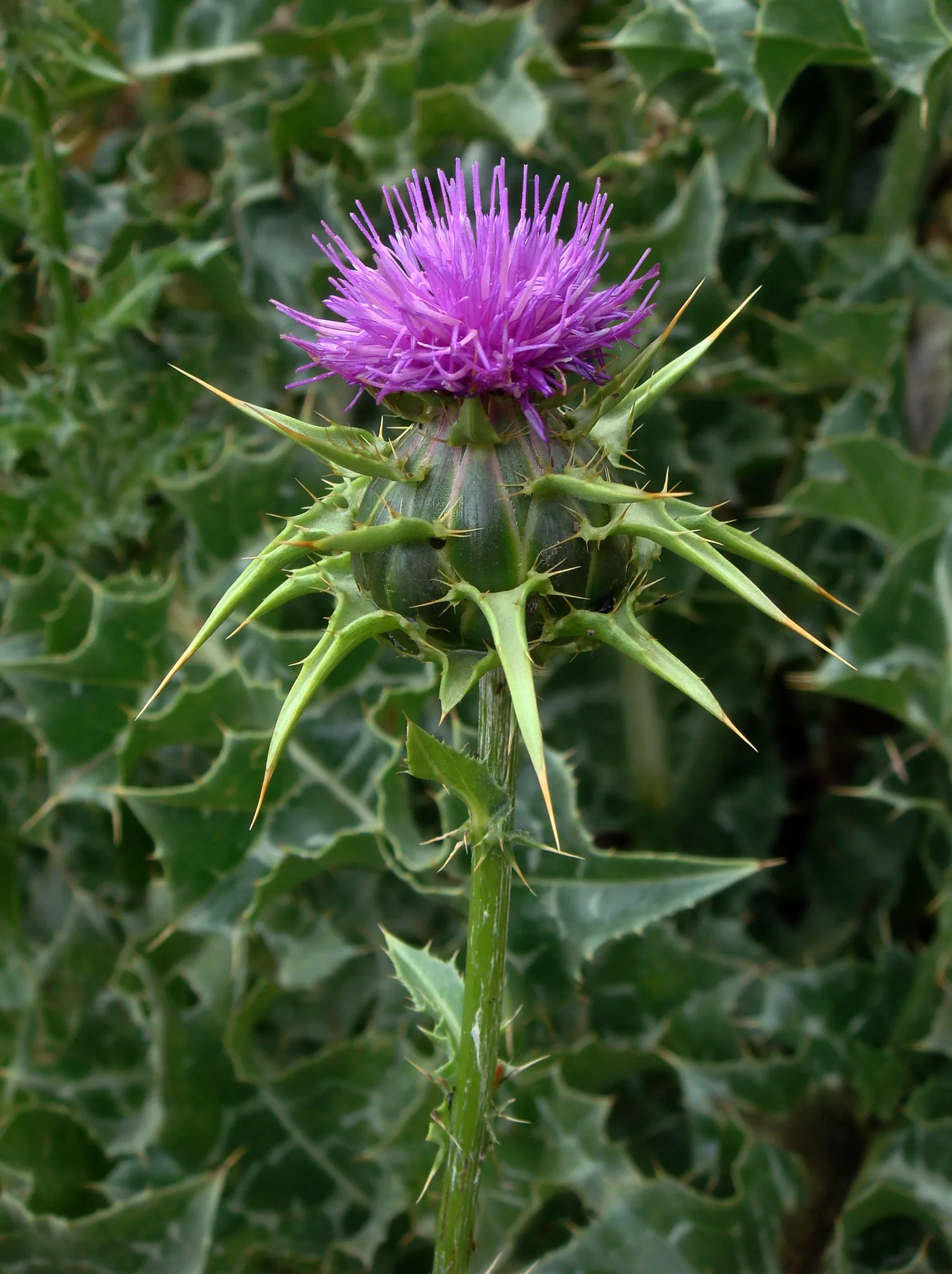

How to Grow and Care for Blessed milkthistle
Silybum marianum
Written by Emilio Marruso · last checked
Toxic to: Livestock · Why
At a glance
Milk thistle is an easygoing plant that tolerates both dry and wet soils and grows simply from seed sown in early spring. It reaches 2 to 6 feet tall, and much of it is edible: the boiled roots taste like salsify, the unopened flower heads cook like artichokes, and the young leaves, stripped of their spines, go raw into salads.
- Water
Easy to water: it tolerates both dry and wet soils
What the sources say (1)
Watering notes: Tolerates both dry and wet soils
They readily tolerate dry ands wet soils, so just let them be.
— Silybum Plant Growing & Care Guide for Gardeners [8] - Cold
Survives winters down to −20 °F (−28.9 °C)
Very hardy · USDA 5 · RHS H7 · Z5
What the sources say (2)
Hardiness, coldest zone: 5 [winter low −28.9 to −23.3 °C (−20 to −10 °F)]
Milk thistle ( Silybum marianum , USDA zones 5-10) is a biennial flowering plant with medicinal properties.
— How To Grow Milk Thistle [6] Hardiness, warmest zone: 10 [winter low −1.1 to 4.4 °C (30 to 40 °F)]
Milk thistle ( Silybum marianum , USDA zones 5-10) is a biennial flowering plant with medicinal properties.
— How To Grow Milk Thistle [6] - Spacing
2–3 ft between plants
What the sources say (1)
Spacing: 61-91 cm (2-3 ft)
Once sprouted, thin plants to about 2 to 3 feet apart.
— How To Grow Milk Thistle [6] - Planting
Plant out after the last spring frost as an annual, or in late summer as a biennial
What the sources say (1)
Planting: Late summer for biennials; after the last frost of spring for annuals
Transplant biennials in late summer, and annuals following the last frost of spring.
— Silybum Plant Growing & Care Guide for Gardeners [8] - Harvest
Seed heads in late summer or fall; young leaves, peeled stems and boiled roots are edible
What the sources say (1)
Harvest: Late summer or autumn (seed heads)
To harvest the seeds, remove the flowers once they start to turn brown. This will probably happen in the late summer or autumn.
— How To Grow Milk Thistle [6] - Pests
Slugs and snails love the new growth
- Size
2 to 6 ft tall
What the sources say (1)
Mature height: 61-183 cm (2-6 ft)
Plants range from 2-6 ft. (0.6-1.8 m) in height, depending on soil moisture.
— Silybum marianum, Blessed Milkthistle – Invasive Species [3] - Propagation
Grows from seed
What the sources say (2)
Propagation: Seed
Seed - if sown in situ during early spring or mid spring, the plant will usually flower in the summer and complete its life cycle in one growing season
— Silybum marianum - Useful Temperate Plants [4] Start seeds indoors several weeks before your last frost date.
— How To Grow Milk Thistle [6] - Sowing
Sow outdoors in early spring, or May to August to get flowers the following year
What the sources say (3)
Sowing: Early spring (direct sowing) or May to August (plants then flower the following year)
Seed - if sown in situ during early spring or mid spring, the plant will usually flower in the summer and complete its life cycle in one growing season
— Silybum marianum - Useful Temperate Plants [4] The seed can also be sown from May to August when the plant will normally wait until the following year to flower and thus behave as a biennial
— Silybum marianum - Useful Temperate Plants [4] You can direct-seed in the early spring if the soil is workable.
— How To Grow Milk Thistle [6] - Containers
Grows in containers too
What the sources say (1)
In containers: Yes
Instead of planting directly in the ground, opt to grow milk thistle in containers .
— How To Grow Milk Thistle [6] - Safety
Can be poisonous to livestock, especially when wilted by drought, mowing or weedkiller
Overview
Milk thistle is an annual or biennial herb native to the Mediterranean region. [3] It self-seeds readily and is considered invasive or a noxious weed in many places. [6]
This record is incomplete: the sources we read do not cover every field yet.
Not yet covered by our sources: Light
Blessed milkthistle care
How to water Blessed milkthistle
Tolerates both dry and wet soils
What the sources say (1)
They readily tolerate dry ands wet soils, so just let them be.How much light Blessed milkthistle needs
Not stated in the sources we read.
How much cold Blessed milkthistle can take
Hardiness, coldest zone
5 [winter low −28.9 to −23.3 °C (−20 to −10 °F)]
What the sources say (1)
Milk thistle ( Silybum marianum , USDA zones 5-10) is a biennial flowering plant with medicinal properties.Hardiness, warmest zone
10 [winter low −1.1 to 4.4 °C (30 to 40 °F)]
What the sources say (1)
Milk thistle ( Silybum marianum , USDA zones 5-10) is a biennial flowering plant with medicinal properties.Where to grow Blessed milkthistle
In containers
Yes
What the sources say (1)
Instead of planting directly in the ground, opt to grow milk thistle in containers .Spacing
61-91 cm (2-3 ft)
What the sources say (1)
Once sprouted, thin plants to about 2 to 3 feet apart.How to propagate Blessed milkthistle
Seed
What the sources say (2)
Seed - if sown in situ during early spring or mid spring, the plant will usually flower in the summer and complete its life cycle in one growing seasonStart seeds indoors several weeks before your last frost date.How to grow Blessed milkthistle
The plant
Life cycle
annual or biennial
What the sources say (1)
Blessed milkthistle is an invasive annual/biennial herb native to the Mediterranean region.Family
Asteraceae
What the sources say (1)
Asterales > Asteraceae > Silybum marianum (L.) Gaertn.
Synonym(s): blessed milk-thistle, milk thistle, spotted thistle, variegated thistleMature height
61-183 cm (2-6 ft)
What the sources say (1)
Plants range from 2-6 ft. (0.6-1.8 m) in height, depending on soil moisture.Fertilizing
Natural fertilizers
The sources give different values depending on region, zone or growing conditions.
What each source says
field production trial, without irrigation (Iran): Microbial biofertilizers, complete (NPK) or phosphate, offset the yield loss without irrigation
What the sources say (1)
field production trial, without irrigation (Iran): the utilization of bio-fertilizers, specifically complete bio-fertilizer and phosphate, can effectively compensate for the decrease in yield by enhancing nutritional conditions.Blessed milkthistle pests and problems
Slugs and snails
Symptom: Slugs and snails are attracted to the growth.
What the sources say (1)
However, slugs and snails are often attracted to its weedy growth.
— How To Grow Milk Thistle [6]
Remedies
Each remedy shows what official sources say about it; traditional remedies without an official source are marked as such. Harmful ones are listed so you know to avoid them.
Getting rid of it
milk thistle infestation
hand-pulling and digging out the taproot Official source, not independently tested
Milk thistle can be poisonous to livestock, especially during periods of wilt from drought, mowing, or herbicide treatment.
— Silybum marianum, Blessed Milkthistle – Invasive Species [3] How: Dig out or hand-pull thistles when they have bolted but not yet flowered, removing as much of the taproot as possible.
The best time to dig or hand-pull thistles is when they have bolted but not yet flowered.
— aces.edu [10] mowing at late bolting stage Partly works
Milk thistle can be poisonous to livestock, especially during periods of wilt from drought, mowing, or herbicide treatment.
— Silybum marianum, Blessed Milkthistle – Invasive Species [3] How: Mow when thistles reach the late bolting stage, when flower buds begin to emerge.
Limited control can be achieved with mowing. The optimal time for mowing is when thistles reach the late bolting stage when flower buds begin to emerge.
— aces.edu [10] What the evidence says Limited control can be achieved with mowing. The optimal time for mowing is when thistles reach the late bolting stage
— aces.edu [10]
Is Blessed milkthistle toxic to pets?
Reported by the source, quoted verbatim. This is not medical or veterinary advice: if a person or an animal may have eaten this plant, contact a poison control centre or a veterinarian.
Milk thistle can be poisonous to livestock, especially during periods of wilt from drought, mowing, or herbicide treatment.
[3]
Calendar
Early spring (direct sowing) or May to August (plants then flower the following year)
What the sources say (3)
Seed - if sown in situ during early spring or mid spring, the plant will usually flower in the summer and complete its life cycle in one growing seasonThe seed can also be sown from May to August when the plant will normally wait until the following year to flower and thus behave as a biennialYou can direct-seed in the early spring if the soil is workable.Late summer for biennials; after the last frost of spring for annuals
What the sources say (1)
Transplant biennials in late summer, and annuals following the last frost of spring.Late summer or autumn (seed heads)
What the sources say (1)
To harvest the seeds, remove the flowers once they start to turn brown. This will probably happen in the late summer or autumn.Months as given by the sources, which are mostly from the United States (northern hemisphere). In the southern hemisphere they shift by about six months.
Edibility
Reported by the source, quoted verbatim. Do not eat a plant on the basis of this page alone: identification mistakes can be dangerous.
the boiled roots offer a delicate flavour similar to salsify, while the flower heads, gathered before opening, can be cooked much like artichokes.
[1]The youngest leaves, once stripped of their spines, are eaten raw in salads for their faint cucumber-like taste or cooked like spinach.
[1]The stems, if carefully peeled, are also edible both raw and cooked.
[1]
Indicative values
Values from a secondary source, not checked word for word like the rest of this page. Use them as a starting point.
- Light
- Full sunIndicative value, adapt it to your climate · Secondary source
- Hours of sun
- 6-8 hoursIndicative value, adapt it to your climate · Secondary source
- Watering
- AverageIndicative value, adapt it to your climate · Secondary source
- Drought tolerant
- yesIndicative value, adapt it to your climate · Secondary source
- Soil pH
- 6-7.5Indicative value, adapt it to your climate · Secondary source
- Growth rate
- LowIndicative value, adapt it to your climate · Secondary source
- Pruning
- May, June, July, May, June, JulyIndicative value, adapt it to your climate · Secondary source
Similar plants
- African Marigold Tagetes erecta
- American Burnweed Erechtites hieraciifolius
- Aspen Fleabane Erigeron speciosus
- Autumn Goldenrod Solidago sphacelata
- Blue Chalksticks Curio repens
- Blue Wood Aster Symphyotrichum cordifolium
- Boneset Eupatorium perfoliatum
- Brown knapweed Centaurea jacea
Sources
Every value above is quoted from these documents. Links lead to the original publisher.
- Silybum marianum (L.) Gaertn. – Giardino della Flora Appenninica · giardinocapracotta.unimol.it, consulted
- Silybum marianum (Milkthistle) | Botanical Profile | Pharmacognosy Institute (PHCI) | University of Illinois Chicago · pharmacognosy.pharmacy.uic.edu, consulted
- Silybum marianum, Blessed Milkthistle – Invasive Species · invasive-species.extension.org, consulted
- Silybum marianum - Useful Temperate Plants · temperate.theferns.info, consulted
- Silybum marianum Profile – California Invasive Plant Council · cal-ipc.org, consulted
- How To Grow Milk Thistle · hunker.com, consulted
- Silybum marianum | Encyclopedia of Puget Sound · eopugetsound.org, consulted
- Silybum Plant Growing & Care Guide for Gardeners · gardenershq.com, consulted
- pmc.ncbi.nlm.nih.gov · pmc.ncbi.nlm.nih.gov
- aces.edu · aces.edu
Written by Emilio Marruso · last checked