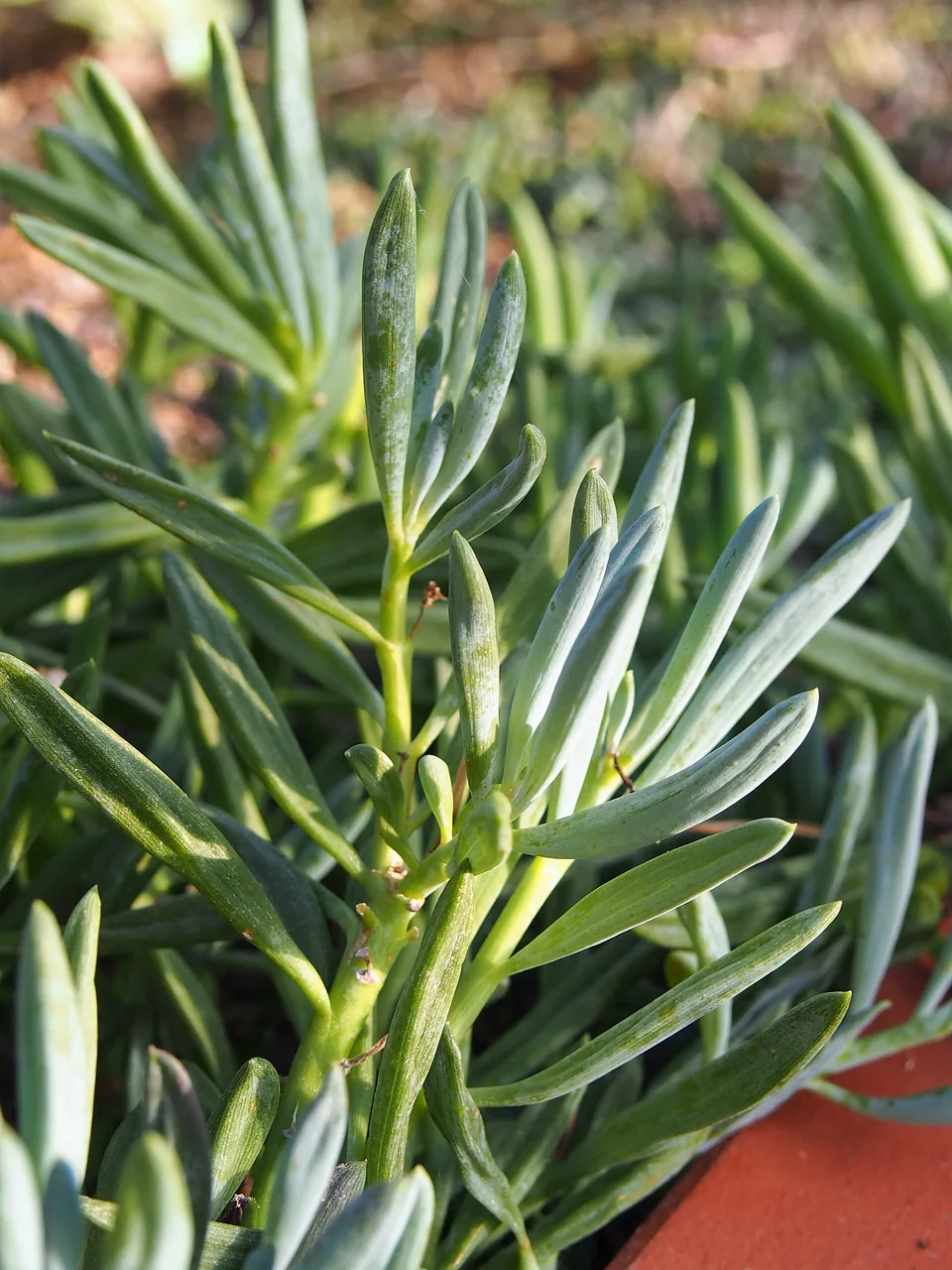


How to Grow and Care for Blue Chalksticks
Curio repens
Written by Emilio Marruso · last checked
Toxic to: Cats, Dogs, Horses, Cattle, People · Why
At a glance
Curio repens is a low, spreading perennial that stays just 6–8 inches tall while reaching 2–3 ft wide. It enjoys full sun to partial shade, grows happily indoors or in a pot, and only asks that you let the soil dry out between waterings. New plants are simple to start from stem cuttings, so one plant can soon become many.
- Sun
Full sun to partial shade; give it some shade where summers are very hot
What the sources say (1)
Light: Full sun to partial shade; partial shade is better tolerated in areas of intense heat
The plant can be grown in full sun to partial shade. In areas of intense heat, partial shade is better tolerated.
— Curio repens (Blue Chalksticks, Blue Chalk Sticks, Blue Toes, Snake Ragwort) | North Carolina Extension Gardener Plant Toolbox [1] - Water
Let the soil dry out between waterings; too much water rots the roots
What the sources say (2)
Watering: Allow the soil or potting medium to dry out between waterings; intolerant of overwatering
It is intolerant to overwatering, and it is best to allow the soil or potting medium to dry out between waterings.
— Curio repens (Blue Chalksticks, Blue Chalk Sticks, Blue Toes, Snake Ragwort) | North Carolina Extension Gardener Plant Toolbox [1] Watering notes: Overwatering and poor drainage can cause root rot; if underwatered, the plant will wilt and shrivel
Overwatering and poor drainage can cause root rot. If underwatered, the plant will wilt and shrivel.
— Curio repens (Blue Chalksticks, Blue Chalk Sticks, Blue Toes, Snake Ragwort) | North Carolina Extension Gardener Plant Toolbox [1] - Cold
Survives winters down to 25 °F (−3.9 °C)
Half hardy: mild winters or an unheated greenhouse · USDA 9b · RHS H3 · Z9
What the sources say (2)
Hardiness, coldest zone: 9b [winter low −3.9 to −1.1 °C (25 to 30 °F)]
USDA Plant Hardiness Zone: 9b, 10a, 10b, 11a, 11b, 12a, 12b
— Curio repens (Blue Chalksticks, Blue Chalk Sticks, Blue Toes, Snake Ragwort) | North Carolina Extension Gardener Plant Toolbox [1] Hardiness, warmest zone: 12b [winter low 12.8 to 15.6 °C (55 to 60 °F)]
USDA Plant Hardiness Zone: 9b, 10a, 10b, 11a, 11b, 12a, 12b
— Curio repens (Blue Chalksticks, Blue Chalk Sticks, Blue Toes, Snake Ragwort) | North Carolina Extension Gardener Plant Toolbox [1] - Pests
Aphids, scale, spider mites and whiteflies; root rot from overwatering
What the sources say (2)
Pests: aphids, scale, spider mites, whiteflies
Monitor of aphids, scale, spider mites, and whiteflies.
— Curio repens (Blue Chalksticks, Blue Chalk Sticks, Blue Toes, Snake Ragwort) | North Carolina Extension Gardener Plant Toolbox [1] Diseases: root rot
Overwatering and poor drainage can cause root rot.
— Curio repens (Blue Chalksticks, Blue Chalk Sticks, Blue Toes, Snake Ragwort) | North Carolina Extension Gardener Plant Toolbox [1] - Watch out
Without enough light the stems stretch out: give it plenty of sun
- Size
6–8 inches tall and 2–3 ft wide
What the sources say (2)
Mature height: 15.24-20.32 cm (6-8 in)
Blue chalksticks can grow up to 6 to 8 inches tall and 2 to 3 feet wide.
— Curio repens (Blue Chalksticks, Blue Chalk Sticks, Blue Toes, Snake Ragwort) | North Carolina Extension Gardener Plant Toolbox [1] Mature width: 60.96-91.44 cm (2-3 ft)
Blue chalksticks can grow up to 6 to 8 inches tall and 2 to 3 feet wide.
— Curio repens (Blue Chalksticks, Blue Chalk Sticks, Blue Toes, Snake Ragwort) | North Carolina Extension Gardener Plant Toolbox [1] - Propagation
Best from stem cuttings; also from seed
What the sources say (1)
Propagation: Stem cuttings (best); seeds
It best propagated by stem cuttings; however, it may also be propagated by seeds.
— Curio repens (Blue Chalksticks, Blue Chalk Sticks, Blue Toes, Snake Ragwort) | North Carolina Extension Gardener Plant Toolbox [1] - Containers
Grows well in pots and indoors too
What the sources say (2)
In containers: Yes
#groundcover #deer resistant #interesting leaves #container plant #poisonous if ingested
— Curio repens (Blue Chalksticks, Blue Chalk Sticks, Blue Toes, Snake Ragwort) | North Carolina Extension Gardener Plant Toolbox [1] Indoors: Yes
This plant is commonly used as a groundcover because of its mat-like habit, and it may also be used as a houseplant.
— Curio repens (Blue Chalksticks, Blue Chalk Sticks, Blue Toes, Snake Ragwort) | North Carolina Extension Gardener Plant Toolbox [1] - Safety
Toxic if eaten by people, cats, dogs or horses: it causes nausea and vomiting
Overview
Blue chalksticks is a creeping succulent groundcover from the Cape Province of South Africa that may also be used as a houseplant. [1] It grows in full sun to partial shade and should be allowed to dry out between waterings, being intolerant of overwatering. [1] The plant is toxic if ingested and contains pyrrolizidine alkaloids. [1]
This record is incomplete: the sources we read do not cover every field yet.
Not yet covered by our sources: Pruning
Blue Chalksticks care
How to water Blue Chalksticks
Watering
Allow the soil or potting medium to dry out between waterings; intolerant of overwatering
What the sources say (1)
It is intolerant to overwatering, and it is best to allow the soil or potting medium to dry out between waterings.Watering notes
Overwatering and poor drainage can cause root rot; if underwatered, the plant will wilt and shrivel
What the sources say (1)
Overwatering and poor drainage can cause root rot. If underwatered, the plant will wilt and shrivel.How much light Blue Chalksticks needs
Full sun to partial shade; partial shade is better tolerated in areas of intense heat
What the sources say (1)
The plant can be grown in full sun to partial shade. In areas of intense heat, partial shade is better tolerated.How much cold Blue Chalksticks can take
Hardiness, coldest zone
9b [winter low −3.9 to −1.1 °C (25 to 30 °F)]
What the sources say (1)
USDA Plant Hardiness Zone:
9b, 10a, 10b, 11a, 11b, 12a, 12bHardiness, warmest zone
12b [winter low 12.8 to 15.6 °C (55 to 60 °F)]
What the sources say (1)
USDA Plant Hardiness Zone:
9b, 10a, 10b, 11a, 11b, 12a, 12bWhere to grow Blue Chalksticks
Indoors
Yes
What the sources say (1)
This plant is commonly used as a groundcover because of its mat-like habit, and it may also be used as a houseplant.In containers
Yes
What the sources say (1)
#groundcover #deer resistant #interesting leaves #container plant #poisonous if ingestedHow to propagate Blue Chalksticks
Stem cuttings (best); seeds
What the sources say (1)
It best propagated by stem cuttings; however, it may also be propagated by seeds.How to grow Blue Chalksticks
The plant
Life cycle
perennial
What the sources say (1)
Blue chalksticks is a succulent herbaceous perennial native to the Cape Province of South Africa.Family
Asteraceae
What the sources say (1)
It is a member of the daisy family (Asteraceae).Mature height
15.24-20.32 cm (6-8 in)
What the sources say (1)
Blue chalksticks can grow up to 6 to 8 inches tall and 2 to 3 feet wide.Mature width
60.96-91.44 cm (2-3 ft)
What the sources say (1)
Blue chalksticks can grow up to 6 to 8 inches tall and 2 to 3 feet wide.Pests and diseases
Pests
aphids, scale, spider mites, whiteflies
What the sources say (1)
Monitor of aphids, scale, spider mites, and whiteflies.Diseases
root rot
What the sources say (1)
Overwatering and poor drainage can cause root rot.Blue Chalksticks pests and problems
Sap-sucking pests
Symptom: Aphids, scale, spider mites and whiteflies
What to do: Monitor the plant for these pests
What the sources say (1)
Monitor of aphids, scale, spider mites, and whiteflies.
— Curio repens (Blue Chalksticks, Blue Chalk Sticks, Blue Toes, Snake Ragwort) | North Carolina Extension Gardener Plant Toolbox [1] Root rot
Symptom: Root rot from overwatering and poor drainage
What to do: Avoid overwatering and ensure good drainage
What the sources say (1)
Overwatering and poor drainage can cause root rot. If underwatered, the plant will wilt and shrivel.
— Curio repens (Blue Chalksticks, Blue Chalk Sticks, Blue Toes, Snake Ragwort) | North Carolina Extension Gardener Plant Toolbox [1] Etiolation
Symptom: Stems stretching for light
What to do: Provide enough sunlight
What the sources say (1)
Etiolation (the stems stretching for light) can result from the lack of sunlight.
— Curio repens (Blue Chalksticks, Blue Chalk Sticks, Blue Toes, Snake Ragwort) | North Carolina Extension Gardener Plant Toolbox [1]
Remedies
Each remedy shows what official sources say about it; traditional remedies without an official source are marked as such. Harmful ones are listed so you know to avoid them.
Treating the plant
mealybugs
rubbing alcohol on a cotton swab Works
Be careful not to get the alcohol on the leaves of the plants as they may be damaged.
— extension.umd.edu [4] Make sure to test the soap and alcohol mixtures on a small portion of the plant prior to full application because some plants may be sensitive to soap or alcohol.
— planttalk.colostate.edu [5] How: Spot-treat minor infestations with a cotton swab dipped in isopropyl rubbing alcohol.
For minor infestations, mealybugs can be spot-treated using a cotton swab dipped in isopropyl rubbing alcohol, which dissolves their waxy coating.
— scienceinsights.org [3] What the evidence says Dipping a cotton swab in household alcohol and dabbing it on the individual mealybugs can control light infestations.
— extension.umd.edu [4] diluted rubbing alcohol spray Works
Make sure to test the soap and alcohol mixtures on a small portion of the plant prior to full application because some plants may be sensitive to soap or alcohol.
— planttalk.colostate.edu [5] How: For a wider infestation, spray a diluted solution of 70% isopropyl alcohol and water on the whole plant.
For a wider infestation, a diluted spray solution of 70% isopropyl alcohol and water can be applied to the entire plant.
— scienceinsights.org [3] What the evidence says For heavy infestations, spray a mixture of 10 percent rubbing alcohol and 90 percent water directly onto the insects.
— planttalk.colostate.edu [5]
scale
manual removal with a soft brush Not verified
Traditional remedy, not verified by an official source.
How: Gently scrape the insects off with a fingernail or a soft brush.
root rot
cutting away rotted roots Not verified
Traditional remedy, not verified by an official source.
How: Remove the plant from the pot and cut away black, soft or disintegrating roots with a sterile blade; air-dry the healthy parts for several days before replanting in fresh dry soil.
Is Blue Chalksticks toxic to pets?
Reported by the source, quoted verbatim. This is not medical or veterinary advice: if a person or an animal may have eaten this plant, contact a poison control centre or a veterinarian.
Animals
Problems: Poisonous to Humans Problem for Cats Problem for Children Problem for Dogs Problem for Horses
[1]- Poisonous parts
Poison Part: Flowers Fruits Leaves Roots Sap/Juice Seeds Stems
[1]- Toxic principle
Poison Toxic Principle: Pyrrolizidine alkaloids Causes Contact Dermatitis: No
[1]- Symptoms
Toxic if ingested by humans, pets, or livestock: loss of appetite, nausea and vomiting. If large amounts are ingested, it can cause irreversible liver disease.
[1]- Severity
This plant has low severity poison characteristics. See below
[1]
#partial shade tolerant #slow growing #full sun #problem for cattle #problem for horses
[1]- Poisonous parts
Poison Part: Flowers Fruits Leaves Roots Sap/Juice Seeds Stems
[1]- Toxic principle
Poison Toxic Principle: Pyrrolizidine alkaloids Causes Contact Dermatitis: No
[1]- Symptoms
Toxic if ingested by humans, pets, or livestock: loss of appetite, nausea and vomiting. If large amounts are ingested, it can cause irreversible liver disease.
[1]- Severity
This plant has low severity poison characteristics. See below
[1]
People
Poison Severity: Low Poison Symptoms: Toxic if ingested by humans, pets, or livestock: loss of appetite, nausea and vomiting.
[1]- Poisonous parts
Poison Part: Flowers Fruits Leaves Roots Sap/Juice Seeds Stems
[1]- Toxic principle
Poison Toxic Principle: Pyrrolizidine alkaloids Causes Contact Dermatitis: No
[1]- Symptoms
Toxic if ingested by humans, pets, or livestock: loss of appetite, nausea and vomiting. If large amounts are ingested, it can cause irreversible liver disease.
[1]- Severity
This plant has low severity poison characteristics. See below
[1]
Calendar
Pruning
Not stated in the sources we read.
Months as given by the sources, which are mostly from the United States (northern hemisphere). In the southern hemisphere they shift by about six months.
Similar plants
- String of Bananas Curio radicans
- String of Pearls Curio rowleyanus
- African Daisy Dimorphotheca pluvialis
- African Marigold Tagetes erecta
- Ageratum Ageratum houstonianum
- Alpine aster Aster alpinus
- Appalachian Blazing Star Liatris squarrulosa
- Appalachian Ironweed Vernonia glauca
Sources
Every value above is quoted from these documents. Links lead to the original publisher.
- Curio repens (Blue Chalksticks, Blue Chalk Sticks, Blue Toes, Snake Ragwort) | North Carolina Extension Gardener Plant Toolbox · plants.ces.ncsu.edu, consulted
- Blue Chalk Sticks - Curio repens | North Carolina Extension Gardener Plant Toolbox · plants.ces.ncsu.edu, consulted
- scienceinsights.org · scienceinsights.org
- extension.umd.edu · extension.umd.edu
- planttalk.colostate.edu · planttalk.colostate.edu
Written by Emilio Marruso · last checked