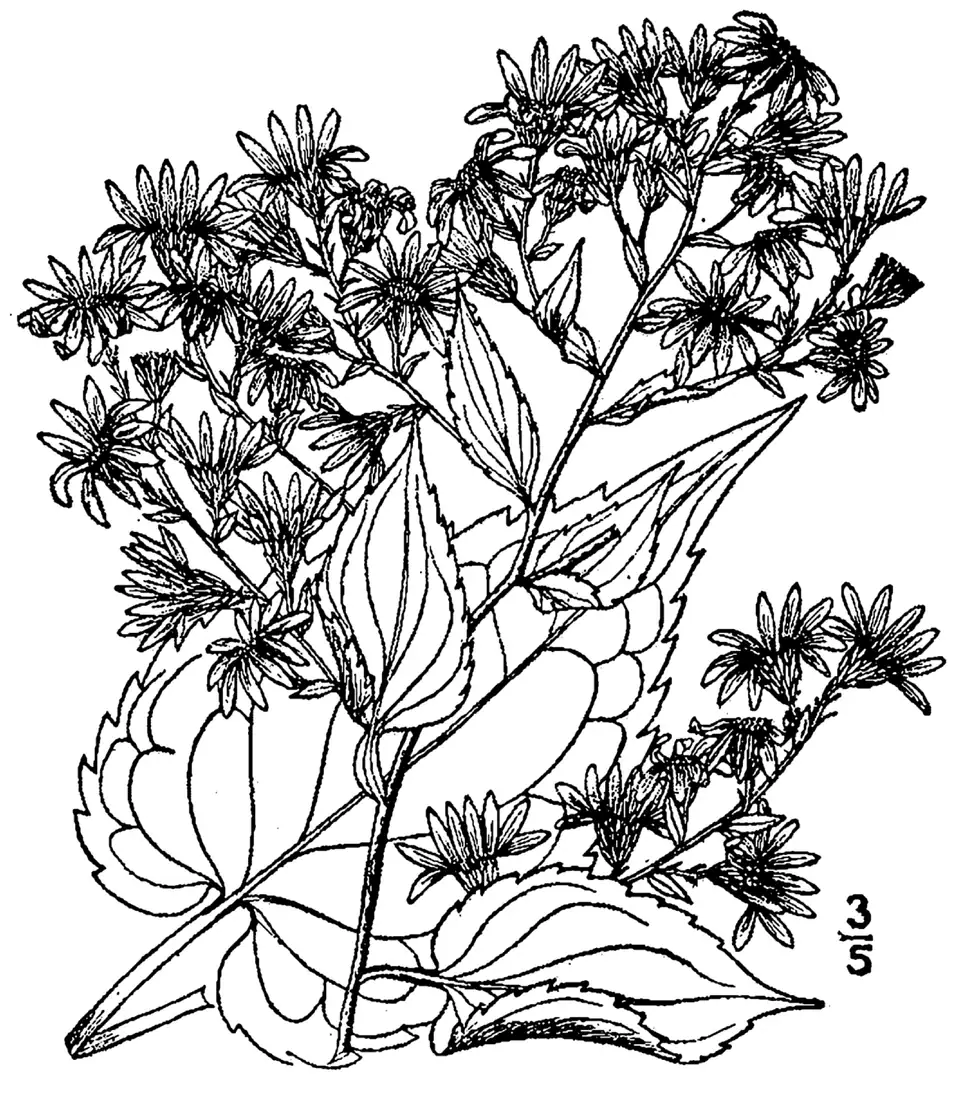


How to Grow and Care for Blue Wood Aster
Symphyotrichum cordifolium
Written by Emilio Marruso · last checked
At a glance
This perennial aster is happy in dappled light, partial shade or full sun, and grows 1 to 4 feet tall. Give it well-drained soil, moist or on the dry side, and good air around the leaves. Pinch the stems for a bushier plant, then cut it to the ground in late summer when the foliage fades.
- Sun
Partial shade is best; dappled light or full sun also work
What the sources say (2)
Light: Dappled sunlight, full sun or partial shade (prefers partial shade)
It prefers partial shady conditions in well-drained moist to dry soils.
— Symphyotrichum cordifolium (Blue Wood Aster, Common Blue Wood Aster, Heart-leaved Aster) | North Carolina Extension Gardener Plant Toolbox [1] Light: Dappled Sunlight (Shade through upper canopy all day) Full sun (6 or more hours of direct sunlight a day) Partial Shade (Direct sunlight only part of the day, 2-6 hours)
— Symphyotrichum cordifolium (Blue Wood Aster, Common Blue Wood Aster, Heart-leaved Aster) | North Carolina Extension Gardener Plant Toolbox [1] - Water
Likes soil from moist to dry, as long as it drains well
What the sources say (1)
Watering: Prefers well-drained moist to dry soils
It prefers partial shady conditions in well-drained moist to dry soils.
— Symphyotrichum cordifolium (Blue Wood Aster, Common Blue Wood Aster, Heart-leaved Aster) | North Carolina Extension Gardener Plant Toolbox [1] - Cold
Survives winters down to −40 °F (−40 °C)
Very hardy · USDA 3a · RHS H7 · Z3
What the sources say (2)
Hardiness, coldest zone: 3a [winter low −40 to −37.2 °C (−40 to −35 °F)]
USDA Plant Hardiness Zone: 3a, 3b, 4a, 4b, 5a, 5b, 6a, 6b, 7a, 7b, 8a, 8b
— Symphyotrichum cordifolium (Blue Wood Aster, Common Blue Wood Aster, Heart-leaved Aster) | North Carolina Extension Gardener Plant Toolbox [1] Hardiness, warmest zone: 8b [winter low −9.4 to −6.7 °C (15 to 20 °F)]
USDA Plant Hardiness Zone: 3a, 3b, 4a, 4b, 5a, 5b, 6a, 6b, 7a, 7b, 8a, 8b
— Symphyotrichum cordifolium (Blue Wood Aster, Common Blue Wood Aster, Heart-leaved Aster) | North Carolina Extension Gardener Plant Toolbox [1] - Soil
Avoid heavy clay that stays wet: it can cause aster wilt
What the sources say (1)
Watering notes: Aster wilt can occur in poorly-drained clay soils
Aster wilt can also be an occasional problem if plants are grown in poorly-drained clay soils.
— Symphyotrichum cordifolium (Blue Wood Aster, Common Blue Wood Aster, Heart-leaved Aster) | North Carolina Extension Gardener Plant Toolbox [1] - Pruning
Cut to the ground in late summer as the leaves fade; pinch stems for a bushier plant
What the sources say (1)
Pruning: Late summer, when the foliage declines (cut to the ground)
The foliage tends to decline by late summer and it can be cut to the ground to avoid any self-seeding and also to help with appearance.
— Symphyotrichum cordifolium (Blue Wood Aster, Common Blue Wood Aster, Heart-leaved Aster) | North Carolina Extension Gardener Plant Toolbox [1] - Pests
Powdery mildew, leaf spots and rust; good air flow helps
What the sources say (1)
Diseases: powdery mildew, leaf spots, rust, aster wilt
Some susceptibility to powdery mildew, leaf spots, or rust. Aster wilt can also be an occasional problem if plants are grown in poorly-drained clay soils.
— Symphyotrichum cordifolium (Blue Wood Aster, Common Blue Wood Aster, Heart-leaved Aster) | North Carolina Extension Gardener Plant Toolbox [1] - Watch out
Self-seeds readily and can turn weedy; tall plants may need staking
- Size
1 to 4 ft tall and 18 in to 2 ft wide
What the sources say (2)
Mature height: 30.48-121.92 cm (1-4 ft)
Dimensions: Height: 1 ft. 0 in. - 4 ft. 0 in. Width: 1 ft. 6 in. - 2 ft. 0 in.
— Symphyotrichum cordifolium (Blue Wood Aster, Common Blue Wood Aster, Heart-leaved Aster) | North Carolina Extension Gardener Plant Toolbox [1] Mature width: 45.72-60.96 cm (1 ft 6 in - 2 ft)
Dimensions: Height: 1 ft. 0 in. - 4 ft. 0 in. Width: 1 ft. 6 in. - 2 ft. 0 in.
— Symphyotrichum cordifolium (Blue Wood Aster, Common Blue Wood Aster, Heart-leaved Aster) | North Carolina Extension Gardener Plant Toolbox [1] - Propagation
Grows from seed
What the sources say (1)
Propagation: Seed
Recommended Propagation Strategy: Seed Country Or Region Of Origin: Canada to U.S.A
— Symphyotrichum cordifolium (Blue Wood Aster, Common Blue Wood Aster, Heart-leaved Aster) | North Carolina Extension Gardener Plant Toolbox [1]
Overview
Symphyotrichum cordifolium is a herbaceous perennial native to eastern and central North America that grows up to 4 feet [1.2 m] tall and 2 feet [61 cm] wide. [1] It prefers partial shade in well-drained moist to dry soils and produces light blue flowers from later summer to fall. [1] It self-seeds readily and can become weedy. [1]
Blue Wood Aster care
Measurements in square brackets are our conversion into the other unit system; the quoted text is unchanged.
How to water Blue Wood Aster
Watering
Prefers well-drained moist to dry soils
What the sources say (1)
It prefers partial shady conditions in well-drained moist to dry soils.Watering notes
Aster wilt can occur in poorly-drained clay soils
What the sources say (1)
Aster wilt can also be an occasional problem if plants are grown in poorly-drained clay soils.How much light Blue Wood Aster needs
Dappled sunlight, full sun or partial shade (prefers partial shade)
What the sources say (2)
It prefers partial shady conditions in well-drained moist to dry soils.Light:
Dappled Sunlight (Shade through upper canopy all day)
Full sun (6 or more hours of direct sunlight a day)
Partial Shade (Direct sunlight only part of the day, 2-6 hours)How much cold Blue Wood Aster can take
Hardiness, coldest zone
3a [winter low −40 to −37.2 °C (−40 to −35 °F)]
What the sources say (1)
USDA Plant Hardiness Zone:
3a, 3b, 4a, 4b, 5a, 5b, 6a, 6b, 7a, 7b, 8a, 8bHardiness, warmest zone
8b [winter low −9.4 to −6.7 °C (15 to 20 °F)]
What the sources say (1)
USDA Plant Hardiness Zone:
3a, 3b, 4a, 4b, 5a, 5b, 6a, 6b, 7a, 7b, 8a, 8bHow to propagate Blue Wood Aster
Seed
What the sources say (1)
Recommended Propagation Strategy:
Seed
Country Or Region Of Origin:
Canada to U.S.AHow to grow Blue Wood Aster
The plant
Life cycle
perennial
What the sources say (1)
Blue wood aster is a herbaceous perennial in the daisy famiy (Asteraceae) native to eastern and central North America.Family
Asteraceae
What the sources say (1)
Blue wood aster is a herbaceous perennial in the daisy famiy (Asteraceae) native to eastern and central North America.Mature height
30.48-121.92 cm (1-4 ft)
What the sources say (1)
Dimensions: Height: 1 ft. 0 in. - 4 ft. 0 in. Width: 1 ft. 6 in. - 2 ft. 0 in.Mature width
45.72-60.96 cm (1 ft 6 in - 2 ft)
What the sources say (1)
Dimensions: Height: 1 ft. 0 in. - 4 ft. 0 in. Width: 1 ft. 6 in. - 2 ft. 0 in.Pests and diseases
Diseases
powdery mildew, leaf spots, rust, aster wilt
What the sources say (1)
Some susceptibility to powdery mildew, leaf spots, or rust. Aster wilt can also be an occasional problem if plants are grown in poorly-drained clay soils.Blue Wood Aster pests and problems
Powdery mildew, leaf spots, rust
Symptom: Some susceptibility to powdery mildew, leaf spots, or rust
What to do: Good air circulation helps reduce the incidence of foliar diseases
What the sources say (2)
Some susceptibility to powdery mildew, leaf spots, or rust. Aster wilt can also be an occasional problem if plants are grown in poorly-drained clay soils.
— Symphyotrichum cordifolium (Blue Wood Aster, Common Blue Wood Aster, Heart-leaved Aster) | North Carolina Extension Gardener Plant Toolbox [1] Good air circulation helps reduce the incidence of foliar diseases.
— Symphyotrichum cordifolium (Blue Wood Aster, Common Blue Wood Aster, Heart-leaved Aster) | North Carolina Extension Gardener Plant Toolbox [1] Aster wilt
Symptom: Occasional problem in poorly-drained clay soils
What to do: Avoid poorly-drained clay soils
What the sources say (1)
Aster wilt can also be an occasional problem if plants are grown in poorly-drained clay soils.
— Symphyotrichum cordifolium (Blue Wood Aster, Common Blue Wood Aster, Heart-leaved Aster) | North Carolina Extension Gardener Plant Toolbox [1] Self-seeding and staking
Symptom: Readily self-seeds and can become weedy; taller plants may need support
What to do: Cut to the ground to avoid self-seeding; pinch back stems for a bushier plant
What the sources say (2)
The foliage tends to decline by late summer and it can be cut to the ground to avoid any self-seeding and also to help with appearance.
— Symphyotrichum cordifolium (Blue Wood Aster, Common Blue Wood Aster, Heart-leaved Aster) | North Carolina Extension Gardener Plant Toolbox [1] Pinching back the stems will lead to a bushier plant and hopefully avoid the need for staking.
— Symphyotrichum cordifolium (Blue Wood Aster, Common Blue Wood Aster, Heart-leaved Aster) | North Carolina Extension Gardener Plant Toolbox [1]
Remedies
Each remedy shows what official sources say about it; traditional remedies without an official source are marked as such. Harmful ones are listed so you know to avoid them.
Treating the plant
powdery mildew
baking soda and horticultural oil spray Works
How: Baking soda (1½ tablespoons) and a light weight (paraffin-based) horticultural oil (3 tablespoons) in water (1 gallon); apply every seven to 14 days from bud break until humid weather subsides.
A combination of baking soda (1½ tablespoons) and a light weight (i.e., paraffin-based) horticultural oil (3 tablespoons) in water (1 gallon) has also been shown to be effective.
— hort.extension.wisc.edu [5] What the evidence says A combination of baking soda (1½ tablespoons) and a light weight (i.e., paraffin-based) horticultural oil (3 tablespoons) in water (1 gallon) has also been shown to be effective.
— hort.extension.wisc.edu [5]
lace bugs
insecticidal soap spray Partly works
How: Insecticidal soaps and horticultural oils are toxic to nymphs and adults but do not kill eggs and give no residual control.
Insecticidal soaps and horticultural oils are toxic to nymphs and adults, but they do not kill eggs nor do they provide any residual control
— content.ces.ncsu.edu [6] What the evidence says Insecticidal soaps and horticultural oils are toxic to nymphs and adults, but they do not kill eggs nor do they provide any residual control
— content.ces.ncsu.edu [6] cutting the plants back Partly works
How: If plants are too heavily damaged, cut them back drastically; they should regrow, though blooming may be delayed or prevented that year.
If plants become too heavily damaged, where they may not flower well anyway, then you have little to lose by cutting the plants back drastically.
— ask.extension.org [7] What the evidence says cutting the plants back drastically. They should regrow and be fine (although, depending on when this is done, blooming may be delayed or prevented for that year)
— ask.extension.org [7] clean up plant debris Partly works
How: Thoroughly clean up plant debris around plants that had outbreaks, to limit the overwintering adults.
around plants that have had outbreaks of pests or diseases, a through clean-up of plant debris may help to limit the overwintering population.
— ask.extension.org [7] What the evidence says around plants that have had outbreaks of pests or diseases, a through clean-up of plant debris may help to limit the overwintering population.
— ask.extension.org [7]
self-seeding
cut foliage to the ground and deadhead Works
How: Cut the plant to the ground in late summer to prevent seeding; deadhead spent flowers to keep it from becoming too weedy.
This self-sowing native aster can be cut to the ground to prohibit seeding and to maintain a tidy appearance in the landscape in late summer. Deadheading spent flowers will also help prevent it from becoming too weedy.
— gardeningknowhow.com [8] What the evidence says The foliage tends to decline by late summer and it can be cut to the ground to avoid any self-seeding and also to help with appearance.
— Symphyotrichum cordifolium (Blue Wood Aster, Common Blue Wood Aster, Heart-leaved Aster) | North Carolina Extension Gardener Plant Toolbox [1]
Getting rid of it
unwanted aster spreading
hand-pulling Not verified
Traditional remedy, not verified by an official source.
How: Pulling is easiest when the soil is moist.
Calendar
Pruning
Late summer, when the foliage declines (cut to the ground)
What the sources say (1)
The foliage tends to decline by late summer and it can be cut to the ground to avoid any self-seeding and also to help with appearance.Months as given by the sources, which are mostly from the United States (northern hemisphere). In the southern hemisphere they shift by about six months.
Indicative values
Values from a secondary source, not checked word for word like the rest of this page. Use them as a starting point.
- Hours of sun
- 6-8 hoursIndicative value, adapt it to your climate · Secondary source
- Drought tolerant
- yesIndicative value, adapt it to your climate · Secondary source
- Soil
- Sandy Loamy ClayIndicative value, adapt it to your climate · Secondary source
- Soil pH
- 5.5-7.5Indicative value, adapt it to your climate · Secondary source
- Care level
- MediumIndicative value, adapt it to your climate · Secondary source
- Growth rate
- LowIndicative value, adapt it to your climate · Secondary source
Similar plants
- Aromatic Aster Symphyotrichum oblongifolium
- Aster Symphyotrichum lateriflorum
- Barrens Silky Aster Symphyotrichum pratense
- Bushy Aster Symphyotrichum dumosum
- Crooked-stemmed Aster Symphyotrichum prenanthoides
- Eastern Silvery Aster Symphyotrichum concolor
- Frost Aster Symphyotrichum pilosum
- Georgia Aster Symphyotrichum georgianum
Sources
Every value above is quoted from these documents. Links lead to the original publisher.
- Symphyotrichum cordifolium (Blue Wood Aster, Common Blue Wood Aster, Heart-leaved Aster) | North Carolina Extension Gardener Plant Toolbox · plants.ces.ncsu.edu, consulted
- Symphyotrichum (Aster, Michaelmas daisy) | North Carolina Extension Gardener Plant Toolbox · plants.ces.ncsu.edu, consulted
- Heart-leaved Aster - Symphyotrichum cordifolium | North Carolina Extension Gardener Plant Toolbox · plants.ces.ncsu.edu, consulted
- Blue Wood Aster - Symphyotrichum cordifolium | North Carolina Extension Gardener Plant Toolbox · plants.ces.ncsu.edu, consulted
- hort.extension.wisc.edu · hort.extension.wisc.edu
- content.ces.ncsu.edu · content.ces.ncsu.edu
- ask.extension.org · ask.extension.org
- gardeningknowhow.com · gardeningknowhow.com
Written by Emilio Marruso · last checked