

How to Grow and Care for Aster
Symphyotrichum lateriflorum
Written by Emilio Marruso · last checked
At a glance
This easygoing perennial comes back year after year and asks for very little. Give it full sun or partial shade and moist, well-drained soil, with extra water during dry spells. In late spring, pinch it back for a shorter, bushier plant, and make more plants by dividing the clumps or sowing seed.
- Sun
Full sun to partial shade
What the sources say (1)
Light: Full sun to partial shade
Calico aster grows in clumps from 1 to 4 feet tall in full sun to partial shade.
— Symphyotrichum lateriflorum (Aster, Calico Aster, Side-Flowering Aster, Starved Aster) | North Carolina Extension Gardener Plant Toolbox [1] - Water
Keep the soil moist; water during dry spells
What the sources say (1)
Watering: Moist, well-drained soil; provide water during drought
Grow in moist, well-drained soils and provide water during drought conditions.
— Symphyotrichum lateriflorum (Aster, Calico Aster, Side-Flowering Aster, Starved Aster) | North Carolina Extension Gardener Plant Toolbox [1] - Cold
Survives winters down to −30 °F (−34.4 °C)
Very hardy · USDA 4a · RHS H7 · Z4
What the sources say (2)
Hardiness, coldest zone: 4a [winter low −34.4 to −31.7 °C (−30 to −25 °F)]
USDA Plant Hardiness Zone: 4a, 4b, 5a, 5b, 6a, 6b, 7a, 7b, 8a, 8b
— Symphyotrichum lateriflorum (Aster, Calico Aster, Side-Flowering Aster, Starved Aster) | North Carolina Extension Gardener Plant Toolbox [1] Hardiness, warmest zone: 8b [winter low −9.4 to −6.7 °C (15 to 20 °F)]
USDA Plant Hardiness Zone: 4a, 4b, 5a, 5b, 6a, 6b, 7a, 7b, 8a, 8b
— Symphyotrichum lateriflorum (Aster, Calico Aster, Side-Flowering Aster, Starved Aster) | North Carolina Extension Gardener Plant Toolbox [1] - Soil
Moist, well-drained soil, pH 6.0–8.0
What the sources say (3)
Watering: Moist, well-drained soil; provide water during drought
Grow in moist, well-drained soils and provide water during drought conditions.
— Symphyotrichum lateriflorum (Aster, Calico Aster, Side-Flowering Aster, Starved Aster) | North Carolina Extension Gardener Plant Toolbox [1] Soil pH, minimum: 6.0
Soil pH: Neutral (6.0-8.0) Soil Drainage: Good Drainage
— Symphyotrichum lateriflorum (Aster, Calico Aster, Side-Flowering Aster, Starved Aster) | North Carolina Extension Gardener Plant Toolbox [1] Soil pH, maximum: 8.0
Soil pH: Neutral (6.0-8.0) Soil Drainage: Good Drainage
— Symphyotrichum lateriflorum (Aster, Calico Aster, Side-Flowering Aster, Starved Aster) | North Carolina Extension Gardener Plant Toolbox [1] - Pruning
Pinch back in late spring for a shorter, bushier plant
What the sources say (1)
Pruning: Late spring (pinch back for a shorter, bushier plant)
Plants can be pinched back in late spring for a shorter, bushier plant.
— Symphyotrichum lateriflorum (Aster, Calico Aster, Side-Flowering Aster, Starved Aster) | North Carolina Extension Gardener Plant Toolbox [1] - Size
1 to 2 ft wide
What the sources say (1)
Mature width: 30-61 cm (1 to 2 ft)
Dimensions: Height: 2 ft. 0 in. - 4 ft. 0 in. Width: 1 ft. 0 in. - 2 ft. 0 in.
— Symphyotrichum lateriflorum (Aster, Calico Aster, Side-Flowering Aster, Starved Aster) | North Carolina Extension Gardener Plant Toolbox [1] - Propagation
Grow new plants from seed or by dividing the clumps
What the sources say (1)
Propagation: Seed, division
Propagation is by seed or division. Plants can
— Symphyotrichum lateriflorum (Aster, Calico Aster, Side-Flowering Aster, Starved Aster) | North Carolina Extension Gardener Plant Toolbox [1]
Overview
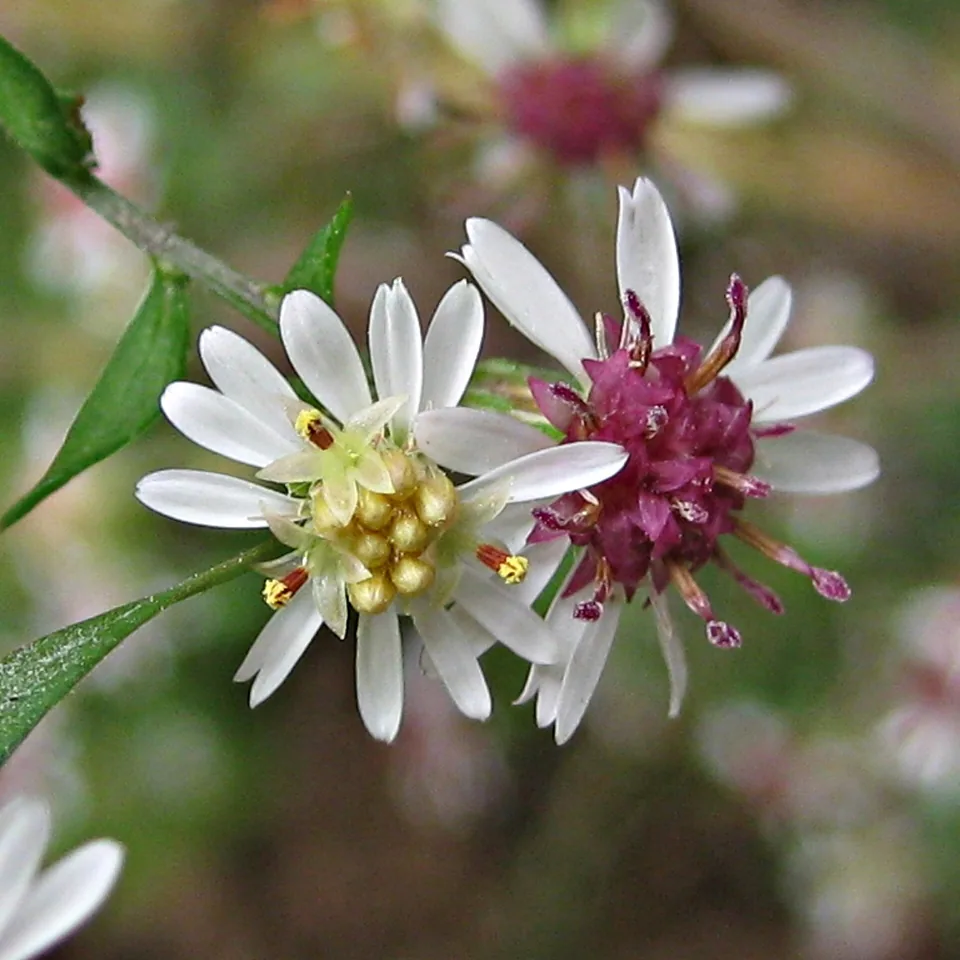
Calico aster is a clumping native perennial of the daisy family, 1 to 4 feet [0.3–1.2 m] tall, with many small white-rayed flowers. [1] It prefers moist, well-drained soil with water during drought, and is propagated by seed or division. [1]
Aster care
Measurements in square brackets are our conversion into the other unit system; the quoted text is unchanged.
How to water Aster
Moist, well-drained soil; provide water during drought
What the sources say (1)
Grow in moist, well-drained soils and provide water during drought conditions.How much light Aster needs
Full sun to partial shade
What the sources say (1)
Calico aster grows in clumps from 1 to 4 feet tall in full sun to partial shade.How much cold Aster can take
Hardiness, coldest zone
4a [winter low −34.4 to −31.7 °C (−30 to −25 °F)]
What the sources say (1)
USDA Plant Hardiness Zone:
4a, 4b, 5a, 5b, 6a, 6b, 7a, 7b, 8a, 8bHardiness, warmest zone
8b [winter low −9.4 to −6.7 °C (15 to 20 °F)]
What the sources say (1)
USDA Plant Hardiness Zone:
4a, 4b, 5a, 5b, 6a, 6b, 7a, 7b, 8a, 8bBest soil for Aster
Soil pH, minimum
6.0
What the sources say (1)
Soil pH:
Neutral (6.0-8.0)
Soil Drainage:
Good DrainageSoil pH, maximum
8.0
What the sources say (1)
Soil pH:
Neutral (6.0-8.0)
Soil Drainage:
Good DrainageHow to propagate Aster
Seed, division
What the sources say (1)
Propagation is by seed or division. Plants canHow to grow Aster
The plant
Life cycle
perennial
What the sources say (1)
The calico aster is a perennial herbaceous plant in the daisy family (Asteraceae) native to the eastern half of North America.Family
Asteraceae
What the sources say (1)
The calico aster is a perennial herbaceous plant in the daisy family (Asteraceae) native to the eastern half of North America.Mature height
Mature width
30-61 cm (1 to 2 ft)
What the sources say (1)
Dimensions:
Height: 2 ft. 0 in. - 4 ft. 0 in.
Width: 1 ft. 0 in. - 2 ft. 0 in.Remedies
Each remedy shows what official sources say about it; traditional remedies without an official source are marked as such. Harmful ones are listed so you know to avoid them.
Treating the plant
lace bugs
strong water spray Works
How: The first approach is to spray nymphs and adults with heavy streams of water. To remove Chrysanthemum lace bugs, direct the spray to the upper AND underside of leaves.
The first approach is to spray nymphs and adults with heavy streams of water. To remove Chrysanthemum lace bugs, direct the spray to the upper AND underside of leaves.
— bygl.osu.edu [4] What the evidence says they can be hosed off of the plant with a strong spray of plain water from a garden hose.
— ask.extension.org [5] insecticidal soap spray Partly works
Follow all product label directions for use, and do not spray open flowers.
— ask.extension.org [5] How: Insecticidal soaps and horticultural oils that control insects through direct contact can also be applied.
Additionally, insecticidal soaps and horticultural oils that control insects through direct contact can also be applied.
— bygl.osu.edu [4] What the evidence says you could consider spraying with either horticultural oil or insecticidal soap.
— ask.extension.org [5] horticultural oil spray Partly works
Follow all product label directions for use, and do not spray open flowers.
— ask.extension.org [5] How: Insecticidal soaps and horticultural oils that control insects through direct contact can also be applied.
Additionally, insecticidal soaps and horticultural oils that control insects through direct contact can also be applied.
— bygl.osu.edu [4] What the evidence says you could consider spraying with either horticultural oil or insecticidal soap.
— ask.extension.org [5] cutting plants back Partly works
How: If plants become too heavily damaged, where they may not flower well anyway, then you have little to lose by cutting the plants back drastically.
If plants become too heavily damaged, where they may not flower well anyway, then you have little to lose by cutting the plants back drastically.
— ask.extension.org [6] What the evidence says If plants become too heavily damaged, where they may not flower well anyway, then you have little to lose by cutting the plants back drastically.
— ask.extension.org [6] clearing plant debris Partly works
How: Around plants that have had outbreaks of pests or diseases, a through clean-up of plant debris may help to limit the overwintering population.
Therefore, around plants that have had outbreaks of pests or diseases, a through clean-up of plant debris may help to limit the overwintering population.
— ask.extension.org [6] What the evidence says Therefore, around plants that have had outbreaks of pests or diseases, a through clean-up of plant debris may help to limit the overwintering population.
— ask.extension.org [6]
Calendar
Pruning
Late spring (pinch back for a shorter, bushier plant)
What the sources say (1)
Plants can be pinched back in late spring for a shorter, bushier plant.Months as given by the sources, which are mostly from the United States (northern hemisphere). In the southern hemisphere they shift by about six months.
Indicative values
Values from a secondary source, not checked word for word like the rest of this page. Use them as a starting point.
- Hours of sun
- 5-7 hoursIndicative value, adapt it to your climate · Secondary source
- Drought tolerant
- yesIndicative value, adapt it to your climate · Secondary source
- Soil
- Well-drainedIndicative value, adapt it to your climate · Secondary source
- Care level
- MediumIndicative value, adapt it to your climate · Secondary source
- Growth rate
- HighIndicative value, adapt it to your climate · Secondary source
- Pests
- Fungal leaf spot, Mites, Mold, Nematodes, Rust, Slugs, snails, Rabbit resistantIndicative value, adapt it to your climate · Secondary source
Similar plants
- Aromatic Aster Symphyotrichum oblongifolium
- Barrens Silky Aster Symphyotrichum pratense
- Blue Wood Aster Symphyotrichum cordifolium
- Bushy Aster Symphyotrichum dumosum
- Crooked-stemmed Aster Symphyotrichum prenanthoides
- Eastern Silvery Aster Symphyotrichum concolor
- Frost Aster Symphyotrichum pilosum
- Georgia Aster Symphyotrichum georgianum
Sources
Every value above is quoted from these documents. Links lead to the original publisher.
- Symphyotrichum lateriflorum (Aster, Calico Aster, Side-Flowering Aster, Starved Aster) | North Carolina Extension Gardener Plant Toolbox · plants.ces.ncsu.edu, consulted
- Calico Aster - Symphyotrichum lateriflorum | North Carolina Extension Gardener Plant Toolbox · plants.ces.ncsu.edu, consulted
- Symphyotrichum (Aster, Michaelmas daisy) | North Carolina Extension Gardener Plant Toolbox · plants.ces.ncsu.edu, consulted
- bygl.osu.edu · bygl.osu.edu
- ask.extension.org · ask.extension.org
- ask.extension.org · ask.extension.org
Written by Emilio Marruso · last checked