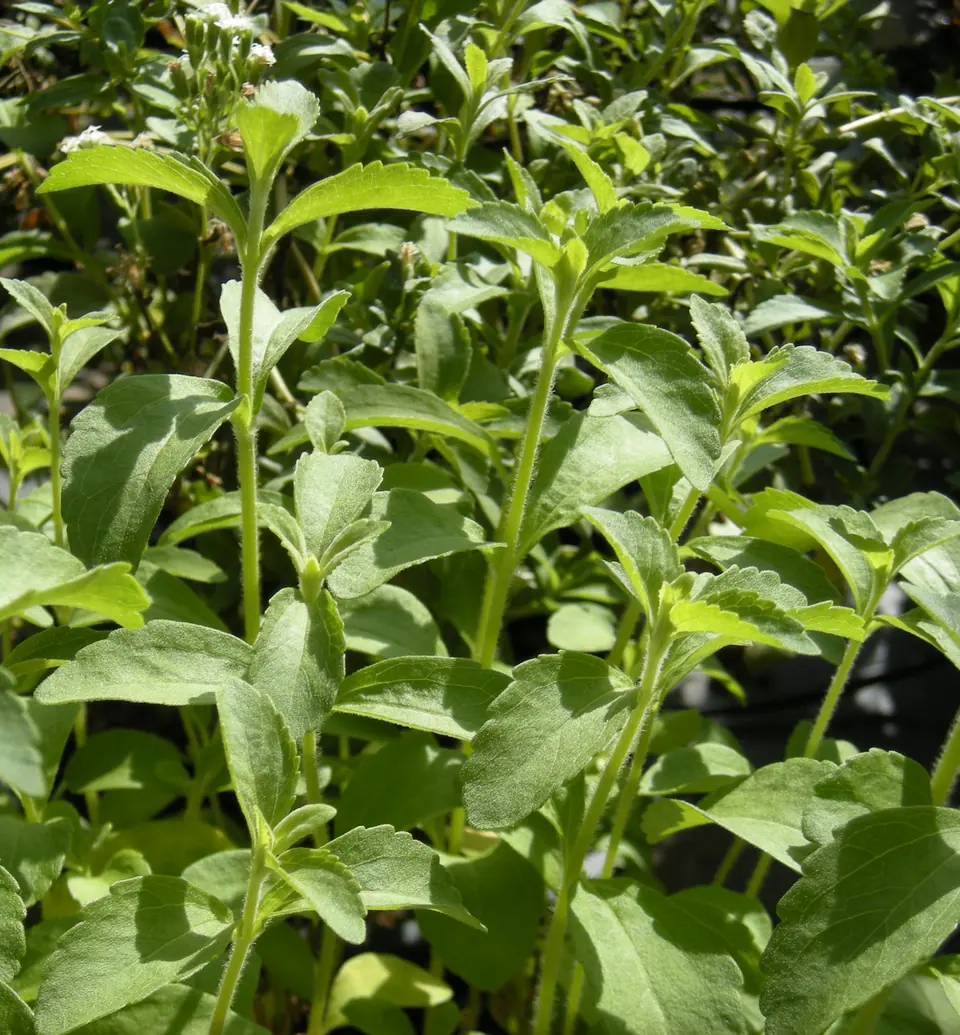


Cómo cultivar y cuidar Estevia
Stevia rebaudiana
Escrito por Emilio Marruso · última revisión
No tóxica para gatos y perros, según las fuentes · Fuentes
De un vistazo
La estevia es una dulce sorpresa: sus hojas endulzan las infusiones y se pueden comer frescas, recién cogidas de la planta. Le gusta el sol pleno o la semisombra, se queda en 30–60 cm y crece feliz en maceta, incluso en interior. Mantén la tierra húmeda sin encharcarla y, a los 90 días de plantarla, podrás empezar a cosechar hojas para secarlas o hacer infusiones.
- Sol
Sol pleno o semisombra
Qué dicen las fuentes (1)
Luz: Pleno sol a semisombra
Sweet leaf prefers full sun and will tolerate partial shade
— Stevia rebaudiana (Candy Leaf, Stevia, Sugar Leaf, Sweet Herb of Paraguay, Sweet Honey Leaf, Sweet Leaf) | North Carolina Extension Gardener Plant Toolbox [1] - Riego
Mantén la tierra húmeda sin pasarte: el exceso de agua pudre las raíces
Qué dicen las fuentes (4)
Riego: Mantén el suelo húmedo pero no lo riegues en exceso
Make sure to keep the soil moist but don’t overwater, which can cause root rot.
— Stevia – Gardening Solutions [3] requires moist, well-drained, slightly acidic, organically rich, loamy, sandy soils
— Stevia rebaudiana (Candy Leaf, Stevia, Sugar Leaf, Sweet Herb of Paraguay, Sweet Honey Leaf, Sweet Leaf) | North Carolina Extension Gardener Plant Toolbox [1] Notas sobre el riego: El riego excesivo puede causar pudrición de la raíz
Insects, Diseases, and Other Plant Problems: It has no known serious insect or diseases problems. Monitor for aphids and spider mites. Overwatering can cause root rot.
— Stevia rebaudiana (Candy Leaf, Stevia, Sugar Leaf, Sweet Herb of Paraguay, Sweet Honey Leaf, Sweet Leaf) | North Carolina Extension Gardener Plant Toolbox [1] Mulching around the plant can help trap moisture and reduce weeds.
— Stevia – Gardening Solutions [3] - Frío
Aguanta inviernos de hasta −1,1 °C (30 °F)
Semirrústica: inviernos suaves o invernadero sin calefacción · USDA 10a · RHS H3 · Z10
Qué dicen las fuentes (2)
Rusticidad, zona más fría: 10a [mínima invernal de −1,1 a 1,7 °C (de 30 a 35 °F)]
Available Space To Plant: 12 inches-3 feet USDA Plant Hardiness Zone: 10a, 10b, 11a, 11b
— Stevia rebaudiana (Candy Leaf, Stevia, Sugar Leaf, Sweet Herb of Paraguay, Sweet Honey Leaf, Sweet Leaf) | North Carolina Extension Gardener Plant Toolbox [1] Rusticidad, zona más cálida: 11b [mínima invernal de 7,2 a 10 °C (de 45 a 50 °F)]
Available Space To Plant: 12 inches-3 feet USDA Plant Hardiness Zone: 10a, 10b, 11a, 11b
— Stevia rebaudiana (Candy Leaf, Stevia, Sugar Leaf, Sweet Herb of Paraguay, Sweet Honey Leaf, Sweet Leaf) | North Carolina Extension Gardener Plant Toolbox [1] - Abonado
Abona cada 4–6 semanas durante la temporada de crecimiento
Qué dicen las fuentes (2)
Cuándo: Durante la temporada de crecimiento
It is recommended to fertilize the plants about every 4 to 6 weeks during the growing season.
— Stevia rebaudiana (Candy Leaf, Stevia, Sugar Leaf, Sweet Herb of Paraguay, Sweet Honey Leaf, Sweet Leaf) | North Carolina Extension Gardener Plant Toolbox [1] Frecuencia: Cada 4 a 6 semanas
It is recommended to fertilize the plants about every 4 to 6 weeks during the growing season.
— Stevia rebaudiana (Candy Leaf, Stevia, Sugar Leaf, Sweet Herb of Paraguay, Sweet Honey Leaf, Sweet Leaf) | North Carolina Extension Gardener Plant Toolbox [1] - Poda
Pellizca los capullos florales en cuanto aparezcan
Qué dicen las fuentes (2)
Poda: Tan pronto como aparezcan los botones florales (despunta los botones)
Pinching off flower buds as soon as they appear will help maximize the quality of the leaves
— Stevia – Gardening Solutions [3] The flowers buds can be pruned to help improve the flavor of the leaves.
— Stevia rebaudiana (Candy Leaf, Stevia, Sugar Leaf, Sweet Herb of Paraguay, Sweet Honey Leaf, Sweet Leaf) | North Carolina Extension Gardener Plant Toolbox [1] - Cosecha
Desde los 90 días tras plantar: corta los tallos a 15 cm del suelo; hojas frescas, secas o en infusión
Qué dicen las fuentes (2)
Días hasta la madurez: 90 días después de la siembra (hasta la cosecha de hojas)
The leaves are harvested about 90 days after planting.
— Stevia rebaudiana (Candy Leaf, Stevia, Sugar Leaf, Sweet Herb of Paraguay, Sweet Honey Leaf, Sweet Leaf) | North Carolina Extension Gardener Plant Toolbox [1] Cómo cosechar: Cosecha justo cuando la planta comienza a florecer; corta los tallos a 15 cm (6 pulgadas) sobre el suelo.
The best time to harvest is just as it begins to flower. The flowers buds can be pruned to help improve the flavor of the leaves. When harvesting cut the stems about 6 inches above the ground.
— Stevia rebaudiana (Candy Leaf, Stevia, Sugar Leaf, Sweet Herb of Paraguay, Sweet Honey Leaf, Sweet Leaf) | North Carolina Extension Gardener Plant Toolbox [1] - Plagas
Pulgón y araña roja; el exceso de riego provoca podredumbre de raíz
Qué dicen las fuentes (2)
Plagas: pulgones, arañitas rojas
It has no known serious insect or diseases problems. Monitor for aphids and spider mites. Overwatering can cause root rot.
— Stevia rebaudiana (Candy Leaf, Stevia, Sugar Leaf, Sweet Herb of Paraguay, Sweet Honey Leaf, Sweet Leaf) | North Carolina Extension Gardener Plant Toolbox [1] Enfermedades: pudrición de la raíz
Make sure to keep the soil moist but don’t overwater, which can cause root rot.
— Stevia – Gardening Solutions [3] - Tamaño
30–60 cm de alto y de ancho
Qué dicen las fuentes (2)
Altura adulta: 30.5-61 cm (1-2 pies)
It is a small shrub reaching 1 to 2 feet tall and 1 to 2 feet wide.
— Stevia – Gardening Solutions [3] Anchura adulta: 30.5-61 cm (1-2 pies)
It is a small shrub reaching 1 to 2 feet tall and 1 to 2 feet wide.
— Stevia – Gardening Solutions [3] - Multiplicación
Por esquejes de tallo o por semillas
Qué dicen las fuentes (1)
Propagación: Esquejes de tallo; semillas
The plant can be propagated by stem cuttings or seeds.
— Stevia rebaudiana (Candy Leaf, Stevia, Sugar Leaf, Sweet Herb of Paraguay, Sweet Honey Leaf, Sweet Leaf) | North Carolina Extension Gardener Plant Toolbox [1] - Maceta
Crece en maceta, incluso en interior
Qué dicen las fuentes (3)
En maceta: Sí
Stevia does well in a container as a houseplant or on the patio.
— Stevia – Gardening Solutions [3] In North Carolina, sweet leaf can be grown as annual in an herb garden or as a container planting.
— Stevia rebaudiana (Candy Leaf, Stevia, Sugar Leaf, Sweet Herb of Paraguay, Sweet Honey Leaf, Sweet Leaf) | North Carolina Extension Gardener Plant Toolbox [1] En interior: Sí
Stevia does well in a container as a houseplant or on the patio.
— Stevia – Gardening Solutions [3] - Seguridad
No es tóxica para gatos, perros ni caballos
Resumen
La stevia es una perenne tierna de la familia de las margaritas, nativa de Brasil y Paraguay y cultivada por sus hojas dulces. [1] Prefiere pleno sol, tolera semisombra y es resistente al invierno en las Zonas de Resistencia USDA 10 a 11. [3] Las hojas se pueden comer frescas o remojadas en agua caliente junto con las hojas de té. [3]
Citado en inglés, como en la fuente.
Esta ficha está incompleta: las fuentes consultadas aún no cubren todos los campos.
Aún no cubierto por nuestras fuentes: Siembra / Plantación
Cuidados
Riego
Riego
Mantén el suelo húmedo pero no lo riegues en exceso
Qué dicen las fuentes (2)
Make sure to keep the soil moist but don’t overwater, which can cause root rot.requires moist, well-drained, slightly acidic, organically rich, loamy, sandy soilsNotas sobre el riego
El riego excesivo puede causar pudrición de la raíz
Qué dicen las fuentes (2)
Insects, Diseases, and Other Plant Problems: It has no known serious insect or diseases problems. Monitor for aphids and spider mites. Overwatering can cause root rot.Mulching around the plant can help trap moisture and reduce weeds.Luz
Pleno sol a semisombra
Qué dicen las fuentes (1)
Sweet leaf prefers full sun and will tolerate partial shadeClima y frío
Rusticidad, zona más fría
10a [mínima invernal de −1,1 a 1,7 °C (de 30 a 35 °F)]
Qué dicen las fuentes (1)
Available Space To Plant:
12 inches-3 feet
USDA Plant Hardiness Zone:
10a, 10b, 11a, 11bRusticidad, zona más cálida
11b [mínima invernal de 7,2 a 10 °C (de 45 a 50 °F)]
Qué dicen las fuentes (1)
Available Space To Plant:
12 inches-3 feet
USDA Plant Hardiness Zone:
10a, 10b, 11a, 11bDónde cultivarla
En interior
Sí
Qué dicen las fuentes (1)
Stevia does well in a container as a houseplant or on the patio.En maceta
Sí
Qué dicen las fuentes (2)
Stevia does well in a container as a houseplant or on the patio.In North Carolina, sweet leaf can be grown as annual in an herb garden or as a container planting.Propagación
Esquejes de tallo; semillas
Qué dicen las fuentes (1)
The plant can be propagated by stem cuttings or seeds.Cultivo
La planta
Ciclo de vida
perenne (tierna; cultivada como anual donde se congela)
Qué dicen las fuentes (1)
Sweet leaf is a tender perennial that is a member of the daisy family (Asteraceae)Familia
Asteraceae
Qué dicen las fuentes (1)
Sweet leaf is a tender perennial that is a member of the daisy family (Asteraceae)Altura adulta
30.5-61 cm (1-2 pies)
Qué dicen las fuentes (1)
It is a small shrub reaching 1 to 2 feet tall and 1 to 2 feet wide.Anchura adulta
30.5-61 cm (1-2 pies)
Qué dicen las fuentes (1)
It is a small shrub reaching 1 to 2 feet tall and 1 to 2 feet wide.Siembra y crecimiento
Días hasta la madurez
90 días después de la siembra (hasta la cosecha de hojas)
Qué dicen las fuentes (1)
The leaves are harvested about 90 days after planting.Cosecha y conservación
Cómo cosechar
Cosecha justo cuando la planta comienza a florecer; corta los tallos a 15 cm (6 pulgadas) sobre el suelo.
Qué dicen las fuentes (1)
The best time to harvest is just as it begins to flower. The flowers buds can be pruned to help improve the flavor of the leaves. When harvesting cut the stems about 6 inches above the ground.Conservación
Seca los tallos cosechados y luego guárdalos en un recipiente hermético en un lugar fresco y seco
Qué dicen las fuentes (1)
They are then dried and then can be stored in an air tight container in a cool dry area.Plagas y enfermedades
Plagas
pulgones, arañitas rojas
Qué dicen las fuentes (1)
It has no known serious insect or diseases problems. Monitor for aphids and spider mites. Overwatering can cause root rot.Enfermedades
pudrición de la raíz
Qué dicen las fuentes (1)
Make sure to keep the soil moist but don’t overwater, which can cause root rot.Abonado
Cuándo
Durante la temporada de crecimiento
Qué dicen las fuentes (1)
It is recommended to fertilize the plants about every 4 to 6 weeks during the growing season.Frecuencia
Cada 4 a 6 semanas
Qué dicen las fuentes (1)
It is recommended to fertilize the plants about every 4 to 6 weeks during the growing season.Problemas
Podredumbre de la raíz
Síntoma: Decaimiento de la planta por riego excesivo
Qué hacer: Mantén el suelo húmedo pero no lo riegues en exceso
Qué dicen las fuentes (1)
Make sure to keep the soil moist but don’t overwater, which can cause root rot.
— Stevia – Gardening Solutions [3] Pulgones y arañitas rojas
Síntoma: Infestación de insectos
Qué hacer: Supervisa la planta.
Qué dicen las fuentes (1)
It has no known serious insect or diseases problems. Monitor for aphids and spider mites. Overwatering can cause root rot.
— Stevia rebaudiana (Candy Leaf, Stevia, Sugar Leaf, Sweet Herb of Paraguay, Sweet Honey Leaf, Sweet Leaf) | North Carolina Extension Gardener Plant Toolbox [1]
Remedios
Cada remedio indica qué dicen las fuentes oficiales; los remedios tradicionales sin fuente oficial aparecen marcados. Los perjudiciales están para que sepas evitarlos.
Cuidar la planta
pulgones
recolección manual de insectos Funciona
Cómo: Retira los insectos con la mano.
Many insect and disease issues can be solved in the home garden by hand-picking insects or clipping and disposing of diseased plant parts.
— extension.unh.edu [4] Qué dicen las pruebas Many insect and disease issues can be solved in the home garden by hand-picking insects or clipping and disposing of diseased plant parts.
— extension.unh.edu [4]
Toxicidad
Según la fuente, citada textualmente. No es un consejo médico ni veterinario: si una persona o un animal pudo haber ingerido esta planta, contacta con un centro de toxicología o con un veterinario.
#non-toxic for cats #non-toxic for horses #non-toxic for dogs
[1]La fuente señala el riesgo para este animal pero no explica por qué.
Calendario
Siembra
No figura en las fuentes consultadas.
Plantación
No figura en las fuentes consultadas.
Cosecha
Las fuentes dan valores distintos según la región, la zona o las condiciones de cultivo.
Lo que dice cada fuente
Según NC State Extension: Justo cuando comienza a florecer; las hojas se cosechan unos 90 días después de la siembra
Según UF/IFAS Gardening Solutions: Otoño
Qué dicen las fuentes (4)
Según NC State Extension: The best time to harvest is just as it begins to flower.Según UF/IFAS Gardening Solutions: Fall is the best time to harvest the leaves, which can be used fresh or dried.The best time to harvest is just as it begins to flower.Fall is the best time to harvest the leaves, which can be used fresh or dried.Poda
Tan pronto como aparezcan los botones florales (despunta los botones)
Qué dicen las fuentes (2)
Pinching off flower buds as soon as they appear will help maximize the quality of the leavesThe flowers buds can be pruned to help improve the flavor of the leaves.Meses tal como los dan las fuentes, en su mayoría de Estados Unidos (hemisferio norte). En el hemisferio sur se desplazan unos seis meses.
Comestibilidad
Según la fuente, citada textualmente. No comas una planta basándote solo en esta página: los errores de identificación pueden ser peligrosos.
Valores orientativos
Valores de una fuente secundaria, no comprobados palabra por palabra como el resto de esta página. Úselos como punto de partida.
- Resiste la sequía
- SíValor orientativo, adáptalo a tu clima · Fuente secundaria
- pH del suelo
- 6.5-7.5Valor orientativo, adáptalo a tu clima · Fuente secundaria
- Nivel de cuidado
- MedioValor orientativo, adáptalo a tu clima · Fuente secundaria
- Crecimiento
- AltaValor orientativo, adáptalo a tu clima · Fuente secundaria
Plantas similares
- Artemisa Artemisia tridentata
- Senecio azul Curio repens
- Caléndula Calendula officinalis
- Manzanilla Chamaemelum nobile
- Manzanilla Matricaria chamomilla
- Hierba de Santa María Tanacetum balsamita
- Feverfew Tanacetum parthenium
- Cempoalxóchitl Tagetes patula
Fuentes
Cada valor anterior se cita de estos documentos. Los enlaces llevan al editor original.
- Stevia rebaudiana (Candy Leaf, Stevia, Sugar Leaf, Sweet Herb of Paraguay, Sweet Honey Leaf, Sweet Leaf) | North Carolina Extension Gardener Plant Toolbox · plants.ces.ncsu.edu, consultado
- Stevia - Stevia rebaudiana | North Carolina Extension Gardener Plant Toolbox · plants.ces.ncsu.edu, consultado
- Stevia – Gardening Solutions · gardeningsolutions.ifas.ufl.edu, consultado
- extension.unh.edu · extension.unh.edu
Escrito por Emilio Marruso · última revisión