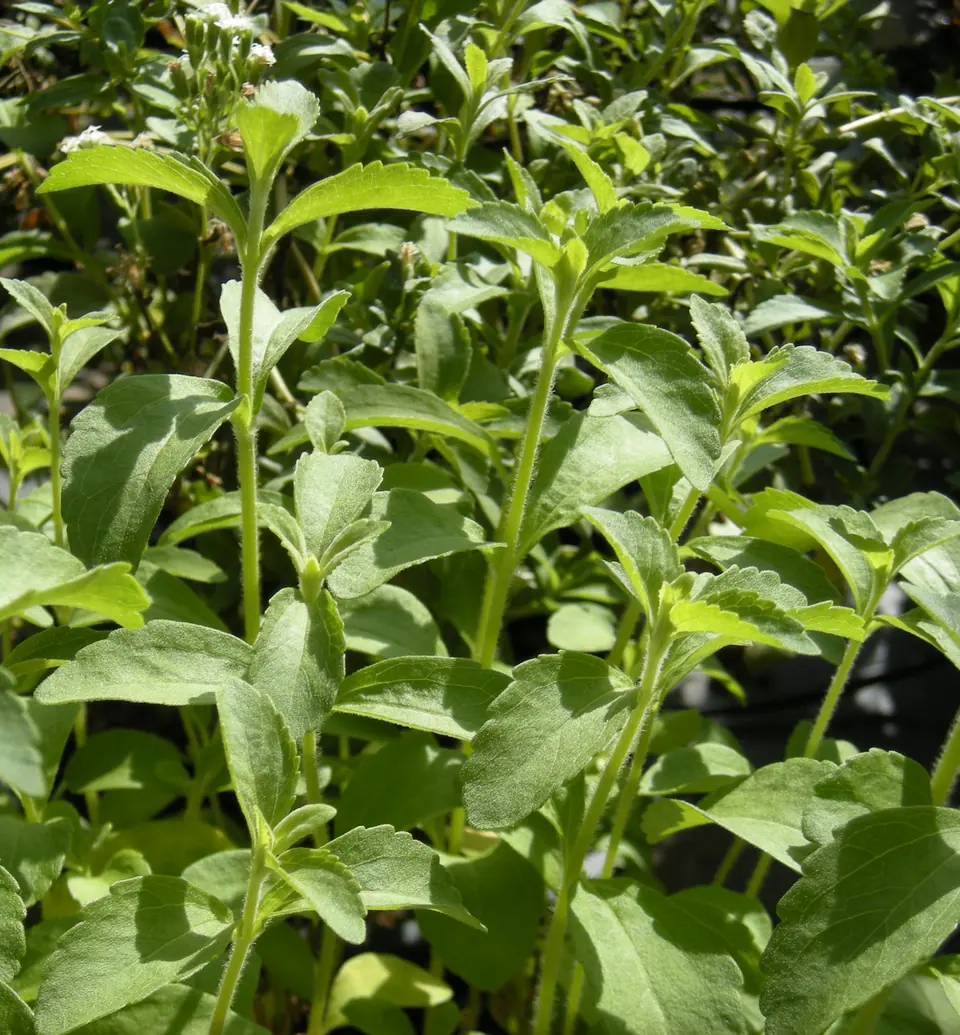


How to Grow and Care for Stevia
Stevia rebaudiana
Written by Emilio Marruso · last checked
Not toxic to cats and dogs, according to the sources · Sources
At a glance
Stevia is a sweet surprise: its leaves sweeten tea and can be eaten fresh, right off the plant. It likes full sun to partial shade, stays a compact 1–2 ft, and grows happily in a pot, even indoors. Keep the soil moist without overwatering, and 90 days after planting you can start harvesting leaves to dry or brew.
- Sun
Full sun to partial shade
What the sources say (1)
Light: Full sun to partial shade
Sweet leaf prefers full sun and will tolerate partial shade
— Stevia rebaudiana (Candy Leaf, Stevia, Sugar Leaf, Sweet Herb of Paraguay, Sweet Honey Leaf, Sweet Leaf) | North Carolina Extension Gardener Plant Toolbox [1] - Water
Keep the soil moist, but don't overwater: too much water rots the roots
What the sources say (4)
Watering: Keep the soil moist but do not overwater
Make sure to keep the soil moist but don’t overwater, which can cause root rot.
— Stevia – Gardening Solutions [3] requires moist, well-drained, slightly acidic, organically rich, loamy, sandy soils
— Stevia rebaudiana (Candy Leaf, Stevia, Sugar Leaf, Sweet Herb of Paraguay, Sweet Honey Leaf, Sweet Leaf) | North Carolina Extension Gardener Plant Toolbox [1] Watering notes: Overwatering can cause root rot
Insects, Diseases, and Other Plant Problems: It has no known serious insect or diseases problems. Monitor for aphids and spider mites. Overwatering can cause root rot.
— Stevia rebaudiana (Candy Leaf, Stevia, Sugar Leaf, Sweet Herb of Paraguay, Sweet Honey Leaf, Sweet Leaf) | North Carolina Extension Gardener Plant Toolbox [1] Mulching around the plant can help trap moisture and reduce weeds.
— Stevia – Gardening Solutions [3] - Cold
Survives winters down to 30 °F (−1.1 °C)
Half hardy: mild winters or an unheated greenhouse · USDA 10a · RHS H3 · Z10
What the sources say (2)
Hardiness, coldest zone: 10a [winter low −1.1 to 1.7 °C (30 to 35 °F)]
Available Space To Plant: 12 inches-3 feet USDA Plant Hardiness Zone: 10a, 10b, 11a, 11b
— Stevia rebaudiana (Candy Leaf, Stevia, Sugar Leaf, Sweet Herb of Paraguay, Sweet Honey Leaf, Sweet Leaf) | North Carolina Extension Gardener Plant Toolbox [1] Hardiness, warmest zone: 11b [winter low 7.2 to 10 °C (45 to 50 °F)]
Available Space To Plant: 12 inches-3 feet USDA Plant Hardiness Zone: 10a, 10b, 11a, 11b
— Stevia rebaudiana (Candy Leaf, Stevia, Sugar Leaf, Sweet Herb of Paraguay, Sweet Honey Leaf, Sweet Leaf) | North Carolina Extension Gardener Plant Toolbox [1] - Feeding
Feed every 4–6 weeks during the growing season
What the sources say (2)
When: During the growing season
It is recommended to fertilize the plants about every 4 to 6 weeks during the growing season.
— Stevia rebaudiana (Candy Leaf, Stevia, Sugar Leaf, Sweet Herb of Paraguay, Sweet Honey Leaf, Sweet Leaf) | North Carolina Extension Gardener Plant Toolbox [1] How often: Every 4 to 6 weeks
It is recommended to fertilize the plants about every 4 to 6 weeks during the growing season.
— Stevia rebaudiana (Candy Leaf, Stevia, Sugar Leaf, Sweet Herb of Paraguay, Sweet Honey Leaf, Sweet Leaf) | North Carolina Extension Gardener Plant Toolbox [1] - Pruning
Pinch off flower buds as soon as they appear
What the sources say (2)
Pruning: As soon as flower buds appear (pinch off buds)
Pinching off flower buds as soon as they appear will help maximize the quality of the leaves
— Stevia – Gardening Solutions [3] The flowers buds can be pruned to help improve the flavor of the leaves.
— Stevia rebaudiana (Candy Leaf, Stevia, Sugar Leaf, Sweet Herb of Paraguay, Sweet Honey Leaf, Sweet Leaf) | North Carolina Extension Gardener Plant Toolbox [1] - Harvest
From 90 days after planting: cut stems 6 in above the ground; eat leaves fresh, dried or in tea
What the sources say (2)
Days to maturity: 90 days after planting (to leaf harvest)
The leaves are harvested about 90 days after planting.
— Stevia rebaudiana (Candy Leaf, Stevia, Sugar Leaf, Sweet Herb of Paraguay, Sweet Honey Leaf, Sweet Leaf) | North Carolina Extension Gardener Plant Toolbox [1] How to harvest: Harvest just as the plant begins to flower; cut the stems 15 cm (6 in) above the ground
The best time to harvest is just as it begins to flower. The flowers buds can be pruned to help improve the flavor of the leaves. When harvesting cut the stems about 6 inches above the ground.
— Stevia rebaudiana (Candy Leaf, Stevia, Sugar Leaf, Sweet Herb of Paraguay, Sweet Honey Leaf, Sweet Leaf) | North Carolina Extension Gardener Plant Toolbox [1] - Pests
Aphids and spider mites; overwatering causes root rot
What the sources say (2)
Pests: aphids, spider mites
It has no known serious insect or diseases problems. Monitor for aphids and spider mites. Overwatering can cause root rot.
— Stevia rebaudiana (Candy Leaf, Stevia, Sugar Leaf, Sweet Herb of Paraguay, Sweet Honey Leaf, Sweet Leaf) | North Carolina Extension Gardener Plant Toolbox [1] Diseases: root rot
Make sure to keep the soil moist but don’t overwater, which can cause root rot.
— Stevia – Gardening Solutions [3] - Size
1–2 ft tall and wide
- Propagation
From stem cuttings or seeds
What the sources say (1)
Propagation: Stem cuttings; seeds
The plant can be propagated by stem cuttings or seeds.
— Stevia rebaudiana (Candy Leaf, Stevia, Sugar Leaf, Sweet Herb of Paraguay, Sweet Honey Leaf, Sweet Leaf) | North Carolina Extension Gardener Plant Toolbox [1] - Containers
Grows in containers, even indoors
What the sources say (3)
In containers: Yes
Stevia does well in a container as a houseplant or on the patio.
— Stevia – Gardening Solutions [3] In North Carolina, sweet leaf can be grown as annual in an herb garden or as a container planting.
— Stevia rebaudiana (Candy Leaf, Stevia, Sugar Leaf, Sweet Herb of Paraguay, Sweet Honey Leaf, Sweet Leaf) | North Carolina Extension Gardener Plant Toolbox [1] Indoors: Yes
Stevia does well in a container as a houseplant or on the patio.
— Stevia – Gardening Solutions [3] - Safety
Safe for cats, dogs and horses
Overview
Stevia is a tender perennial of the daisy family, native to Brazil and Paraguay and grown for its sweet leaves. [1] It prefers full sun, tolerates partial shade and is winter hardy in USDA Hardiness Zones 10 to 11. [3] The leaves can be eaten fresh or steeped in hot water along with tea leaves. [3]
This record is incomplete: the sources we read do not cover every field yet.
Not yet covered by our sources: Sowing / Planting
Stevia care
How to water Stevia
Watering
Keep the soil moist but do not overwater
What the sources say (2)
Make sure to keep the soil moist but don’t overwater, which can cause root rot.requires moist, well-drained, slightly acidic, organically rich, loamy, sandy soilsWatering notes
Overwatering can cause root rot
What the sources say (2)
Insects, Diseases, and Other Plant Problems: It has no known serious insect or diseases problems. Monitor for aphids and spider mites. Overwatering can cause root rot.Mulching around the plant can help trap moisture and reduce weeds.How much light Stevia needs
Full sun to partial shade
What the sources say (1)
Sweet leaf prefers full sun and will tolerate partial shadeHow much cold Stevia can take
Hardiness, coldest zone
10a [winter low −1.1 to 1.7 °C (30 to 35 °F)]
What the sources say (1)
Available Space To Plant:
12 inches-3 feet
USDA Plant Hardiness Zone:
10a, 10b, 11a, 11bHardiness, warmest zone
11b [winter low 7.2 to 10 °C (45 to 50 °F)]
What the sources say (1)
Available Space To Plant:
12 inches-3 feet
USDA Plant Hardiness Zone:
10a, 10b, 11a, 11bWhere to grow Stevia
Indoors
Yes
What the sources say (1)
Stevia does well in a container as a houseplant or on the patio.In containers
Yes
What the sources say (2)
Stevia does well in a container as a houseplant or on the patio.In North Carolina, sweet leaf can be grown as annual in an herb garden or as a container planting.How to propagate Stevia
Stem cuttings; seeds
What the sources say (1)
The plant can be propagated by stem cuttings or seeds.How to grow Stevia
The plant
Life cycle
perennial (tender; grown as an annual where it freezes)
What the sources say (1)
Sweet leaf is a tender perennial that is a member of the daisy family (Asteraceae)Family
Asteraceae
What the sources say (1)
Sweet leaf is a tender perennial that is a member of the daisy family (Asteraceae)Mature height
30.5-61 cm (1-2 ft)
What the sources say (1)
It is a small shrub reaching 1 to 2 feet tall and 1 to 2 feet wide.Mature width
30.5-61 cm (1-2 ft)
What the sources say (1)
It is a small shrub reaching 1 to 2 feet tall and 1 to 2 feet wide.Sowing and growth
Days to maturity
90 days after planting (to leaf harvest)
What the sources say (1)
The leaves are harvested about 90 days after planting.Harvest and storage
How to harvest
Harvest just as the plant begins to flower; cut the stems 15 cm (6 in) above the ground
What the sources say (1)
The best time to harvest is just as it begins to flower. The flowers buds can be pruned to help improve the flavor of the leaves. When harvesting cut the stems about 6 inches above the ground.Storage
Dry the harvested stems, then store in an airtight container in a cool, dry place
What the sources say (1)
They are then dried and then can be stored in an air tight container in a cool dry area.Pests and diseases
Pests
aphids, spider mites
What the sources say (1)
It has no known serious insect or diseases problems. Monitor for aphids and spider mites. Overwatering can cause root rot.Diseases
root rot
What the sources say (1)
Make sure to keep the soil moist but don’t overwater, which can cause root rot.Fertilizing
When
During the growing season
What the sources say (1)
It is recommended to fertilize the plants about every 4 to 6 weeks during the growing season.How often
Every 4 to 6 weeks
What the sources say (1)
It is recommended to fertilize the plants about every 4 to 6 weeks during the growing season.Stevia pests and problems
Root rot
Symptom: Plant decline from overwatering
What to do: Keep soil moist but do not overwater
What the sources say (1)
Make sure to keep the soil moist but don’t overwater, which can cause root rot.
— Stevia – Gardening Solutions [3] Aphids and spider mites
Symptom: Insect infestation
What to do: Monitor the plant
What the sources say (1)
It has no known serious insect or diseases problems. Monitor for aphids and spider mites. Overwatering can cause root rot.
— Stevia rebaudiana (Candy Leaf, Stevia, Sugar Leaf, Sweet Herb of Paraguay, Sweet Honey Leaf, Sweet Leaf) | North Carolina Extension Gardener Plant Toolbox [1]
Remedies
Each remedy shows what official sources say about it; traditional remedies without an official source are marked as such. Harmful ones are listed so you know to avoid them.
Treating the plant
aphids
hand-picking insects Works
How: Remove the insects by hand.
Many insect and disease issues can be solved in the home garden by hand-picking insects or clipping and disposing of diseased plant parts.
— extension.unh.edu [4] What the evidence says Many insect and disease issues can be solved in the home garden by hand-picking insects or clipping and disposing of diseased plant parts.
— extension.unh.edu [4]
Is Stevia poisonous?
Reported by the source, quoted verbatim. This is not medical or veterinary advice: if a person or an animal may have eaten this plant, contact a poison control centre or a veterinarian.
#non-toxic for cats #non-toxic for horses #non-toxic for dogs
[1]The source flags the risk for this animal but does not explain why.
Calendar
Sowing
Not stated in the sources we read.
Planting
Not stated in the sources we read.
Harvest
The sources give different values depending on region, zone or growing conditions.
What each source says
According to NC State Extension: Just as it begins to flower; leaves harvested about 90 days after planting
According to UF/IFAS Gardening Solutions: Fall
What the sources say (4)
According to NC State Extension: The best time to harvest is just as it begins to flower.According to UF/IFAS Gardening Solutions: Fall is the best time to harvest the leaves, which can be used fresh or dried.The best time to harvest is just as it begins to flower.Fall is the best time to harvest the leaves, which can be used fresh or dried.Pruning
As soon as flower buds appear (pinch off buds)
What the sources say (2)
Pinching off flower buds as soon as they appear will help maximize the quality of the leavesThe flowers buds can be pruned to help improve the flavor of the leaves.Months as given by the sources, which are mostly from the United States (northern hemisphere). In the southern hemisphere they shift by about six months.
Edibility
Reported by the source, quoted verbatim. Do not eat a plant on the basis of this page alone: identification mistakes can be dangerous.
Indicative values
Values from a secondary source, not checked word for word like the rest of this page. Use them as a starting point.
- Drought tolerant
- yesIndicative value, adapt it to your climate · Secondary source
- Soil pH
- 6.5-7.5Indicative value, adapt it to your climate · Secondary source
- Care level
- MediumIndicative value, adapt it to your climate · Secondary source
- Growth rate
- HighIndicative value, adapt it to your climate · Secondary source
Similar plants
- Big sagebrush Artemisia tridentata
- Blue Chalksticks Curio repens
- Calendula Calendula officinalis
- Chamomile Chamaemelum nobile
- Chamomile Matricaria chamomilla
- Costmary Tanacetum balsamita
- Feverfew Tanacetum parthenium
- French Marigold Tagetes patula
Sources
Every value above is quoted from these documents. Links lead to the original publisher.
- Stevia rebaudiana (Candy Leaf, Stevia, Sugar Leaf, Sweet Herb of Paraguay, Sweet Honey Leaf, Sweet Leaf) | North Carolina Extension Gardener Plant Toolbox · plants.ces.ncsu.edu, consulted
- Stevia - Stevia rebaudiana | North Carolina Extension Gardener Plant Toolbox · plants.ces.ncsu.edu, consulted
- Stevia – Gardening Solutions · gardeningsolutions.ifas.ufl.edu, consulted
- extension.unh.edu · extension.unh.edu
Written by Emilio Marruso · last checked